Why Memorizing 12 Agile Principles Will Cost You the Job (And How 4 Core Values Save It)
Imagine sitting in a high-stakes interview for a Lead Project Manager or Agile Program Director role. You have navigated the behavioral questions, outlined your delivery history, and demonstrated clear commercial acumen. Suddenly, a senior panelist leans forward and fires off a classic trick prompt: “Can you list all 12 principles of the Agile Manifesto verbatim?”
Your pulse spikes. You mentally scramble through the list, desperately trying to recall whether principle number eight was about sustainable pace or technical excellence. You stumble, pause, miss two principles, and leave the impression of a candidate who flustered under pressure.
Here is the stark corporate reality: you just fell into the classic trivia trap.
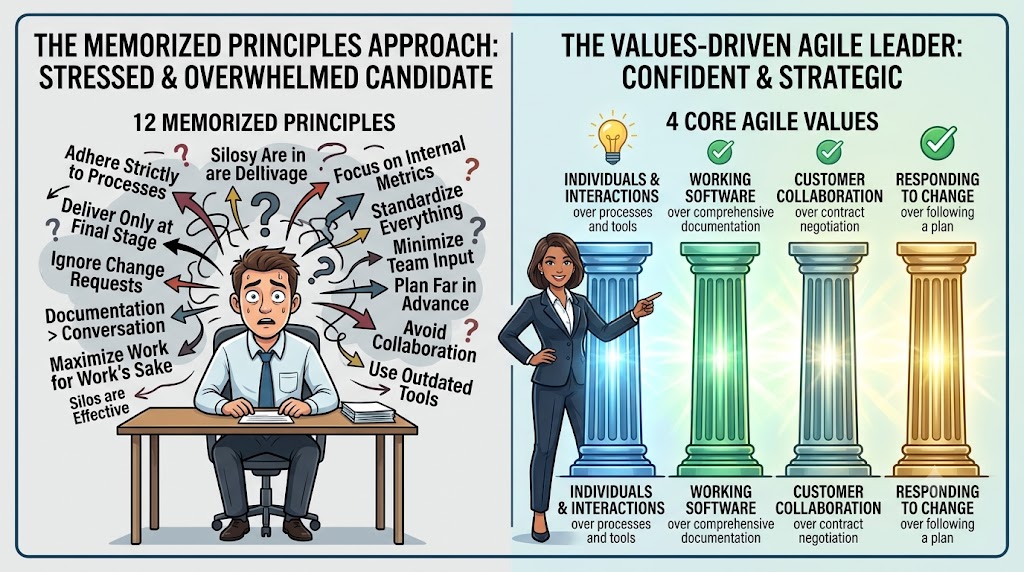
A pervasive corporate myth suggests that elite Agile leadership requires human encyclopedias who can recite methodology handbooks on command. In reality, senior executive panels do not hire textbook reciters; they hire strategic leaders who understand first principles. Attempting to memorize twelve distinct principles word-for-word under interview pressure signals a operational, junior mindset. True leadership authority comes from conceptual anchoring: the ability to tie every operational decision, framework nuance, and technical principle back to the four foundational Agile values.
The Trap of Trivia vs. The Power of First Principles
When interviewers ask heavy, specification-focused questions about methodology rules, they are rarely testing your rote memory. Instead, they are evaluating your executive presence and decision-making framework. Candidates who try to rattle off all twelve principles word-for-word usually sound like line workers reading from a training manual. When faced with complex real-world delivery problems, rigid rule-followers break; strategic leaders adapt.
Agile is not a set of rigid instructions; it is a mindset built on a clear structural hierarchy. The four core values form the root system and trunk of the tree. The twelve principles are simply the branches, while specific frameworks like Scrum, Kanban, or SAFe represent the seasonal leaves.
If you lose sight of the trunk, the leaves become meaningless clutter. When an candidate grounds their answers in the four core values, they demonstrate an ability to navigate ambiguity, handle stakeholder friction, and drive business outcomes regardless of which specific framework an organization uses.
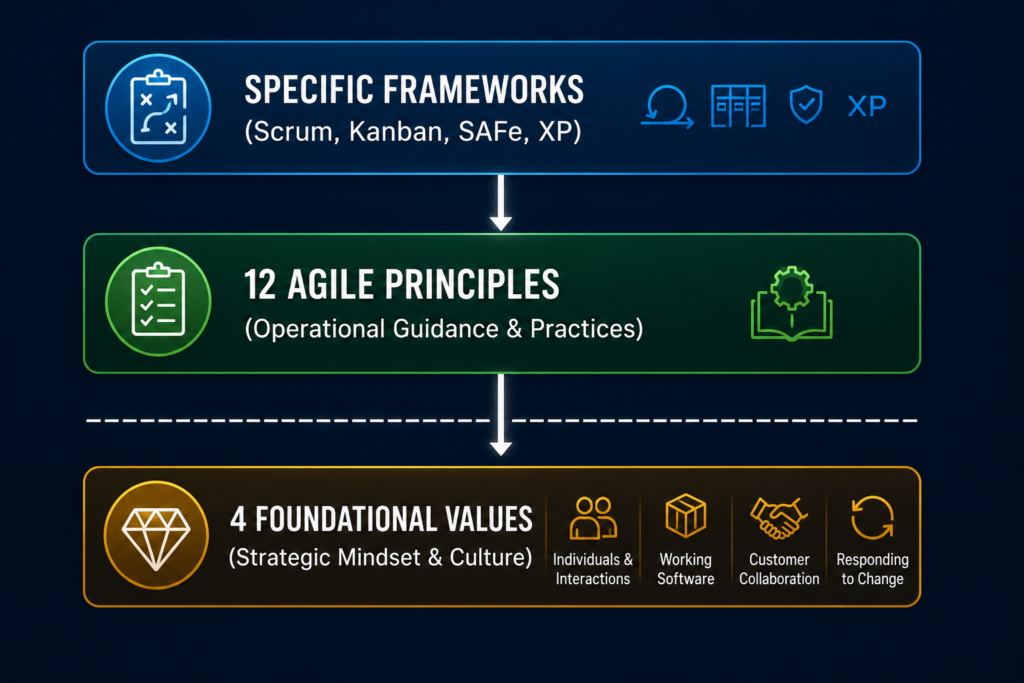
To position yourself as an authority in high-stakes interviews, you must systematically map tactical principles back to these strategic anchors:
Individuals and Interactions over Processes and Tools
Working Software over Comprehensive Documentation
Customer Collaboration over Contract Negotiation
Responding to Change over Following a Plan
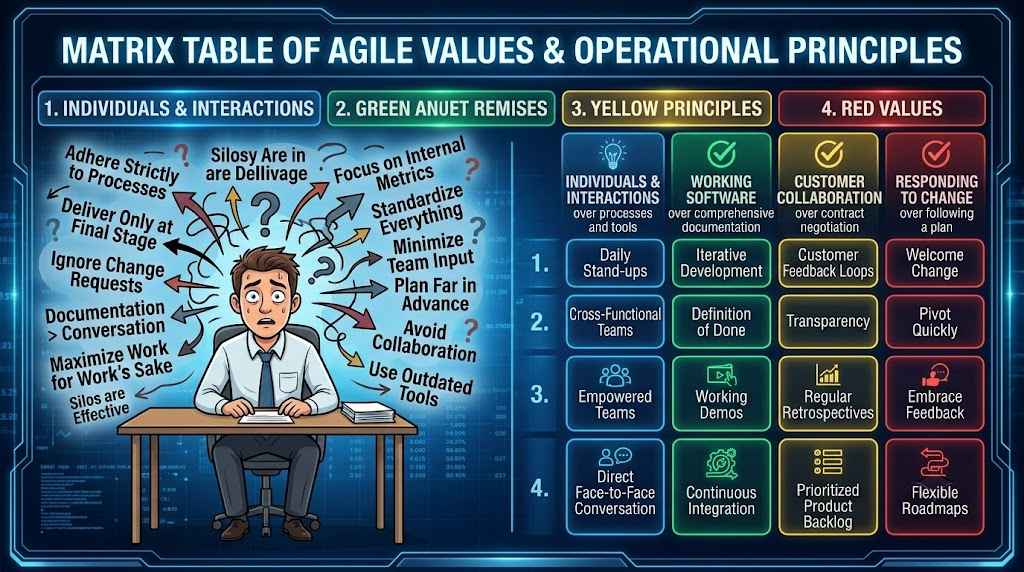
The Strategic Mapping Matrix: Connecting Principles to Core Values
Instead of trying to store twelve isolated sentences in your working memory during an interview, train your brain to see the four core values as thematic collection buckets. Every single principle in the Agile Manifesto is simply an operational extension of one (or more) of these four values.
| Core Foundational Value | Associated Operational Principles | Strategic Interview Focus |
| 1. Individuals & Interactions | • Business people and developers working together daily • Build projects around motivated individuals • Face-to-face conversation as primary communication • Self-organizing teams driving design and architecture • Regular team reflection and adaptation | Human-centric delivery, psychological safety, cross-functional synergy, and removing operational silos. |
| 2. Working Software / Tangible Outcomes | • Satisfy the customer through early/continuous delivery • Deliver working software frequently • Working software as the primary measure of progress • Continuous attention to technical excellence • Simplicity: maximizing the amount of work not done | Value realization, minimizing waste, avoiding documentation traps, and prioritizing real deliverables. |
| 3. Customer Collaboration | • Co-creating value with business partners • Continuous feedback loops over rigid upfront agreements | Partnering with stakeholders rather than managing them defensively through change requests. |
| 4. Responding to Change | • Welcome changing requirements, even late in development • Agile processes promoting sustainable development pace | Adaptability, market responsiveness, progressive elaboration, and competitive advantage. |
Strategic Conceptual Anchoring: The 3-Step Interview Pivot
When an interviewer asks you a hyper-specific, rule-based question like “What is the ninth principle of Agile?” or “How do you enforce self-organizing teams according to the manifesto?”, do not attempt to recall verbatim text. Use the 3-Step Value Anchor Framework to regain control of the conversation.
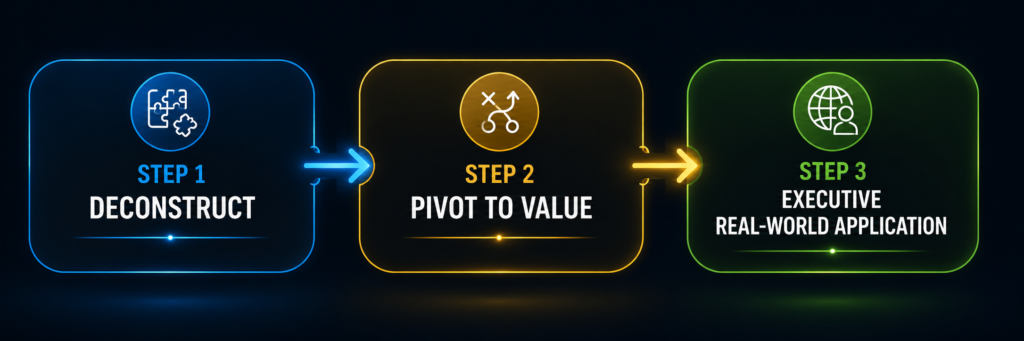
Step 1: Deconstruct the Tactical Prompt
Acknowledge the core intent behind the interviewer’s question without getting trapped in the literal wording. Identify the underlying operational challenge they are trying to solve.
Step 2: Pivot to First Principles
Explicitly bridge the question back to one of the four foundational Agile values. State clearly that while individual principles provide helpful guidance, your leadership practice is guided by the core philosophy that drives those principles.
Step 3: Provide Executive Proof
Deliver a concise, real-world operational scenario that demonstrates how aligning with that core value solved a tangible business problem, restored delivery momentum, or optimized team output.
Verbatim Recitation vs. Strategic Conceptual Anchoring
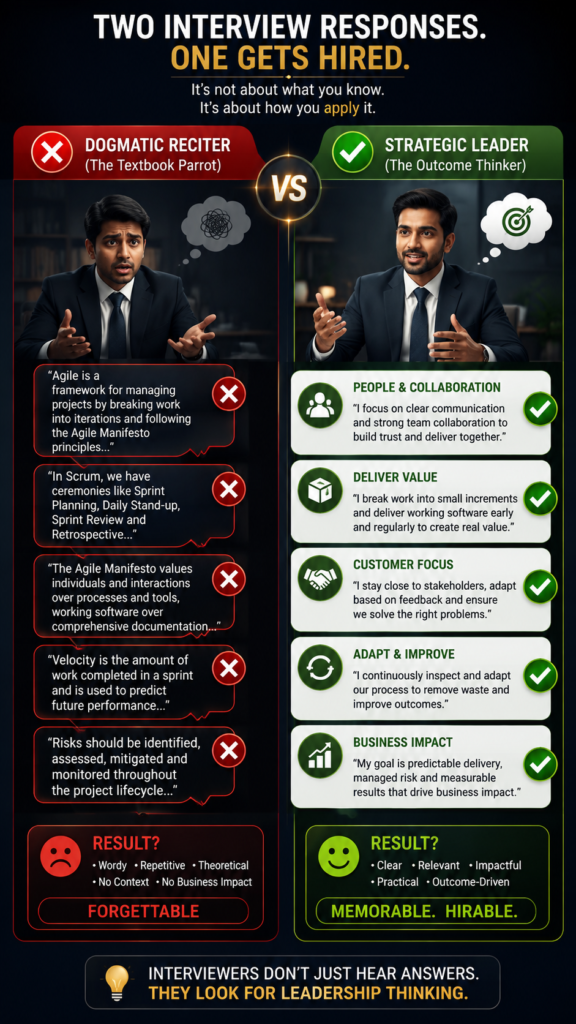
To understand how this pivot transforms your executive positioning, examine how two different candidates handle the same interview prompt.
Interviewer Prompt: “Can you explain how the Agile principles address team efficiency and documentation requirements?”
The Junior Candidate (Rote Memorization Approach)
“Yes, principle number ten states that simplicity, the art of maximizing the amount of work not done, is essential. Also, principle number seven says that working software is the primary measure of progress. So in Agile, we don’t do documentation if it gets in the way of coding, and we try to keep things simple by following Scrum guidelines.”
Why this fails: It sounds defensive, dogmatic, and academically superficial. It implies that documentation is useless and focuses entirely on mechanics rather than business value.
The Elite Candidate (Strategic Conceptual Anchoring Approach)
“While several manifesto principles touch on efficiency, I always anchor my delivery strategy in the core value of Working Software Over Comprehensive Documentation—or more broadly, tangible outcomes over process overhead.”
“In my experience, teams often confuse compliance with progress. On a recent enterprise platform migration, the team was bogged down writing 80-page specification documents that were obsolete before approval. I refocused the team on delivering functional, incremented prototypes every two weeks to gather real user feedback. We reduced documentation overhead by 60% while increasing delivery velocity and stakeholder satisfaction, simply by evaluating every task against a single question: ‘Does this directly advance a working, testable product?'”
Why this succeeds: It bypasses memory traps, establishes immediate strategic authority, proves business impact, and demonstrates practical leadership over dogmatic framework enforcement.
Mastering Real-World Operational Ambiguity
Strategic interview positioning extends beyond handling trivia questions; it prepares you to handle high-stakes operational scenarios where rigid rules break down. In real-world enterprise environments, project managers frequently face situations where manifesto principles appear to conflict with corporate realities.
Consider two common operational dilemmas that frequently surface in senior-level interviews:
Scenario A: Enterprise Compliance vs. "Minimal Documentation"
In heavily regulated industries such as healthcare, fintech, or defense, comprehensive documentation is not optional waste; it is a legal requirement. A dogmatic practitioner who insists on “working software over documentation” without context will cause compliance failures.
The Strategic Response:
Anchor back to Customer Collaboration and Working Software. Define “working software” in a compliance context to include regulatory clearance. Explain that documentation in a regulated space is a core component of the tangible deliverable, but apply the principle of simplicity by automating compliance artifact generation directly within the CI/CD pipeline rather than writing manual manuals.
Scenario B: Fixed-Scope Enterprise Contracts vs. "Responding to Change"
Enterprise sales cycles often rely on fixed-price, fixed-scope contracts, which directly challenge the Agile preference for fluid scope adaptation.
The Strategic Response:
Anchor back to Customer Collaboration Over Contract Negotiation. Explain how you implement Progressive Elaboration and Rolling Wave Planning. Detail how you establish a fixed budget and timeline envelope while maintaining flexibility on feature depth, using transparent backlog prioritization to trade new requirements for lower-priority items without blowing up the commercial agreement.
From Framework Reciter to Strategic Thought Partner
When you master conceptual anchoring, your entire professional trajectory shifts. You stop approaching interviews as an exam candidate trying to earn a passing grade from a panel. Instead, you enter the room as a peer and strategic thought partner.
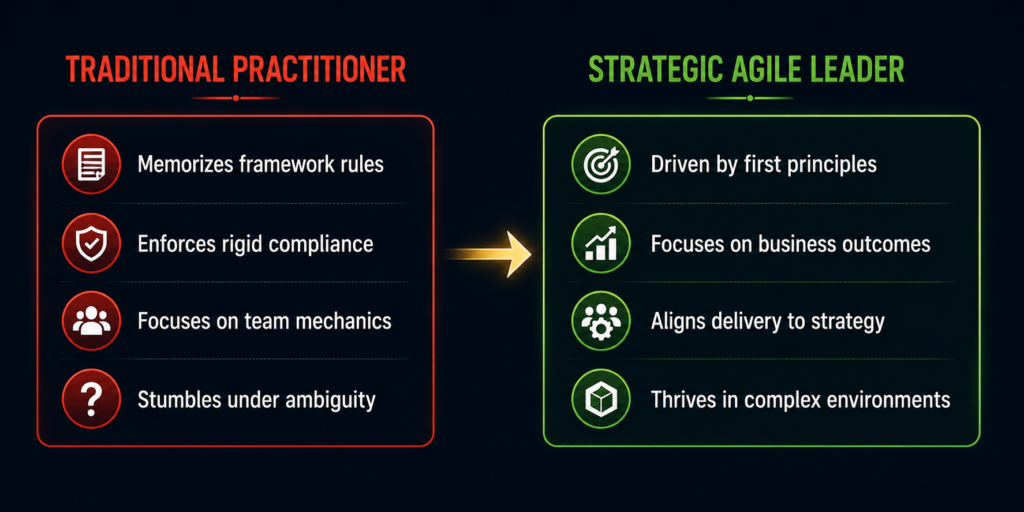
This mindset transformation changes how you run projects on the ground:
Eliminating Scope Creep Panic: Scope changes are no longer seen as project failures; they become opportunities to deliver higher value by evaluating them against core business outcomes.
Ending Team Burnout: Instead of forcing teams through rigid process checklists, you focus on removing impediments, fostering autonomy, and maintaining a sustainable delivery pace.
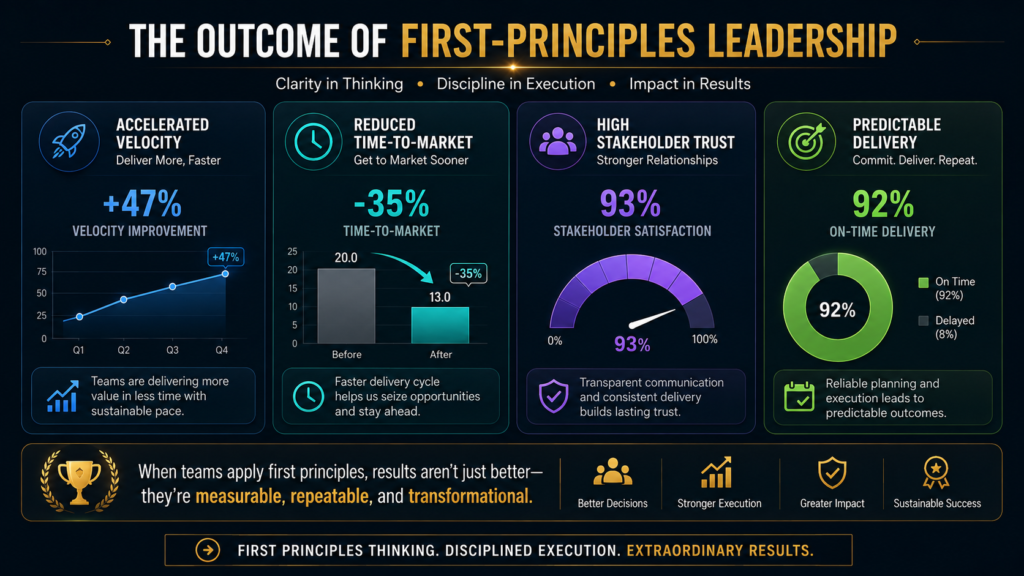
Building Stakeholder Trust: Executives stop viewing your PMO as a bureaucratic bottleneck and start seeing it as a predictable, high-velocity engine for value realization.
Adopting this first-principles framework moves you out of low-tier project coordination and positions you for high-impact program director and transformation lead roles.
Elevate Your Strategic Positioning with Skillsetify
Navigating high-stakes hiring panels and managing complex enterprise portfolios requires far more than memorizing methodology textbooks. It requires mastering the mental models, strategic positioning, and executive communication frameworks that top-tier organizations demand.
If you are ready to stop guessing, move up the corporate ladder, and learn project management the right way, reach out to Skillsetify. We do not just teach frameworks: we show you your exact career growth trajectory.