The Corporate Reality of Framework Dogma
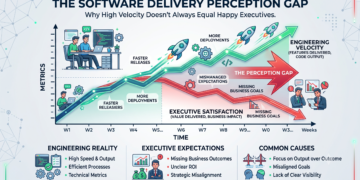
The board meeting room was silent except for the hum of the air conditioner. A twelve-million-dollar enterprise software deployment was forty-five days past its hard regulatory deadline. The Chief Technology Officer had insisted on a dogmatic, textbook implementation of Scrum across all twelve engineering squads. Daily standups happened religiously, story points were tracked on burn-down charts, and sprint reviews were celebrated. Yet, the product could not legally launch. Why? Because the software integrated directly into a heavily audited legacy mainframe that required six months of rigorous static compliance testing, fixed vendor procurement schedules, and strict baseline documentation.
The team was running fast, but they were running on a treadmill. Developers were exhausted from context-switching, risk officers were filing formal objections, and executive leadership was demanding heads on a spike.
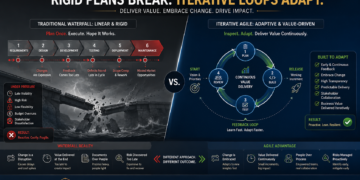
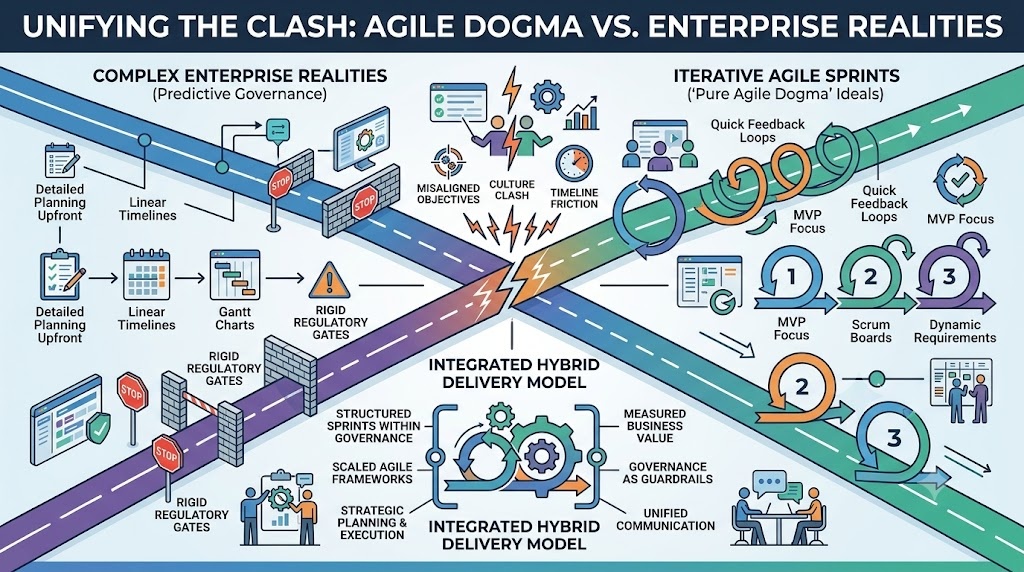
This disaster highlights a pervasive myth in modern corporate culture: the assumption that pure Agile is always superior to traditional project management, and that hybrid methodologies are merely an embarrassing compromise for organizations too stubborn to fully transform. The uncomfortable truth is that dogmatic framework adherence destroys value. In complex enterprise environments, forcing a single pure framework onto mismatched operational realities guarantees chaos. The most successful organizations do not pick sides in the methodology wars. Instead, they engineer bespoke, context-appropriate hybrid models that combine predictive governance with adaptive execution.
Decoding Framework Selection & Hybrid Mechanics
Decoding Framework Selection: Matching Methodology to Organizational Context
Selecting the right project delivery framework is not a matter of preference or trendiness: it is an engineering decision driven by project complexity, environmental stability, and organizational constraints. To select or customize a delivery framework, delivery leaders must evaluate two primary variables: requirement uncertainty and technical uncertainty.
When requirements are clear and technology is mature, predictive lifecycles offer maximum efficiency and cost control. When requirements are fluid and technology is novel, adaptive frameworks like Scrum or Extreme Programming excel. However, enterprise initiatives rarely exist at these extreme ends of the spectrum. They live in the middle ground where hardware, legacy integrations, and regulatory compliance require predictive baselines, while user interfaces, features, and market adaptations demand agile flexibility.
To visualize how different methodologies align with operational needs, consider the structural trade-offs:
Delivery Lifecycle | Requirement Stability | Governance & Risk Profile | Iteration Speed | Best Suited Environment |
| Predictive (Waterfall) | High certainty, fixed early | Formal stage-gates, heavy documentation | Low flexibility, fixed milestones | Construction, hardware, strict compliance |
| Adaptive (Scrum/XP) | High fluidity, emerging | Iterative validation, lightweight documentation | High, 1 to 4-week timeboxes | Green-field SaaS, mobile apps, customer discovery |
| Flow-Based (Kanban) | Variable operational demand | Continuous delivery, WIP limits | Continuous, pull-based delivery | Service operations, maintenance, support |
| Hybrid Tailoring | Mixed (Fixed core, adaptive edge) | Dual-layer governance, milestone-based sprints | Flexible execution within fixed guardrails | Enterprise ERP, regulated fintech, IoT hardware |
The Mechanics of Framework Hybridization
Hybridization is the deliberate blending of predictive and adaptive lifecycles to optimize risk management, speed to market, and resource allocation. It is not an unorganized mix of random practices. True hybridization requires architecting clear structural boundaries between different delivery mechanisms.
The three most powerful hybrid topologies utilized by enterprise leaders include:
Water-Scrum-Fall: Strategic discovery, budgeting, and architecture phases are managed using predictive milestones to satisfy executive governance and regulatory requirements. Execution is handed off to cross-functional Scrum teams operating in rapid iterations. Once features are developed, deployment and release engineering transition back to a structured, predictive integration pipeline.
Parallel Subsystem Lifecycle: Subsystems within the same project operate under different lifecycles based on technical constraints. For example, in an Internet-of-Things (IoT) release, physical hardware and firmware engineering follow a predictive schedule due to long manufacturing lead times, while the companion mobile application uses Scrum to continuously iterate on user experience based on beta user feedback.
Scrumban with Predictive Baselines: Teams adopt Scrum cadences for planning and retrospectives, but utilize Kanban pull systems and Work-In-Progress (WIP) limits to manage continuous feature flows. High-level delivery targets remain anchored to predictive Earned Value Management control gates.

The Step-by-Step Implementation Framework: Architecting Your Hybrid Engine
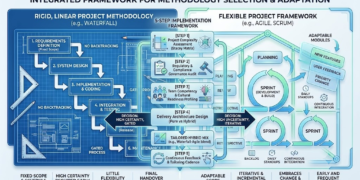
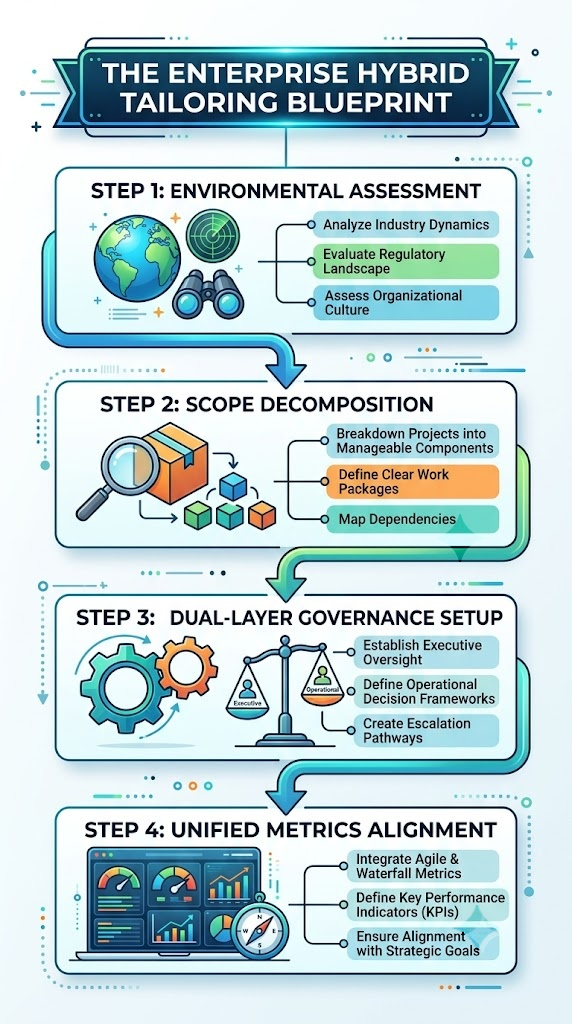
Building a high-performing hybrid delivery lifecycle requires systematically tailoring practices to your specific operational constraints. Delivery leaders should follow this four-stage blueprint to design and deploy a context-appropriate hybrid model.
Step 1: Conduct an Environmental & Governance Assessment
Before selecting tools or defining cadences, evaluate the enterprise environment using a structured complexity matrix:
Regulatory Exposure: Does the initiative require formal third-party audits, strict data privacy compliance, or legal sign-offs prior to public launch? High exposure requires predictive governance gates.
Vendor & Procurement Dependencies: Are critical deliverables tied to fixed-price external vendor contracts? Fixed vendor commitments require predictive milestone mapping.
Market Volatility: Is competitive advantage gained by releasing incremental functionality to end-users every few weeks? High volatility demands agile iteration cycles.
Step 2: Perform Scope Lifecycle Decomposition
Do not treat the project as a monolithic entity. Deconstruct the Work Breakdown Structure into distinct operational layers and assign appropriate lifecycles to each layer:
Foundational Layer (Predictive): Core architecture, database schemas, security protocols, and hardware integrations. These components carry high change costs and should be baselined early.
Feature & Application Layer (Adaptive): User interfaces, workflow automation, customer-facing modules, and analytics dashboards. These components carry low change costs and benefit from iterative prototyping and feedback.
Step 3: Establish Dual-Layer Governance Gateways
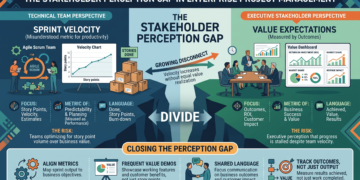
The primary cause of hybrid failure is friction between agile engineering teams and predictive executive leadership. Resolve this by establishing clear mapping between agile artifacts and traditional governance control points:
Strategic Stage-Gates: Retain quarterly executive steering committee reviews to evaluate overall scope, budget burn, and strategic alignment against major project milestones.
Sprint Cadences: Empower self-organizing delivery teams to manage 2-week sprint backlogs, burn-down metrics, and daily standups within the boundaries set by the quarterly stage-gates.
Definition of Done Alignment: Ensure that the agile team’s Definition of Done incorporates required compliance, documentation, and security artifacts so that sprint outputs seamlessly pass through predictive regulatory stage-gates.
Step 4: Synchronize Metrics & Reporting Interfaces
Hybrid models require a unified dashboard that translates agile velocity into executive-level performance indicators:
Translate Story Points to Earned Value: Map completed sprint velocity against baseline scope milestones to compute Schedule Variance and Cost Variance for executive reporting.
Track Lead Time & Cycle Time: Monitor flow metrics alongside traditional critical path schedules to identify operational bottlenecks before they impact release deadlines.
From Firefighting to Strategic Mastery
Imagine stepping into your organization with total clarity on how to navigate complex project demands. Gone are the days of endless firefighting, sprint goals crushed by unforeseen compliance demands, and tense steering committee meetings where executives demand fixed dates from adaptive teams.
When you master framework selection and hybridization, you transcend the role of a passive framework administrator or dogmatic Scrum Master. You become a Delivery Architect: a strategic leader capable of designing execution engines tailored to the exact financial, technical, and regulatory reality of your business.
In this transformed state:
Projects land on schedule because hard external dependencies are insulated by predictive planning.
Products delight end-users because customer-facing features are refined through rapid, iterative feedback loops.
Engineering teams operate without burnout because governance requirements are seamlessly integrated into sprint cadences rather than retrofitted at the eleventh hour.
Mastering context-driven project delivery elevates your standing within the enterprise hierarchy. Organizations do not promote leaders who blindly push theoretical textbooks; they promote pragmatic orchestrators who consistently deliver high-risk, high-value initiatives with predictable precision.

Master Context-Driven Leadership with Skillsetify
The era of rigid methodology wars is over. Success in today’s fast-moving corporate landscape requires project leaders who can evaluate organizational context, select the right operational tools, and build hybrid delivery systems that balance agility with enterprise governance. Dogmatic framework execution leads to friction and failure; tailored hybridization leads to predictable, high-value delivery.
If you are ready to stop guessing, move up the corporate ladder, and learn project management the right way, reach out to Skillsetify. We do not just teach frameworks: we show you your exact career growth trajectory.