Why Brilliant Project Leaders Fail the PMP Exam
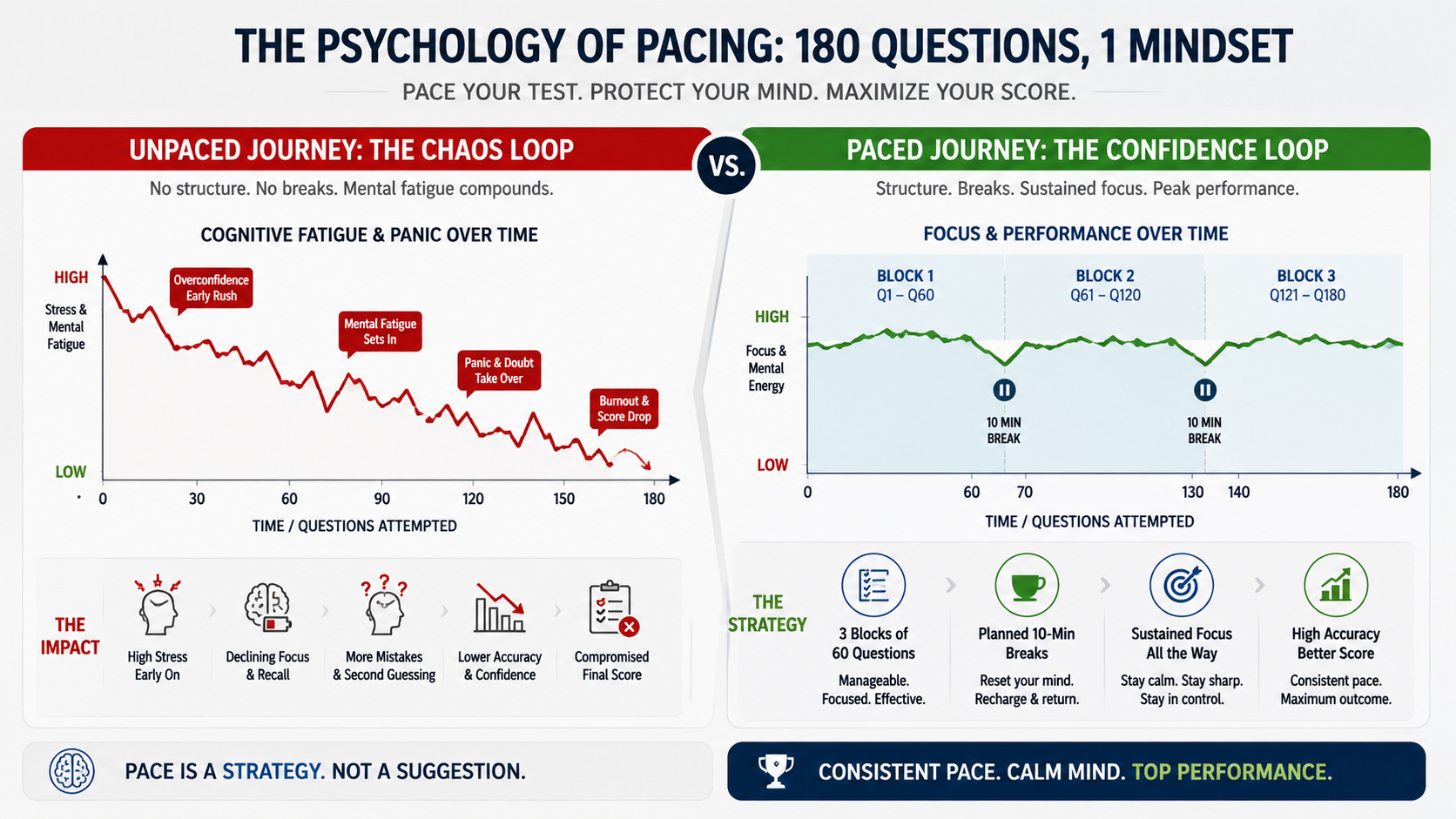
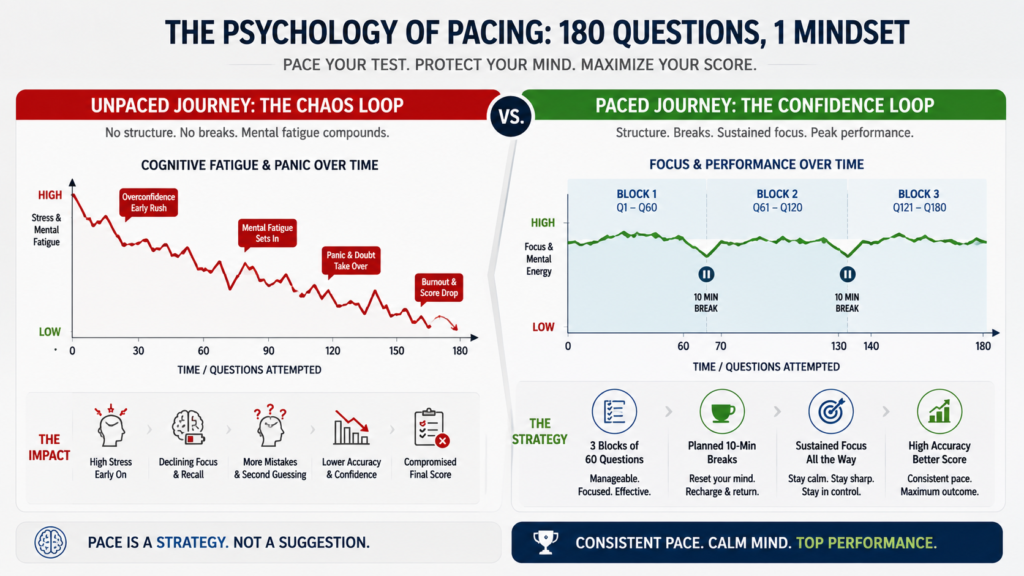
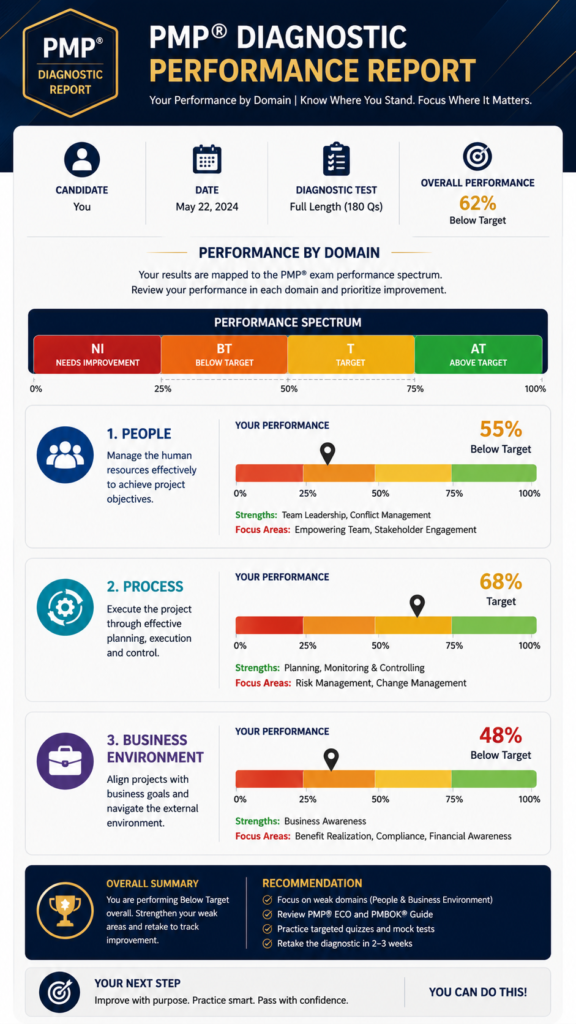
Imagine this reality: You have managed multi-million dollar enterprise software deployments, led cross-functional global teams, and spent months mastering PMBOK principles. You step into the PMP examination center or launch your proctored session at home, confident in your knowledge. But at question 120, a sudden wave of fatigue sets in. You look at the countdown timer: 45 minutes remaining, with 60 complex, scenario-based questions still ahead. Panic triggers. You rush through options, misread critical constraints, and leave your strategic breaks unutilized. Two days later, the diagnostic report arrives with a heartbreaking result: Below Target.
This scenario plays out daily for senior project professionals globally. The failure point is rarely a lack of project management knowledge. Instead, it is a total failure of cognitive stamina, pacing logistics, and strategic exam mechanics.
The standard corporate myth suggests that passing high-stakes certifications like the PMP is simply a test of content mastery. Organizations assume that years of hands-on delivery experience naturally translate into exam success. In reality, the Project Management Professional (PMP) examination is a high-intensity cognitive endurance test. Without a precise execution blueprint for managing time, navigating block submissions, utilizing built-in breaks, and understanding psychometric scoring, even senior practitioners fall victim to time management traps.
Timing, Structure, and Psychometric Grading
To engineer an optimal exam performance, you must first master the architectural rules governing the current PMP examination format.
The Core Blueprint: 180 Questions Across 230 Minutes
The exam consists of 180 questions to be completed within a total testing window of 230 minutes. Out of these 180 items, 175 are scored questions, while 5 are unscored “pretest” questions randomly distributed across the test. These pretest items do not impact your final score and are used by the Project Management Institute (PMI) to validate questions for future exam iterations. Because pretest items are indistinguishable from operational questions, you must treat every question with equal diligence.
mathematically speaking, 230 minutes for 180 questions yields approximately 76.6 seconds per question. When factoring in multi-page scenarios, drag-and-drop items, hotspot visuals, and complex mathematical evaluation, managing this timer becomes a primary skill.
The Three-Block Architecture and Mandatory Breaks
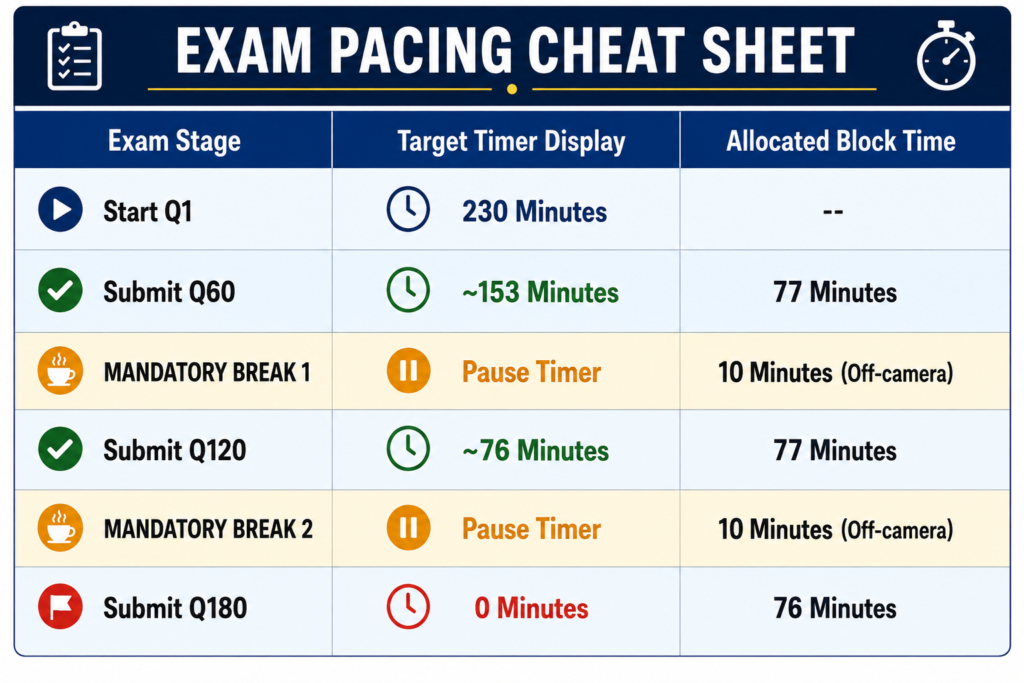
The exam is divided into three distinct operational sections of 60 questions each. This structure incorporates two mandatory, built-in 10-minute breaks that do not deduct time from your 230-minute exam timer.
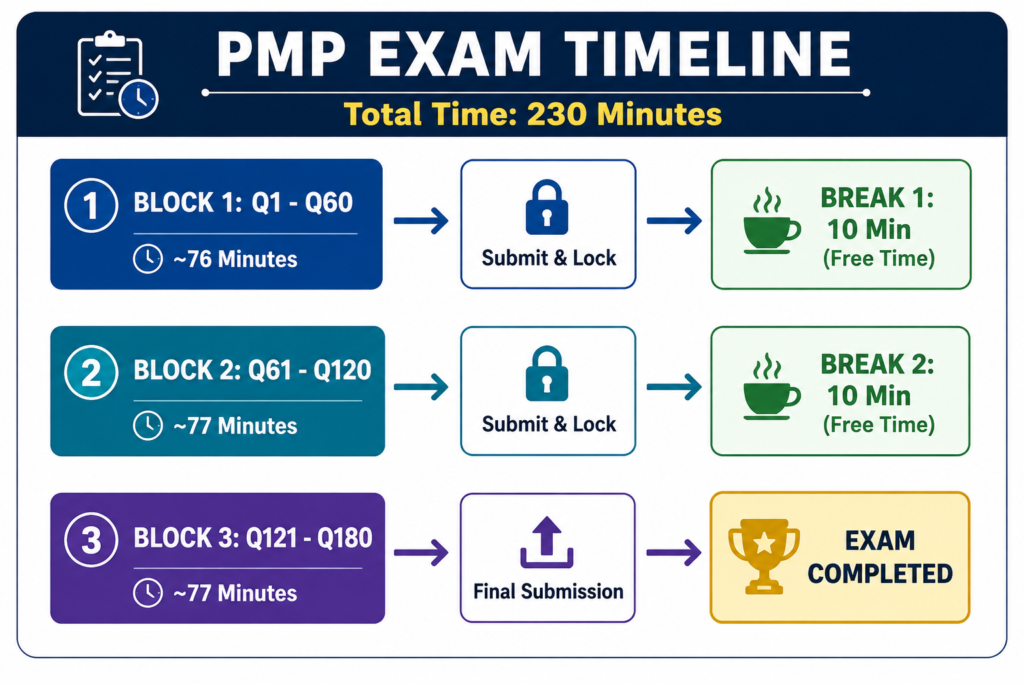
Understanding the hard locks on block submissions is critical:
Block 1 (Questions 1 to 60): You complete the first 60 questions. Upon reaching question 60, the system prompts you to review flagged items within this block. Once you complete your review and submit Block 1, you enter your first 10-minute break. Crucial Rule: Once submitted, Block 1 is permanently locked. You cannot return to or alter any answers in Questions 1 through 60 after taking your break.
Block 2 (Questions 61 to 120): You return from Break 1 and execute the next 60 questions. At question 120, you review your flags, submit Block 2, lock those answers permanently, and step into your second 10-minute break.
Block 3 (Questions 121 to 180): You complete the final set of 60 questions and issue your final exam submission.
Grading Mechanics: Domain Thresholds over Percentage Scores
PMI has moved away from published percentage pass marks. You will not receive a numerical score (such as 75% or 82%). Instead, performance is evaluated using psychometric Angoff scoring across three foundational domains:
People Domain (42% of Exam Weight): Evaluates team leadership, conflict resolution, stakeholder engagement, and empowerment.
Process Domain (50% of Exam Weight): Assesses technical project delivery, risk management, budget allocation, schedule management, and governance execution.
Business Environment Domain (8% of Exam Weight): Tests organizational strategy alignment, compliance, benefits realization, and organizational change management.
Your final score report evaluates performance in each domain using four performance rating categories:
Above Target (AT): Performance exceeds minimum requirement parameters.
Target (T): Performance satisfies minimum requirement parameters.
Below Target (BT): Performance falls slightly below minimum requirement parameters.
Needs Improvement (NI): Performance falls well below minimum requirement parameters.
To pass the examination overall, candidate performance must aggregate across domains to meet or exceed an established proficiency baseline. Achieving a score of “Target” or “Above Target” across all domains guarantees a pass.
The Strategic Execution Framework: Tactical Pacing & Break Optimization
Executing at an elite level requires converting test mechanics into an intentional pacing algorithm.
Step 1: The Countdown Timer Target Milestones
Rather than calculating seconds per question while under stress, monitor your countdown timer at the exact boundary of each block submission:
Start of Exam: Timer displays 230:00 remaining.
Completion of Block 1 (Question 60): Aim for 153:00 remaining (Spend ~77 minutes). Submit block, lock answers, take Break 1 (10 mins).
Completion of Block 2 (Question 120): Aim for 76:00 remaining (Spend ~77 minutes). Submit block, lock answers, take Break 2 (10 mins).
Completion of Block 3 (Question 180): Timer hits 00:00 (Spend remaining ~76 minutes). Submit final exam.
Step 2: Strategic Break Management Protocol
Skipping breaks to “keep momentum” is a critical strategic error. Mental endurance degrades exponentially after 90 minutes of intensive contextual processing.
Follow this operational protocol during your breaks:
Physical Reset: Step away from the test terminal immediately. Stand up, stretch, and perform deep breathing exercises to reset your nervous system.
Hydration & Glycogen Replenishment: Drink water and consume light, slow-release snacks (e.g., nuts or an energy bar). Avoid heavy sugar spikes that lead to mid-exam fatigue.
Visual Recalibration: Focus your eyes on distant objects to reduce ocular strain caused by screen blue light.
Mindset Clearance: Do not ruminate over submitted blocks. Treat each block as an isolated, independent mini-exam.
Step 3: Question Triage and Tactical Elimination
To avoid burning precious minutes on overly complex questions, deploy a structured question triage strategy:
The 60-Second Rule: If you spend 60 seconds reading a scenario without identifying the core problem or eliminating at least two options, make an educated guess, flag the item, and move forward.
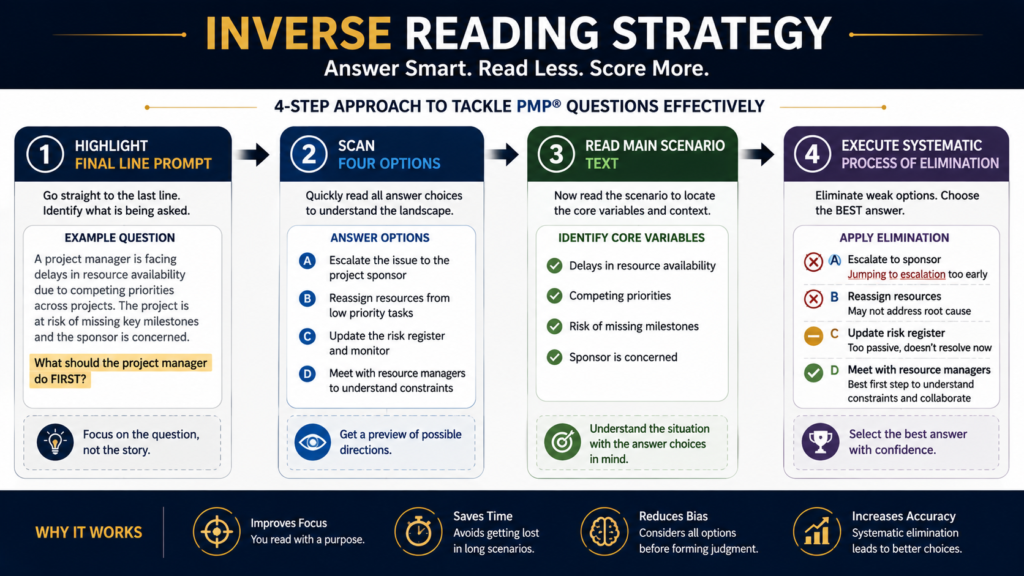
Inverse Reading Technique: For dense, paragraph-long scenario questions, read the last sentence first to identify the specific question prompt. Then scan the four response choices. Finally, read the full scenario context from the beginning. This anchors your attention on key details while filtering out redundant background text.
Eliminate Absolute Language: In PMP scenarios, options containing extreme or defensive phrasing (e.g., “Immediately terminate,” “Escalate to executive sponsor,” “Fire team member”) are almost always incorrect. PMI prioritizes proactive analysis, direct collaboration, and established change management protocols.
Master Pacing to Master Enterprise Delivery
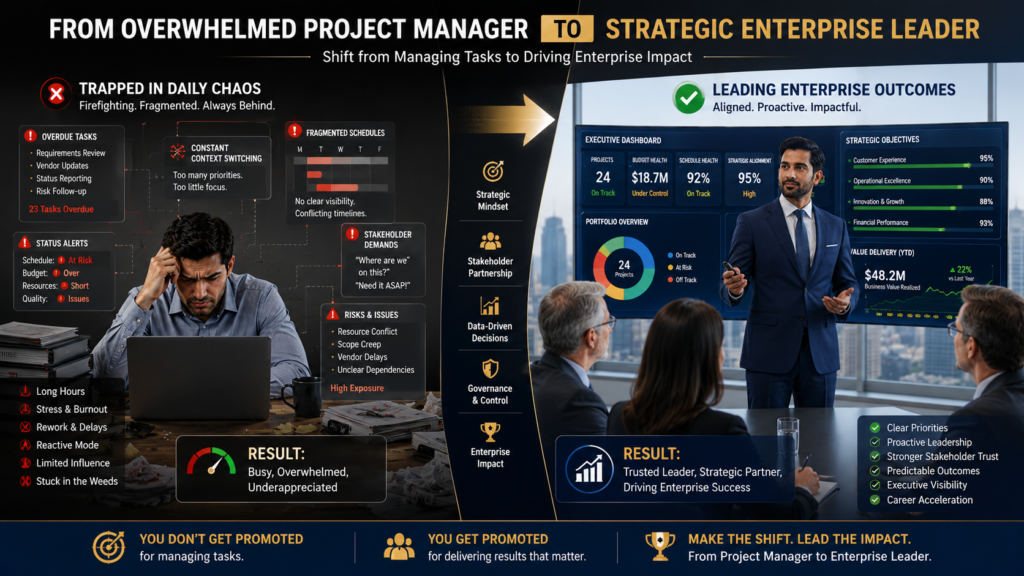
Mastering exam pacing and structural logistics is about more than passing a test: it is a functional blueprint for modern executive performance.
When you internalize the discipline required to pace 180 high-stakes decisions under strict constraints, your operational mindset changes:
From Reactive Crisis Management to Strategic Delivery: Instead of getting bogged down in day-to-day operational fires, you learn to step back, evaluate high-level priorities, and execute structured decisions under tight deadlines.
From Information Overload to Precise Filtering: The inverse reading method translates directly into enterprise leadership. You gain the ability to strip away noise from complex status reports and focus on core operational metrics.
From Decision Fatigue to Elite Execution: Learning to manage cognitive energy through strategic breaks prepares you to guide organizations through complex transformations without burning out your team.
Ambition alone does not elevate a career; enterprise mastery does. Leaders who possess deep technical knowledge paired with structural execution authority earn the strategic roles in modern business. Learning project management through structured, systematic methodologies transforms you into an indispensable asset in any corporate ecosystem.
Accelerate Your Executive Career with Skillsetify
Navigating the complexities of PMP certification logistics, situational question mechanics, and enterprise execution requires expert guidance. You do not need to decipher this journey alone or rely on outdated, generic study materials.
At Skillsetify, we specialize in transforming ambitious project professionals into recognized enterprise delivery leaders. We go beyond basic curriculum coverage: we provide immersive pacing simulations, personalized diagnostic evaluations, and practical frameworks designed to sharpen your execution leadership.
If you are ready to stop guessing, move up the corporate ladder, and learn project management the right way, reach out to Skillsetify. We do not just teach frameworks: we show you your exact career growth trajectory.
Transform your delivery performance and secure your competitive advantage. Contact Skillsetify today.