Why Elite Project Managers Blend Predictive, Agile, and Hybrid Methodologies
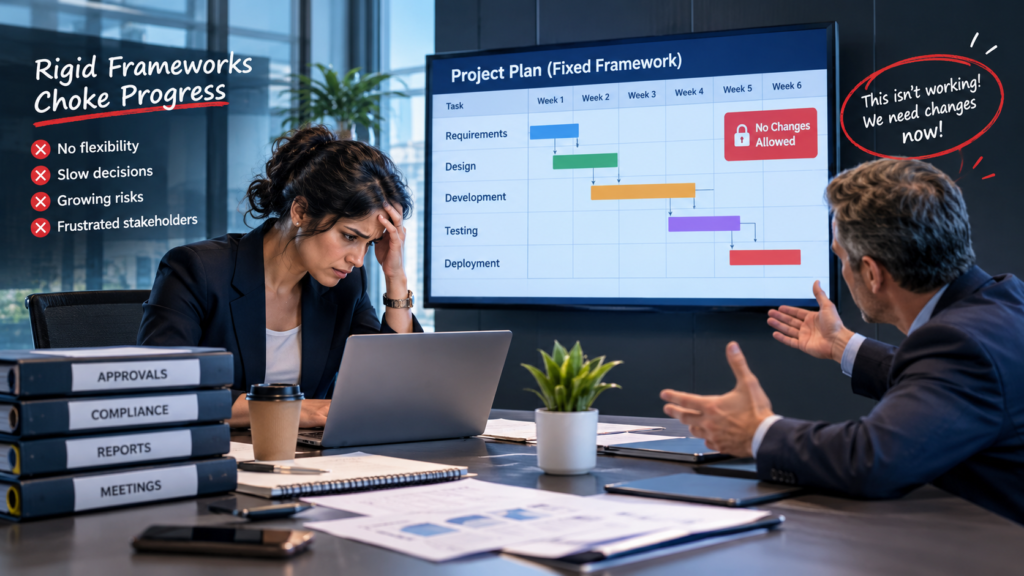
A project manager sits in a sterile boardroom. The client is visibly furious. The project is technically on time according to the rigidly maintained Gantt chart, but the deliverables are completely misaligned with the current market reality. The project manager defends the plan, pointing to the locked scope and the signed requirements document, while the client demands immediate strategic pivots. This is the exact moment a promising career stalls. It happens when project managers prioritize methodology purity over actual business value.
Let us dispel a pervasive corporate myth right away. There is an industry-wide illusion that modern, innovative enterprises run entirely on cutting-edge Agile frameworks. The truth is much more grounded in reality. Absolutely no company on this face of Earth is 100 percent traditional or 100 percent Agile. When a professional proudly claims their organization runs on a purely Agile framework, it is often a clear indicator that their fundamental understanding of enterprise project management is highly limited. The reality of the modern corporate landscape requires a sophisticated, nuanced understanding of how to blend approaches to fit exact environmental constraints.
Core Frameworks & PMBOK Architecture
To elevate your project management career, you must master the core architectural differences between the primary methodologies. The Project Management Institute is actively evolving its global standards to reflect corporate reality, particularly as the framework shifts toward newer iterations.
Modern project management architecture categorizes activities into three primary domains: People, Process, and Business Environment. The Business Environment domain is receiving heavily increased focus because you must deeply understand the exact corporate environment in which your projects operate. The degree of flexibility and authority you possess within this environment dictates exactly how you deploy the following methodologies.
The Predictive Methodology
When industry professionals use the terms “predictive”, “traditional”, or “waterfall”, they all mean the exact same thing. The predictive approach involves predicting the project requirements fully upfront and delivering the final, completed product at the end of the lifecycle. This framework is highly effective for projects with crystal-clear requirements, strict regulatory constraints, or physical engineering demands where the cost of change is astronomically high. In a predictive environment, scope changes are heavily scrutinized and must pass through a formal Change Control Board.
The operational structure of predictive management relies on a classic phased approach. It utilizes five distinct process groups: Initiation, Planning, Execution, Monitoring and Control, and Closing. The upcoming PMBOK 8th Edition is specifically bringing these five critical process groups back to the forefront of the methodology. This structured, sequential approach ensures a rigorous method for tracking progress against a heavily defined, locked baseline.
The Agile Methodology
Agile methodologies were born directly out of the frustration of delivering predictive projects where the final product did not match the customer’s evolved needs. Instead of attempting to plan the entire complex project upfront, Agile project management takes requirements for very short durations, typically 15 to 21 days. The team works intensely on these specific requirements and delivers a functional product increment. Because the execution timeframe is so short, any new changes or shifting client demands can be easily addressed in the next set of 15 to 21 days.
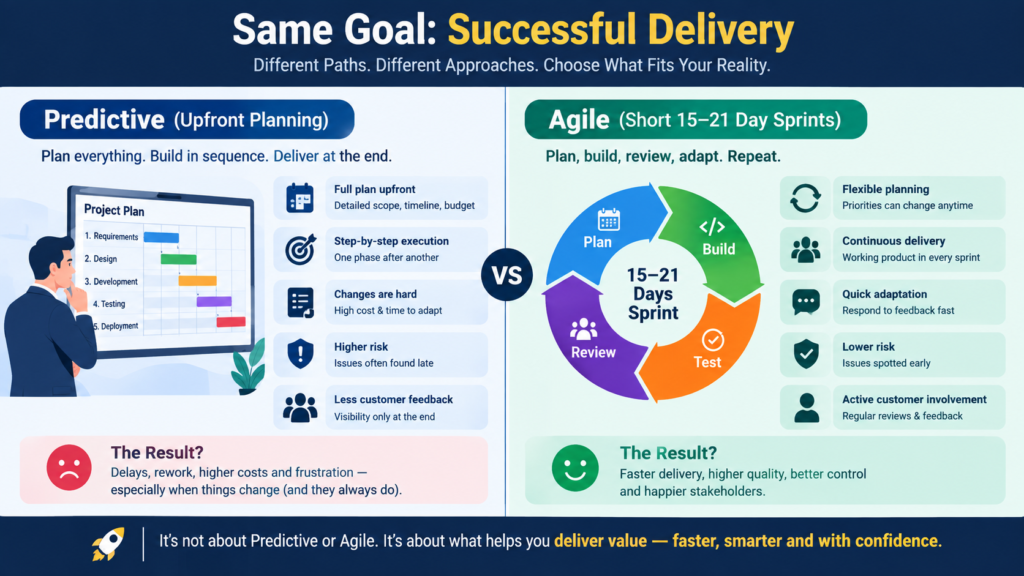
Agile is not an excuse to abandon planning. It is a highly disciplined system of continuous adaptation. In a pure Agile environment, there is no formal Change Control Board. Instead, the Product Owner reprioritizes the project backlog based on immediate, real-time business value. The team utilizes servant leadership to remove impediments, focusing heavily on collaboration over rigid control.
The Hybrid Methodology
Because completely pure frameworks rarely survive contact with complex enterprise realities, Hybrid methodologies have become the ultimate industry standard. A Hybrid approach strategically blends the rigorous upfront planning and risk management of the Predictive framework with the rapid execution flexibility of Agile sprints. For example, a global software rollout might use a Predictive model for hardware procurement, legal compliance, and security audits, while simultaneously utilizing Agile sprints for the user interface software development.
The latest PMBOK updates explicitly treat methodology as agnostic. The framework provides the project management processes, but you are expected to tailor them to fit the situation. Tailoring is the deliberate adaptation of processes, governance, and methods to fit the project’s exact context. You are not deviating from the standard when you build a Hybrid model. You are applying the standard exactly as intended.
The Hybrid Implementation Framework
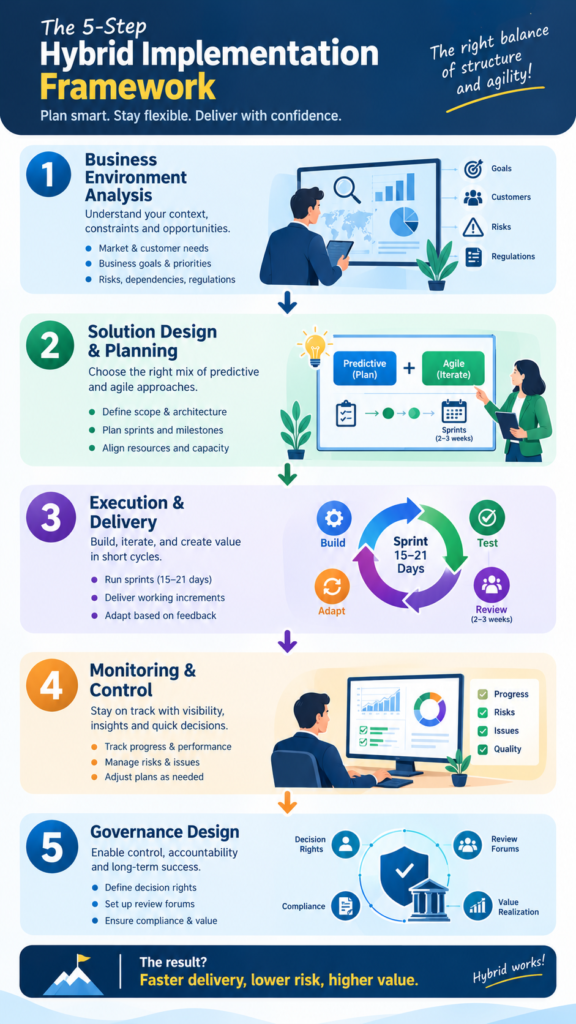
To stop guessing and start leading confidently, you need a replicable framework for implementing a Hybrid methodology. Project Managers can copy and use the following detailed steps immediately to establish absolute project control and necessary flexibility.
Analyze the Business Environment: Before selecting any methodology, you must comprehensively evaluate your organization’s flexibility and your own level of authority. Assess the regulatory requirements, stakeholder risk tolerance, and enterprise funding structure to dictate the boundaries of your approach.
Deconstruct the Project Deliverables: Break the massive project down into its core functional components. Identify precisely which components have fixed, unchangeable requirements and which components require active user feedback and iterative development.
Assign Predictive Models to Rigid Components: Apply the Predictive framework to the inflexible components. Establish firm baselines, utilize the five process groups (Initiation, Planning, Execution, Monitoring and Control, Closing), and confidently lock in the project scope.
Establish Iterative Agile Cadences: For the flexible software or design components, establish 15 to 21-day Agile sprints. Empower the development team to adapt to market changes quickly without bottlenecking the rigid, predictive components of the project.
Design an Enabling Governance Model: Governance should always act as an enabler that enhances the work for the people executing it, rather than acting as a bureaucratic blocker. If your governance model blocks progress, the model itself is fundamentally flawed and must be redesigned.
The Professional Transformation
Mastering the deployment of Predictive, Agile, and Hybrid methodologies is the ultimate catalyst for a massive professional transformation. When you truly understand how to navigate these diverse frameworks, you instantly stop being a tactical taskmaster and become a strategic business partner. Your projects shift from chaotic, scope-creeping disasters into predictable, elite delivery engines.
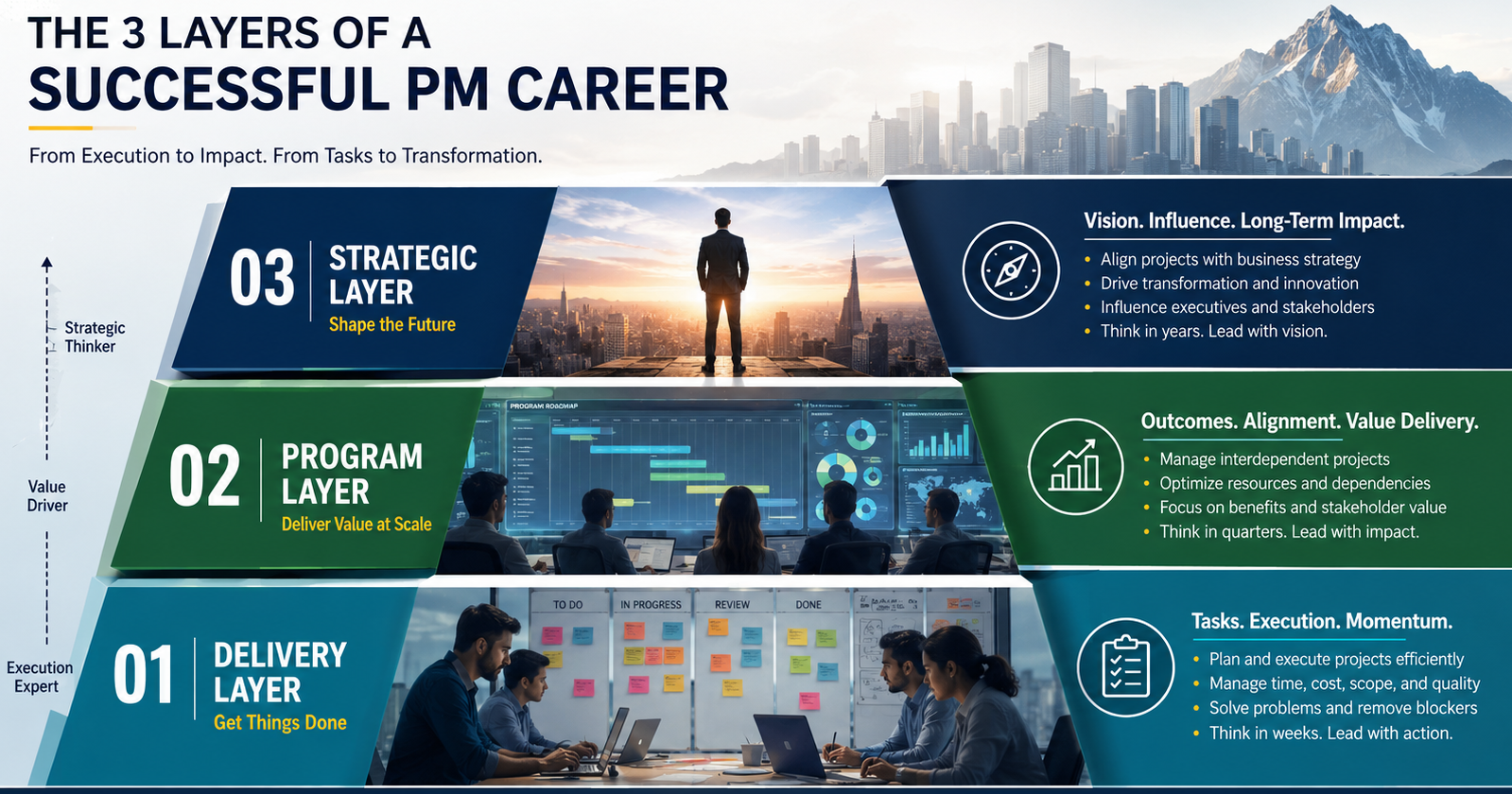
The true secret to career acceleration is recognizing that your technical skills have a firm ceiling. To break through that ceiling and achieve significant career growth, you must intentionally move from the delivery layer into the program layer.
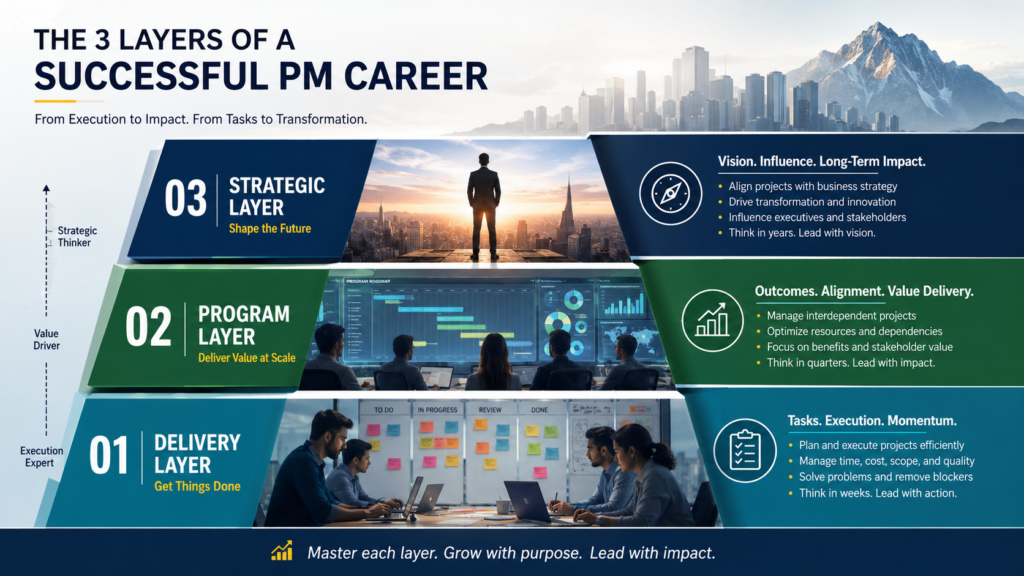
Corporate organizational structures consist of three primary layers. The strategic layer sits at the very top, which is where the executive leadership team operates. The program layer sits in the middle and focuses on delivering actual business value, which is where management sits. Finally, the delivery layer sits at the foundation, focusing on hands-on execution.
To be an elite project manager, your responsibility is to connect your program layer directly to the strategic initiatives of the executive leadership team. You must learn to translate that vision downward, speaking the required technical language to your delivery teams at the bottom, while simultaneously speaking the strategic language of business value to the leadership at the top.
Furthermore, deploying the right methodology builds immense, unbreakable trust with your stakeholders. Stakeholder perception is absolutely paramount to your long-term success. You can execute a project flawlessly, but if stakeholder perception is poor, the entire project is considered a failure. By meticulously tailoring your methodology to fit their exact business needs and communicating clearly, you build supreme confidence. You eventually transition into becoming a vocal advocate for the client.
When you operate at this strategic level, your managers and executives will actively seek you out for high-visibility opportunities, pulling you up the corporate ladder organically. Your career growth happens precisely because leadership sees you seamlessly handling complex governance, mitigating catastrophic risks, and managing vital stakeholder relationships. This is what it truly means to learn project management the right way.
Summary & Next Steps
The relentless debate between Predictive and Agile methodologies is a massive distraction for serious professionals. The reality of modern corporate project management requires a highly nuanced, tailored approach that strategically blends the best of both worlds into a robust Hybrid framework. By deeply understanding the PMBOK architecture, mastering the five classic process groups, and embracing Agile execution flexibility where it truly counts, you position yourself as an indispensable asset to any enterprise. You transition from merely managing basic tasks to proactively driving strategic business outcomes that impact the corporate bottom line.
If you are ready to stop guessing, move up the corporate ladder, and learn project management the right way, reach out to Skillsetify. We do not just teach frameworks: we show you your exact career growth trajectory.