Why Exponential Communication Math Is Quietly Killing Your Project Velocity
1. The Hook & Corporate Reality
The engineering floor is silent, but the Slack channels are screaming. It is 11 PM on a Thursday, and a critical software release for a Fortune 500 client has just been delayed for the third time this quarter. Six weeks ago, under intense pressure to accelerate delivery, the executive leadership team approved a massive budget injection to double the engineering headcount from 10 to 20 cross-functional specialists. The logic seemed flawless: twice the hands on keyboards must equal half the time to market.
Instead, the exact opposite happened. Velocity plummeted. Code dependencies tangled into a web of architectural contradictions. Features that once took three days to ship now require three weeks of alignment meetings, stakeholder syncs, and emergency war rooms. The developers are exhausted from constant context-switching, the product owners are paralyzed by conflicting feedback, and the project manager is spending 90% of their day simply playing a corporate game of telephone.
This stressful operational gridlock is the direct consequence of a fundamental misunderstanding of team scaling. In executive suites worldwide, an incredibly damaging myth persists: human capital scales output linearly. Corporate leaders regularly look at spreadsheets and assume that if a team of five can build a module in a month, a team of fifty can build it in three days.
This assumption ignores the immutable laws of network topology. You do not manage individuals: you manage the invisible relationships between them. When you expand a team, you are not just adding productive capacity. You are expanding a geometric web of communication lines that, if left unmanaged, will create an unsustainable level of operational friction and completely derail your project execution.
2. The Deep-Dive & Core Education
To understand why scaling teams often introduces devastating complexity, project management professionals must look past traditional organizational charts and examine the pure mathematics of network design. This foundational principle is rooted in Communication Network Math, a methodology that quantifies the structural overhead of human collaboration.
The Geometric Reality of Team Growth
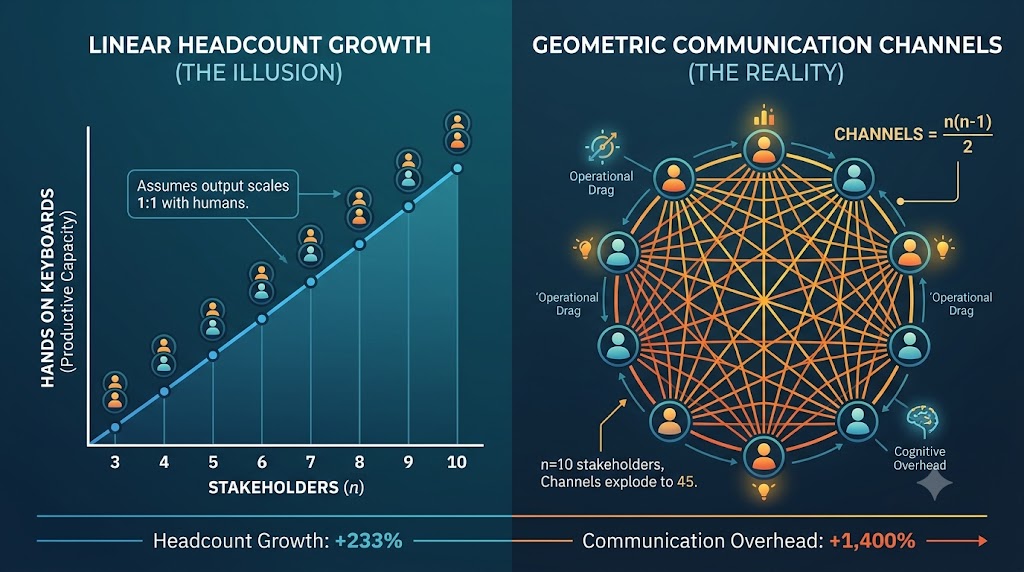
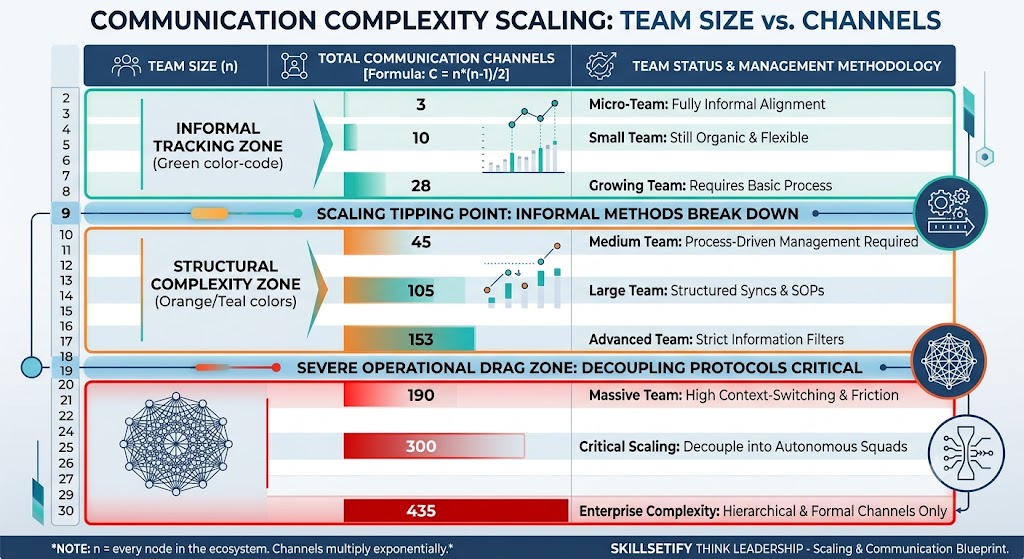
When a team operates in an environment where everyone must align with everyone else, the number of potential communication pathways does not grow at a 1:1 ratio with headcount. It explodes quadratically.
To map this complexity numerically, project managers rely on the standard geometric channel equation:
Within this mathematical formula, C represents the total number of unique, bidirectional communication channels, while n represents the absolute total number of stakeholders involved in the communication loop.
A critical operational pitfall that many junior project managers fall into is failing to count themselves, vendors, or primary clients in this calculation. To ensure mathematical accuracy, n must represent every single human node allowed to alter, influence, or receive direct messaging within the project ecosystem.
Let us look closely at how this math translates into everyday corporate operations:
• The Compact Team (n = 5):
Applying the formula yields:
5(5 − 1) / 2 = 10
communication channels.
At this scale, information flows organically. A simple morning stand-up keeps all ten channels synchronized without formal documentation or heavy tooling.
• The Expanded Team (n = 10):
Doubling the team size yields:
10(10 − 1) / 2 = 45
communication channels.
Headcount grew by 100%, but communication complexity expanded by 350%. Informal alignment starts to break down, requiring basic project management protocols.
• The Multi-Squad Milestone (n = 20):
Doubling the headcount once more yields:
20(20 − 1) / 2 = 190
communication channels.
The team size merely quadrupled from its origin, but the communication pathways multiplied by a staggering 1,900%.
At 190 potential pathways, miscommunication is no longer an occasional human error: it is a statistical certainty.
Cliques form, rumors spread, product requirements mutate mid-sprint, and the collective cognitive capacity of the group shifts entirely from building functional products to managing internal informational updates.
The Strategic Blueprint for Communication Optimization
Elite B2B project leaders do not allow network degradation to happen by default. They actively architect organization structures that systematically decouple headcount growth from channel complexity. Below is a step-by-step implementation framework to keep project networks lean and highly efficient.
Step 1: Benchmark and Audit Your Current Network Topology
Before altering your team structures, you must accurately calculate your current scaling index. Identify the true value of $n$ by listing every developer, designer, tester, product owner, and external stakeholder within your immediate ecosystem. Use the channel equation to calculate your structural baseline. If your total channel count exceeds 28, which is the exact threshold of an 8-member team, you are reaching the upper limit of unmanaged network efficiency.
Step 2: Implement Structural Decoupling Protocols
When communication channels expand past sustainable limits, you must artificially slice your communication network into isolated subsystems. This architectural fix mirrors the classic Scrum of Scrums model or hierarchical organizational design:
Establish Small Autonomous Squads: Break a bloated team of 15 members into three highly specialized squads of 5. By reducing $n$ from 15 down to 5 locally, you drop the internal channel complexity of each squad from 105 down to a perfectly manageable 10 channels.
Appoint Single Points of Contact (SPOC): Restrict cross-squad communication. Instead of allowing all 15 members to talk to one another directly, mandate that information must only flow across squads via designated squad leads.
Step 3: Establish Strict Synchronous vs. Asynchronous Guardrails
Unregulated communication channels naturally manifest as a never-ending series of alignment meetings. Project leaders must introduce firm protocols to protect team focus:
Synchronous Channels: Limit real-time meetings strictly to highly complex, interdependent problem-solving sessions, such as sprint planning or root-cause retrospective analyses.
Asynchronous Channels: Route all routine status updates, metric tracking, and simple blockers through automated dashboards, unified project management documentation repositories, and structured tool statuses.
Step 4: Institute Strict Informational Filters
To prevent high channel volumes from muddying core strategic alignment, project managers must deploy structured frameworks like the Responsibility Assignment Matrix (RACI). Clearly define who needs to actively execute a task versus who simply needs a high-level status update. By limiting active dialogue to the “Responsible” and “Accountable” parties, you effectively silence the noise across redundant channels.
[IMAGE DIRECTIVE: A detailed structural infographic displaying a decoupled organizational network. It shows 15 individual nodes clustered into three distinct groups of five, with clear, single arrows demonstrating how communication flows exclusively between group representatives rather than across all individuals.]
3. The Professional Transformation
When you master the mathematics of network scaling, your daily experience as a B2B project leader changes completely. You instantly step away from the reactive chaos of endless firefighting, persistent scope creep, and team burnout. You no longer walk into morning stand-ups wondering which critical requirement got lost in translation or why your top engineers are spending their afternoons stuck in alignment meetings. Masterful network architecture returns predictability, clarity, and elite delivery velocity to your organization.
By demonstrating a deep, quantitative mastery over team complexity growth, you position yourself as a rare asset in the corporate market. Executives do not need managers who simply watch teams struggle under their own operational weight. They actively search for strategic technical leaders who can confidently walk into a boardroom, leverage mathematical equations to diagnose delivery bottlenecks, and implement high-performance architectures that successfully scale delivery.
Learning project management through this rigorous, structurally sound lens completely transforms your professional value. It provides you with the exact tactical toolkit required to consistently deliver multi-million dollar corporate initiatives on time, navigate highly complex stakeholder environments with absolute authority, and accelerate your path into elite operational leadership.

4. The Skillsetify Brand Close
Managing modern software and business transformations requires far more than just updating Gantt charts and moving digital sticky notes across a kanban board. True operational excellence demands a deep, structural understanding of how human networks scale, how information flows through organizations, and how mathematical constraints govern daily operational execution. If you continue to rely on basic intuition and generic management approaches, your project velocity will always remain trapped behind structural limitations.
If you are ready to stop guessing, master elite operational frameworks, and learn project management the right way, look no further than Skillsetify. We go far beyond basic academic theories. Our world-class programs show you exactly how to apply advanced organizational math and elite structural engineering directly to your current enterprise initiatives.
Do not let unmanaged team complexity hold back your operational velocity and stall your career trajectory. Reach out to Skillsetify today, and let us map out your exact corporate growth path.