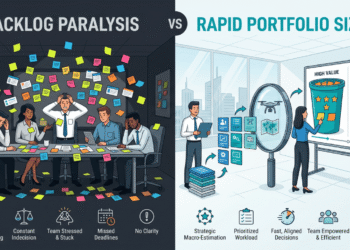
Mastering Planning Poker, Relative Sizing, and Delivery Metrics
Picture this exact scenario playing out on a Monday morning in your corporate office. The stakeholders are furious. The flagship product update is three weeks behind schedule. The engineering team is completely burned out, working late nights to make up for lost time. The sales team has already promised this new feature to a massive enterprise client, and their credibility is on the line. Why did this catastrophic chain of events occur? It happened because someone in leadership asked an arbitrary question: “How many hours will this feature take to build?” The lead developer, feeling cornered in a high-pressure meeting, guessed that it would take roughly forty hours.
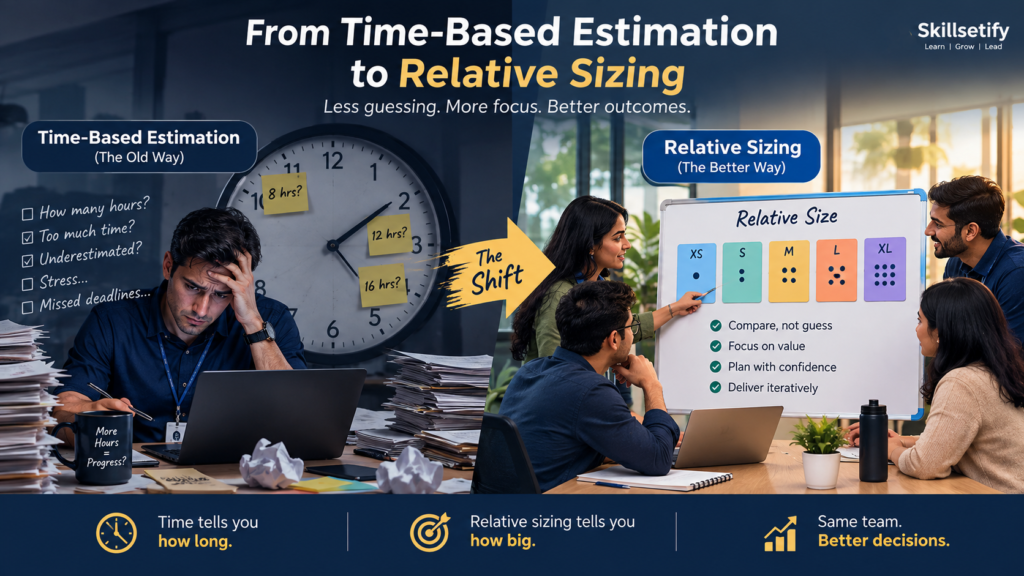
This brings us to the biggest myth in corporate project management. We must dispel this myth right away: humans are inherently terrible at estimating absolute time. Time-based estimates are a dangerous trap. When you ask a developer to estimate in hours, they are forced to predict the future. They have to account for unknown bugs, shifting requirements, code reviews, and meeting interruptions. The reality is that we cannot accurately predict if a complex software feature will take forty hours or eighty hours. However, human beings are remarkably gifted at relative sizing. Even a child can look at a bicycle and a car and tell you the car is much larger. In the professional world, an engineer knows instinctively that building a completely new database architecture is significantly larger than changing the color of a submission button.
The Core Mechanics of Relative Sizing
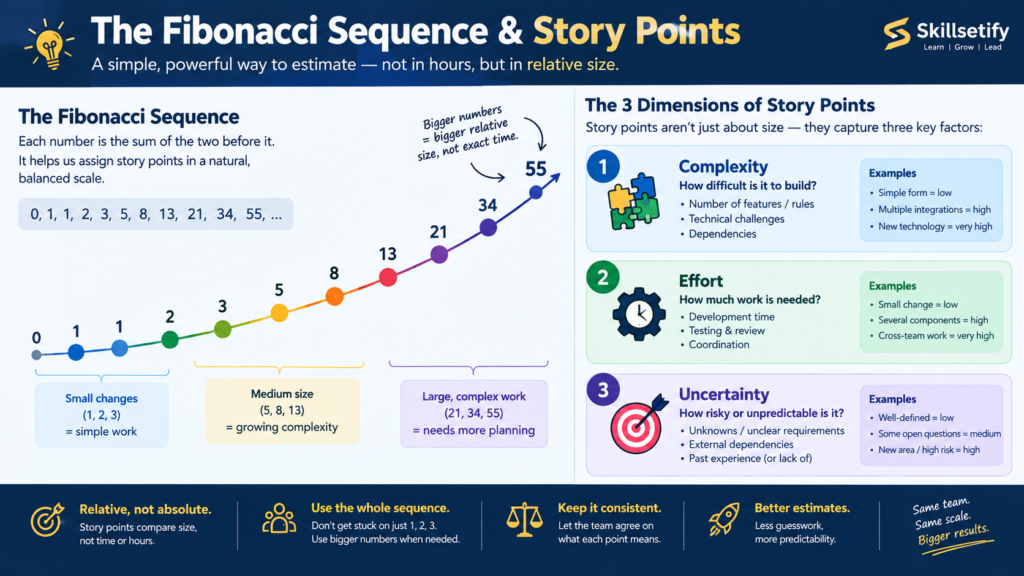
To fix the estimation crisis, elite B2B organizations abandon hours and adopt relative sizing. Instead of time, we measure relative complexity, effort, and uncertainty using a unit called Story Points. Story points do not equal hours. They represent the size of the problem. If a baseline task, like updating a text field, is one point, then integrating a third-party payment gateway might be eight points because it is roughly eight times more complex.
This is where the Fibonacci sequence enters the agile ecosystem. The Fibonacci sequence is a mathematical series of numbers where each number is the sum of the two preceding ones: 1, 2, 3, 5, 8, 13, 21, and so on. Why do agile teams use this specific sequence instead of a standard linear scale like one through ten? The answer lies in human psychology and natural imprecision. As things get larger, our ability to estimate their exact size diminishes.
If you ask a team to choose between a size seven and a size eight, their brains will get stuck in analysis paralysis. The distinction is too fine, and the discussion becomes a waste of valuable meeting time. The Fibonacci sequence forces a clear, distinct choice. You must choose between an eight and a thirteen. There is no middle ground. This intentional gap reflects the natural uncertainty of software development. It forces the team to acknowledge that if a task is larger than an eight, it is significantly larger and carries much more risk.
By using the Fibonacci sequence, teams evaluate three specific dimensions. First, they look at technical complexity to understand the unknowns and technical difficulty. Second, they evaluate the raw effort to understand the sheer volume of work involved. Finally, they measure uncertainty to account for what might be discovered during execution. The higher the uncertainty, the higher the Fibonacci number must be to account for the unknown risks.
The Planning Poker Masterclass Framework
Understanding relative sizing is only the first step. You need a structured methodology to extract these estimates from your team without bias. This is where Planning Poker becomes your most powerful project management tool. Planning Poker is a consensus-based estimation technique that leverages the collective wisdom of the entire cross-functional team. Here is the highly detailed, step-by-step implementation framework that you can copy and use in your very next sprint planning meeting.
Step 1: The Pre-Game Preparation. The Product Owner must come to the meeting with a prioritized backlog. The user stories must be clearly written with defined acceptance criteria. If a story is not well-defined, it cannot be estimated. Each team member is given a deck of cards containing the Fibonacci numbers.
Step 2: The Pitch and Clarification. The Product Owner reads the user story aloud to the team. The development team then asks probing questions. What are the edge cases? Are there dependencies on other teams? What are the exact acceptance criteria?. This stage is crucial because it uncovers hidden requirements before a single line of code is written.
Step 3: The Silent Vote. This is the magic of Planning Poker. In traditional meetings, the most senior developer or the loudest voice in the room speaks first. If the senior developer says a task is easy, the junior developers will remain quiet, even if they see massive risks. In Planning Poker, everyone selects their estimate card privately to prevent anchoring early estimates.
Step 4: The Simultaneous Reveal. Once everyone has chosen, all team members reveal their chosen cards at the exact same time. This completely eliminates bias and ensures all perspectives are valid.
Step 5: The Debate and Consensus. If everyone reveals a five, you record the estimate and move on. However, if one developer reveals a three and another reveals a thirteen, a debate begins. The individuals explain their reasoning and clarify their different perspectives. Often, the person who voted high has noticed a critical architectural flaw that everyone else missed. After a brief, focused discussion, the team votes again until they reach a consensus.

The Missing Link of Delivery Metrics
Mastering Planning Poker will revolutionize how your team estimates work, but you must also understand how this work flows through your delivery pipeline. This brings us to a critical topic: the vital difference between Lead Time and Cycle Time. Many executives and project managers use these terms interchangeably, and it causes massive confusion across the organization.
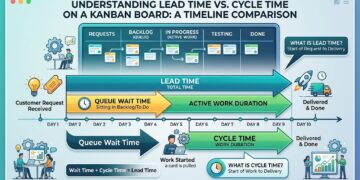
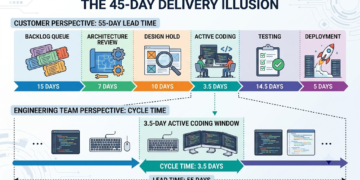
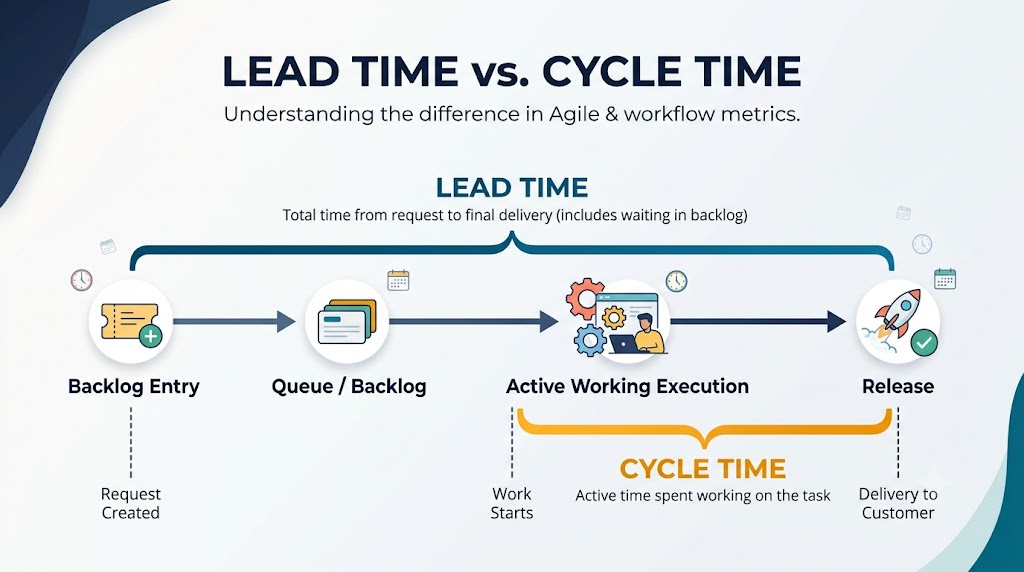
Lead Time measures the entire journey of a work item. It is the total duration from the exact moment a feature request is placed into the backlog until the completed feature is delivered to the customer. Lead Time is a measure of the customer experience. If a stakeholder requests a report generation tool, their clock starts ticking immediately. They do not care about your internal processes. They only care about how long they have to wait to receive the value, and this metric captures backlog queue durations and scheduling gaps.
Cycle Time, on the other hand, measures only the active working execution duration. The Cycle Time clock does not start until a developer actually begins work. It stops when the task is marked as done. Cycle Time is a measure of engineering efficiency. It reflects the speed of your delivery machine once work is actively underway.
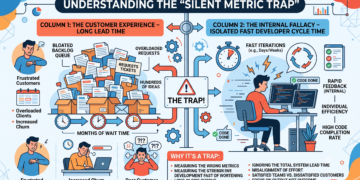
Why does this difference matter? Imagine a feature request that sits in your product backlog for thirty days awaiting prioritization. Once prioritized and estimated via Planning Poker, a developer picks it up and finishes it in just four days. The engineering team will proudly report a highly efficient Cycle Time of four days. They are correct. However, the business leadership experienced a wait time of thirty-four days. They are also correct. The gap between Lead Time and Cycle Time is purely waiting time in queues prior to execution.
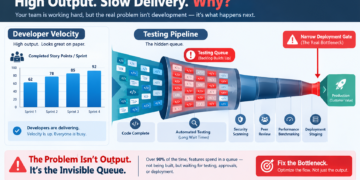
When your team uses Planning Poker accurately, you optimize your Cycle Time. You ensure that tickets are sized perfectly so they flow through the active execution phase without bottlenecks. However, you must also manage the backlog carefully to reduce Lead Time. If you only look at Cycle Time, your dashboards will look perfectly healthy while your clients remain deeply frustrated by the long overall wait. Elite project managers track both metrics simultaneously to ensure both engineering efficiency and optimal stakeholder satisfaction.
The Professional Transformation
To achieve this level of operational excellence, you must move beyond basic theory and apply these advanced methodologies with precision. Traditional time estimation will always fail you. Relative sizing, Planning Poker, and a deep understanding of Lead Time versus Cycle Time are the definitive tools of elite B2B teams. Implementing them correctly requires discipline, focus, and the right guidance.
If you are ready to stop guessing, move up the corporate ladder, and learn project management the right way, reach out to Skillsetify. We do not just teach frameworks: we show you your exact career growth trajectory.