How Elite Product Leaders Use Affinity Estimation to Size Massive Portfolios in Minutes
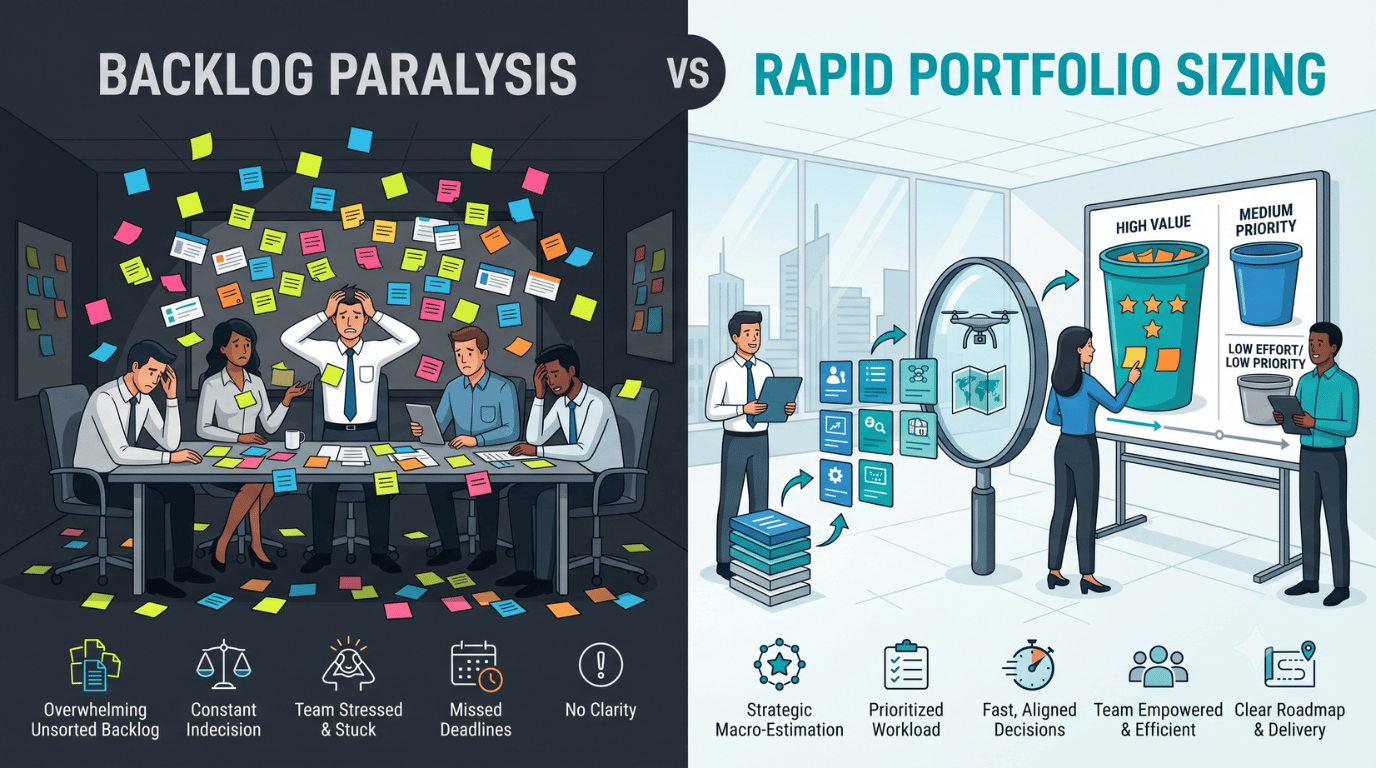
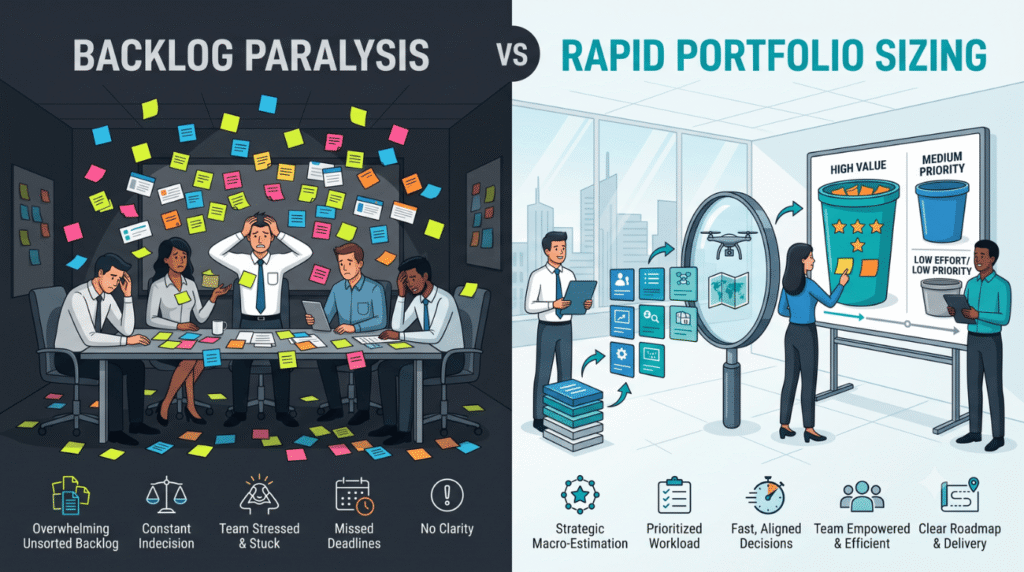
Imagine a modern enterprise product group sitting in a corporate boardroom for six consecutive hours, completely deadlocked over whether a checkout interface modification represents a three or a five on the Fibonacci sequence. Outside the room, executive sponsors are demanding an immediate roadmap delivery schedule for an incoming portfolio that spans hundreds of unestimated requirements. The traditional route of processing every line item through granular team voting will consume weeks of expensive, soul-crushing alignment meetings.
This scenario represents backlog paralysis, a corporate delivery bottleneck born from a widespread industry myth: the belief that every single user story must be deeply analyzed, meticulously decomposed, and perfectly calculated before a project initiative can begin.
Elite project management leaders understand that striving for precision in the earliest phases of a major initiative is an illusion. When an organization is confronted with an overwhelming volume of work and constrained by tight corporate schedules, forcing teams into micro-level analysis is counterproductive. Instead of descending immediately into tactical debates, modern delivery organizations utilize macro-level sorting tools to gauge the overall scope of their work. By zooming out to a high-level view, leadership can establish a predictable path forward without wasting valuable engineering hours on early-stage estimation overhead.
The Strategic Blueprint of Affinity Estimation
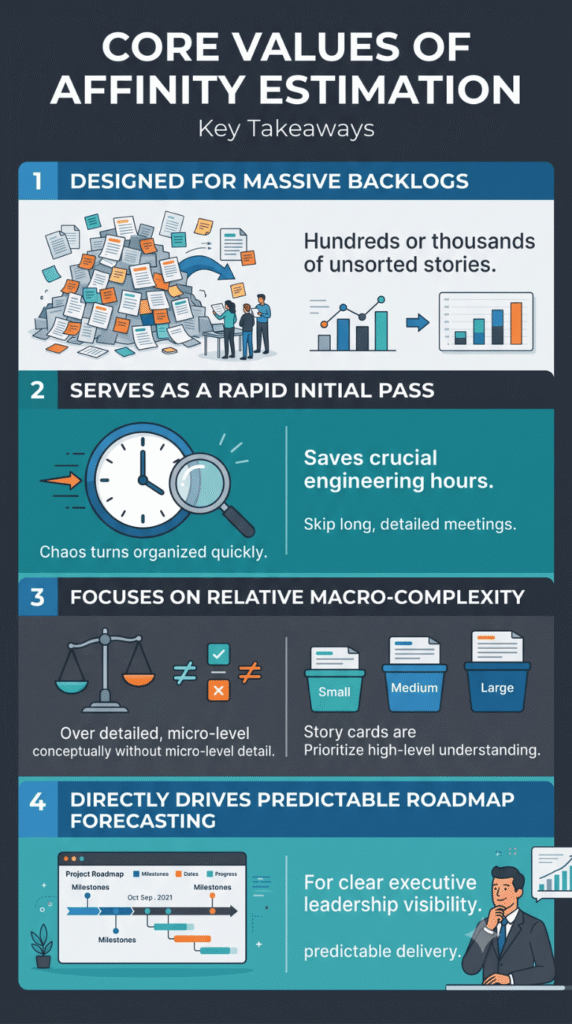
Affinity Estimation is a rapid portfolio sizing technique engineered to help product delivery teams quickly sort and categorize a massive volume of user stories without getting trapped in exhaustive verbal debates. The framework is specifically designed for scenarios where an organization must evaluate hundreds or even thousands of unrated requirements under aggressive timelines.
The operational philosophy of the methodology is embedded in the word affinity itself, which signifies closeness or structural relation. Rather than looking at an isolated requirement in a vacuum, the delivery team evaluates how close or structurally similar a user story is to other surrounding items in the portfolio.
This approach serves as an initial pass for project sizing. It is not designed to uncover granular, task-level technical details, nor is it intended to generate a flawless, legally binding contract estimate. Instead, it functions as a visual sorting activity that helps the team zoom out to a 30,000-foot perspective. This macro-view allows leaders to reconcile the systemic gap between complicated technical components and complex corporate ecosystems—addressing a classic project manager’s dilemma—before committing significant time to technical execution.
Mapping the Core Sizing Mechanics
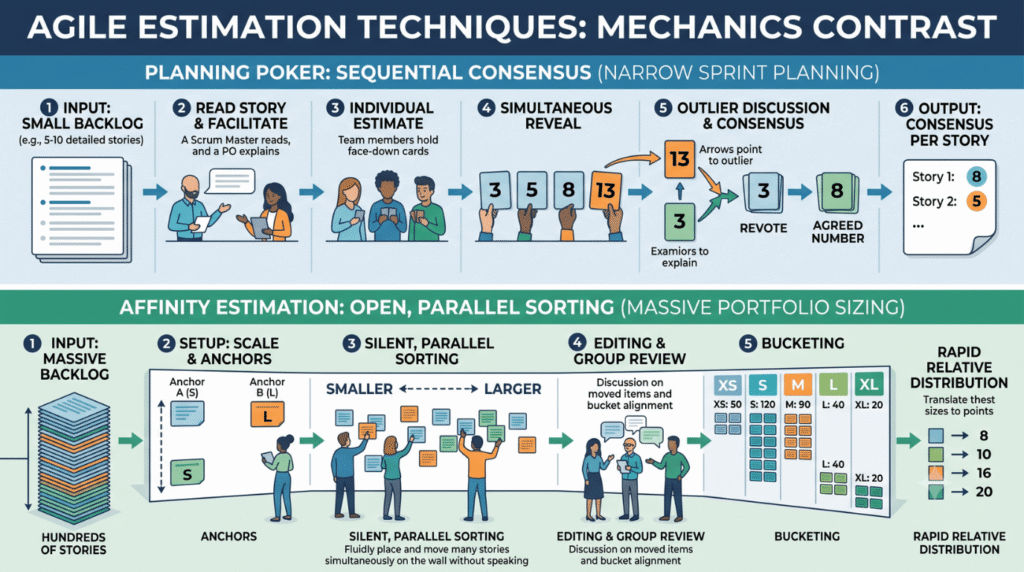
The operational framework of Affinity Estimation relies on collaborative relative sizing, which stands in stark contrast to secretive, card-reveal estimation methods like Planning Poker. In a standard Planning Poker environment, team members hide their individual sizing metrics, reveal their cards simultaneously, and engage in lengthy debates to reconcile outlying perspectives. While that granular approach is valuable during immediate sprint planning cycles, it is completely unsuited for high-level portfolio initialization.
Affinity Estimation operates as an open, group-wide collaborative exercise. The team works collectively to place user stories into designated conceptual buckets based on visible relative complexity. This real-time alignment bypasses individual presentation blocks, enabling teams to evaluate a massive backlog in a fraction of the time required by traditional methods.
The Step-by-Step Affinity Estimation Implementation Framework
To execute this methodology successfully within an enterprise environment, project managers must follow a structured, repeatable implementation model. This process transforms a raw, unorganized list of user stories into a structured portfolio backlog that is ready for executive road mapping.
Step 1: Establish the Sizing Environment and Reference Baselines
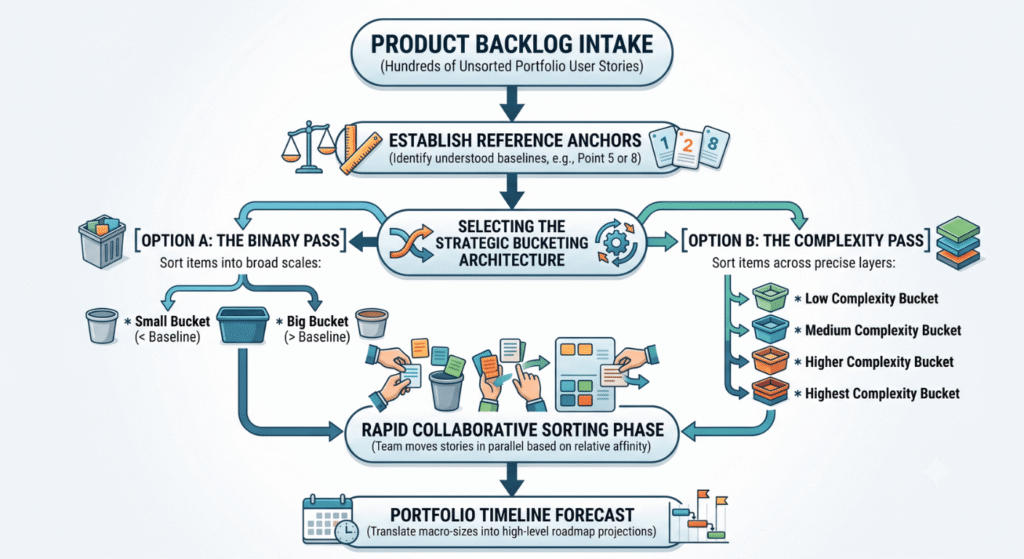
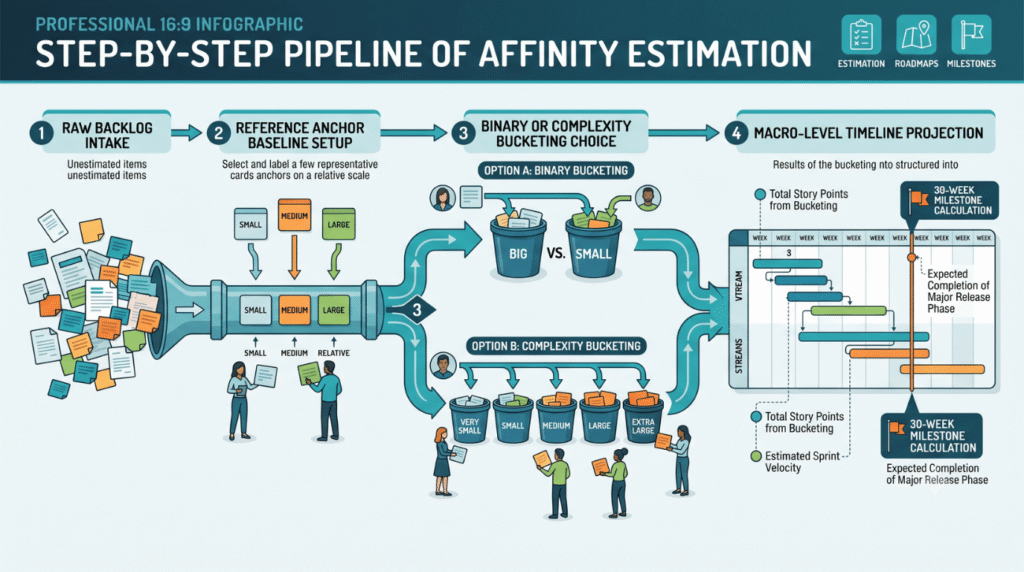
The process begins by gathering the core delivery team and placing the entire unestimated backlog into a shared workspace. Before any sorting occurs, the project leader introduces one or two reference user stories that the team already understands thoroughly. These reference stories serve as the psychological anchors for the entire session, giving the team a tangible baseline against which all incoming requirements will be compared
Step 2: Define the Bucketing Strategy
The project leader establishes the physical or digital sorting buckets that will guide the session. Depending on the specific needs of the product and the preferences of the delivery group, the bucketing strategy can take two distinct structural forms:
The Binary Pass (Big versus Small)
- In its simplest format, the team sets up two primary categories: a small bucket and a big bucket. The group selects a central reference point, such as a 5 or an 8 on the standard story point scale. Any user story that demands less effort or contains less complexity than the reference baseline is placed in the small bucket, while any requirement that exceeds the baseline is moved to the big bucket. This binary division gives leadership a fast, reliable breakdown of the overall scope.
The Structurally Advanced Pass (Multi-Bucket Complexity Sizing)
- For organizations requiring deeper portfolio insight, the framework can expand beyond simple binary categories into four or five distinct buckets. Instead of sorting items based on raw effort alone, the team categorizes stories using a progressive scale of low complexity, medium complexity, higher complexity, and highest complexity.
Step 3: Differentiate Technology Complications from Environmental Complexity
When sorting items into complexity buckets, an elite project manager must guide the team to distinguish between technically complicated tasks and environmentally complex requirements.
A requirement should be categorized as technically complicated if its challenges are primarily tied directly to technology parameters. Complicated requirements usually feature clear, knowable outcomes that can be systematically resolved by assigning a technical subject matter expert or bringing in the right specialized engineering talent.
Conversely, a requirement possesses environmental complexity when it is defined by systemic uncertainty, shifting corporate environments, massive stakeholder circles, multi-region coordination blocks, and frequent operational surprises. Understanding this distinction ensures that the team accurately accounts for external risk factors during the macro-sorting process, preventing large, high-risk items from being mistakenly categorized as simple or low-effort tasks.
Step 4: Translate Sizing Totals into Macro Leadership Timelines
Once the sorting activity is finalized, the project leader can aggregate the bucket counts to generate initial timeline estimates for executive leadership. This translation relies on applying macro-level math to the sorted portfolio rather than relying on hyper-detailed sprint metrics.
For example, consider a massive incoming enterprise portfolio where the initial affinity pass reveals a total estimated volume of roughly 1,000 macro story points. If historical organizational data or baseline team performance benchmarks indicate a stable average velocity of 100 story points per delivery cycle, the project manager can easily calculate a high-level roadmap projection.
By dividing the 1,000 total portfolio story points by the team’s average velocity of 100 points, the leader can project that the entire scope of work will require approximately 10 distinct delivery cycles. Assuming a standard, time-boxed sprint duration of 3 weeks per cycle , 10 cycles multiplied by 3 weeks results in an overall timeline projection of 30 weeks. This simple calculation tells the project leader that the portfolio will require roughly 7 months of continuous execution to achieve complete delivery.
This macro-forecasting model allows the project management office to deliver realistic, data-backed timeline expectations to executive stakeholders early in the cycle. It successfully avoids the weeks of meeting overhead and scheduling friction typically required to extract early projections using traditional estimation techniques.
Shifting From Tactical Friction to Elite Delivery Leadership
Mastering Affinity Estimation enables a profound professional transformation for both project managers and their delivery organizations. It marks a definitive shift away from reactive tactical friction and toward proactive, strategic delivery leadership.
In traditional corporate environments, project execution is frequently slowed down by early-stage estimation debates. Teams spend hours arguing over minor details for requirements that may shift in scope before development ever begins. This hyper-tactical focus strains team morale, frustrates engineering talent, and delays the delivery of critical early-stage roadmap projections to executive sponsors.
By implementing Affinity Estimation during product backlogging and early initialization phases, you protect your engineering teams from meeting fatigue and eliminate unnecessary tactical friction. The team transitions into a smooth, parallel sorting motion that honors their time while providing clear portfolio visibility. This macro-level sizing model enables an organization to map out extensive roadmaps in minutes, allowing them to spot dependencies early and proactively manage systemic complexity before a single sprint cycle begins.
For the ambitious project professional, mastering this macro-level approach is an important step in long-term career advancement. True leadership within an enterprise organization is not demonstrated by rigidly administering micro-level frameworks or forcing teams into unnecessary administrative compliance. Instead, it is demonstrated by knowing how to deploy the right tool at the right time to maintain organizational velocity.
When you demonstrate the ability to take an unorganized backlog of a thousand user stories and turn it into a clear, data-backed roadmap projection in a single afternoon, executive leadership views you differently. You step outside the role of a tactical framework coordinator and assert yourself as an elite, business-minded delivery leader who knows how to move products from concept to market efficiently.
Master the Art of Enterprise Project Leadership with Skillsetify
The business landscape does not reward professionals who simply memorize textbook definitions and rigidly apply frameworks in environments where they do not fit. Modern corporate organizations demand project leaders who understand the business realities behind the frameworks: professionals who can look at portfolio complexity, protect engineering velocity, and deliver clear predictability to executive stakeholders.
If you are ready to stop guessing, step past basic framework administration, and learn how to manage enterprise project execution the right way, reach out to the team at Skillsetify today.
At Skillsetify, we go far beyond teaching standard industry definitions. We focus on equipping you with the tactical strategies, real-world execution models, and advanced leadership patterns required to navigate complex corporate environments with absolute confidence. Our specialized corporate curriculum is built to show you your exact career growth path, transforming you from a tactical project coordinator into an elite delivery leader. Connect with Skillsetify today, and discover how to accelerate your professional trajectory.