Why Forcing Detailed Estimation Early Destroys Enterprise Velocity
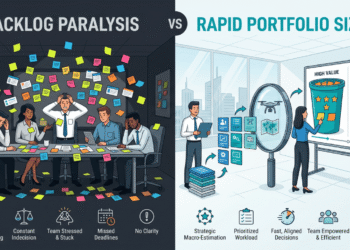
A high-stakes corporate steering committee is gathered in a packed boardroom, reviewing a multi-million dollar transformation initiative. The product manager stands before the room, presenting a massive, newly minted product backlog containing over eight hundred raw user stories. In an attempt to deliver the pinpoint timeline precision that executive leadership demands, the project management office insists on running a traditional estimation process.
The entire delivery squad is trapped in meeting rooms for three consecutive days, walking line-by-line through the backlog to calculate exact numerical story points. By hour twelve, developers are actively arguing over minor acceptance criteria for features slated for implementation nine months down the line. Cognitive fatigue sets in, alignment fractures, and the product development engine completely stalls before a single line of code is written.
The foundational error here stems from a widespread corporate myth: the belief that all requirements must be estimated with the exact same level of granular precision from day one. Many leadership teams demand immediate micro-level certainty, mistakenly assuming that calculating exact numbers at the very beginning of a project will yield an accurate long-term roadmap.
In reality, forcing ground-level micro-estimation onto a massive, fluid backlog produces fiction, wastes hundreds of expensive engineering hours, and induces severe analysis paralysis. To maintain velocity, elite project leaders must decouple long-term macro-forecasting from short-term iteration planning.
Decoding Agile Sizing: Macro vs. Micro Perspectives
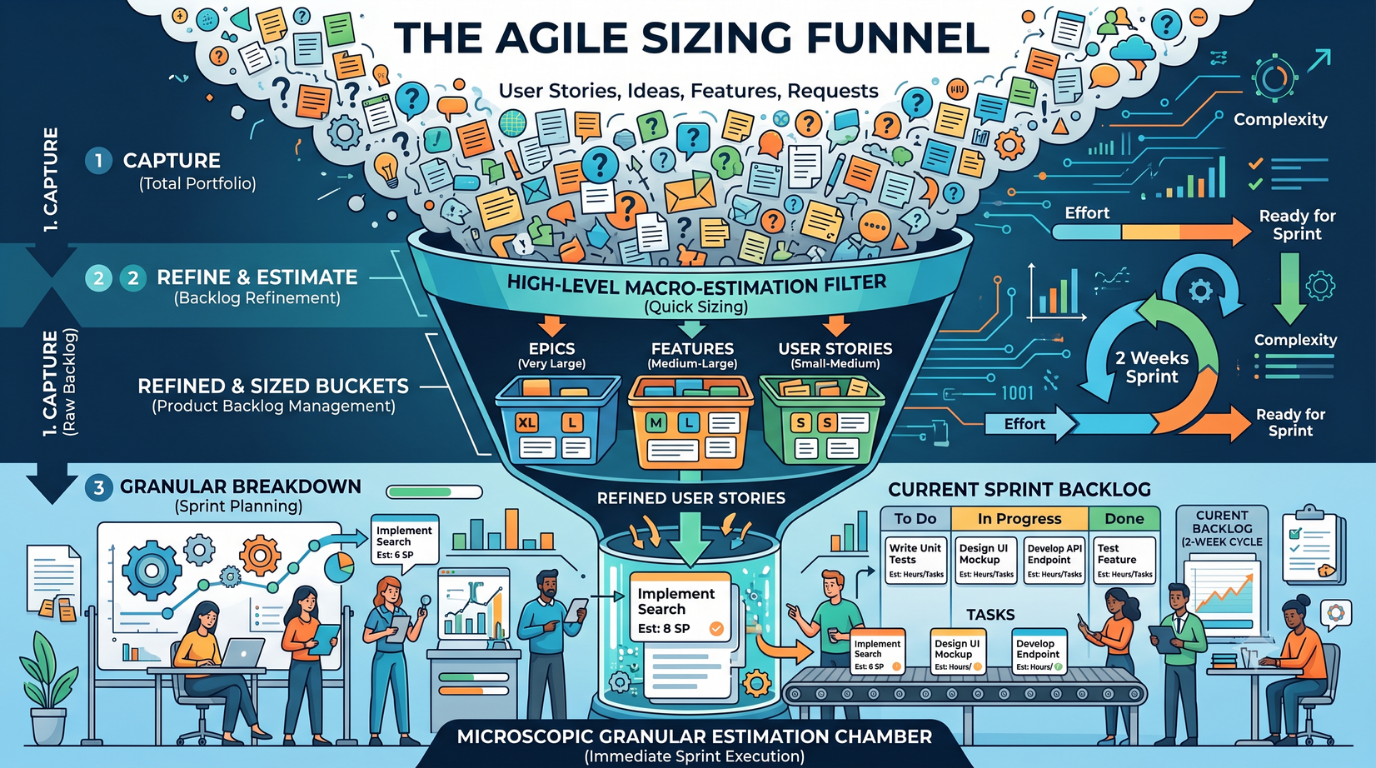
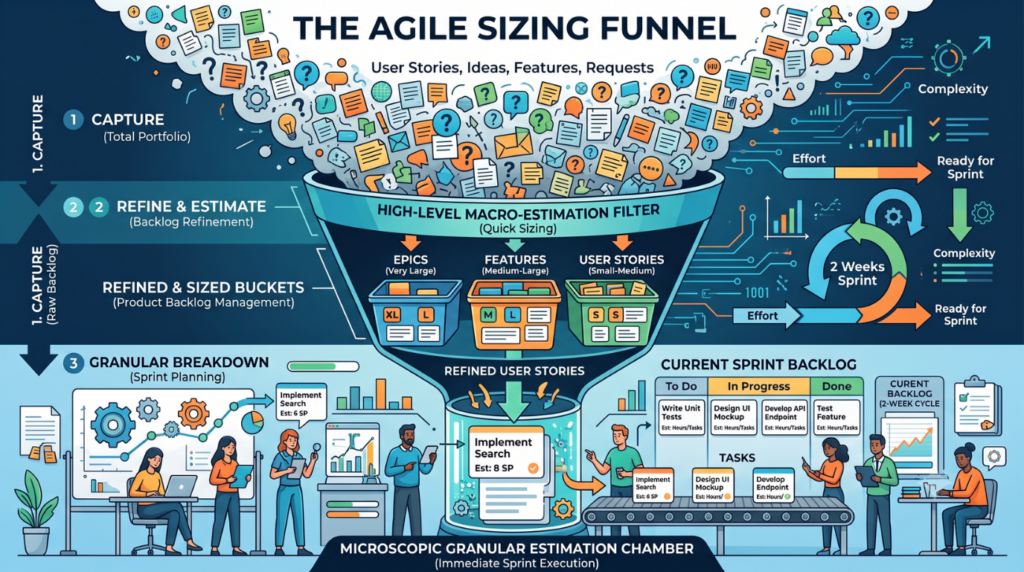
To build a high-performing delivery engine, modern enterprise leaders must treat estimation not as a single, static ritual, but as a multi-tiered filtering system. You cannot use a satellite map to perform precision surgery, nor can you use a microscope to navigate a cross-country flight. In the product ecosystem, balancing executive visibility with engineering execution requires the strategic orchestration of two distinct relative sizing methodologies: Affinity Estimation and Planning Poker.
Decoding Agile Sizing: Macro vs. Micro Perspectives
To build a high-performing delivery engine, modern enterprise leaders must treat estimation not as a single, static ritual, but as a multi-tiered filtering system. You cannot use a satellite map to perform precision surgery, nor can you use a microscope to navigate a cross-country flight. In the product ecosystem, balancing executive visibility with engineering execution requires the strategic orchestration of two distinct relative sizing methodologies: Affinity Estimation and Planning Poker.
Affinity Estimation: The 30,000-Foot Strategic Lens
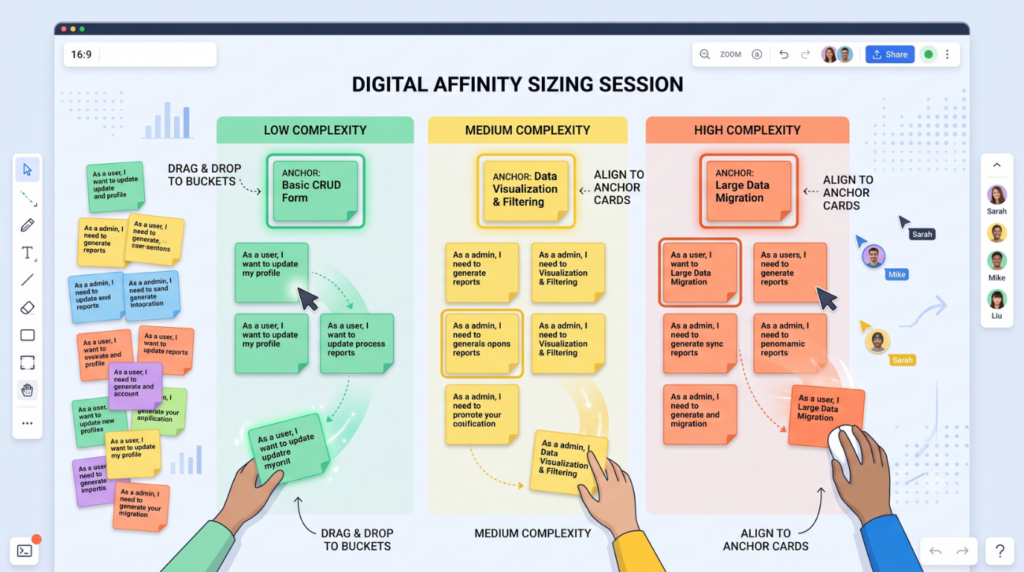
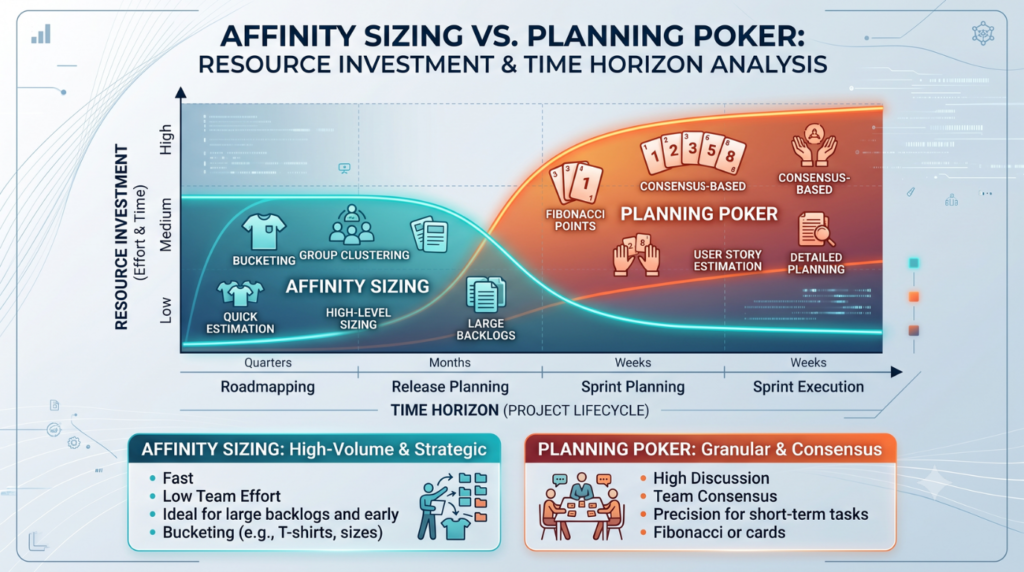
Affinity Estimation is a rapid, collaborative sizing technique designed to categorize large volumes of work without getting bogged down in individual ticket debates. Instead of assigning explicit numerical values sequentially to hundreds of unrefined user stories, the team leverages the power of relative complexity to sort items into broad, comparative groups.
The underlying mechanics are built on speed and relative comparison. The team establishes baseline reference anchors: often using simplified binary buckets such as big versus small, or classic sizing variants like low, medium, and high complexity. A well-understood baseline user story is selected to serve as the anchor point.
The product leader then surfaces subsequent backlog items in rapid succession. The team collectively evaluates each item against the anchor story, asking a singular, foundational question: Does this new item represent more, less, or equal effort relative to our baseline? The ticket is sorted into its corresponding bucket instantly.
The primary objective of this exercise is not to discover absolute precision. Rather, it is about testing the depth of the waters and establishing rapid strategic visibility for senior leadership. When an enterprise is initiating a major product launch, evaluating an expansive backlog item-by-item is logistically impossible and economically wasteful.
Affinity Estimation allows a team to zoom out, group similar concepts through collaborative consensus, and view the entire landscape from a 30,000-foot perspective. It yields the macro-level view necessary to project high-level funding requirements, allocate resources, and establish initial release horizons early in the project initiation phase before active sprints begin.
Planning Poker: The Ground-Level Tactical Deep-Dive
Once the overarching boundaries of the product roadmap are defined, the delivery team requires an entirely different mechanism to govern short-term iteration execution. This is where Planning Poker becomes indispensable. Planning Poker is a consensus-based, card-revealing approach to micro-estimation, typically executed during active sprint planning or localized backlog refinement sessions.
Unlike the rapid, macro sorting characteristically found in Affinity Sizing, Planning Poker relies on structural isolation to eliminate cognitive bias, specifically the anchoring effect. Anchoring occurs when team members subconsciously alter their estimates to align with the opinion of the loudest or most senior developer in the room.
To mitigate this risk, every participating engineer is given a deck of cards displaying numbers that typically follow a modified Fibonacci sequence: 1, 2, 3, 5, 8, 13, 20, 40, and 100. The non-linear progression of these values perfectly mirrors human cognition: as a task grows in size, our capacity to estimate it with precise accuracy naturally diminishes.
When a prioritized user story is introduced, the product owner clarifies the explicit acceptance criteria, and the engineering team engages in a brief technical discussion regarding implementation. Crucially, no numerical values are spoken aloud. Instead, each developer selects a card representing their individual estimate and places it face down on the table.
On a count of three, all participants reveal their cards simultaneously. If the team displays absolute alignment, the estimate is locked, and the next story is introduced. However, if a massive variance occurs, for example, if a junior developer presents a 2 while a principal architect reveals a 20, the team halts the process to discuss the extremes.
This directed variance discussion forces hidden technical assumptions, architectural constraints, testing complexities, and potential dependencies out into the open, ensuring the squad reaches a shared understanding of the work before committing it to an active sprint backlog.
Sizing Framework Matrix: Striking the Proper Balance
To optimize delivery velocity, project managers must accurately identify when to look through the strategic lens of Affinity Sizing and when to trigger the tactical mechanics of Planning Poker. Utilizing the wrong tool at the wrong phase inevitably results in either executive misalignment or extreme operational waste.
| Sizing Attribute | Affinity Estimation | Planning Poker |
|---|---|---|
| Backlog Volume Capacity | Ideal for hundreds or thousands of unrefined items. | Optimized for small subsets of prioritized work (10 to 30 items). |
| Primary Project Phase | Project initiation, product roadmapping, early discovery. | Active sprints, immediate iteration planning, backlog grooming. |
| Target Audience | Executive leadership, steering committees, portfolio managers. | Engineering squads, product owners, Scrum squads. |
| Level of Granularity | Macro-level relative sizing and bucket grouping. | Micro-level detailed story point assignments. |
| Facilitation Complexity | Minimal discussion after initial grouping; highly scalable. | Intensive collaborative discussion for every individual backlog item. |
| Business Outcome | Accelerates strategic forecasting and release planning. | Improves sprint predictability, estimation accuracy, and team alignment. |
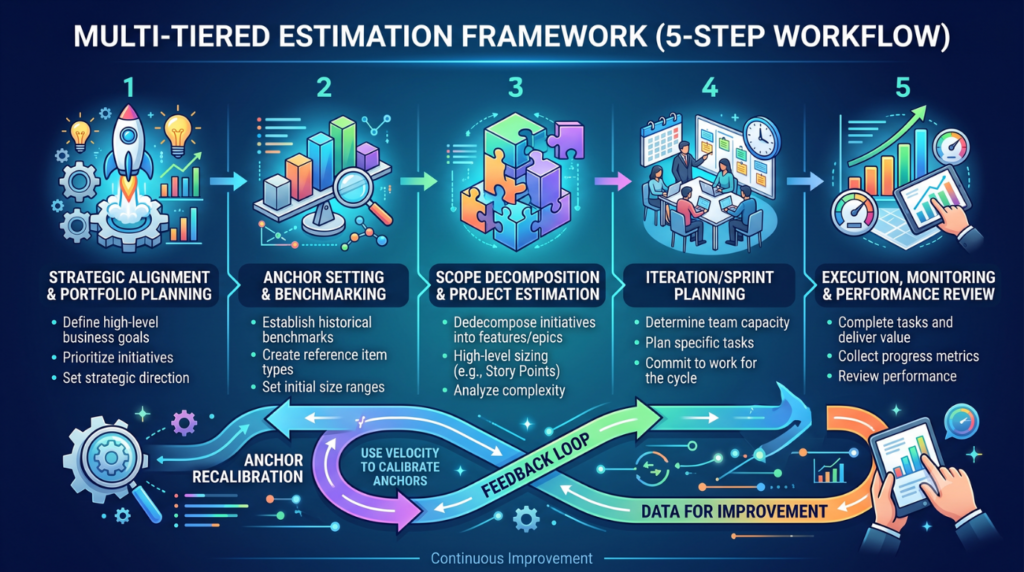
The Multi-Tiered Estimation Framework: A Step-by-Step Blueprint
To implement project management the right way, elite practitioners must synthesize these relative sizing methodologies into a single, cohesive framework. This step-by-step blueprint allows teams to navigate from vague, high-level product concepts to highly predictable, operational delivery.
Step 1: Establish the Backlog and Anchors
Gather the initial product requirements. Do not delay execution while waiting for perfectly written, atomic user stories. Identify two or three well-understood requirements to serve as your operational anchors. Select one requirement that clearly represents a minimal baseline effort and another that represents a highly complex, known baseline.
Step 2: Execute the High-Level Affinity Pass
Convene the delivery team for a rapid relative sizing workshop. Present the unrated backlog items sequentially. Using your anchor stories as a continuous point of reference, quickly sort the incoming items into broad complexity buckets. Focus exclusively on relative complexity rather than hours or days. Use this macro-level map to compute the total global scope of the initiative, giving leadership an early, data-backed projection of the overall timeline.
Step 3: Map Items to Strategic Themes and Epics
Translate your newly sorted affinity buckets into structured requirement hierarchies. Group related high-complexity items to surface long-term architectural bottlenecks, flag foundational technical risks, and organize your backlog into a phased release roadmap grounded in strict business value.
Step 4: Trigger Granular Planning Poker in Sprint Planning
As items migrate from the long-term release roadmap into the immediate execution horizon, activate your micro-estimation loops. During sprint planning, isolate the highly prioritized user stories chosen for the upcoming iteration. Execute rigorous Planning Poker sessions, ensuring cards are revealed simultaneously to foster completely unbiased debates and expose localized technical dependencies.
Step 5: Track Team Velocity and Improvise Continuously
Measure the exact volume of story points successfully delivered at the conclusion of each sprint cycle to determine your team’s historical velocity. Compare this empirical data against your early macro-level affinity forecasts. If a significant variance emerges, do not simply add or subtract tickets blindly.
Convene the team for a thorough retrospective to discover the root cause: evaluate if the variance stems from shifting requirements, technical debt, or internal team friction. Continually recalibrate your baseline sizing anchors based on real-world delivery metrics, iteratively driving down project uncertainty.
The Professional Transformation: Shifting from Chaos to Elite Delivery
When you successfully master the integration of macro and micro estimation, the operational dynamic of your entire department transforms. You no longer walk into executive steering committee meetings with a sense of dread, because your long-term roadmap projections are anchored in collective team metrics rather than arbitrary guesses. On the development floor, the systemic friction caused by scope creep, unpredictable timelines, and chronic engineer burnout disappears. Sprints evolve into highly predictable, elite delivery cycles where commitments are consistently met and engineering squads operate with absolute confidence.
This commanding structural control over product delivery is what separates an ordinary project coordinator from an elite, high-value project leader. Cultivating deep expertise in these advanced sizing frameworks does more than stabilize localized product execution: it elevates your authority across the entire enterprise. It clearly demonstrates to executive leadership your capacity to protect multi-million dollar portfolios, mitigate systemic operational risk, and maximize return on investment, rapidly accelerating your upward career trajectory into senior leadership roles.
Master Elite Project Leadership with Skillsetify
Navigating the complexities of enterprise scale delivery requires moving far beyond textbook theories and rigid, one-size-fits-all frameworks. True operational mastery lies in knowing exactly when to look through a strategic macro lens to align executive stakeholders and when to employ precise tactical tools to empower engineering execution.
If you are ready to stop guessing, move up the corporate ladder, and learn project management the right way, reach out to Skillsetify. We do not just teach frameworks: we show you your exact career growth trajectory. Partner with Skillsetify today to optimize your delivery engine, secure absolute predictability, and accelerate your professional rise.