Why Your Enterprise Implementation Is Failing (And How Mindset Fixes It)
A tier-one financial institution spends $14 million on a digital transformation. They hire top-tier management consultants, send 400 engineers to certified Scrum Master training, and mandate Jira across 50 cross-functional teams. Twelve months later, product delivery speed has slowed by 15%, employee burnout is at an all-time high, and software releases are still delayed by months.
When leadership demands answers, the audit reveals a brutal truth: the enterprise adopted the mechanics of Agile while remaining fiercely committed to Waterfall thinking. Standup meetings became daily status interrogations. Sprints became high-pressure, bi-weekly micro-deadlines. User stories became rigid functional requirements wrapped in modern software jargon.
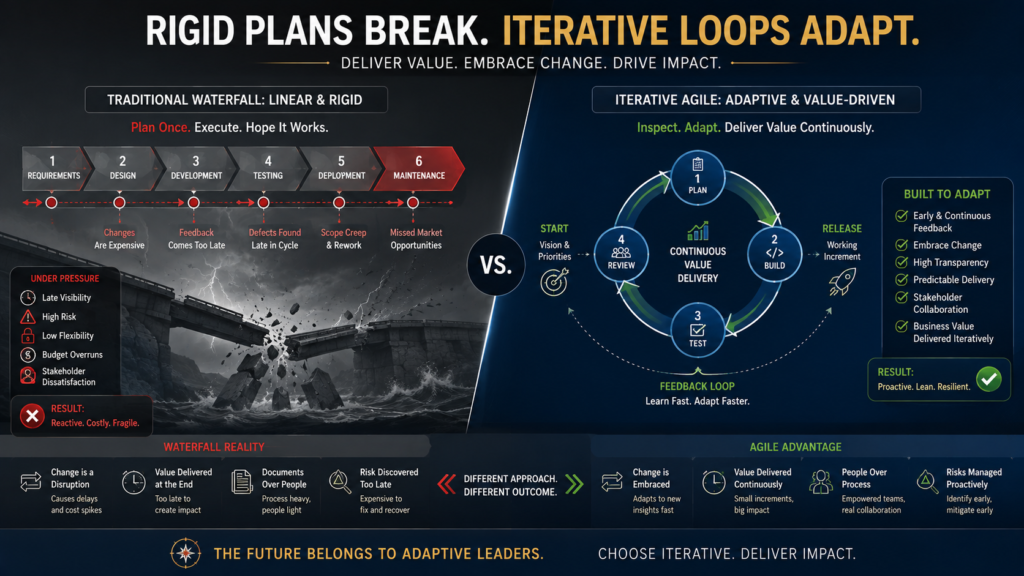
The fundamental corporate myth blighting modern enterprise strategy is simple: Agile is not a methodology, a software suite, or a collection of prescribed ceremonies.
Agile is a foundational mindset. It is a philosophy rooted in four core values and twelve principles defined over two decades ago to address a single truth: software development and complex project management take place in environment of extreme uncertainty. When you treat Agile as a rigid set of rules, you fail. When you embrace Agile as a strategic philosophy, you unlock unmatched operational resilience.
Deconstructing the Agile Mindset: Philosophy Over Mechanics
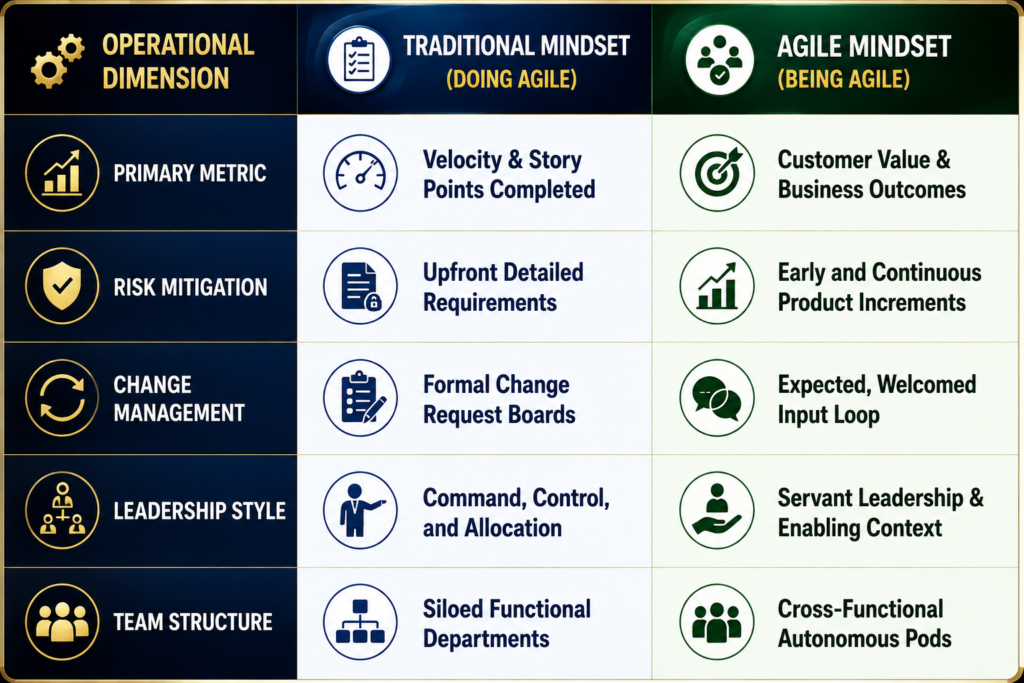
To understand why traditional organizations struggle with agility, you must look at the structural difference between doing Agile and being Agile. Doing Agile means going through the motions: holding daily standups, estimating tasks in story points, and sprint planning. Being Agile means operating within a cultural framework built on continuous adaptation, psychological safety, and rapid feedback loops.
The Four Core Values Re-examined
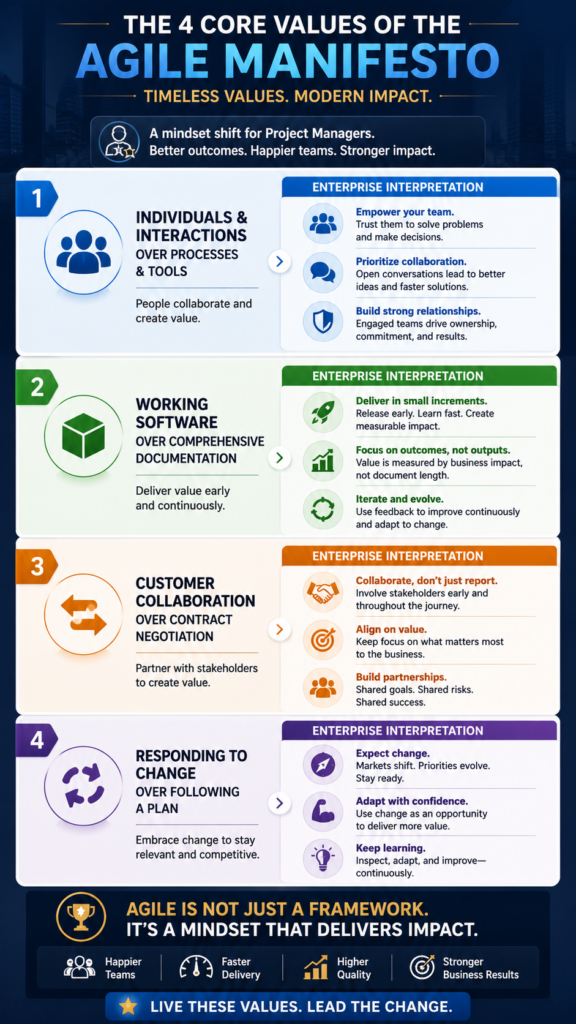
The Agile Manifesto, authored in 2001 at Snowbird, Utah, established a profound shift in project execution. Understanding these values requires looking beyond their surface definitions into their strategic corporate application.
Individuals and Interactions over Processes and Tools: Software and physical infrastructure do not solve enterprise problems; human collaboration does. High-performing teams leverage tools to serve communication, rather than allowing rigid tool configurations to dictate communication channels.
Working Software over Comprehensive Documentation: The ultimate metric of progress is a tangible, functioning deliverable. While documentation has strategic value, 200-page functional specification documents create an illusion of progress while hiding operational risks.
Customer Collaboration over Contract Negotiation: Traditional procurement and governance model enterprise success around fixed-scope contracts. Agile flips this model, positioning the customer as an active co-creator throughout the lifecycle of the product.
Responding to Change over Following a Plan: A project plan is a baseline hypothesis, not an absolute blueprint. In high-complexity markets, rigid adherence to a plan guarantees irrelevance when market conditions, technology, or user preferences pivot.
The Philosophical Engine: The Cynefin Framework
Why does the Agile mindset work so effectively in modern business environments? The strategic justification relies on Dave Snowden’s Cynefin Framework, which categorizes problems into four domains: Simple, Complicated, Complex, and Chaotic.
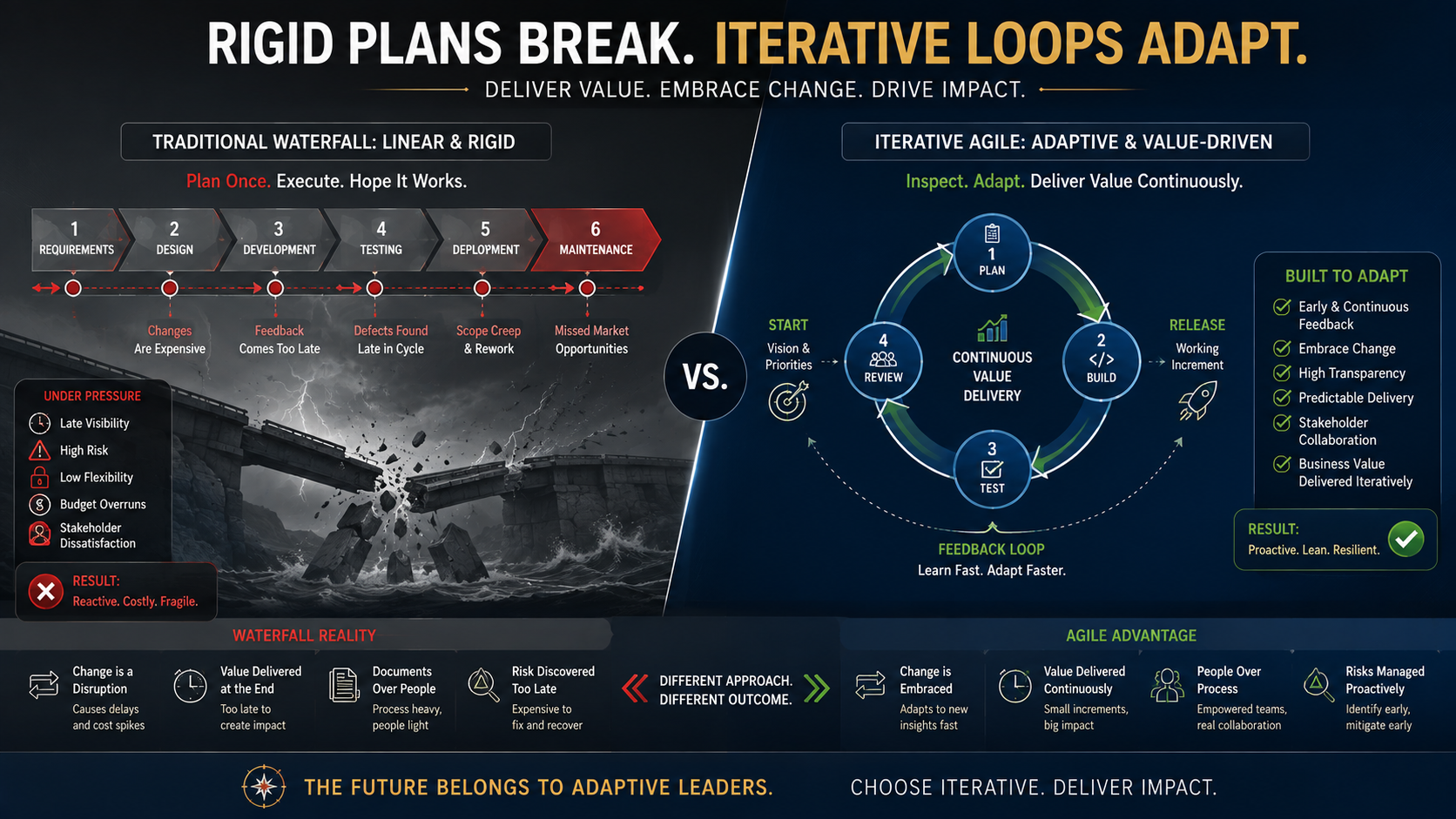
Traditional waterfall project management thrives in the Complicated domain, where cause-and-effect relationships are predictable and can be analyzed in advance. However, modern product development exists almost exclusively in the Complex domain. In complex systems, cause and effect can only be deduced in retrospect.
Trying to apply upfront, predictive planning to complex problems creates massive scope creep, missed deadlines, and systemic waste. An Agile mindset shifts the team execution pattern from Sense-Analyze-Respond (predictive) to Probe-Sense-Respond (experimental).
Transitioning from Methodology to Mindset
For Project Managers, Directors, and Enterprise PMO Leaders, instilling an Agile mindset requires an intentional, structural framework. Below is a five-phase execution roadmap to shift your organizational culture from rigid compliance to adaptive agility.
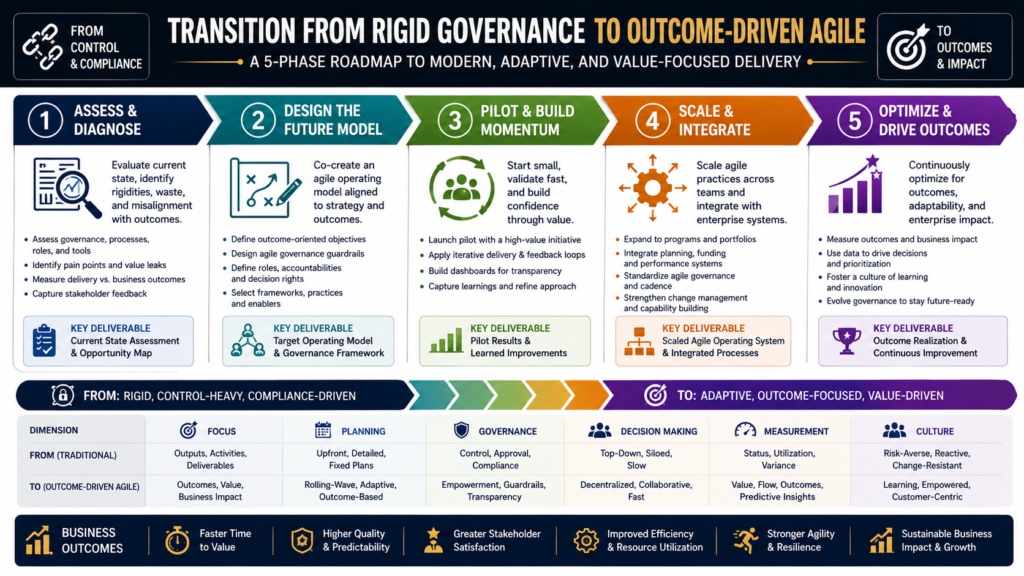
Phase 1: Establish Outcome-Based Governance
Shift your PMO metrics away from proxy variables like velocity, story point throughput, or strict adherence to a schedule. Align project success directly to business outcomes and value metrics.
Define Value Streams: Map end-to-end workflows to isolate delays and remove organizational handoffs.
Implement OKRs (Objectives and Key Results): Connect daily team outputs directly to high-level strategic goals.
Shift to CapEx/OpEx Dynamic Funding: Fund product streams instead of static projects to allow resource reallocation without friction.
Phase 2: Cultivate Psychological Safety
An Agile mindset cannot survive in an environment driven by fear. Continuous experimentation requires room for calculated failures.
Decouple Failure from Performance Reviews: Treat failed experiments as essential operational intelligence rather than personal errors.
Normalize Blameless Post-Mortems: When incidents occur, focus systematically on process vulnerabilities rather than individual fault.
Encourage Decentralized Decision-Making: Move authority to where the information lives. Empower product teams to make immediate architecture and priority calls.
Phase 3: Optimize for Short Feedback Loops
Speed of learning is the primary competitive advantage in modern business. Design every workflow to accelerate learning cycles.
Cap Work in Progress (WIP): Apply Kanban principles to limit active projects, drastically reducing multitasking overhead and context switching.
Shrink Batch Sizes: Deliver smaller, functional increments to users frequently rather than holding for massive, quarterly releases.
Automate Testing and Integration: Build technical excellence directly into your CI/CD pipelines to make deployment risk-free.
From Chaos to Predictable Excellence
When an organization successfully absorbs the Agile mindset, the day-to-day work environment undergoes a remarkable change.
Imagine moving away from late-night emergency release bridges, contentious scope battles with client stakeholders, and burnout-inducing quarterly rushes. Instead, picture an environment where project delivery is calm, continuous, and highly predictable.
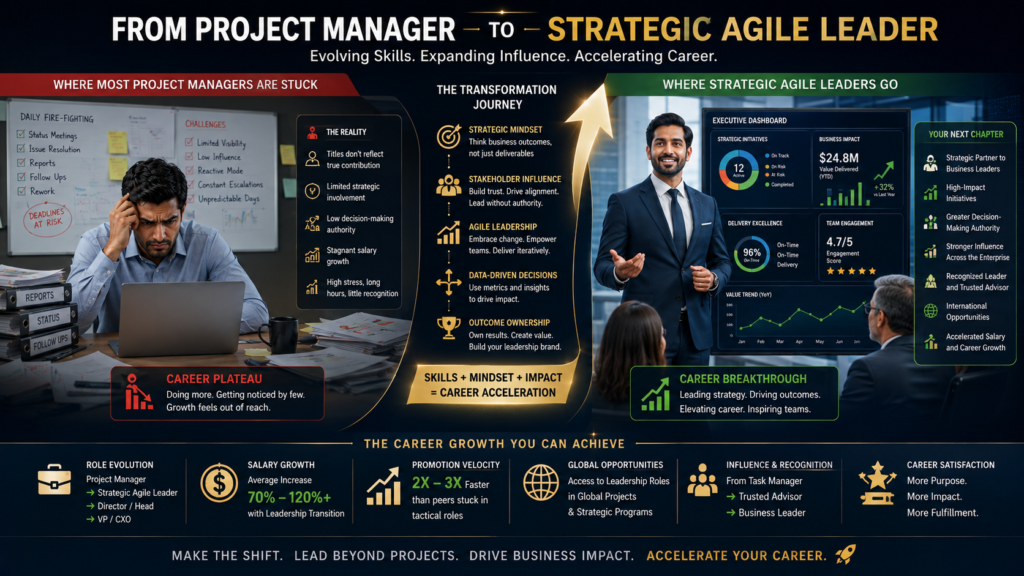
In an Agile environment:
Scope Creep Disappears: Scope is no longer an unwelcome intruder; it is evaluated dynamically based on ROI and business context.
Team Engagement Soars: Professionals thrive when granted autonomy, mastery over their craft, and a clear sense of purpose.
Career Velocity Accelerates: Leaders who understand how to drive value through cultural agility stand out instantly.
Project managers who transition from traditional task managers to strategic Agile leaders move from tracking tasks to shaping enterprise outcomes. This capability elevates project leaders directly into executive conversations.
Accelerate Your Executive Trajectory with Skillsetify
Navigating the transition from traditional framework execution to strategic Agile leadership is the single most effective way to fast-track your executive career. Yet, most professional development programs continue to teach static formulas, outdated textbook definitions, and rigid certification checklists that fail standard business reality tests.
At Skillsetify, we take a different approach. We believe that true project leadership cannot be learned by memorizing terms for an exam.
Our elite professional development programs are engineered by industry executives who have built, scaled, and rescued complex delivery operations inside top-tier global corporations. We do not just teach you how to run ceremonies or track tickets in software tools. We teach you how to build high-trust cultures, optimize complex value streams, and lead strategic transformations that command executive attention.
If you are ready to stop guessing, move up the corporate ladder, and master project management the right way, reach out to Skillsetify today. Let us show you your exact career growth trajectory and give you the executive capabilities needed to lead in an unpredictable world.