The Servant Leader’s Guide to Mastering Stakeholder Perception
The $10 Million Delivery Illusion
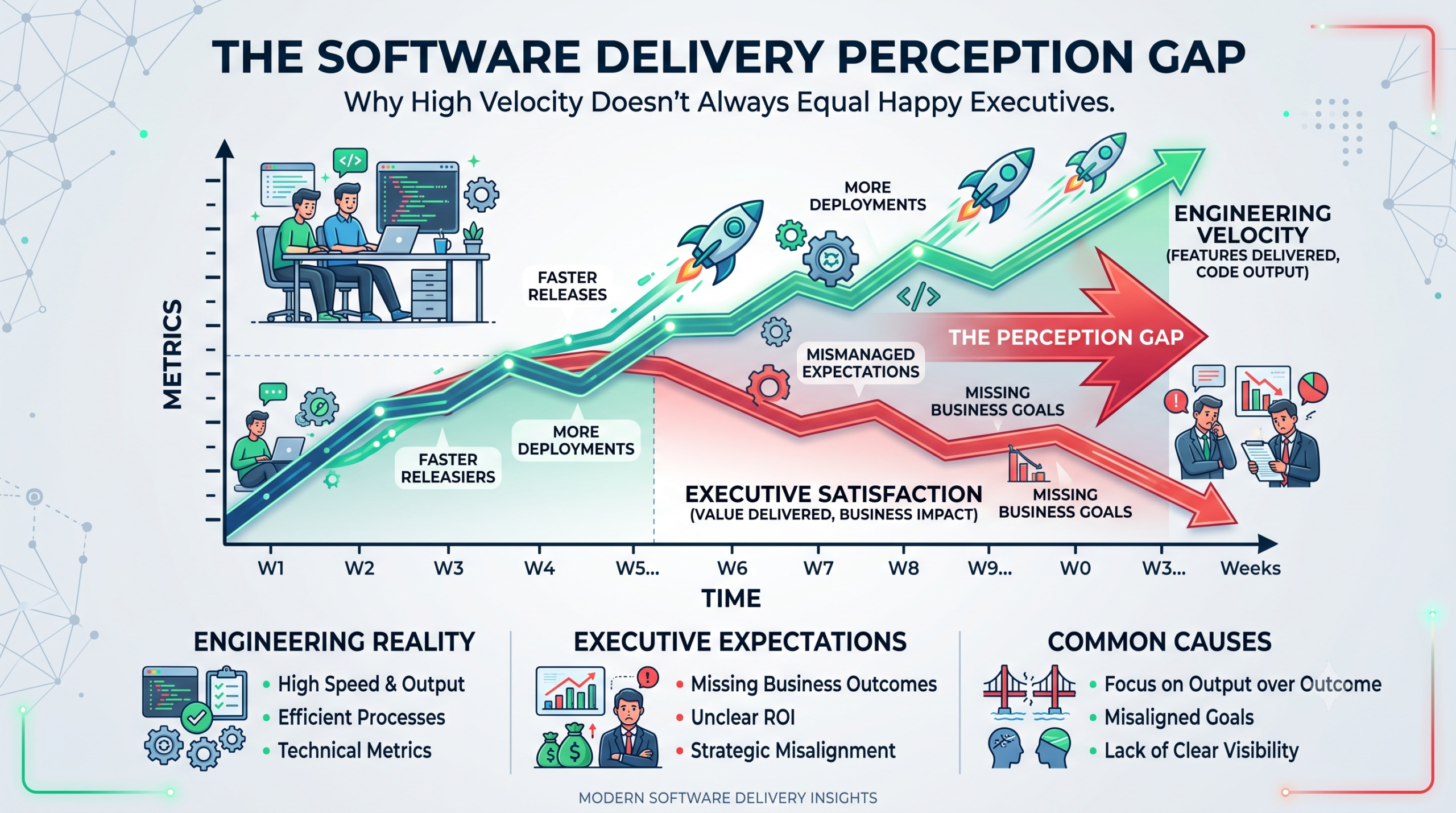
The sprint dashboard was glowing bright green. For six consecutive iterations, the engineering organization hit 100% velocity, cleared their backlogs, and deployed every scheduled user story on time. By all internal software metrics, the project was a resounding technical success.
Then came the executive review.
On launch day, the Chief Revenue Officer and the Vice President of Operations stood before the project leadership team and declared the release a catastrophic failure. The new enterprise module, while technically flawless, failed to address the core operational workflows the executive suite had envisioned. Critical reporting dashboards were missing, customer onboarding took twice as long, and key client-facing features had been deprioritized during sprint planning.
The delivery team had hit every milestone, yet the project failed completely. Why? Because delivery does not happen in an isolated technical vacuum. Project delivery fails catastrophically whenever stakeholder perception and expectations are mismanaged.
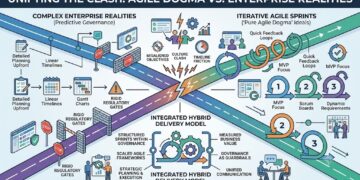
This crisis exposes a pervasive corporate myth: the belief that a project manager’s sole job is to execute scope on time and within budget while blindly shielding the delivery team from external business noise. Many professionals mistake Servant Leadership for passive martyrdom, assuming that a true servant leader simply says “yes” to the development team, takes all the political heat from executives in silence, and hides organizational realities until the final release.
That approach is not leadership. It is passive compliance, and it routinely destroys projects, trust, and executive alignment.
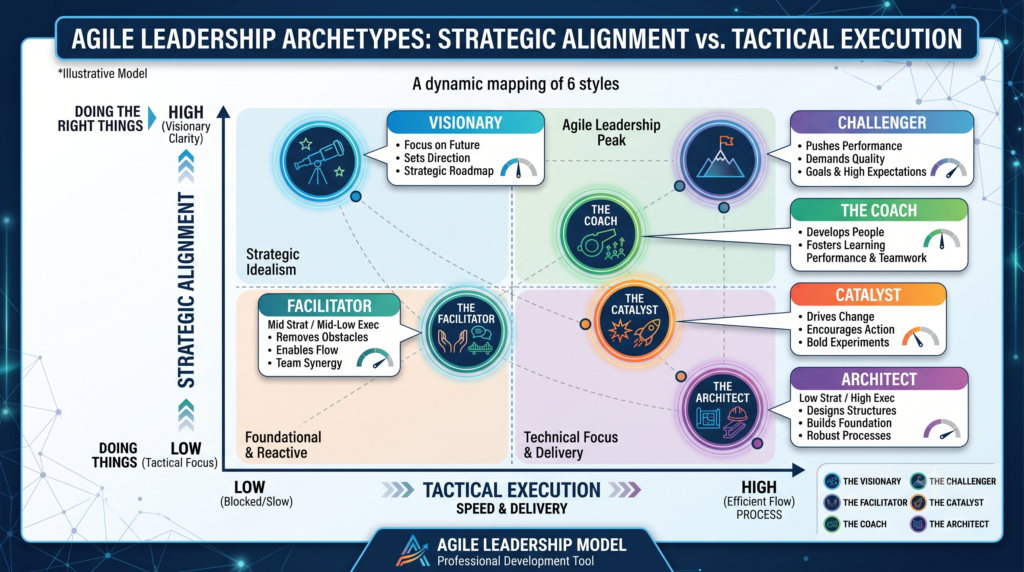
The Agile Leadership Spectrum: Beyond the Passive Facilitator
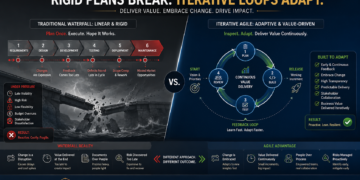
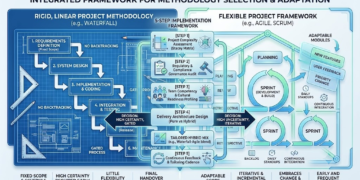
Agile is fundamentally a philosophy, a mindset governed by overarching values, rather than a rigid, unyielding rulebook. Because environments differ across organizations, a successful leader cannot rely on a single, one-size-fits-all management style. True mastery requires deploying adaptive leadership traits tailored to specific project pressures, team dynamics, and stakeholder expectations.
Core Leadership Archetypes in Modern Delivery
The Servant Leader: Focuses primarily on enabling the team, removing delivery friction, and clearing operational blockers. A servant leader puts the team first, facilitating success rather than issuing top-down mandates.
The Adaptive Leader: Recognizes that no single management style works in every scenario. When project pressure spikes or critical bottlenecks emerge, an adaptive leader smoothly pivots between directive decision-making, supportive coaching, and executive alignment.
The Strategic Protector: Acts as a calibrated cushion between senior leadership and the execution team. They absorb external political noise and high-pressure demands without severing the team’s connection to business goals.
The Change Agent: Spearheads digital and operational transformations. They create strategic paths through outdated corporate processes, aligning departments behind new workflows and modernized methodologies.
The Visionary: Articulates the strategic purpose behind every epic and story. A visionary leader ensures that developers do not just build features, but understand precisely how those features drive enterprise revenue and customer value.
The Coach and Facilitator: Concentrates on individual growth, trust-building, and creating self-organizing environments where cross-functional teams solve complex problems autonomously.
Why Mismanaging Perception Kills Projects Faster Than Bad Code
Technical bugs can be patched, but broken trust with key stakeholders is notoriously difficult to repair. When project leaders focus exclusively on internal team execution while ignoring external executive perception, a dangerous misalignment occurs.
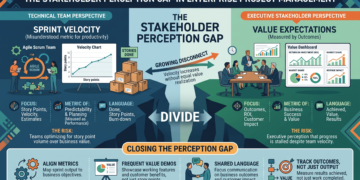
Executives operate on business outcomes, return on investment, and operational predictability. Development teams operate on story points, technical architecture, and sprint capacity. The servant leader serves as the crucial translator between these two worlds.
If a leader insulates the development team so aggressively that senior leadership feels disconnected from project progress, stakeholders instinctively grow anxious. Anxiety breeds micromanagement. Executives begin demanding emergency status meetings, questioning team capability, and pushing for last-minute scope changes.
When servant leaders fail to manage stakeholder expectations proactively, they invite political intervention that demoralizes the team and derails project delivery.
The "Soft and Firm" Framework: Balancing Cushioning with Transparency
To prevent stakeholder friction from undermining project success, servant leaders must balance team protection with extreme operational transparency. This delicate balance can be understood through the visual of flying a kite.
If you pull the kite string too tightly, the line snaps under the intense tension, representing team burnout and toxic pressure. If you let the line go completely loose, the kite plummets to the ground, representing a total lack of strategic direction and executive alignment. A master servant leader knows precisely when to give slack and when to pull the line tight.
Strategic Protection vs. Passive Shielding
| Leadership Dimension | Naïve Shielding (Passive Management) | Strategic Servant Leadership |
| Stakeholder Alignment | Hides executive friction from the team entirely, creating a false sense of security. | Translates high-level business pressure into clear, context-rich delivery priorities. |
| Status Transparency | Relies on manual, static status reports that conceal emerging risks until deadline day. | Deploys real-time Information Radiators that expose project reality openly. |
| Expectation Management | Agrees to all stakeholder scope additions verbally without assessing team capacity. | Conducts formal stakeholder mapping to establish realistic delivery baselines. |
| Accountability & Morale | Excuses missed commitments to preserve temporary team comfort. | Uses “Soft and Firm” coaching: empathetic on personal challenges, firm on delivery standards. |
| Blocker Resolution | Escalates every minor friction point directly to senior executive management. | Empowers internal self-organization while facilitating targeted executive decisions. |
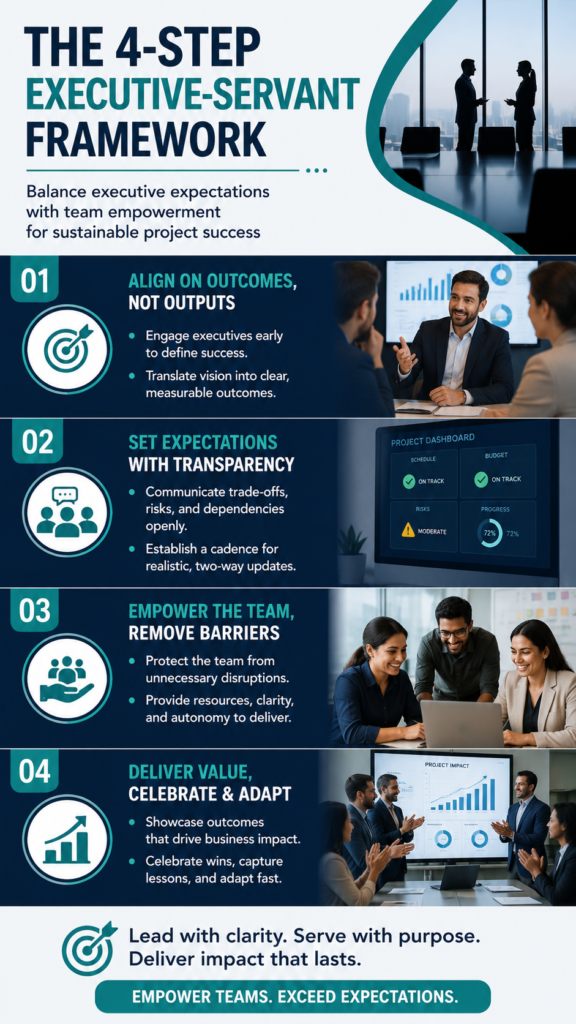
Step-by-Step Implementation Framework for Project Managers
Step 1: Execute Dynamic Stakeholder Power and Interest Mapping
Before sprint planning begins, map out every project stakeholder across two primary dimensions: influence power and business interest. Categorize them into clear action buckets:
High Power, High Interest: Require close, continuous partnership and active expectation management.
High Power, Low Interest: Require concise, high-level business outcome updates to keep them satisfied without overloading their schedules.
Low Power, High Interest: Require transparent operational reporting to maintain trust and enthusiasm.
Step 2: Deploy Public Information Radiators
Eliminate secretive status reporting. Establish automated, highly visible dashboards that broadcast real-time project metrics across the enterprise:
Burnup and Burndown Charts: Display actual progress against release baselines visually.
Cumulative Flow Diagrams (CFD): Highlight operational bottlenecks and work-in-progress (WIP) limits before they delay milestones.
Big Visible Charts (BVC): Position key roadmaps and release goals where stakeholders can review progress independently at any time.
Step 3: Apply the “Soft and Firm” Interpersonal Principle When team members encounter performance obstacles or miss commitments, avoid extreme reactions. Be soft on the individual, but firm on the delivery expectations:
Conduct immediate one-on-one coaching to isolate the root cause of delay.
Determine whether the issue is environmental, technical, or behavioral.
Establish transparent follow-up mechanisms, ensuring the individual understands how their output impacts total team delivery.
Step 4: Practice Continuous Context Feeding
During daily stand-ups and sprint refinements, systematically connect tactical user stories to business impact. Regularly communicate the repercussions of scope shifts to senior stakeholders, ensuring everyone understands the tradeoff between adding new features and maintaining launch dates.
From Delivery Chaos to Elite Strategic Leadership
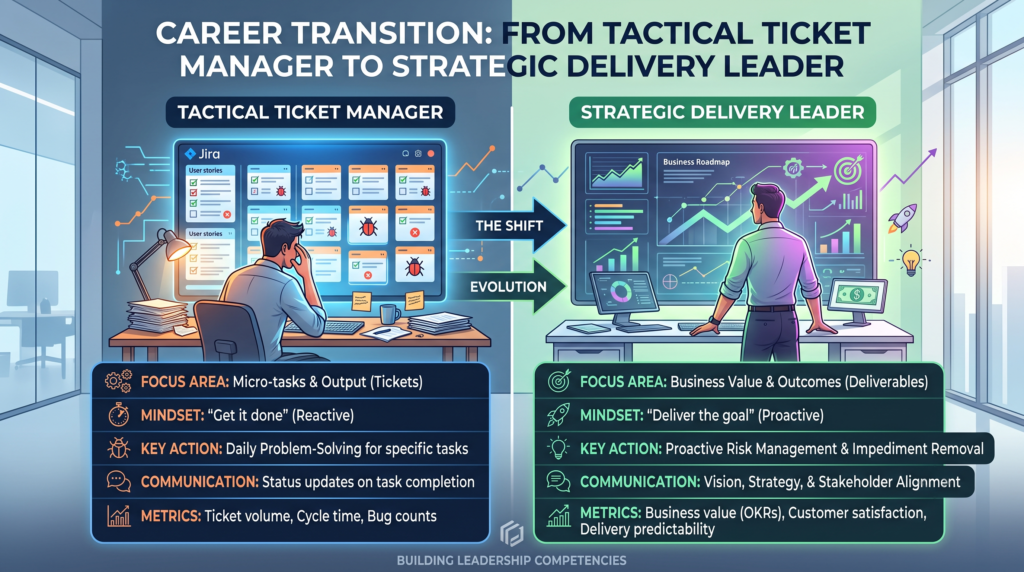
Mastering servant leadership within complex corporate environments transforms your professional reality.
Imagine stepping into your workplace where release dates are no longer accompanied by panic, fire drills, or finger-pointing. Your engineering teams operate with quiet confidence, completely clear on their daily priorities because they are protected from political interference. Simultaneously, executive stakeholders act as enthusiastic champions of your project because they feel informed, respected, and aligned at every phase of the delivery lifecycle.
When you master the art of managing stakeholder perception through strategic servant leadership, your standing in the organization shifts dramatically:
You cease to be viewed as a tactical project administrator who simply moves tickets across a board.
You become recognized as an indispensable strategic delivery partner capable of steering high-stakes enterprise initiatives to success.
You unlock accelerated career progression, moving seamlessly from managing individual projects to leading complex portfolios, organizational transformations, and executive business units.
Learning project management the right way means understanding that frameworks like Scrum, Kanban, and SAFe are merely tools. The true differentiator of an elite project leader lies in combining technical execution with human psychology, stakeholder alignment, and adaptive leadership.
Elevate Your Project Leadership Strategy
Predictable project delivery is never an accident. It is the direct result of intentional leadership, adaptive frameworks, and disciplined alignment between execution and stakeholder perception. By abandoning passive management myths and adopting strategic servant leadership, you insulate your initiatives from corporate disruption and establish a track record of consistent success.
If you are ready to stop guessing, move up the corporate ladder, and learn project management the right way, reach out to Skillsetify. We do not just teach frameworks: we show you your exact career growth trajectory.