Overcoming Cognitive Friction in Agile Estimation through Relative Sizing
The engineering lead and senior database architect are locked in a heated debate over whether building an automated authentication endpoint will take 14 hours or 18 hours. The rest of the cross-functional team is staring blankly at their screens, mentally checked out, paralyzed by decision fatigue. The project manager attempts to mediate by asking for a precise breakdown of every line of code, but the finer the detail requested, the more uncertain the estimates become.
This nightmare scenario is a weekly reality for thousands of B2B project teams. Organizations routinely collapse under the weight of a fundamental corporate myth: the belief that estimating complex software development in absolute hours yields higher accuracy and better predictability.
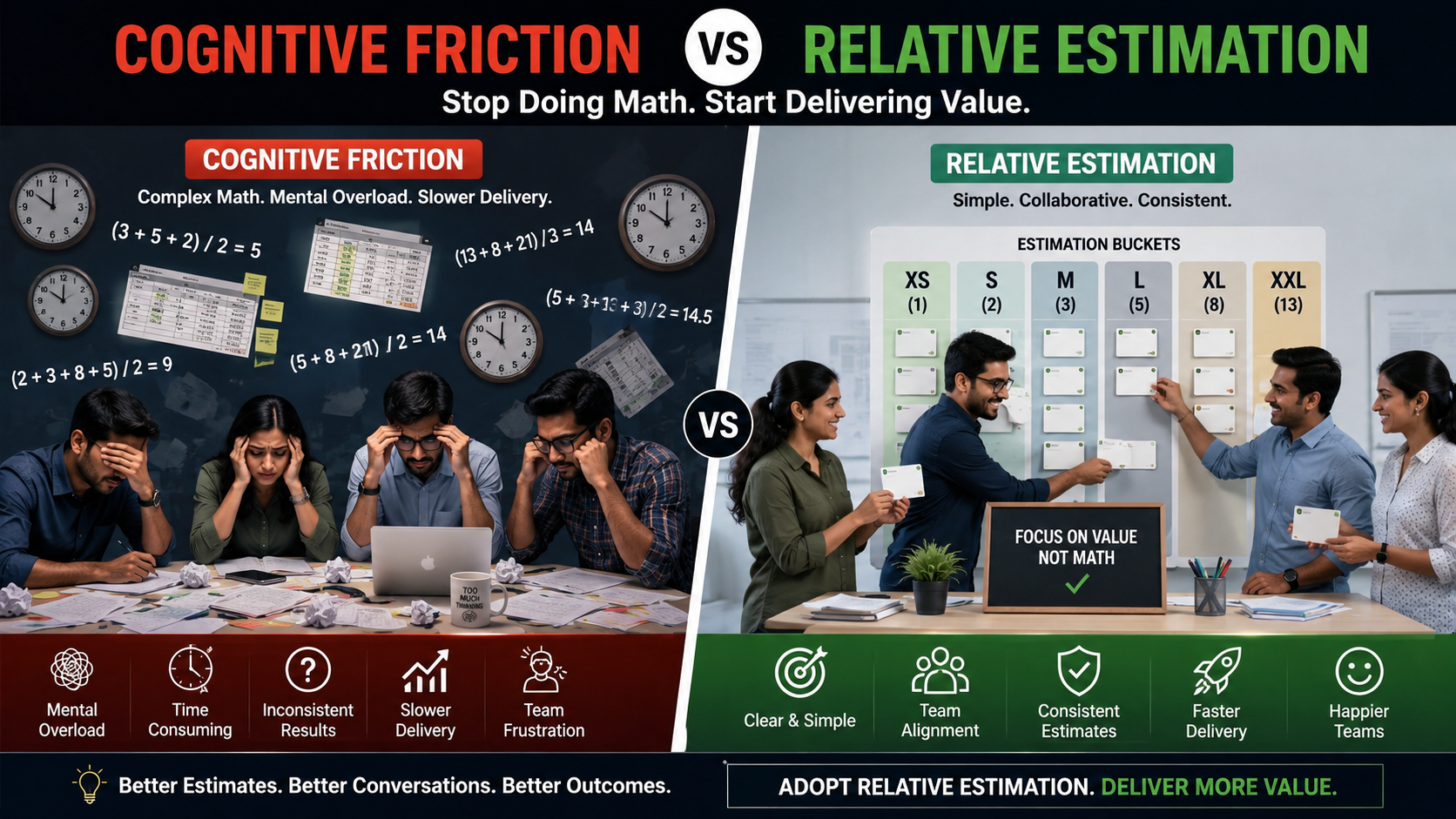
In reality, attempting to calculate absolute hours for abstract, non-linear knowledge work creates massive cognitive friction. It introduces a false sense of precision, drains engineering energy, and transforms sprint planning from a strategic alignment session into an exhausting marathon of guessing games.
What is Cognitive Friction in Project Estimation?
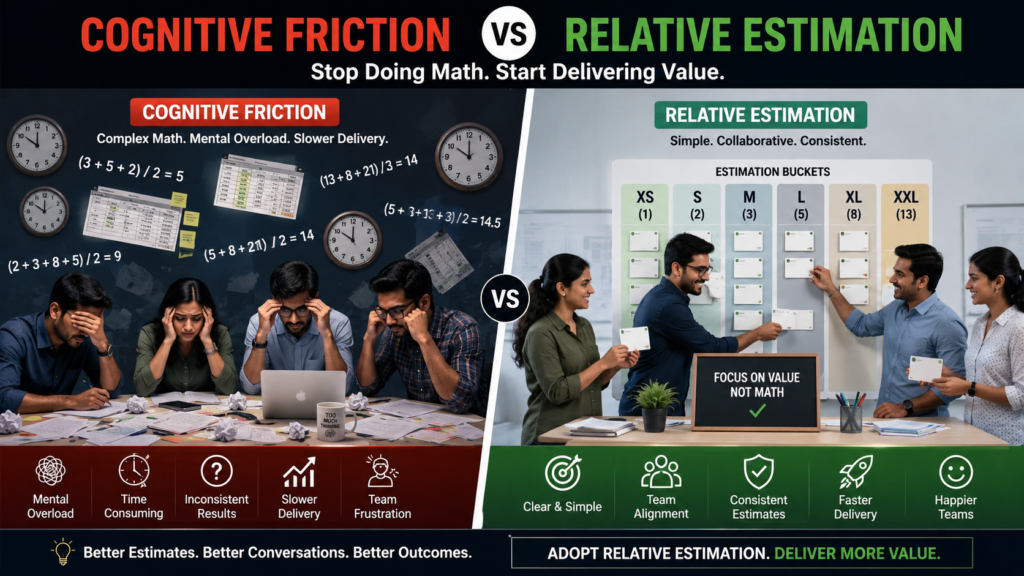
In cognitive psychology and project management, cognitive friction refers to the mental overhead and decision fatigue experienced when the human brain attempts to process complex, multi-variable tasks using an ill-suited framework.
When project managers force software developers to estimate work in absolute units like hours or days, they are asking the brain to perform an unnatural calculation. Software engineering involves unknown dependencies, varying skill levels, testing edge cases, and unexpected architectural constraints. Forcing an engineer to synthesize all those volatile factors into a single linear metric (e.g., “This will take exactly 11.5 hours”) imposes an immense cognitive load. The mind resists, debate stalls, and team morale plummets.
The Foundations of Relative Estimation: Why the Brain Prefers Comparison
Human cognition is naturally wired for relative comparison rather than absolute measurement.
Consider an intuitive analogy: if someone holds up a pen and asks, “Is this pen large or small?”, the question is practically meaningless without context. Large or small relative to what? However, if you place two pens side by side, your brain instantly recognizes which one is taller and by roughly how much. Similarly, evaluating two dogs of the same breed can make it difficult to discern subtle size differences, but comparing a Doberman to a Pomeranian instantly establishes an obvious, relative scale.
Relative estimation leverages this innate brain capability in software and product development. Instead of asking engineers to forecast exact timelines, relative estimation asks them to compare a new user story against an established baseline: Is this task larger, smaller, or roughly equivalent to our reference point?
Minimizing Fatigue through Structured Numerical Groupings
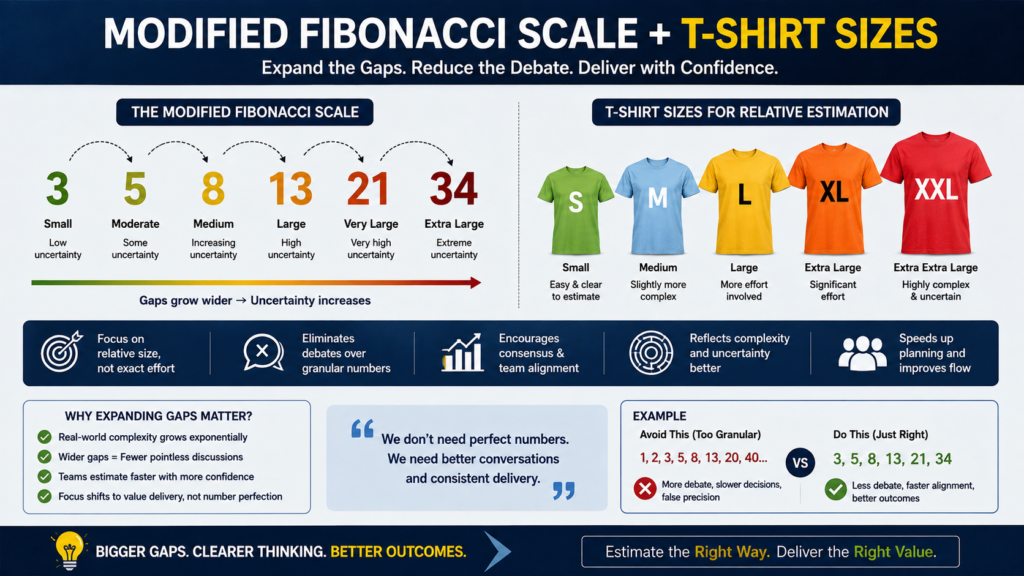
To systematically eliminate estimation fatigue, high-performing B2B organizations abandon linear number scales (1, 2, 3, 4, 5, 6, 7…) in favor of structured numerical groupings, most notably the modified Fibonacci sequence (3, 5, 8, 13, 21, 34).
Why are structured, non-linear numerical groupings so powerful at reducing cognitive friction?
Elimination of Granular Debates: In a linear 1 to 10 scale, teams waste endless minutes debating whether a user story is a 6 or a 7. In a Fibonacci scale, the choices skip from 5 to 8. The gap forces the brain to make a categorical jump rather than splitting hairs over minor nuances.
Proportional Reflection of Uncertainty: As a task grows in size, its inherent risk and complexity grow exponentially, not linearly. A jump from 13 to 21 story points reflects the reality that larger work carries vastly more unknown variables.
Reduced Cognitive Load: Limiting options to a defined set of exponential numbers drastically reduces decision paralysis, allowing teams to size items in seconds rather than minutes.
The Implementation Framework for B2B Project Managers
Transitioning your organization from absolute hour estimation to structured relative sizing requires a disciplined operational framework. Here is the step-by-step masterclass approach:
Step 1: Establish a Permanent Baseline Reference Anchor
Before estimating new backlog items, your team must agree on a baseline reference story.
Select a fully understood, medium-complexity user story from your backlog (e.g., building a standard user dashboard report).
Assign this anchor story a benchmark value, such as 8 story points.
Crucial Rule: Freeze this reference anchor for the entirety of the project lifecycle. Every future user story will be measured relative to this anchor
Step 2: Adopt Mapped Numerical Groupings
Whether your team prefers numerical story points or visual T-Shirt sizing (Small, Medium, Large, Extra Large, Double XL), ensure that categorical groupings are mapped to underlying Fibonacci values on the back end. This ensures that visual simplicity during estimation still converts into mathematical metrics required for capacity tracking.
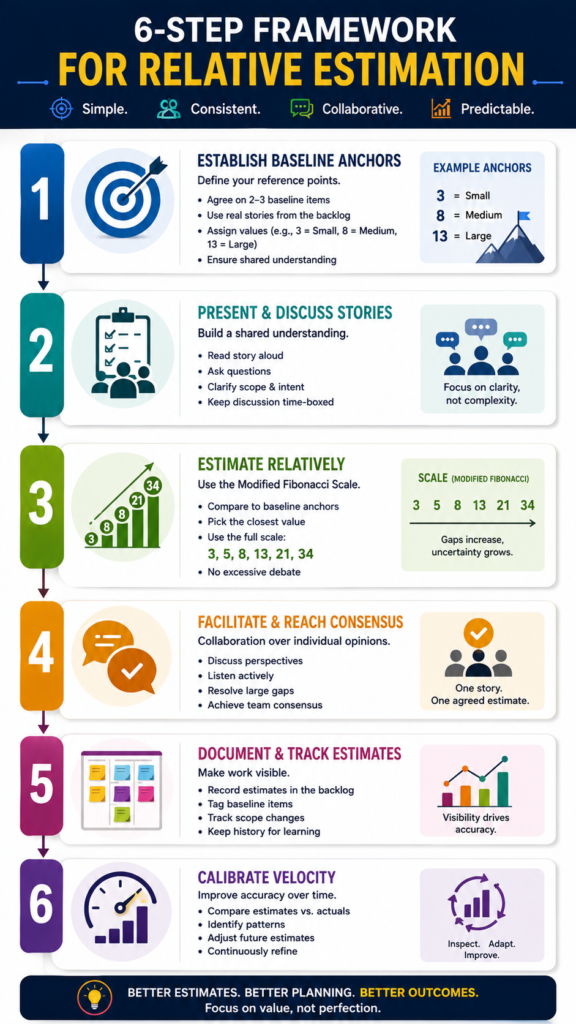
Step 3: Run Blind Consensus Protocols (Planning Poker)
To eliminate anchor bias and senior title influence, execute consensus voting using secret selection techniques such as Planning Poker:
The Product Owner reads the user story requirements clearly.
Each team member independently selects a Fibonacci card representing their estimate without revealing it.
All cards are flipped simultaneously to expose the team’s collective thinking.
If estimates diverge significantly (e.g., one engineer votes 3 while another votes 21), invite the highest and lowest voters to explain their reasoning. The low voter may see an existing code template that reduces effort, while the high voter may spot an unstated API dependency.
Step 4: Validate Requirement Clarity via "Fist of Five"
If variance persists after discussion, gauge team understanding before re-voting by using the “Fist of Five” consensus tool:
Ask team members to hold up 1 to 5 fingers indicating their level of clarity regarding the requirements.
If ratings are low (1 or 2 fingers), the Product Owner must clarify scope, technical dependencies, or acceptance criteria before re-estimating.
Once clarity reaches a 4 or 5 across the team, conduct a final blind re-estimate to lock in consensus.
Step 5: Prioritize Complex Backlogs with Dot Voting
When evaluating dozens of user stories without rigid technical prerequisites, use Dot Voting to establish consensus priorities without cognitive overload:
Distribute a set allocation of virtual or physical “dots” (e.g., 100 points or tokens) secretly to each team member.
Team members allocate their dots across backlog items based on perceived impact and urgency.
Sorting the stories in descending order of accumulated dots reveals the team’s organic consensus on delivery priority, free from loud-voice bias.
Step 6: Calibrate True Team Velocity
Never expect your team’s velocity (the number of story points completed per sprint) to be fixed from day one.
In Sprint 1, the team commits to a reasonable estimation total (e.g., 28 story points).
Track actual completed points versus committed points over 2 to 3 sprint cycles.
By Sprint 3 or 4, the team’s true velocity stabilizes into a predictable baseline (e.g., 30 points consistently delivered per two-week sprint).
The Professional Transformation
From Estimation Chaos to Elite Delivery
Imagine stepping into your sprint planning sessions where energy is high, consensus is reached in minutes, and estimation fatigue is completely banished.
When you replace absolute hourly guessing with structured relative estimation, your engineering team shifts from burnout and defensive estimates to high-confidence, predictable output. Sprint planning transitions from a grueling 4-hour negotiation into a crisp, 45-minute strategic alignment session. Scope creep shrinks because requirements are rigorously vetted through structured consensus tools like Planning Poker and Fist of Five.
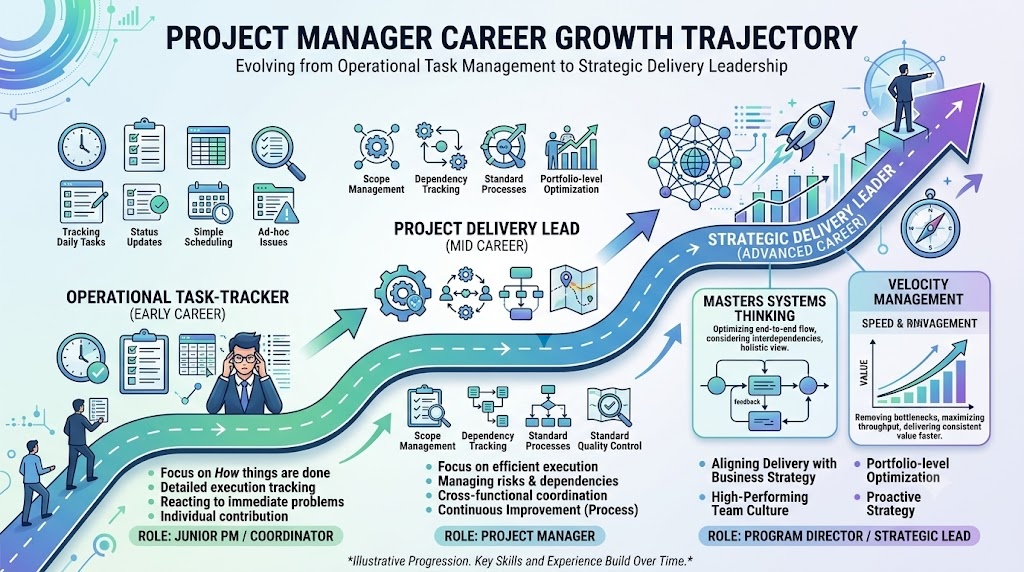
For an ambitious B2B project manager, mastering these methodologies is the catalyst for executive career advancement. C-suite executives and VP-level leaders do not promote project managers who act as glorified task-trackers nagging developers for hourly updates. They promote strategic delivery leaders who know how to build friction-free delivery systems, protect engineering bandwidth, and provide reliable, data-backed forecasting.
Learning project management the right way means understanding the human psychology behind team performance. When you demonstrate the ability to eliminate cognitive friction, stabilize team velocity, and scale output predictably, you immediately position yourself for senior management and director trajectories.
Master Strategic Delivery with Skillsetify
Eliminating cognitive friction through relative estimation is not just a tactical tweak: it is a fundamental shift in how modern B2B projects are governed. By replacing arbitrary hour estimates with structured numerical groupings, clear baseline anchors, and collaborative consensus tools, you unlock true team velocity while protecting your engineers from decision fatigue.
If you are ready to stop guessing, move up the corporate ladder, and learn project management the right way, reach out to Skillsetify. We do not just teach frameworks: we show you your exact career growth trajectory.