On the virtual whiteboard, sticky notes read: “Deployment pipeline failed again,” “Requirements were unclear,” and “Too many context switches during execution.”
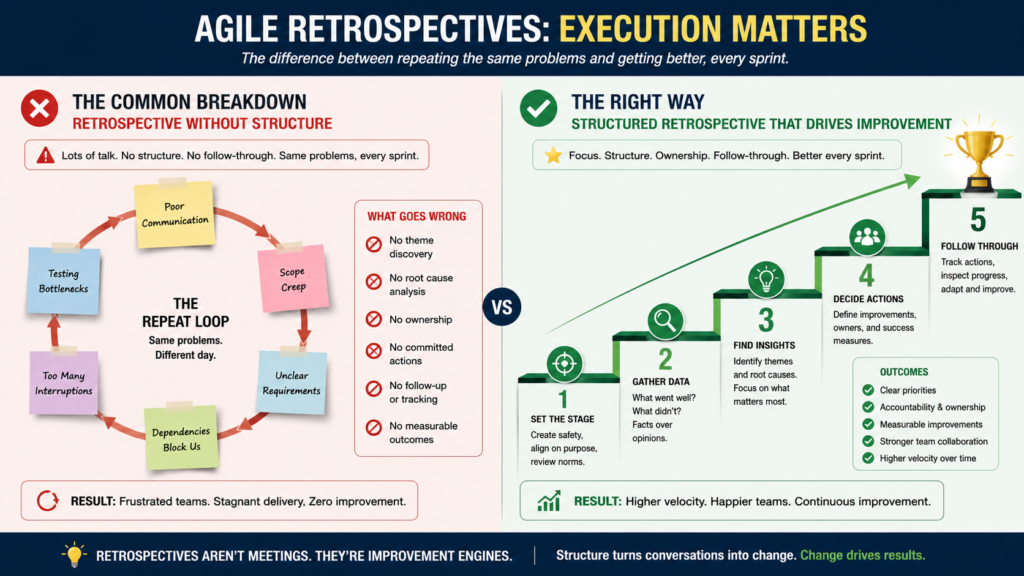
You scroll back to look at the retrospective boards from three months ago. The sticky notes are identical.
Your team is trapped in an operational groundhog day. Despite running two-week sprints, holding daily stand-ups, and rigorously estimating story points, velocity has plateaued. Defect rates in production are rising, scope creep is rampant, and burnout is creeping into every team call.
This scenario plays out across thousands of enterprise engineering organizations every single day. Project managers and Scrum Masters find themselves playing firefighter, constantly reacting to the same delivery bottlenecks without ever fixing the underlying system.
The Common Corporate Myth: Many executives and project managers believe that adopting Agile methodologies inherently guarantees continuous improvement.
The reality is far harsher. Frameworks like Scrum, Kanban, or SAFe provide cadence, visibility, and structure for feature delivery. However, they do not automatically optimize quality or refine execution mechanics. Simply holding a retrospective every two weeks does not mean your organization is getting better. Without a disciplined, scientific feedback engine powering your delivery, Agile frameworks do not cure operational chaos: they merely accelerate it.
Decoupling the Hype: What Plan-Do-Check-Act (PDCA) Really Means in Modern PM
To break the cycle of repetitive delivery failures, elite project management leaders turn to a foundational quality control paradigm: the Plan-Do-Check-Act (PDCA) cycle, also known as the Deming Cycle.
Originally popularized by W. Edwards Deming for industrial manufacturing precision, PDCA is not an outdated legacy tool, nor is it a substitute for Agile. It is the missing execution engine that transforms retrospectives from passive venting sessions into systematic operational upgrades.
The 4 Mechanics of PDCA in Agile Execution
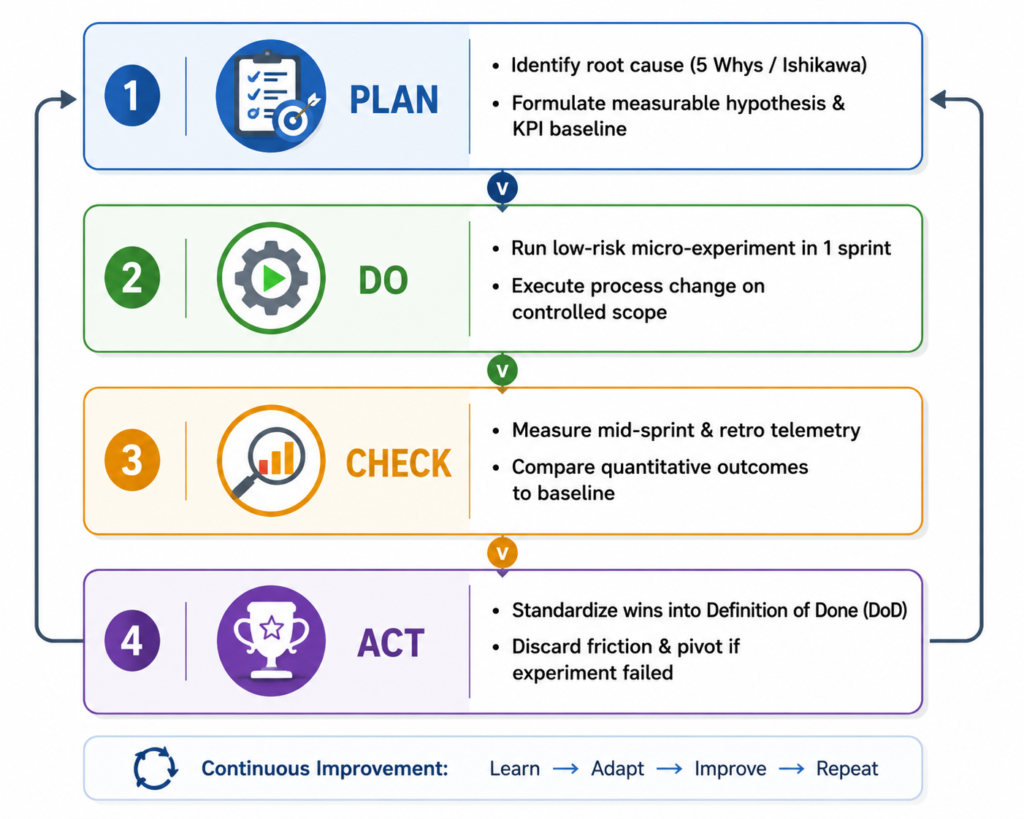
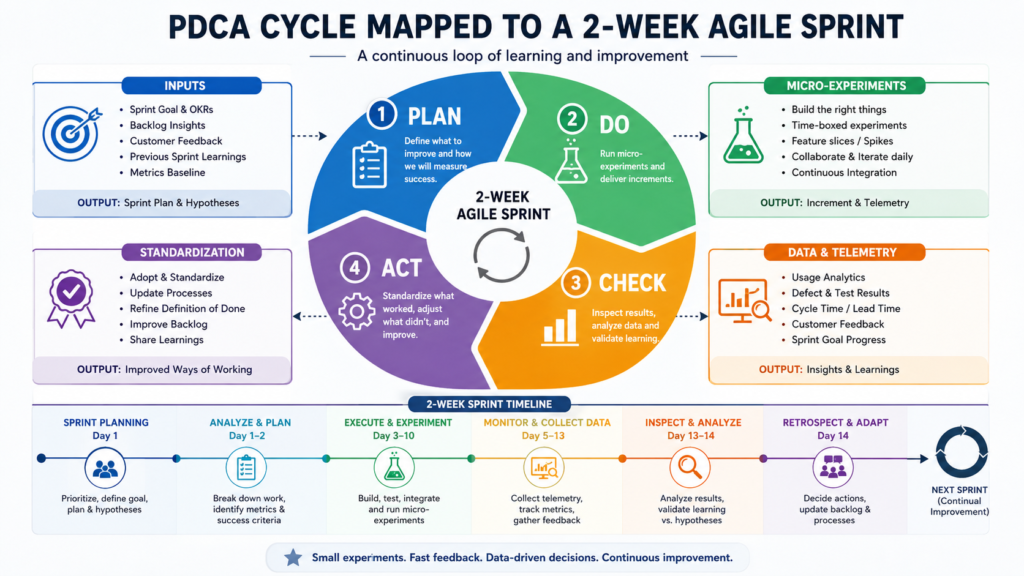
When embedded directly into the iterative rhythm of Agile sprints, the four stages of PDCA function as a continuous scientific loop for team performance.
Plan: Identify the root cause of an execution bottleneck or defect pattern. Instead of setting vague goals like “we need better requirements,” formulate a precise hypothesis tied to a measurable metric. For instance: “If we mandate acceptance criteria in the Definition of Ready before sprint commitment, then mid-sprint scope churn will decrease by 25%.”
Do: Execute the plan on a controlled, small scale. Rather than forcing a sweeping policy across the entire department, run a low-risk micro-experiment during a single two-week iteration with one dedicated sub-team.
Check: Measure results quantitatively during the Sprint Review and Retrospective. Compare post-experiment telemetry against historical baselines. Did scope churn drop by 25%? Did cycle time increase or decrease?
Act: Take decisive operational action based on empirical data. If the experiment succeeded, institutionalize the practice into standard operating procedures and scale it across teams. If it failed, document the insights, discard the process friction, and pivot to the next hypothesis.
The 5-Step Organizational Execution Framework
To transition your team from reactive firefighting to predictable, high-quality delivery, implement this five-step PDCA execution blueprint within your project management workflow.
Step 1: Baseline Metrics and Root Cause Analysis
Never launch a process change without a clear quantitative baseline. Track your current lead time, cycle time, defect density, and planned-to-done ratio. When a systemic failure occurs, avoid surface-level fixes. Conduct a structured 5 Whys analysis or build an Ishikawa (Fishbone) diagram to expose the true root operational cause.
Step 2: Micro-Experiment Mapping
Convert your root-cause findings into a clear, testable backlog item. Ensure every process improvement attempt meets three core criteria:
Scope: Reversible and low-risk to overall delivery.
Duration: Contained within 1 to 2 sprint cycles.
Metric: Quantifiable, objective, and time-bound.
Step 3: Mid-Sprint Telemetry and Verification
During daily stand-ups and mid-sprint check-ins, actively track the operational experiment alongside user story progress. Do not wait for the post-sprint retrospective to assess whether a process change is creating unnecessary friction.
Step 4: Standardization or Fast Pivot
When an experiment yields positive data, incorporate it immediately into your Definition of Done (DoD), Definition of Ready (DoR), or team working agreements. If the experiment fails, formally retire the practice. Eliminating ineffective process overhead is just as valuable as introducing successful improvements.
Step 5: Institutionalizing Feedback Loops
Feed operational insights back into both the Product Backlog and Process Backlog. Process Debt must be treated with the same urgency as Technical Debt.
Comparing Execution Frameworks
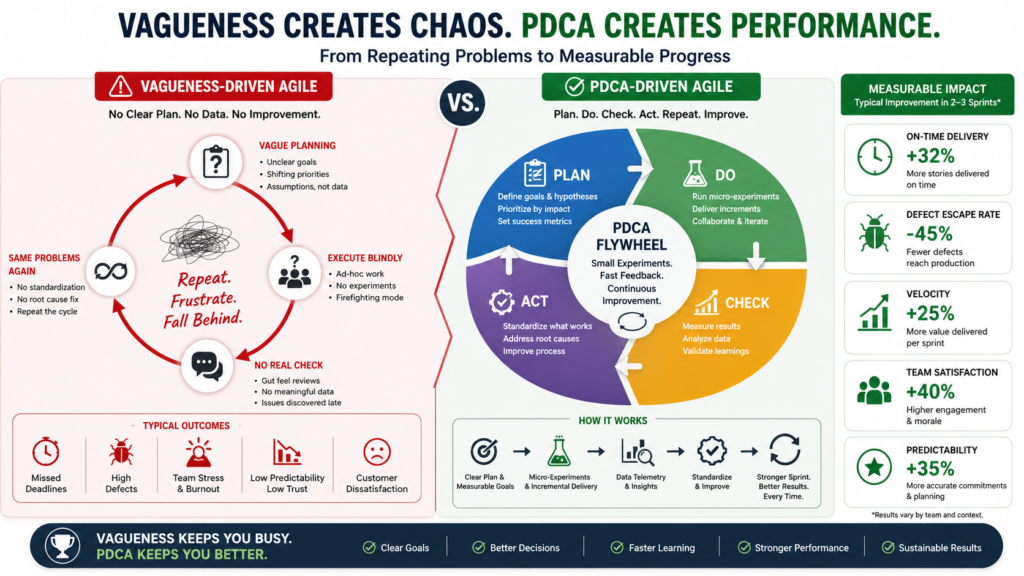
To understand the transformative power of this approach, consider how process management differs between standard Agile practices and a PDCA-driven quality model:
| Operational Dimension | Vagueness-Driven Agile | PDCA-Driven Agile Quality |
| Retrospective Action | Vague intentions (“Communication needs work”) | Quantified experiments (“Implement daily async Slack check-ins”) |
| Quality Assurance | Reactive bug fixes post-release | Systematic root-cause prevention during sprint execution |
| Process Change | Top-down mandates forced across teams | Bottom-up micro-experiments validated with empirical data |
| Performance Metric | Subjective team feeling or velocity hype | Predictable lead time, low defect density, stable throughput |
| Sustainment | Tribal knowledge and forgotten guidelines | Formally updated Definition of Done (DoD) & automated tooling |
Sprint planning sessions run with crisp, data-backed confidence. Your team consistently hits its commit-to-complete ratios. Scope creep is systematically identified and neutralized before it compromises delivery targets. Developers spend their time shipping valuable features rather than wading through urgent production hotfixes.
More importantly, your retrospectives become the most energizing 45 minutes of the sprint. Instead of repeating old complaints, your team reviews concrete data from recent experiments, celebrates operational wins, and selects the next high-value process enhancement.
This is what happens when you master continuous improvement through structured PDCA execution.
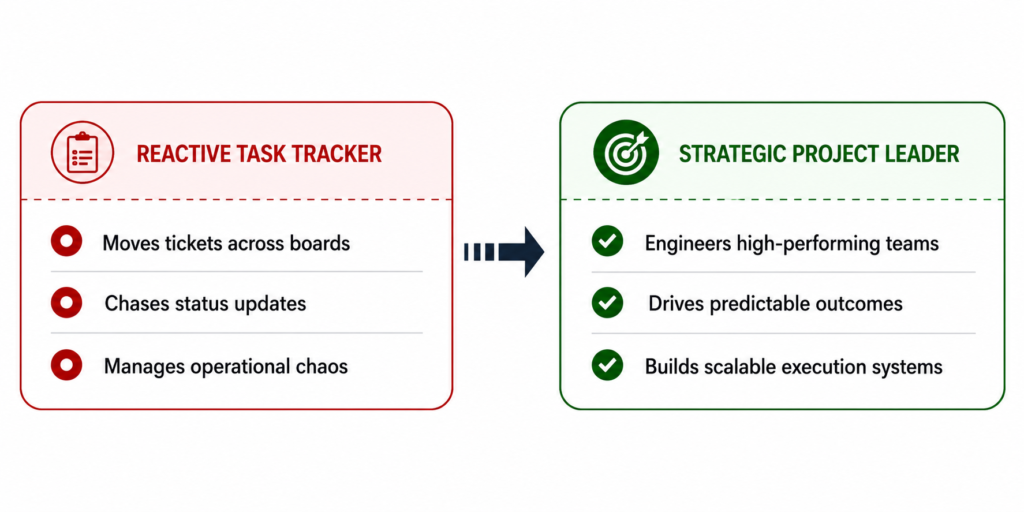
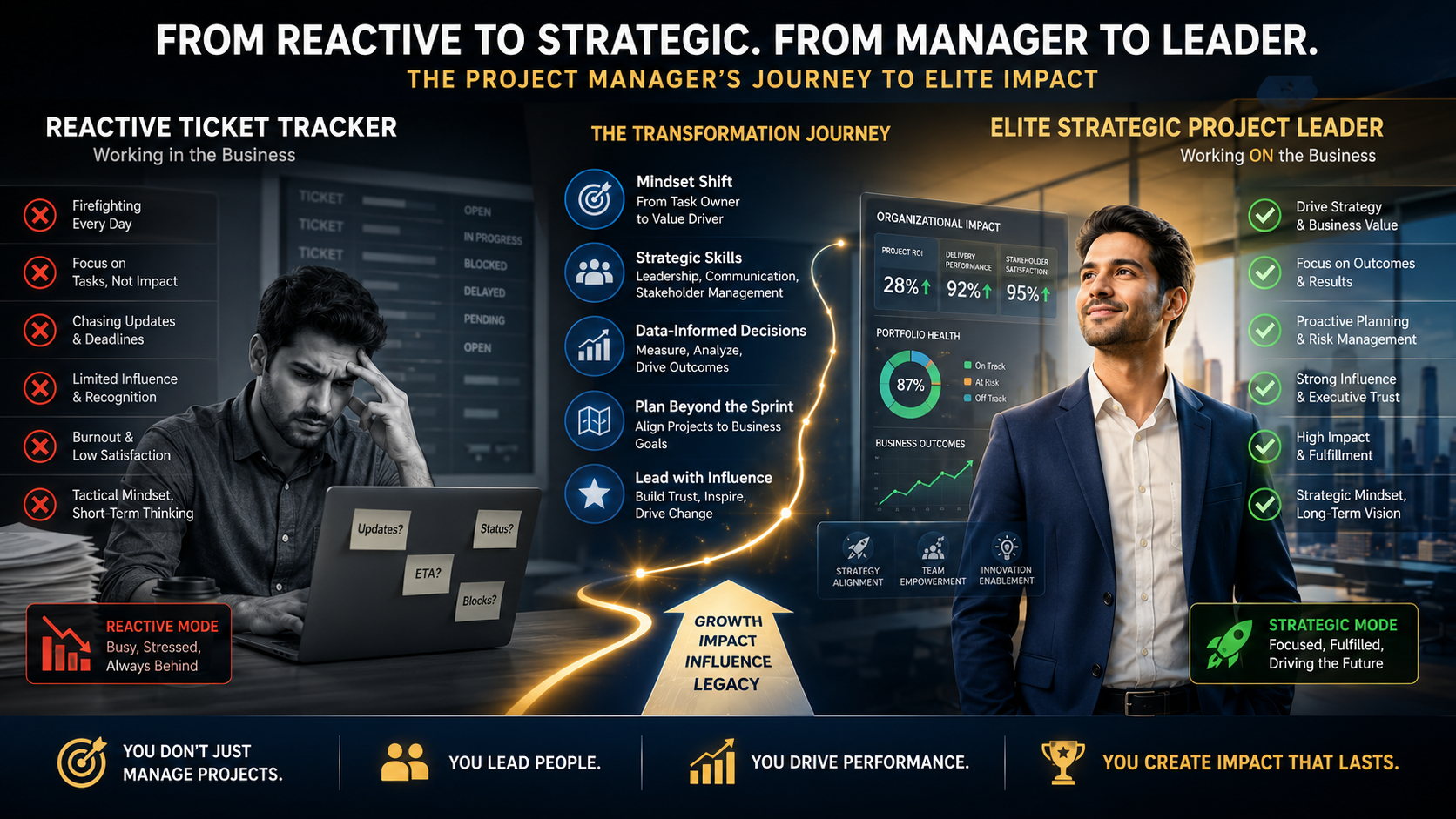
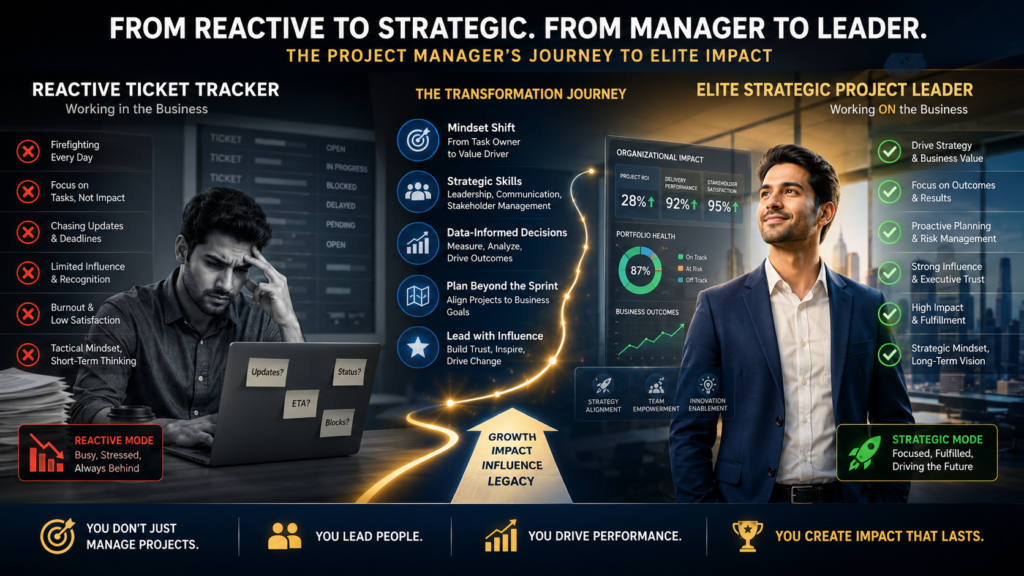
Transitioning from a reactive task-tracker to a strategic project leader changes everything. You stop being the person who merely updates Gantt charts or moves Jira tickets across columns. You become an irreplaceable operational leader capable of engineering high-performing team dynamics, driving predictable business outcomes, and building scalable organizational systems. This level of mastery is what accelerates your career and opens doors to executive project leadership.
Building true operational excellence requires more than memorizing terminology or reading framework guides. It demands deep practical mastery of how quality practices, iterative execution, and strategic governance intersect in real-world corporate environments.
If you are ready to stop guessing, move up the corporate ladder, and learn project management the right way, reach out to Skillsetify. We do not just teach frameworks: we show you your exact career growth trajectory.