Why Iteration Is the Secret to Product Quality
Your team has spent seven months building a complex software suite in isolation. Every specification from the original charter was followed to the exact letter. Yet, during the final dry run, the user flow stumbles, critical edge-case errors pop up, and the executive team realizes the solution solves last year’s operational problems, not today’s business goals.
The post-mortem reveals the core issue: the project attempted to deliver perfection in a single, massive wave without real-world feedback loops.
The corporate ecosystem suffers from a dangerous myth: the belief that iteration is simply a rework protocol for fixing mistakes. Leadership teams often view iterative cycles as evidence of poor initial planning or failure to capture requirements correctly up front.
In modern project management, iteration is not a recovery strategy: iteration is fundamentally about cycling through execution to lock in product quality.
The Core Mechanics of Iterative Delivery
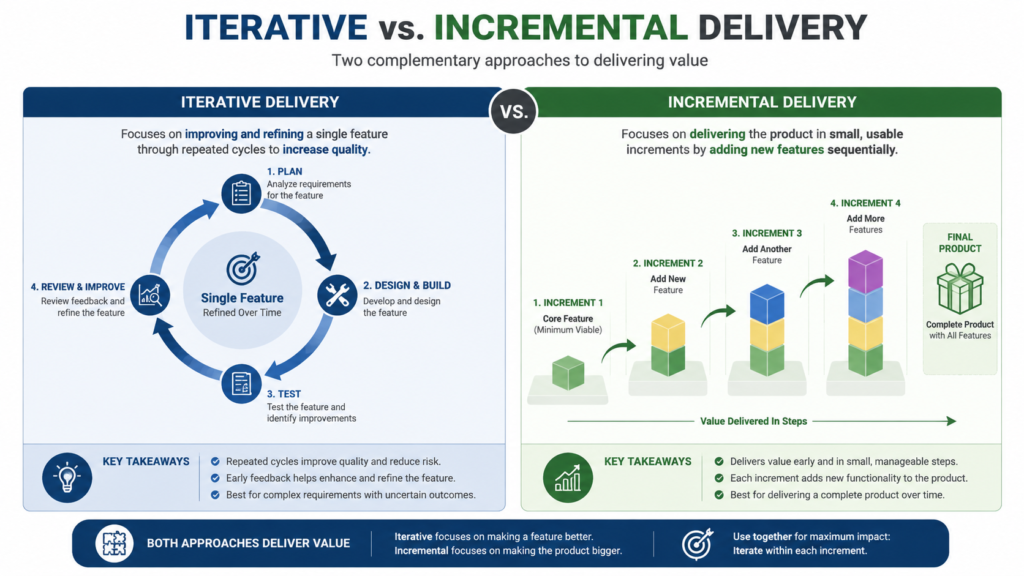
To leverage iteration effectively, enterprise leaders must first separate iterative delivery from incremental delivery. While these concepts are frequently bundled together in project charters, they address two distinct dimensions of execution.
| Dimension | Iterative Execution | Incremental Execution |
|---|---|---|
| Primary Goal | Perfect product quality and refinement | Deliver functional business value early |
| Core Mechanism | Cyclical execution (Evaluate → Create → Test → Refine) | Additive building block additions |
| Product Impact | Transforms rough concepts into polished solutions | Expands total scope with finished features |
| Risk Reduction | Reduces quality, usability, and architecture risks | Reduces time-to-market and delayed feedback risks |
Why Iteration Drives Quality
Quality is rarely a static parameter defined on Day 1. It is a dynamic outcome established through validation, user testing, and real-time execution feedback.
When a project team loops through an iterative cycle, they are executing a controlled hypothesis test. Each pass through the cycle tests technical assumptions, validates user expectations, and identifies edge-case defects long before they cascade into system-wide failure.
Iterative execution improves quality through three primary levers:
Defect Radius Reduction: Errors caught in early iterative loops cost a fraction of what they cost to remediate right before deployment.
Dynamic Requirement Alignment: Requirements continuously align with changing enterprise environments, technical dependencies, and market shifts.
Execution Refinement: Team efficiency increases as the mechanics of testing, building, and evaluating are repeated and optimized.
The Enterprise Quality Iteration Framework (EQIF)
Implementing iteration successfully requires structured discipline, clear boundaries, and predictable cadence. Without structure, iteration devolves into unguided, endless rework
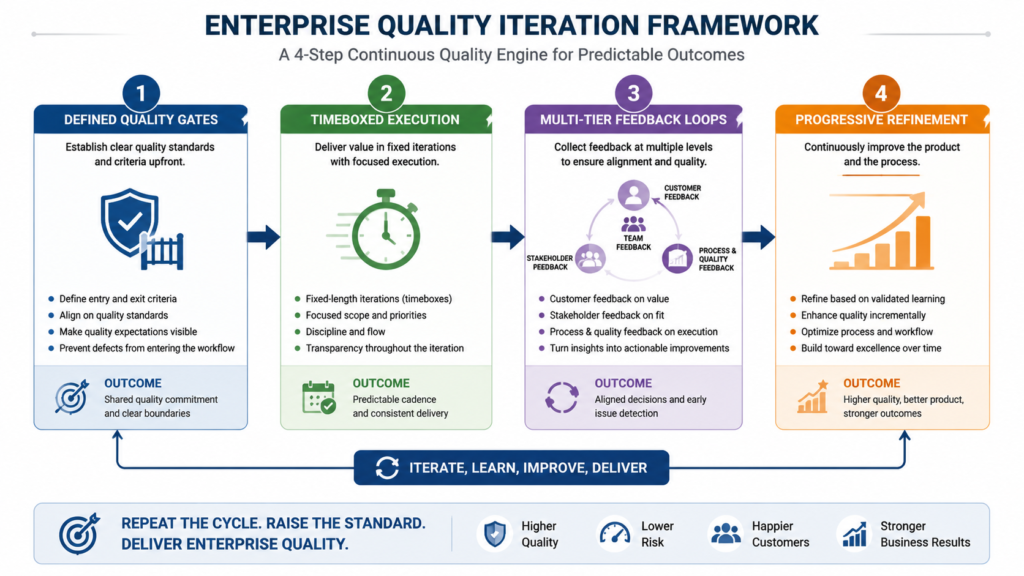
Here is a step-by-step framework to embed quality-focused iteration into your project delivery strategy:
Step 1: Establish Explicit Quality Gates
Before initiating an iteration, establish clear criteria for what constitutes success. Define your Definition of Done (DoD) alongside explicit Quality Metrics.
Defect Tolerance Thresholds: Zero critical/high severity open defects.
Performance Metrics: Automated test coverage benchmarks and load-time targets.
Usability Baselines: User acceptance score thresholds for every functional cycle.
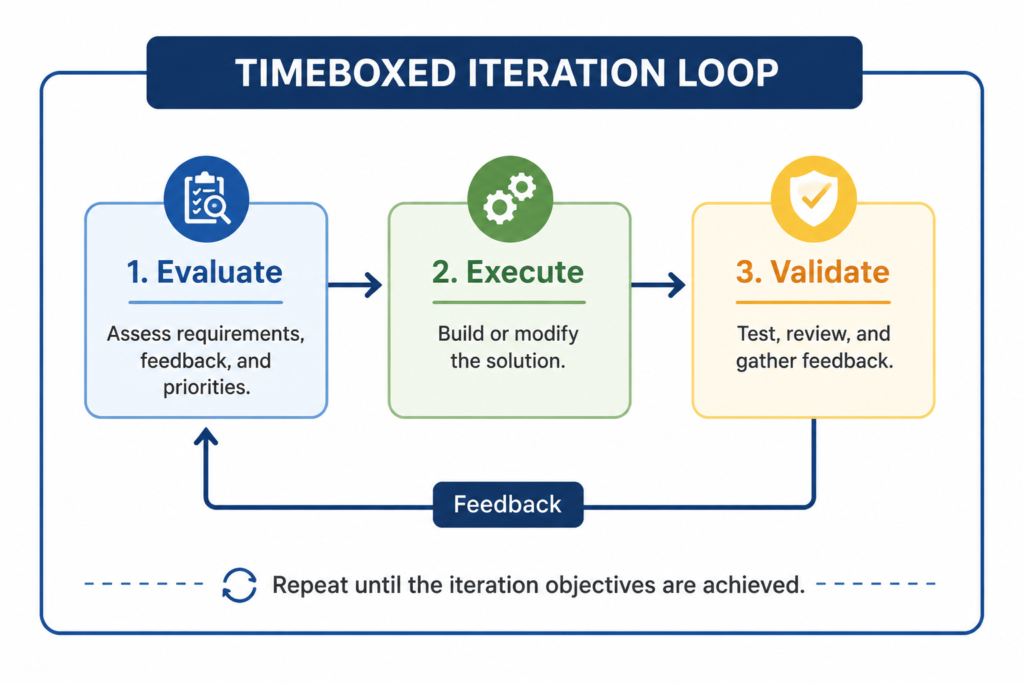
Step 2: Enforce Timeboxed Cycles
Iterations must operate within strict timeboxes (typically two to four weeks). Timeboxing prevents scope creep and forces teams to focus on high-priority refinements rather than gold-plating features.
Step 3: Integrate Multi-Tier Feedback Loops
Quality requires diverse evaluation perspectives. Structure every feedback loop to capture three critical views:
Technical Integrity: Automated integration tests and peer code/architecture reviews.
Operational Usability: Hands-on validation from operational end-users and subject matter experts.
Strategic Value: Business stakeholder review to verify market alignment.
Step 4: Execute Progressive Refinement
Use findings from Step 3 to refine the product backlog. Adjust execution plans based on demonstrated realities rather than theoretical assumptions. High-value enhancements are queued for the next cycle, while low-value requests are discarded.
Moving Beyond Chaos to Predictable Delivery
When enterprise teams embrace iteration as a mechanism for quality rather than a reaction to failure, delivery performance shifts dramatically:
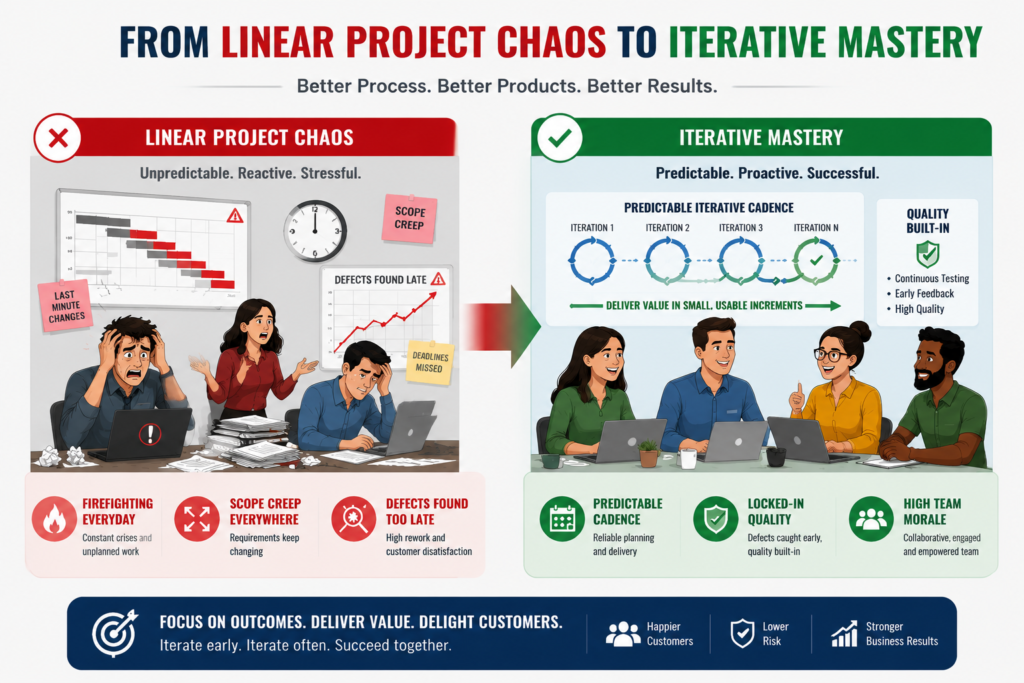
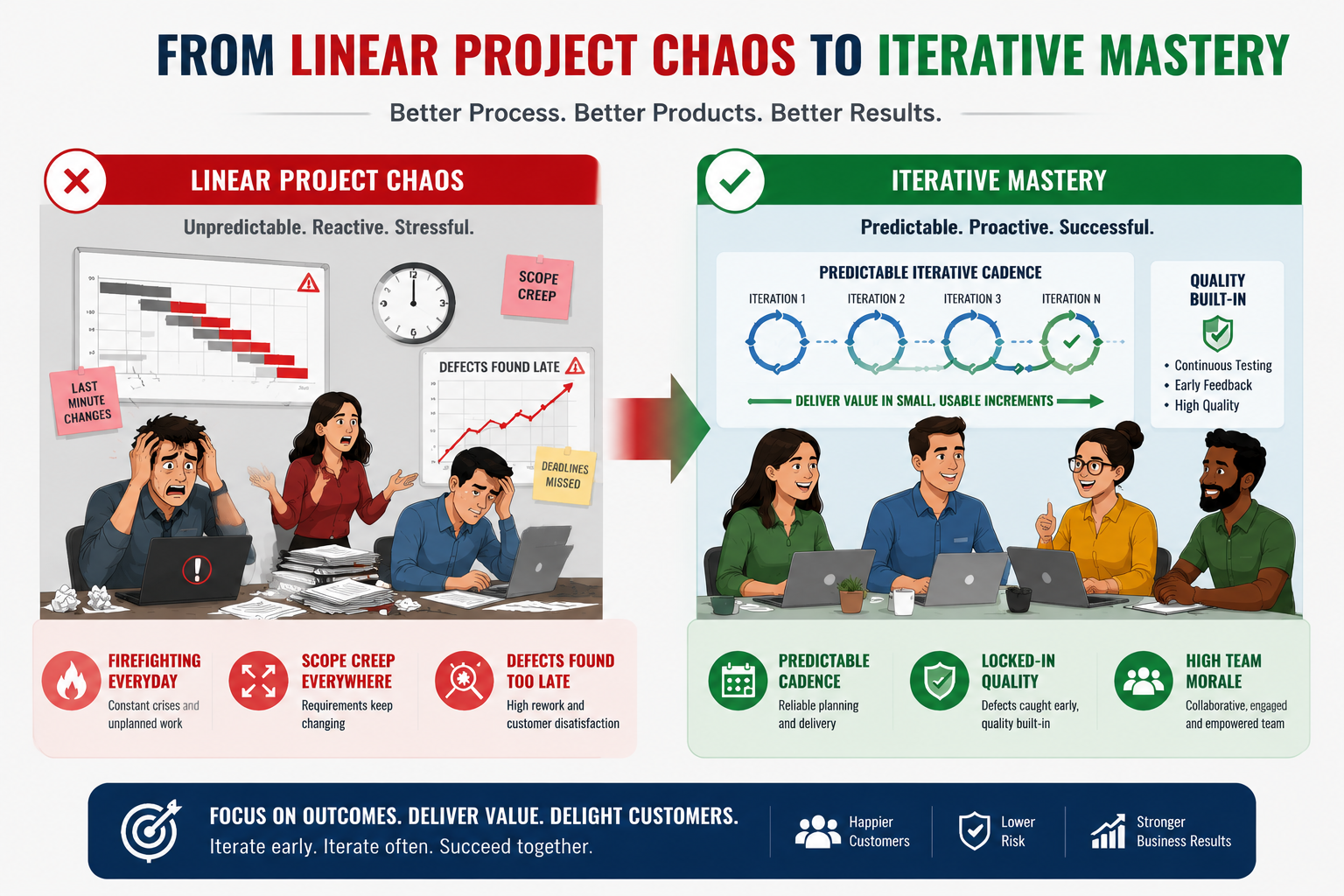
From Firefighting to Predictable Cadence: Instead of discovering catastrophic architecture flaws during late-stage user acceptance testing, teams surface and resolve edge cases every cycle.
From Scope Creep to Strategic Control: Changes are evaluated systematically at iteration boundaries rather than injected arbitrarily mid-stream.
From Burnout to High-Performance Autonomy: Cross-functional, self-organizing teams gain ownership over their quality standards, eliminating the demoralizing crunch periods typical of traditional waterfall handoffs.
Mastering this approach transforms how project managers navigate complex corporate environments. Moving beyond rigid, linear plans positions professionals as strategic value drivers capable of steering high-stakes initiatives toward consistent success.
Master Modern Delivery with Skillsetify
If you are ready to stop guessing, move up the corporate ladder, and learn project management the right way, reach out to Skillsetify. We do not just teach frameworks: we show you your exact career growth trajectory.
Partner with Skillsetify today to elevate your execution capability, lead complex delivery initiatives with confidence, and build an exceptional trajectory in enterprise project leadership.