How Standardized Product Vision Statements Eliminate Scope Creep at the Top of the Agile Planning Onion
It is 9:00 AM on a Monday, and the sprint planning meeting has devolved into total anarchy. The engineering team is visibly exhausted, having spent the previous quarter delivering a suite of complex features that executive leadership has suddenly declared obsolete. Millions of dollars in capital expenditure have vanished, engineering velocity has hit an all-time low, and team morale is severely fractured.
When projects fail in this manner, post-mortems usually point fingers at sprint execution: poor user story writing, inaccurate estimation, or inadequate daily standup cadence. However, these diagnoses miss the actual root cause. The engineering team did not fail at execution; they executed perfectly on a strategy that was fundamentally flawed from day one. They were building blindly without an immutable strategic anchor.
This scenario highlights a widespread corporate myth: that a Product Vision Statement is merely executive fluff, a marketing tagline designed for investor slide decks or corporate career pages.
In enterprise environments, treating product vision as an afterthought is a catastrophic error. A Product Vision Statement is not a superficial marketing exercise. It represents the outermost, most governing layer of the Agile Planning Onion. Without an explicit, standardized vision statement, product roadmaps degenerate into chaotic wish lists, release planning becomes an exercise in guessing, and iterations decay into feature factories that build non-essential software at high speed.
Contextualizing Vision Within the Agile Planning Onion
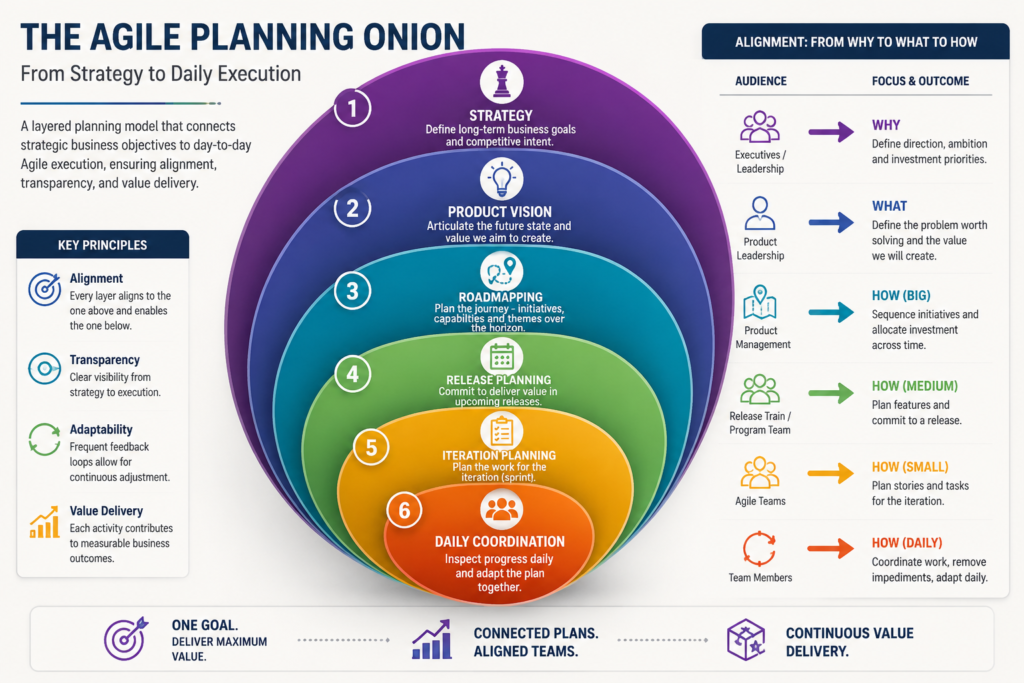
To understand why product vision statements fail in corporate settings, one must first analyze where planning originates. Agile delivery is structured like an onion, composed of nested layers of progressive elaboration.
Layer 1: Vision (Outermost Layer): Defines the long-term destination, strategic context, target audience, and core differentiation.
Layer 2: Roadmap: Translates the vision into high-level strategic milestones across a multi-quarter or multi-year timeline.
Layer 3: Release: Groups functional capabilities into deployable increments that deliver discrete business value.
Layer 4: Iteration (Sprint): Breaks release capabilities into actionable user stories executed by the delivery team over short cycles.
Layer 5: Daily Standup (Innermost Layer): Tracks tactical execution and removes daily blockers
When project managers jump straight into building product backlogs and managing sprints without anchoring the top layer of the planning onion, every downstream layer collapses. Planning without vision is simply executing without vector direction.
The Four Pillars of an Authoritative Product Vision Statement
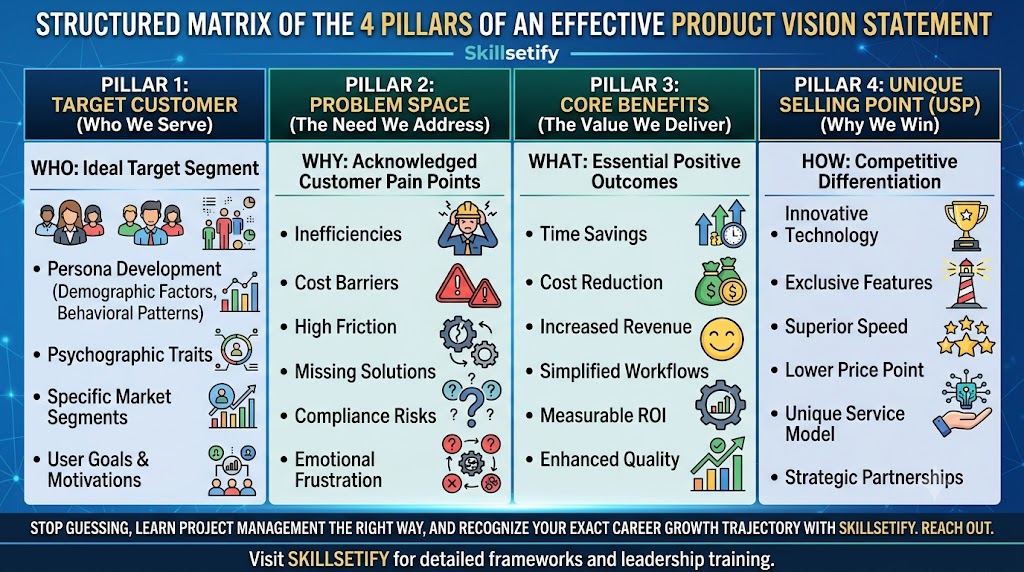
A standardized product vision statement must serve as an active filter for decision-making. To achieve this, it must clearly define four non-negotiable structural pillars:
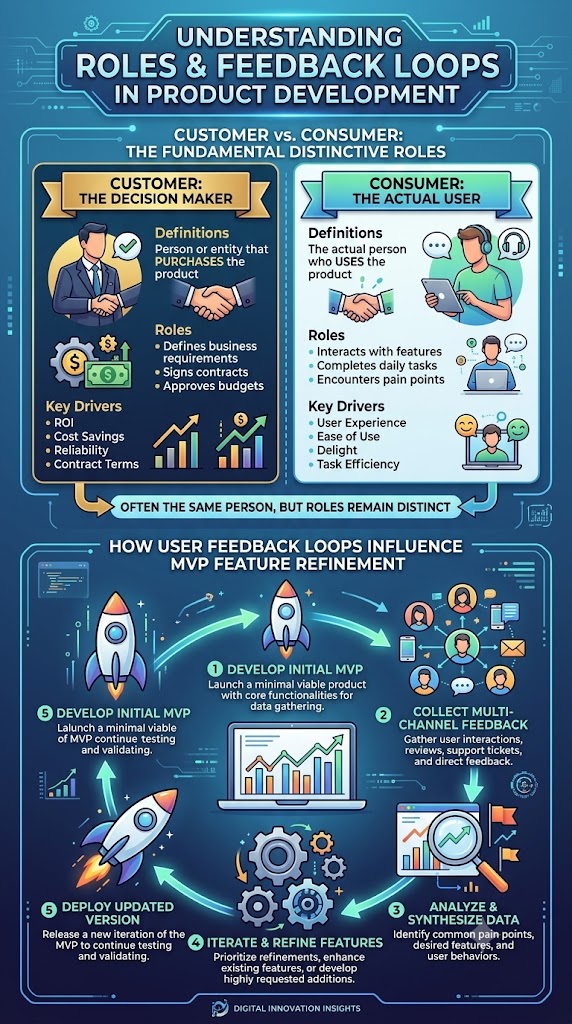
The Target Customer: Clearly identifies who the product is built for, distinguishing between the paying buyer and the actual end consumer.
The Problem Space: Explicitly states the market need, operational inefficiency, or unaddressed customer pain point.
Core Benefits: Focuses on the tangible, measurable outcomes delivered to the user, rather than a list of technical features.
Explicit Unique Selling Points (USPs): Articulates precisely why this product will win over existing market alternatives or status-quo processes.
The Standardized Framework: Step-by-Step Template
To enforce rigor and eliminate vague generalizations, project managers and product leaders must adopt a standardized vision framework. The most battle-tested structure across enterprise environments is the vision template adapted from classic product management practices:
FOR [Target Customer]
WHO [Statement of the Need or Opportunity]
THE [Product Name]
IS A [Product Category]
THAT [Key Benefit, Compelling Reason to Buy/Use]
UNLIKE [Primary Competitive Alternative or Status Quo]
OUR PRODUCT [Statement of Primary Differentiation / USP]
Step-by-Step Implementation Guide for Project Leaders
To implement this template across enterprise teams, follow this systematic four-step workshop workflow:
Map the Customer Profile: Facilitate a workshop with cross-functional leaders from sales, engineering, and support. Clearly delineate the customer profile. Ask explicitly: Who is the primary user, and what is their operational context?
Isolate the Primary Pain Point: Resist the urge to solve multiple problems simultaneously. Force the leadership team to choose the single most acute problem space that justifies capital allocation.
Define Quantifiable Outcomes: Express the product’s value in terms of user capabilities and business metrics (e.g., reducing processing time, lowering operational risk) rather than technical specifications.
Establish Hard Competitive Differentiation: Document existing market alternatives, including internal manual workarounds. Articulate why your solution provides a distinct advantage that competitors cannot easily replicate.
Real-World Enterprise Scenario: Vague vs. Standardized Vision
To illustrate the operational impact of this framework, consider an enterprise software initiative aimed at building an internal analytics platform named DataVault Pro
Scenario A: The Vague Corporate Vision (Failure State)
“DataVault Pro will be a world-class, AI-driven data platform that leverages modern cloud architectures to revolutionize how our organization handles data analytics.”
Why this fails: It provides zero strategic guidance. It does not define the user, the problem, or the unique value. Every stakeholder will interpret “world-class” and “revolutionize” differently, leading to scope creep as team members request their favorite features.
Scenario B: The Standardized Actionable Vision (Success State)
“FOR enterprise data analysts WHO spend hours manually aggregating fragmented departmental reports, THE DataVault Pro IS A centralized cloud analytics engine THAT automates cross-departmental data ingestion and reduces report generation time from days to minutes. UNLIKE legacy, siloed SQL databases that require custom engineering support for every query, OUR PRODUCT provides self-service semantic data modeling with native automated compliance tracking.”
Strategic Comparison Matrix
| Structural Component | Vague Vision (Scenario A) | Standardized Vision (Scenario B) | Operational Impact on Project Execution |
| Target Customer | Unspecified (“our organization”) | Enterprise data analysts | Keeps engineering focused on analyst workflows rather than general executive dashboards. |
| Problem Space | Ambiguous (“handles data analytics”) | Hours lost manually aggregating fragmented departmental reports | Establishes a baseline metric for project success: time reduction. |
| Product Category | Buzzword-heavy (“AI-driven data platform”) | Centralized cloud analytics engine | Clarifies architectural scope and infrastructure requirements immediately. |
| Core Benefit | Abstract (“revolutionize data”) | Automates ingestion; cuts reporting time from days to minutes | Provides clear acceptance criteria for high-level roadmap planning. |
| USP / Differentiator | None | Self-service semantic modeling with native compliance tracking | Prevents feature creep by filtering out requests that do not advance self-service compliance. |
When you master the art of standardizing product vision statements at the top of the Agile Planning Onion, your day-to-day professional life transforms dramatically.
Instead of acting as a reactive “backlog administrator” who spends hours mediating feature disputes and defending sprint boundaries against endless change requests, you become an authoritative strategic leader.
The Operational Shift
Scope Creep Neutralization: When a stakeholder requests an out-of-scope feature during backlog refinement, you no longer need to rely on subjective arguments. You simply evaluate the request against the standardized vision statement. If the feature does not directly serve the target customer or reinforce the explicitly defined USP, it is systematically deprioritized.
Predictable, Elite Delivery: Engineering teams thrive when given clear constraints and meaningful context. A well-defined vision provides the why behind every user story, enabling developers to make smarter architectural decisions independently.
Executive Leadership Alignment: By framing project discussions around capital feasibility, target customer pain points, and distinct market advantages, you speak the language of C-suite executives. You transition from managing tactical tasks to driving corporate portfolio performance.
Learning project management the right way means moving past mechanical execution. It means understanding how organizational strategy cascades down into daily engineering tasks. Mastering top-level planning frameworks positions you as an indispensable asset capable of guiding complex programs to successful commercial outcomes, directly accelerating your corporate career trajectory.
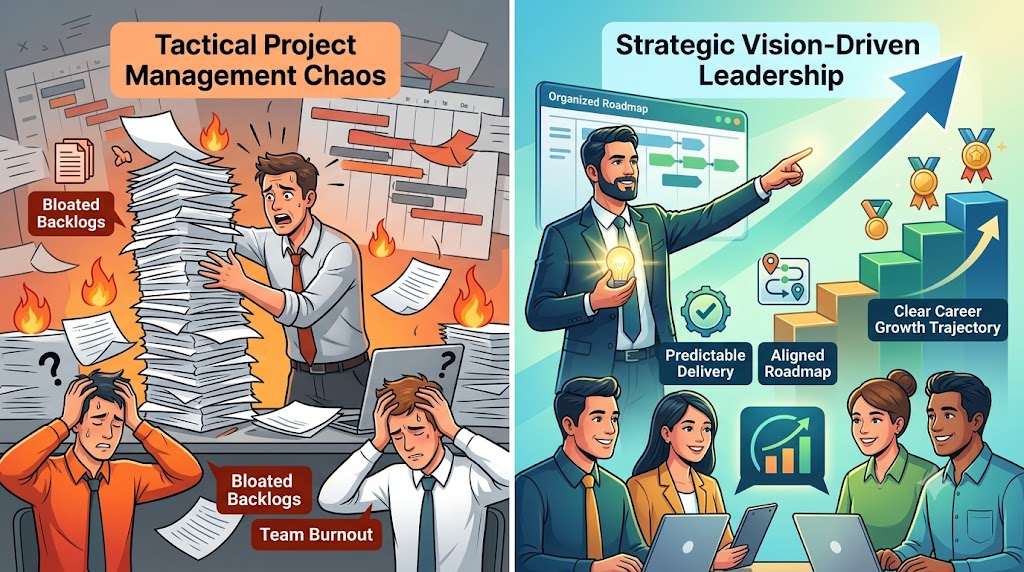
Defining an exceptional Product Vision Statement is the critical first step in mastering the Agile Planning Onion. By standardizing how your organization identifies target customers, problem spaces, core benefits, and explicit USPs, you create a robust strategic anchor that protects your team from scope creep, aligns senior stakeholders, and ensures consistent value delivery across every sprint.
If you are ready to stop guessing, move up the corporate ladder, and learn project management the right way, reach out to Skillsetify. We do not just teach frameworks: we show you your exact career growth trajectory.