The Secret to Mastering the Agile Planning Onion
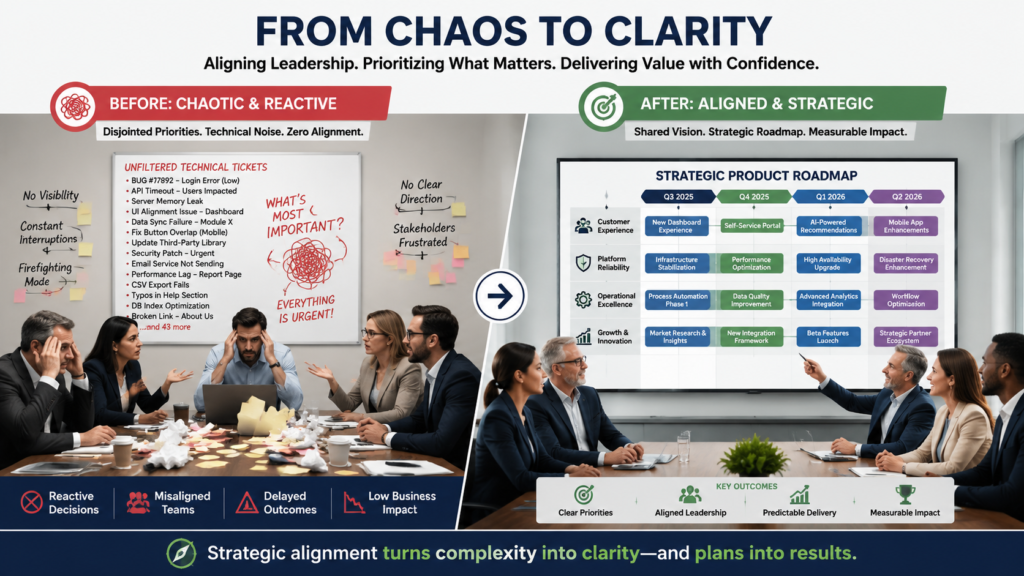
It is Thursday afternoon at 2:00 PM. The Vice President of Product walks into the executive steering committee expecting a strategic update on the product strategy for the upcoming fiscal year. Leadership wants to see quarterly milestones, revenue-driving launch dates, and strategic market expansion goals.
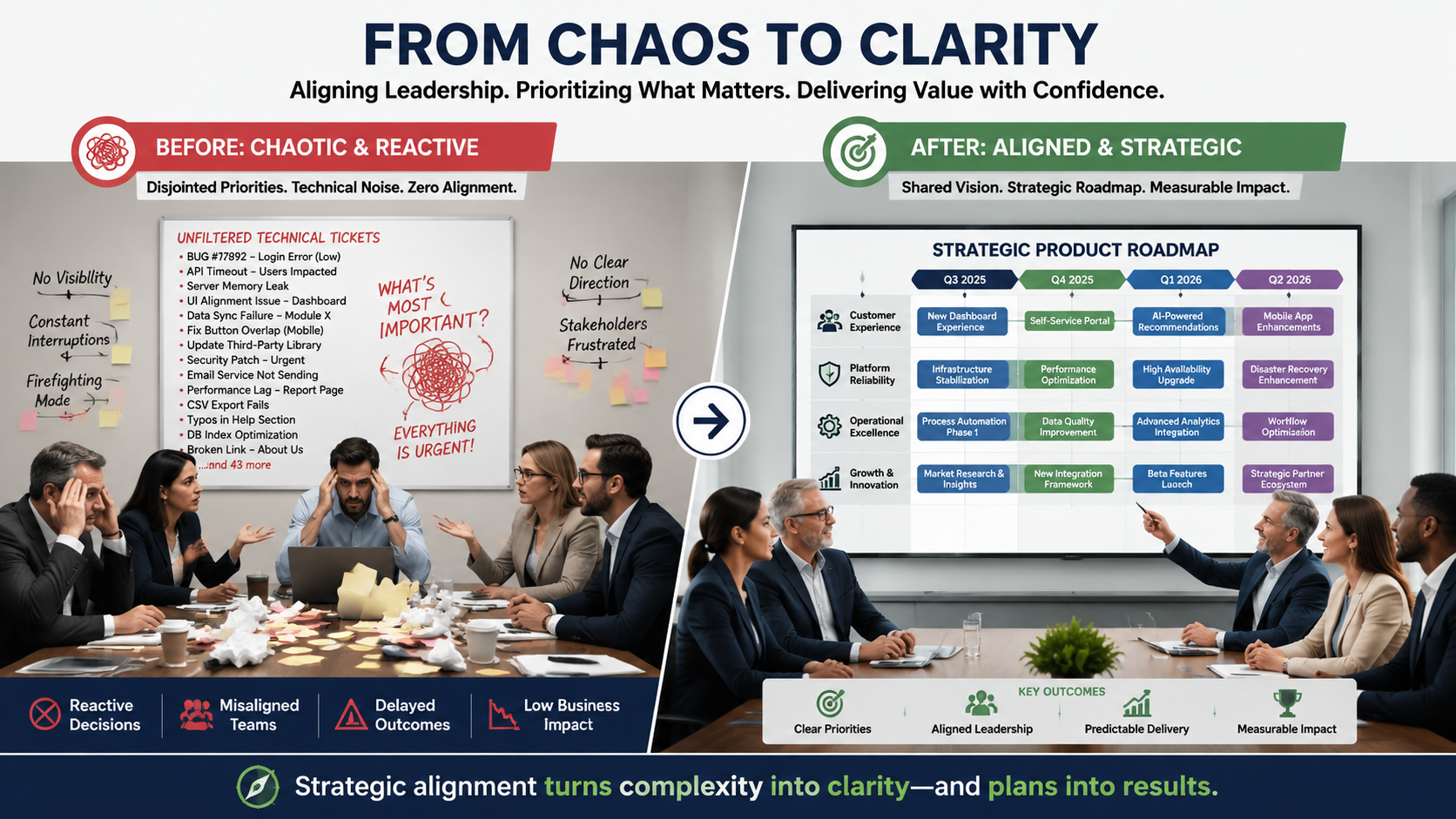
Instead, the Project Manager opens a screen share displaying a Jira board containing 450 unprioritized user stories, technical refactoring tickets, and bug fixes sorted by creation date.
The room goes silent. The VP demands to know when the enterprise security integration will be completed for the new strategic client. The Engineering Lead points to Ticket #842, which sits below three dozen minor UI tweak tasks. Engineering is furiously burning through story points every sprint, yet executive leadership is convinced the product is completely off track.
This scenario plays out daily in enterprise organizations worldwide. It stems from a widespread, destructive corporate myth: the belief that a Product Backlog is simply a detailed Product Roadmap, or that working in an Agile environment eliminates the need for long-term strategic roadmaps altogether.
When organizations confuse tactical execution items with strategic milestone plans, teams suffer from perpetual priority shifts, massive scope creep, developer burnout, and lost executive trust. To fix this disconnect, project managers must master the foundational structure of modern product delivery: The Agile Planning Onion.
The Agile Planning Onion: Where Roadmaps and Backlogs Live
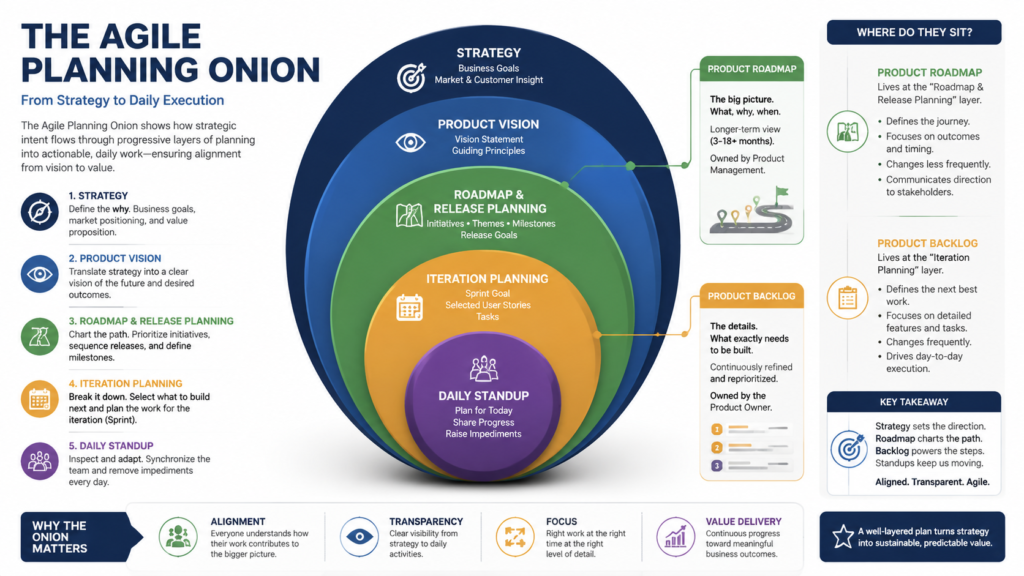
In modern software and product management, planning is not a single, one-time event. It is an iterative, multi-layered process represented by the Agile Planning Onion. This model breaks down planning into distinct horizons, ranging from long-term enterprise vision down to daily team coordination.
The 6 Layers of the Agile Planning Onion:
Product Vision: The overarching purpose and ultimate destination of the product.
Product Strategy / Portfolio: High-level investment goals, target markets, and strategic drivers.
Product Roadmap: Chronological, milestone-driven release themes mapped across time horizons.
Release Plan: Groupings of features and capabilities targeted for a specific market deployment.
Iteration / Sprint Plan: The tactical commit of work items for the next one to four weeks.
Daily Standup: Daily team alignment to track immediate progress and clear impediments.
The critical disconnect in corporate project management occurs between Layer 3 (The Product Roadmap) and Layer 5 (The Product Backlog / Iteration Plan). While these two planning artifacts are intimately connected, they serve radically different audiences, timeframes, and strategic functions.
Roadmaps vs. Backlogs: A Head-to-Head Comparison
To maintain operational clarity, project managers must understand the core structural distinctions between a Roadmap and a Backlog.
| Dimension | Product Roadmap | Product Backlog |
| Primary Focus | Strategic vision, business outcomes, and chronological milestones. | Tactical execution, granular deliverables, and technical implementation. |
| Primary Audience | Executives, investors, key clients, cross-functional business heads. | Software engineers, Scrum Masters, QA testers, UI/UX designers. |
| Time Horizon | Long-term (6 months to 2 years, structured in quarters or horizons). | Short-term (Immediate 1 to 3 sprints, highly detailed). |
| Items Included | Strategic themes, high-level epics, target release milestones. | User stories, bug fixes, technical debt items, spike tasks. |
| Flexibility Cadence | Adjusted quarterly or semi-annually based on market shifts. | Groomed weekly, re-prioritized per sprint based on team velocity. |
| Core Question Answered | “Where are we going, why does it matter, and when will key milestones land?” | “What exact items are we building right now, and how will they be implemented?” |
| Primary Ownership | Product Leaders, Portfolio Managers, Strategic Project Managers. | Product Owners, Technical Project Managers, Engineering Leads. |
The Anatomy of a High-Impact Product Roadmap
A Product Roadmap is a strategic communication tool. It communicates direction, aligns stakeholders, and sets expectations without locking engineering into premature technical promises.
A high-performing product roadmap includes four vital elements:
Strategic Themes: Broad, outcome-driven goals (for example, “Streamline Enterprise Onboarding” or “Achieve SOC-2 Security Compliance”).
Time-Horizon Buckets: Chronological milestones structured logically (such as “Now / Next / Later” or “Q1 / Q2 / Q3”).
Target Release Capabilities: High-level epics representing significant functional capabilities rather than specific line-item software tasks.
Business Impact Metrics: Key Performance Indicators (KPIs) tied directly to each strategic objective.
When executives review a roadmap, they should immediately see how engineering efforts map directly to business growth and enterprise ROI.
The Anatomy of an Actionable Product Backlog
Conversely, a Product Backlog is an execution engine. It is an itemized, prioritized list of everything required in the product, expressed in actionable technical units.
A well-structured product backlog adheres to the DEEP framework:
Detailed Appropriately: Items near the top (scheduled for immediate sprints) are broken down into granular user stories with precise acceptance criteria. Items near the bottom remain high-level concepts.
Estimated: Top-priority items possess effort estimates (such as story points) calculated by the development team.
Emergent: Items are continuously added, removed, or modified as market feedback and technical discovery occur.
Prioritized: Items are ordered rigorously based on business value, technical dependencies, and risk mitigation.
A product backlog item must follow standard user story syntax: “As a [user type], I want [action], so that [business benefit].” Without this structure, backlogs degrade into chaotic arrays of developer notes.
Step-by-Step Implementation Framework for Project Managers
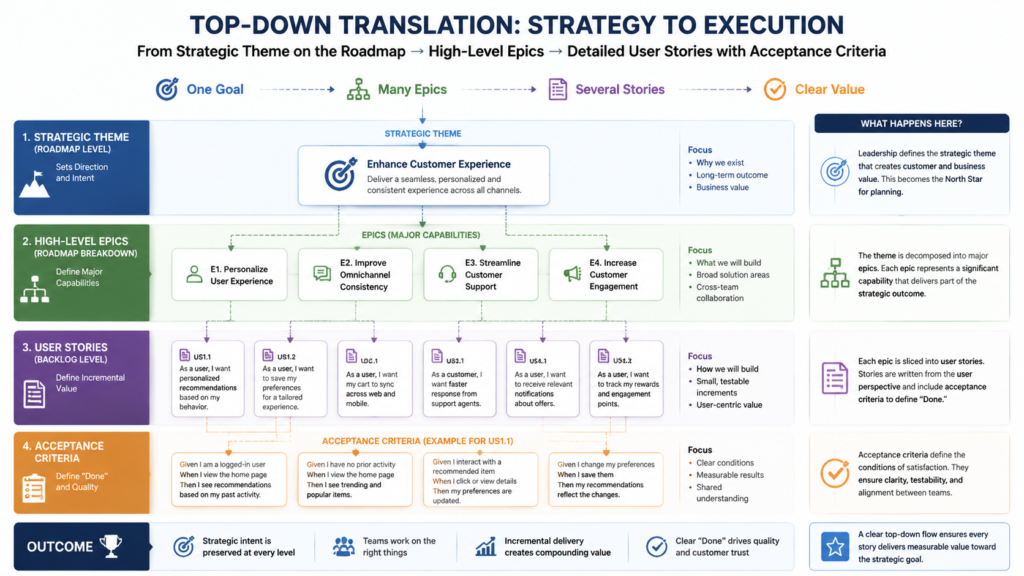
If your organization is suffering from roadmap-backlog confusion, follow this four-step tactical framework to establish top-down alignment.
Step 1: Establish Strategic Themes at the Roadmap Layer
Lorem ipsum dolor sit amet,
Before opening Jira or Azure DevOps, meet with product leadership and executive sponsors. Define three to five overarching strategic outcomes for the product cycle.
Example: Instead of setting a feature goal like “Build an export button,” establish a strategic outcome goal: “Enable self-service enterprise reporting to reduce customer support tickets by 20%.”
Step 2: Build a Horizon-Based Roadmap
Group your strategic capabilities into logical time horizons. Avoid assigning hard calendar dates to unrefined features months in advance. Use time horizons such as:
Now (Current Quarter): High confidence, fully refined, currently in engineering execution.
Next (Upcoming Quarter): Medium confidence, currently undergoing discovery and architectural definition.
Later (Future Quarters): Low confidence, strategic intent pending validation and discovery.
Step 3: Slice Roadmap Milestones into Backlog Epics and Stories
Once a roadmap capability moves into the “Now” or “Next” horizon, initiate collaborative refinement sessions with technical architects and project leads. Break down each roadmap capability into technical Epics, then slice those Epics into discrete User Stories.
Step 4: Institute Dual-Cadence Refinement
Maintain distinct operational rhythms for managing these two artifacts:
Monthly/Quarterly Roadmap Review: Strategic meeting with executive leaders to review market alignment, overall release velocity, and strategic pivot needs.
Weekly Backlog Grooming: Tactical meeting with the engineering team to refine user stories, review acceptance criteria, resolve technical dependencies, and estimate story points for upcoming sprints.
The Professional Transformation of an Elite Project Leader
Imagine walking into your next executive project review with absolute confidence.
Instead of defending a spreadsheet of unorganized software tickets, you present a clean, strategic Product Roadmap mapped directly to key corporate objectives. You show executives precisely how current sprint velocity translates into milestone delivery dates.
When leadership asks why a new feature request cannot be delivered immediately, you point to the clear trade-off decisions on the roadmap. You demonstrate how adding new scope directly impacts scheduled strategic themes.
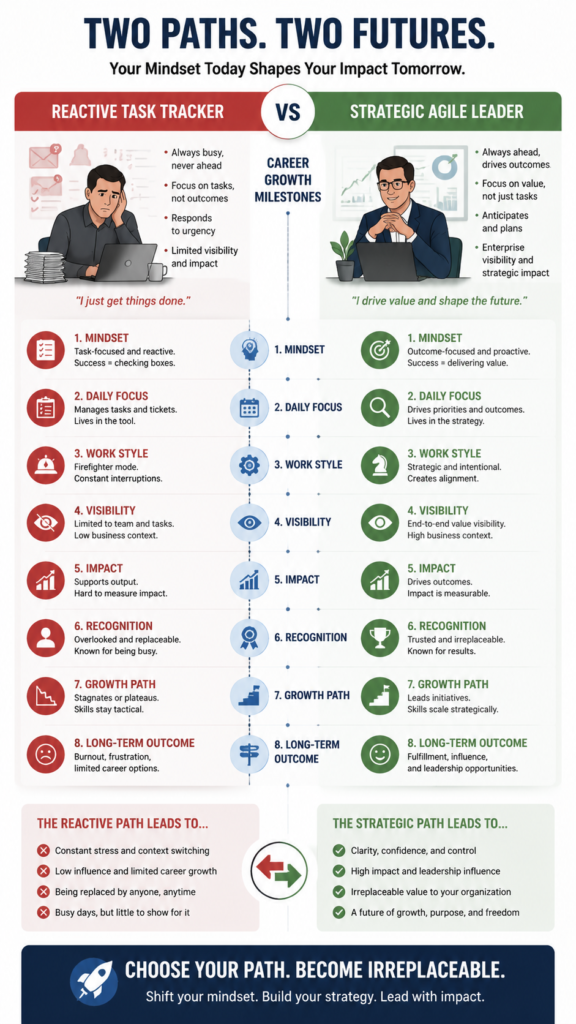
This operational clarity changes team performance completely:
Engineering Teams stop building blindly; they understand the business context behind every user story in their sprint.
Executive Leaders gain complete visibility into strategic progress without micromanagement or constant status updates.
Project Managers evolve from reactive ticket-trackers into respected, strategic orchestrators of business value.
Mastering the layers of the Agile Planning Onion is the defining capability that separates entry-level project coordinators from high-earning, strategic Directors of Program Management. When you master top-down alignment, you become the indispensable link between business strategy and technical execution.
Master Strategic PM Frameworks with Skillsetify
Navigating the nuances of modern corporate project delivery requires more than memorizing terminology. It demands a structured understanding of high-level portfolio governance, release planning, capital budgeting techniques, and strategic cross-functional execution.
By separating high-level strategic roadmaps from granular execution backlogs, you bring structure to project chaos, eliminate scope creep, and position yourself as an elite product delivery leader.
If you are ready to stop guessing, move up the corporate ladder, and learn project management the right way, reach out to Skillsetify. We do not just teach frameworks: we show you your exact career growth trajectory.