Why Judging Capacity by Your First Sprint is Sabotaging Your Delivery
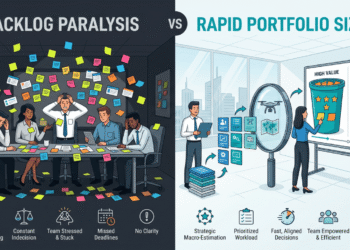
Picture this all too common corporate crisis. Your newly formed Agile team just wrapped up their very first sprint. Adrenaline was high, coffee was flowing, and the team miraculously crushed forty-five story points. The stakeholders are ecstatic. Riding this wave of absolute optimism, you project this forty-five point velocity forward, lock in a massive product launch date, and confidently present the roadmap to the executive board.
Fast forward to the end of Sprint 3. The initial adrenaline has worn off. The team is burning out. Unforeseen technical debt is piling up rapidly. In this iteration, they only manage to scrape together twenty-four story points. The promised launch date is now mathematically impossible to hit. The release is delayed, stakeholder trust evaporates, and your credibility as a Project Manager takes a massive, public hit.
This is the harsh reality for countless teams that fail to understand the absolute necessity of Multi-Sprint Stabilization.
Let us shatter a pervasive corporate myth right now: velocity is not a measure of raw speed or developer performance. Velocity is a metric of predictability. If you attempt to predict your long-term capacity based on a single iteration, you are not managing a project. You are gambling with your career. To build a robust, predictable delivery engine, Project Managers must learn to observe capacity trends over multiple deployment iterations to identify standard speed parameters. This is the only reliable way to separate the noise of a new project from the actual, sustainable signal of your team’s output.
What is Multi-Sprint Stabilization?
Multi-Sprint Stabilization is the strategic process of tracking and analyzing a development team’s completed work over a series of sequential iterations to discover their true baseline capacity. It acknowledges a fundamental psychological and operational truth: when a team first tackles a new project, their estimates are highly educated guesses. They do not yet know the intricacies of the new codebase, the hidden dependencies in the architecture, or even the unique working rhythms of their peers.
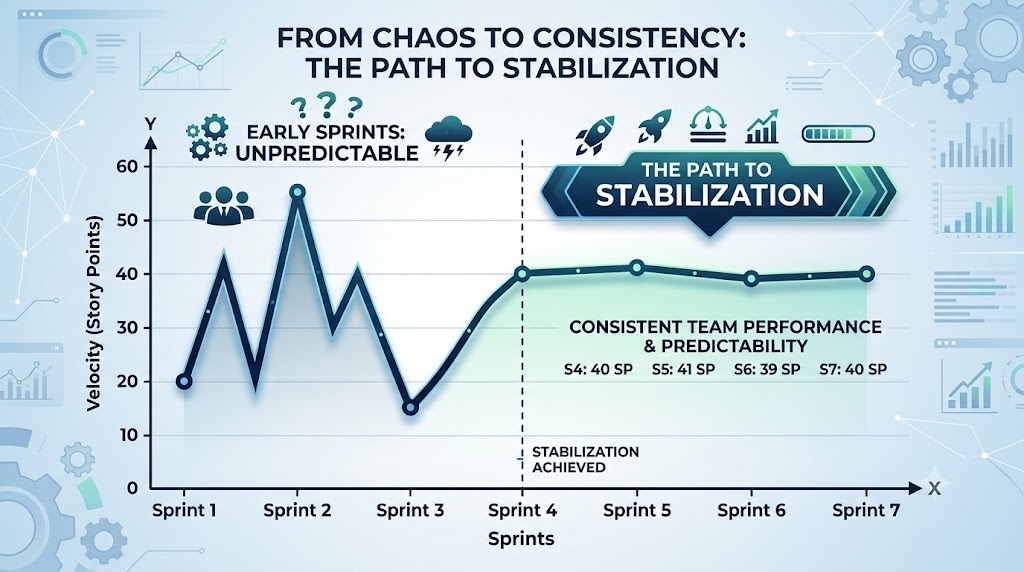
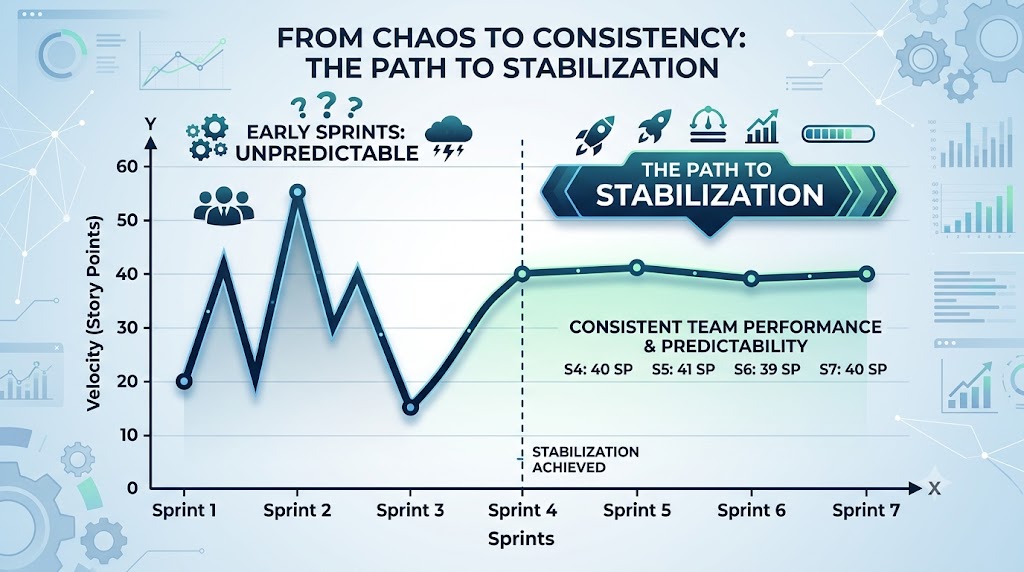
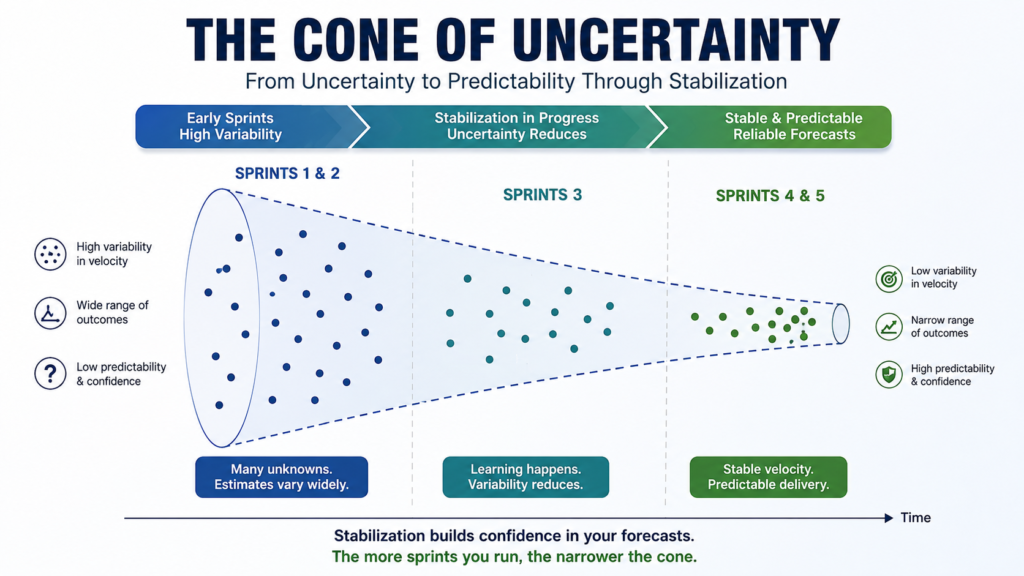
During the first few sprints, velocity will inevitably fluctuate. A team might overestimate their capacity in Sprint 1, under-deliver, and then drastically underestimate their capacity in Sprint 2 to compensate. This creates a volatile data set. Multi-Sprint Stabilization requires the Project Manager to patiently collect this data over three to five sprints. As the team normalizes their estimation practices and figures out exactly what a “five-point story” actually means in the context of this specific project, the volatility decreases. The data points begin to cluster around a stable median. That median is your stabilized velocity.
Why Multi-Sprint Stabilization Matters
Operating without a stabilized velocity is like trying to drive a car blindfolded while relying on someone else to shout directions. You will eventually crash. Understanding capacity trends over multiple iterations provides three massive strategic advantages.
First, it prevents scope creep through objective data. When business stakeholders inevitably ask to squeeze in one more feature, you no longer have to rely on emotional arguments or subjective pushback. You can point directly to the stabilized velocity metric and explain exactly what trade-offs must occur.
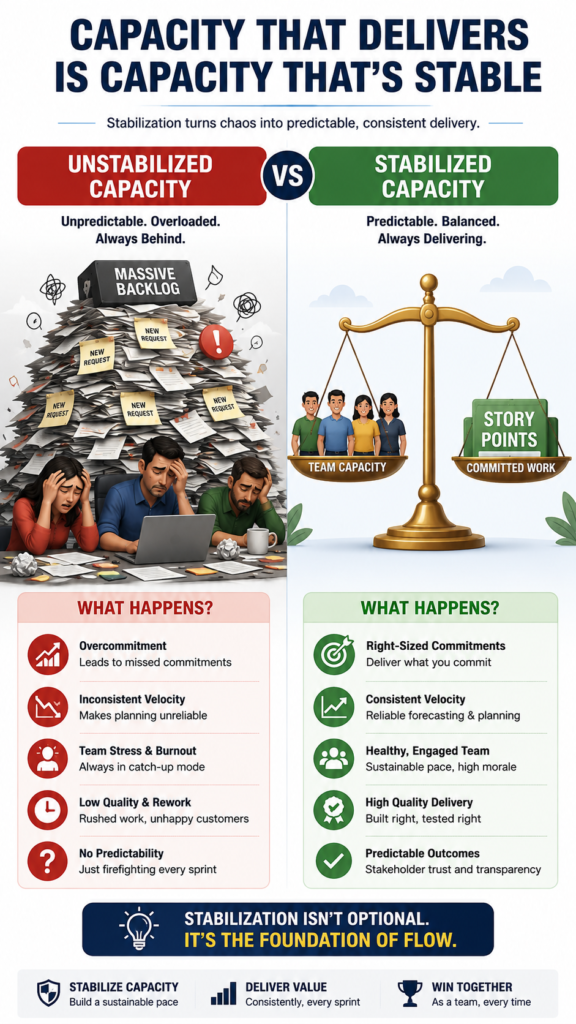
Second, it fiercely protects team morale. Developer burnout is usually caused by chronic over-commitment. When you plan sprints based on a stabilized, historical average rather than optimistic fantasies, the team can actually achieve their goals, leading to higher job satisfaction and lower turnover.
Third, it provides executive leadership with the one thing they crave above all else: predictability. Executives can handle bad news, but they despise surprises. A stabilized velocity allows you to forecast long-term delivery dates with a high degree of mathematical confidence.
The Step-by-Step Implementation Framework
Understanding the theory is only half the battle. To reach elite Project Manager status, you must know how to implement this tracking systematically. Here is the exact framework to establish standard speed parameters and stabilize your team’s velocity.
Step 1: Establish a Permanent Reference Baseline
Before you can track velocity, you must ensure your team is estimating consistently. In your initial Sprint Planning meeting, the team must select a medium-sized user story to act as the permanent reference baseline. If they assign this story an eight, every single future user story must be sized relative to this exact baseline. This reference story must remain constant across all future sprints. If the reference point changes, your data becomes instantly corrupted, and stabilization is impossible.
Step 2: Track the Cone of Uncertainty
Commit to a stabilization period of at least three to four sprints. During this phase, you must openly communicate to stakeholders that velocity is in a discovery phase. Track the total completed story points at the end of each iteration. Do not count partially completed work. If a story is not deployed or fully verified according to the Definition of Done, it yields zero points. Plot these completed numbers on a tracking chart to visualize the variance. You will typically see a wide spread (the cone of uncertainty) that gradually narrows as the team calibrates.
Step 3: Calculate the Rolling Average
Once you have completed three sprints, you can begin calculating your rolling average. Add the completed story points from the last three sprints and divide by three.
For example:
Sprint 1: 22 points
Sprint 2: 34 points
Sprint 3: 28 points
The total is 84 points. Divided by three, your rolling average is 28 points. This rolling average is a far more accurate predictor of future capacity than any single sprint’s performance. As you complete Sprint 4, drop the data from Sprint 1 and average Sprints 2, 3, and 4. This rolling method ensures your capacity parameter adapts to the team’s evolving maturity while remaining highly stable.
Step 4: Apply Capacity Modifiers
A common mistake novice Project Managers make is applying the stabilized velocity blindly. You must adjust your standard speed parameter for real-world capacity modifiers. If your stabilized velocity is thirty points, but two of your five developers are taking scheduled vacations during the upcoming sprint, your capacity is significantly reduced. You must calculate the percentage of team availability and modify the projected velocity accordingly before committing to stakeholders.
From Chaos to Predictability
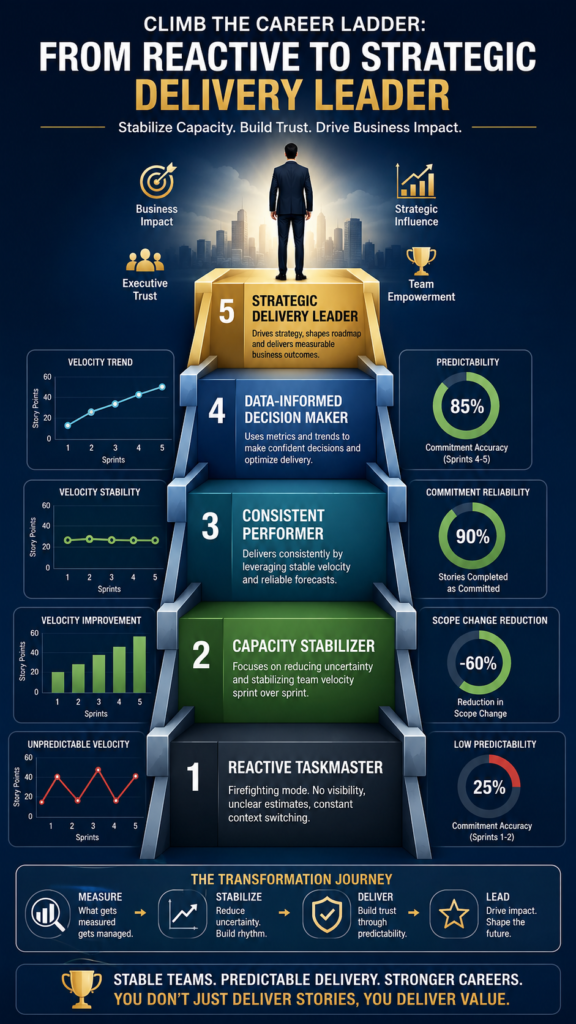
When you master Multi-Sprint Stabilization, your entire professional life transforms. You will transition from being a reactive taskmaster who is constantly putting out fires to becoming a strategic advisor who commands respect.
Imagine walking into a quarterly planning meeting. The product team hands you a massive list of requirements. Instead of breaking into a cold sweat and blindly promising to get it all done, you pull up your stabilization charts. You calmly show the executive team that based on historical capacity trends over the last five deployment iterations, the team can confidently deliver sixty percent of this list. You then ask them to prioritize the most critical features.
This is what it looks like to learn project management the right way. It is the shift from project chaos, scope creep, and chronic team burnout to predictable, elite delivery. Stakeholders will stop seeing you as a bottleneck and start seeing you as a trusted partner who guarantees operational excellence. This data-driven approach is the exact skillset that accelerates an ambitious professional’s career, separating the order-takers from the true thought leaders.
Accelerate Your Trajectory
Tracking team velocity through Multi-Sprint Stabilization is not just an Agile ceremony. It is a critical survival skill for any technology delivery professional. By taking the time to let your team normalize their estimation, tracking the rolling averages, and adjusting for real-world capacity, you insulate your projects from catastrophic failure and build a culture of sustainable, high-quality output. Stop treating your first sprint as a promise. Treat it as the first data point in a much larger, much more important equation.
If you are ready to stop guessing, move up the corporate ladder, and learn project management the right way, reach out to Skillsetify. We do not just teach frameworks: we show you your exact career growth trajectory.