Why Your Project Sequences Are Sabotaging Your Sprints
Every seasoned project manager has experienced the sting of a blocked deployment. Picture a highly relatable corporate crisis. It is a Thursday afternoon, and your flagship enterprise software release is at a complete standstill. The engineering lead insists the front-end user interface cannot be built until the secondary analytics database is finalized. Stakeholders are furious, deadlines are evaporating, and your budget is hemorrhaging cash. You scramble to reallocate resources, assuming your hands are tied by strict technical limitations.
However, upon conducting a post-mortem, you discover a bitter truth. The analytics database was not a strict technical requirement for the user interface. It was merely a developer preference. It was a strategic best-practice choice masquerading as a mandatory structural blockage.
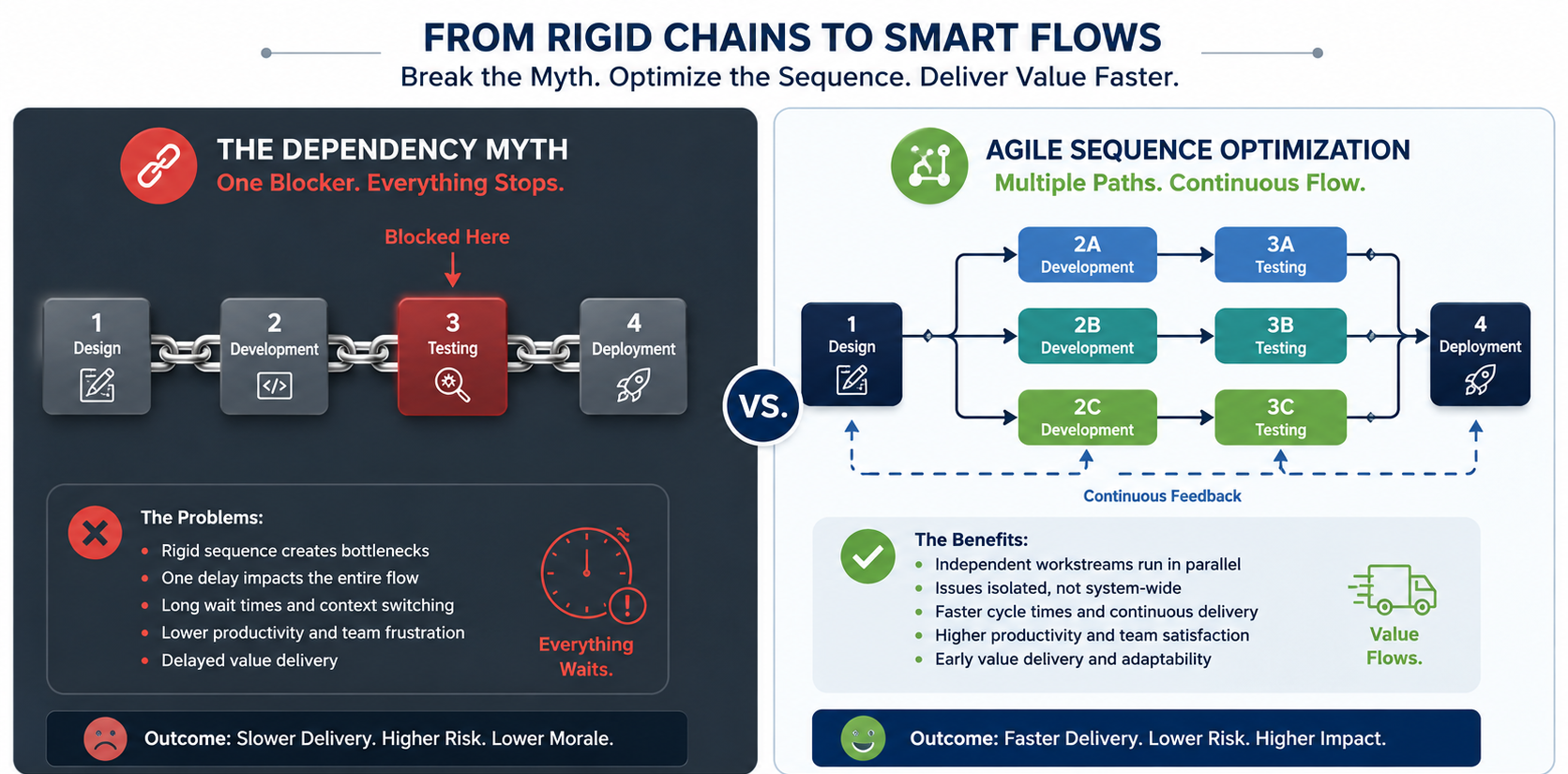
Let us dispel a massive corporate myth right away. Treating every task relationship as a mandatory sequence is destroying your delivery timelines and creating artificial bottlenecks in your Agile workflows. In enterprise project management, failing to distinguish between actual physical limitations and flexible strategic preferences is the root cause of countless delayed sprints. When teams chain everything together in rigid, immovable sequences, they surrender their agility.
To achieve predictable and elite delivery, a project manager must master the art of categorizing mandatory system sequences apart from strategic choices. It is time to stop guessing and start restructuring your dependency management.
The Anatomy of a Dependency
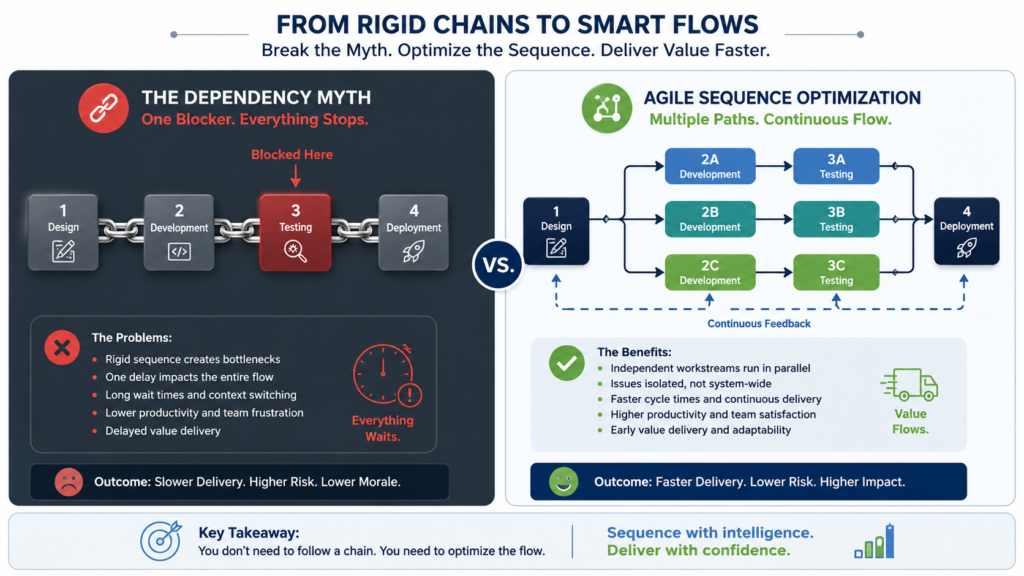
To manage a project backlog effectively, we must first dissect what a dependency actually is. In the world of Agile and software development, dependencies dictate the order in which tasks or user stories must be completed. However, not all dependencies carry the same weight.
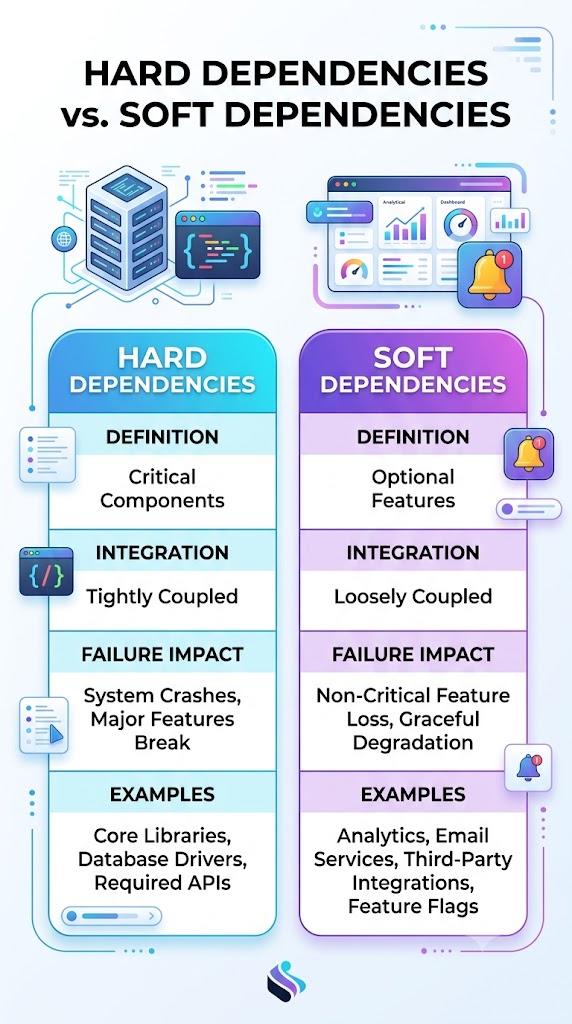
Identifying Hard Dependencies (Structural)
Hard dependencies represent mandatory sequences where completing one task before another is a non-negotiable requirement. These are instances where you have absolutely no choice in the matter, meaning prioritization is effectively decided for you.
To conceptualize a hard dependency, look at traditional construction. You cannot pour a concrete foundation without first buying the land. The act of purchasing the property is a hard, physical dependency for the foundation. In the software engineering world, consider a scenario where your team needs to write and deploy back-end code. You cannot push the code or conduct technical testing without first building a server. Building the server and configuring its environment is a mandatory prerequisite. If task B fundamentally cannot exist without task A, you are dealing with a hard structural dependency.
Unmasking Soft Dependencies (Strategic)
Conversely, soft dependencies represent strategic best-practice choices rather than inflexible laws of physics. While there might be a preferred, logical order to execute these tasks, the physical sequence is not strictly restricted.
When you have soft dependencies, you are presented with choices regarding which items to tackle first. For example, deciding between painting the interior walls of a house or installing the decorative light fixtures involves a soft dependency. Doing one before the other might be cleaner or more efficient, but neither physically blocks the other. In software, building an aesthetic dashboard versus developing a user notification system might just be a matter of preference.
Recognizing soft dependencies is critical because IT is ultimately an enabler for the business. IT teams exist to support business objectives and workflows, not to act as the primary business themselves. When project managers treat every soft dependency as a hard blockage, they prioritize technical preferences over immediate business value.
The Prioritization Engine: Mastering Dot Voting
Once you have stripped away the artificial hard dependencies, you will be left with a backlog full of soft dependencies. Because you now have choices, you must prioritize. But how do you decide which user stories to pull into a sprint when multiple options are viable?
Leaving prioritization up to an unstructured open discussion is a recipe for disaster. In verbal meetings, team members with the strongest voices or the highest corporate titles often dominate the conversation, heavily influencing the rest of the group. If a senior architect suggests feature A is the most important, junior developers will naturally fall in line and agree, neutralizing the value of a cross-functional team.
To eliminate this bias and uncover the true consensus of the development team, elite project managers utilize a surprisingly powerful framework known as Dot Voting.
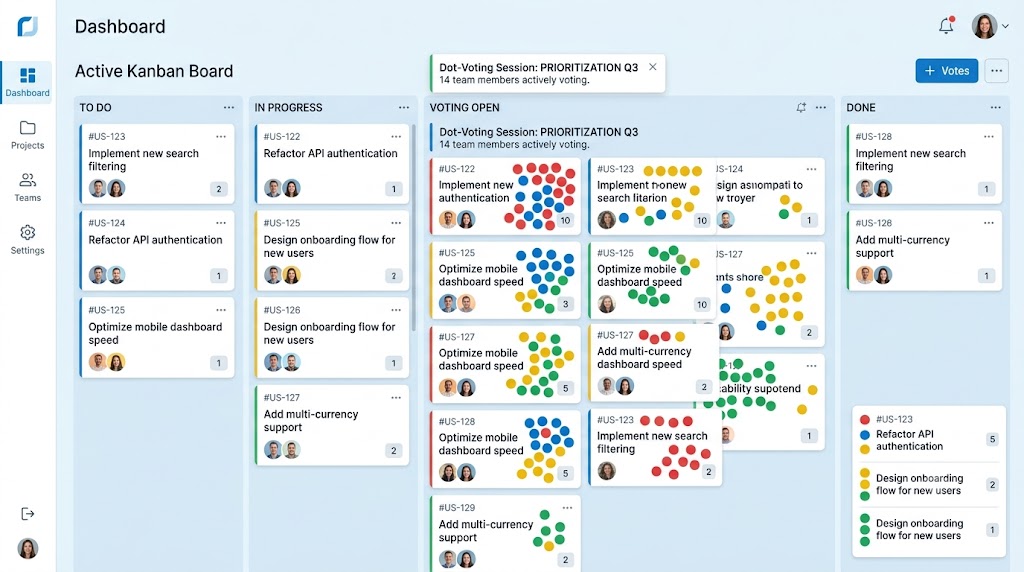
Dot voting is a highly effective, democratic prioritization mechanism that gives the team the autonomy to choose the most valuable user stories for the upcoming sprint. Here is the exact, step-by-step implementation framework you can use to run a flawless dot voting session with your team today.
The Step-by-Step Dot Voting Framework
Define the Backlog Pool: Start by presenting the team with the available options. For instance, place 40 groomed user stories on the board that represent the upcoming project scope.
Distribute the Voting Budget: Provide each participating team member with a specific budget of “dots.” A standard approach is to give 100 dots to each individual on a ten-person team, generating a total economy of 1,000 dots.
Mandate Secret Allocation: Instruct each team member to secretly distribute their 100 dots among a limited number of user stories, such as their top four choices. They are entirely free to weigh their votes based on their technical insight. For example, a developer might allocate 50 dots to a heavily demanded business feature, 35 dots to a backend optimization, 10 to a minor bug fix, and 5 to a UI tweak. Playing this game secretly ensures absolute confidentiality and prevents title-based influence. Tools and dedicated Agile software platforms are highly recommended for keeping this step genuinely anonymous.
Execute the Reveal: Once all team members have exhausted their dot budgets, reveal the results simultaneously. Organize the user stories in descending order based on the total number of dots received. The items at the top of the list clearly represent the group consensus for the highest priority user stories.
Forging True Consensus
The dot voting reveal is rarely perfect on the first try. You might find that a vast majority of the dots clustered around three features, but a few team members placed heavy votes on an outlier task.
This is where true Agile leadership shines. Do not ignore the outliers. Ask the individuals who voted differently to explain their rationale. They might possess a unique technical perspective or foresee a hidden risk that the rest of the team completely missed. As the product owner or project manager clarifies requirements based on these discussions, you must actively verify that the entire team comprehends the new information.
To gauge this understanding quickly, deploy the “Fist of Five” technique. Ask the team to hold up a hand showing zero to five fingers to represent their level of clarity regarding the user story requirements. If you see mostly fours and fives, consensus is strong, and the team is ready to move forward. If you see ones and twos, you must pause, clarify further, and re-evaluate.
By marrying secret dot voting with transparent consensus building, you eliminate guesswork, silence office politics, and guarantee that the team is working on the highest-value deliverables.
The Professional Transformation
Implementing strict dependency categorization alongside unbiased dot voting will fundamentally transform your project management reality.
Imagine walking into your next sprint planning meeting completely free of anxiety. Instead of arguing over subjective priorities or dealing with arbitrary roadblocks, you deploy a structured, mathematical approach to sequence management. The chaos of scope creep fades away. The burnout associated with constant context-switching is replaced by predictable, focused, and elite delivery. Your development team feels empowered because they have genuine autonomy in selecting priority items, while stakeholders remain thrilled because IT is consistently acting as an effective enabler of core business value.
Mastering these structural nuances is what separates a traditional task-tracker from a highly respected strategic leader. Learning project management the right way equips you with the authority to challenge assumptions, streamline architectures, and dramatically accelerate your professional career trajectory. When you know exactly how to untangle a web of corporate dependencies, you become the most valuable asset in the room.
Stop Guessing and Start Leading
Treating every project task as a hard dependency is a widespread corporate delusion. By learning to differentiate mandatory physical sequences from soft strategic choices, you immediately unlock hidden flexibility within your timelines. When you pair this categorization with democratic prioritization mechanisms like dot voting and the Fist of Five, you create an unstoppable, high-velocity delivery engine.
If you are ready to stop guessing, move up the corporate ladder, and learn project management the right way, reach out to Skillsetify. We do not just teach frameworks: we show you your exact career growth trajectory.