Operationalizing Architectural Layers for Flawless B2B Delivery
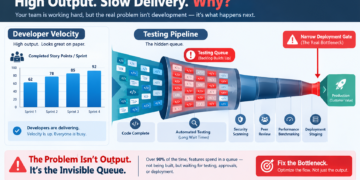
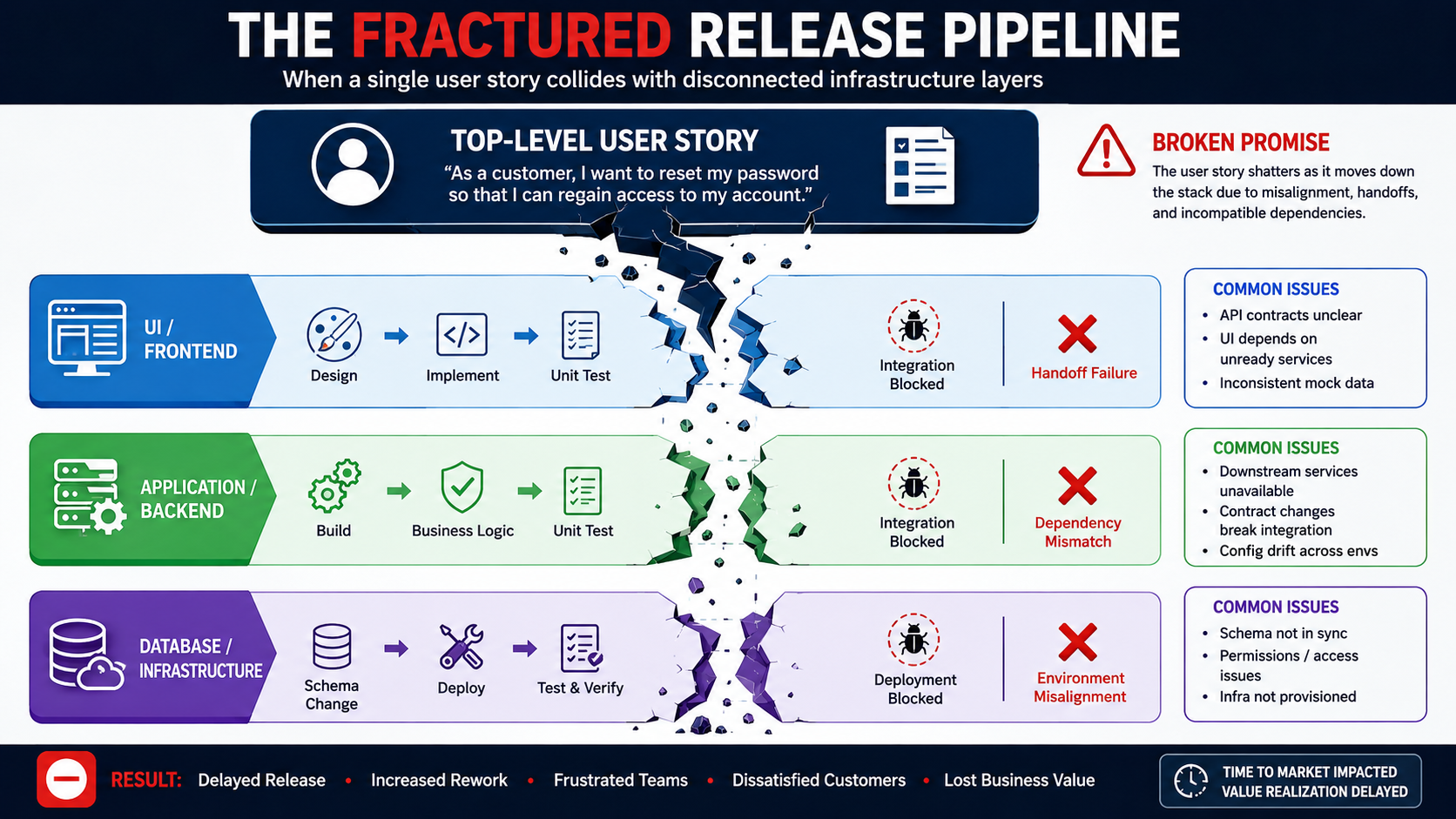
In software engineering and enterprise IT project management, a catastrophic pattern repeats itself across organisations of every size: the end-of-sprint deployment disaster. A product team spends weeks planning a feature, defining acceptance criteria, and refining user stories. Yet, when deployment day arrives, the release collapses. The database schema lacks the required migration scripts, security policies block the necessary API endpoints, and the infrastructure environment cannot support the newly pushed code.
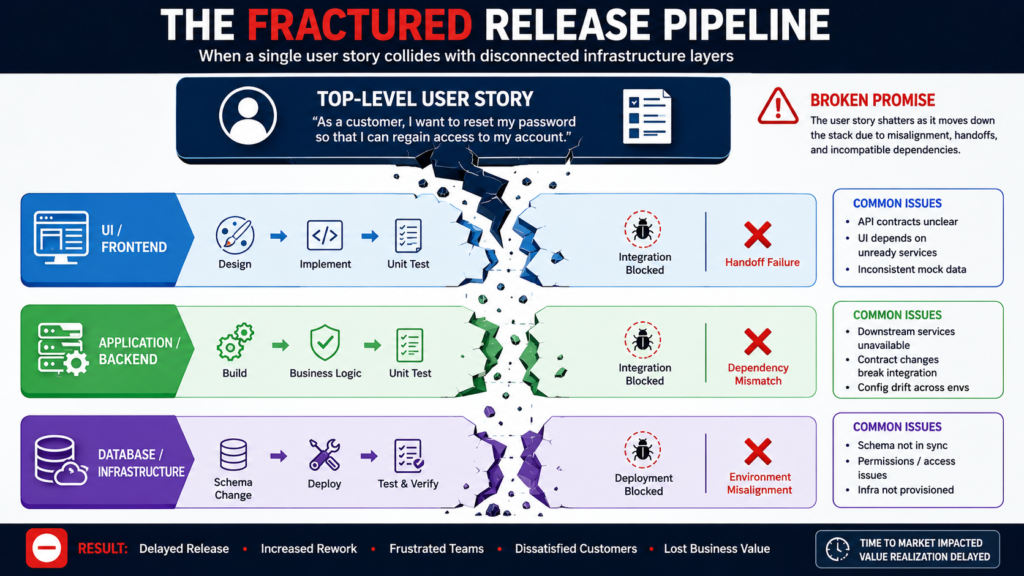
The root cause of this breakdown is almost never a lack of developer skill. It is an operational failure: confusing product-level user stories with operational technical tasks.
A common corporate myth suggests that cross-functional Agile teams should purely focus on vertical user stories, allowing individual engineers to figure out technical execution details on the fly. While vertical slices ensure functional feature delivery, treating complex technical implementations as monolithic, single-layer tasks creates massive hidden risk. High-performing engineering organisations do not simply assign user stories; they break functionality down into operational technical tasks distributed cleanly across distinct architectural layers.
The Anatomy of Technical Task Decomposition
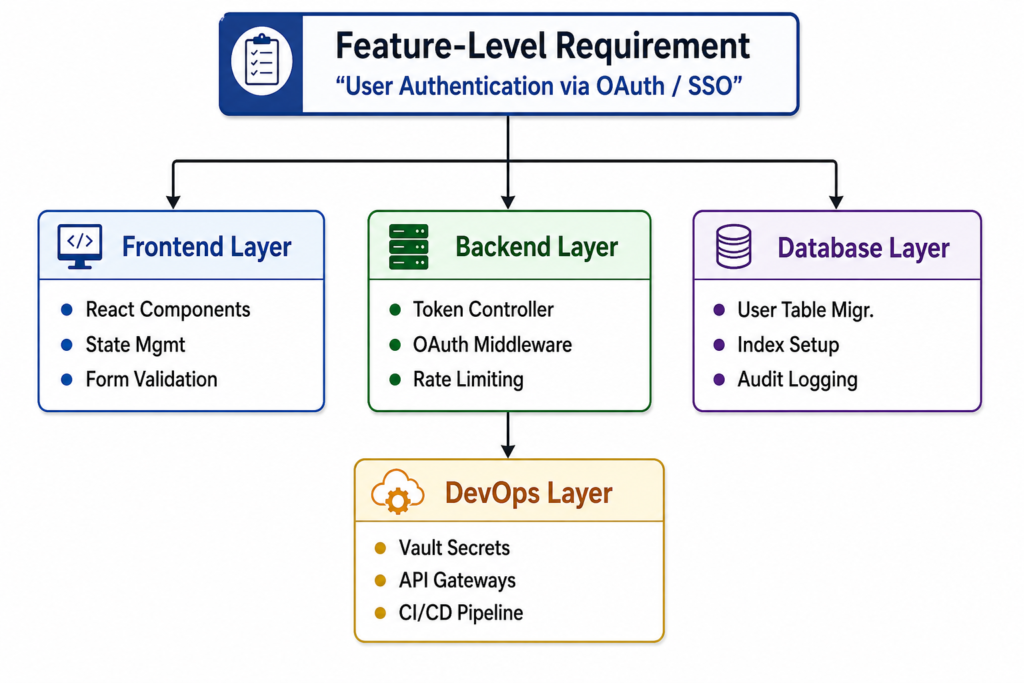
To eliminate integration risk and deliver predictable releases, project managers and technical leads must master the breakdown of feature-level requirements into operational components. This requires moving beyond high-level feature requirements to map work across the standard layers of modern software architecture: UI/Frontend, Application/Backend, Data/Database, and Infrastructure/DevOps.
The Architectural Layers Explained
Frontend / Presentation Layer: This layer encompasses everything the user interacts with directly. Operational tasks here involve component creation, state management integration, input sanitization, dynamic routing, and accessibility compliance.
Backend / Application Layer: The business logic engine. Tasks in this domain include endpoint creation, protocol handlers, service layer orchestration, event processing, rate limiting, and third-party API integration.
Data / Persistence Layer: The foundation of organizational state. Operational components focus on schema design, migration script creation, indexing strategy, data access object (DAO) creation, and query optimization.
Infrastructure / Operations Layer: The environment that powers the application. Tasks here cover Cloud Infrastructure provisioning (Terraform/CloudFormation), CI/CD pipeline updates, API gateway configuration, secret management, and observability metrics.
Step-by-Step Execution Framework for Project Managers
Transforming abstract features into crisp, operational technical tasks requires a disciplined, repeatable process. Project managers should implement the following four-step decomposition model during sprint refinement and technical planning sessions.
Step 1: Mapping the Architectural Dependency Matrix
Before writing a single task ticket, map out the technical dependencies across your architectural stack. Determine which layer acts as the prerequisite blocker for others.
Database Schema Migrations: Must be designed and deployed before backend services can interact with new data models.
API Contracts: Interface specifications (OpenAPI/Swagger) must be defined before frontend and backend teams can work in parallel.
Infrastructure Provisioning: Cloud storage buckets, message queues, and environment variables must exist before deployment scripts execute.
Step 2: Defining Concrete Operational Tasks
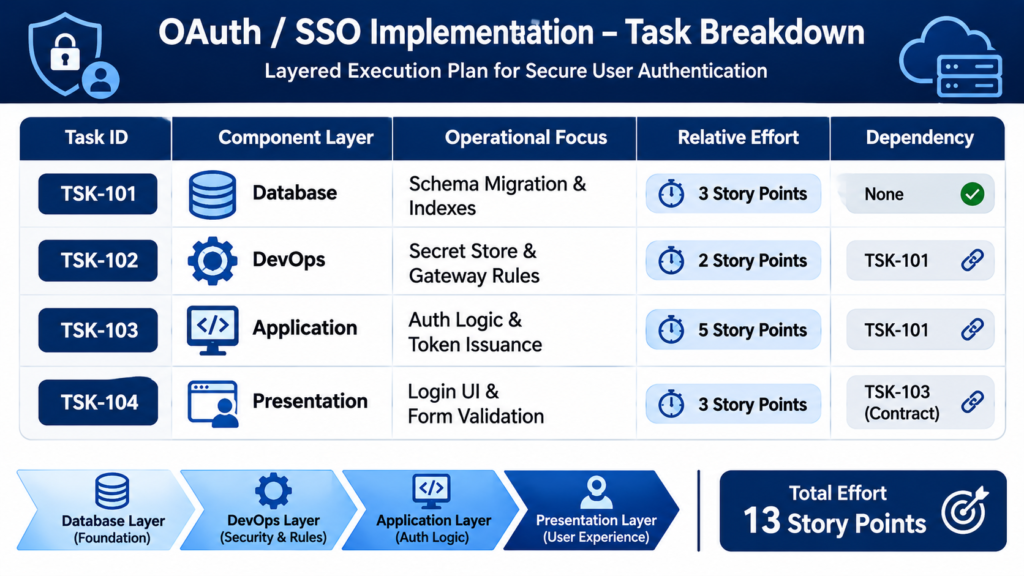
Avoid vague task descriptions like “Build Login Functionality.” Instead, create explicit operational units structured around technical boundaries:
Task 1 (Database): Execute migration script for
usersandauth_tokenstables with appropriate indices.Task 2 (Backend): Implement POST
/api/v1/auth/loginendpoint with JWT generation and password hashing.Task 3 (Backend): Configure rate-limiting middleware for auth endpoints using Redis.
Task 4 (DevOps): Store OAuth client secrets in Key Vault and update API Gateway route rules.
Task 5 (Frontend): Build responsive Login form component using design system tokens with client-side validation.
Task 6 (Frontend): Integrate auth state management store with persistent session storage.
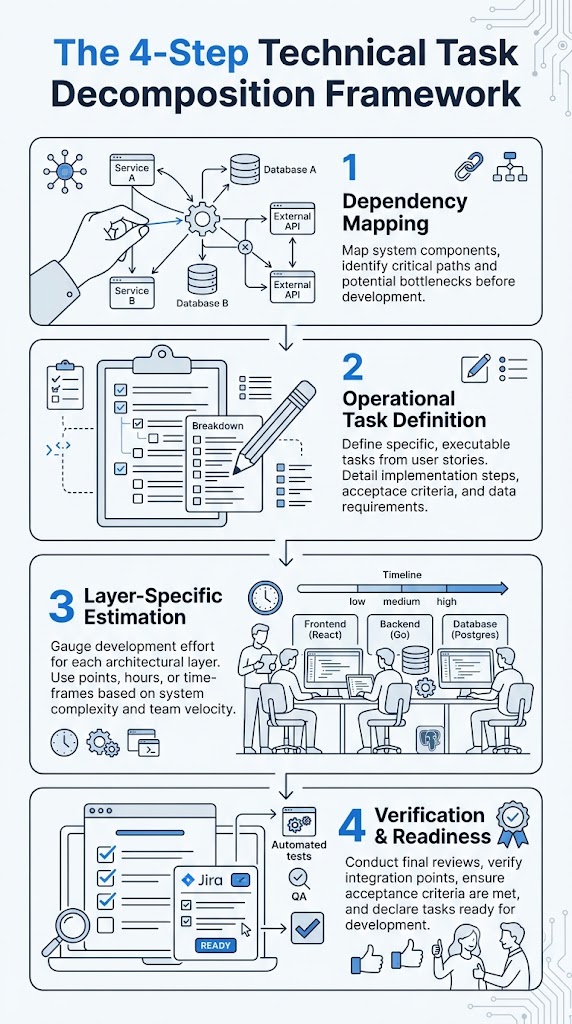
Step 3: Estimation and Relative Sizing Across Layers
Once decomposed, tasks must be estimated relatively using Fibonacci sequences or T-Shirt sizes within their respective domains. Estimating backend tasks against backend references (and frontend against frontend) maintains estimation accuracy and prevents cross-domain skew.
Step 4: Establishing Definition of Ready (DoR) and Done (DoD)
A technical task is only actionable if its operational boundaries are defined:
Definition of Ready (DoR): The technical task has a defined payload structure, explicit interface contracts, identified prerequisites, and assigned layer owners.
Definition of Done (DoD): Code is merged to the feature branch, unit tests achieve target coverage thresholds, layer-level integration tests pass, and infrastructure changes are validated in staging environments.
From Delivery Chaos to Elite Predictability
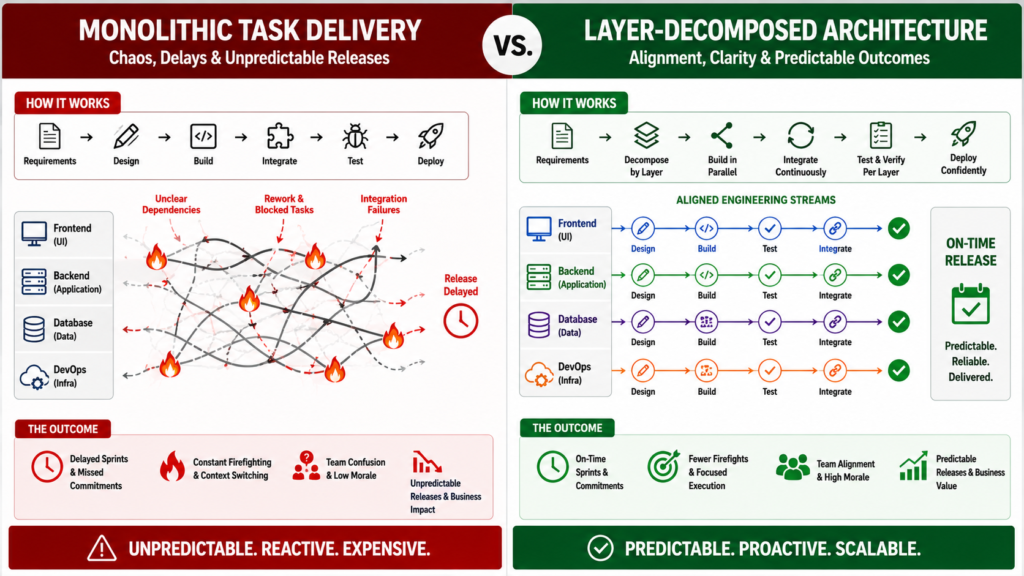
Operating without granular technical task decomposition forces engineering teams into a perpetual cycle of reactive troubleshooting. Dependencies surface late in the sprint, pull requests stall awaiting unbuilt APIs, and QA cycles turn into extended debugging sessions.
When project leaders enforce systematic decomposition across architectural layers, team dynamics shift immediately:
Parallel Engineering: Clear API contracts allow frontend and backend developers to build simultaneously using mock interfaces, cutting delivery lead times in half.
Precise Bottleneck Identification: Blockers are pinpointed to specific layers (e.g., an unapproved security policy or delayed database script) rather than vaguely attributed to a whole feature.
Reduced Cognitive Load: Engineers focus on clear, self-contained operational objectives rather than navigating ambiguous feature specs.
Uncompromising Release Quality: Security, database performance, and infrastructure requirements are built directly into sprint delivery rather than treated as post-development launch blockers.
Mastering this level of operational clarity is what separates reactive project coordinators from strategic B2B project leaders. When you understand how software is built across its underlying layers, you gain the authority to drive complex technical programs, align engineering execution with enterprise goals, and position yourself as an indispensable asset in modern corporate technology management.
Master Strategic Technical Leadership with Skillsetify
Navigating the complexities of modern software delivery requires more than superficial framework knowledge. It demands deep operational insight, strategic execution frameworks, and the ability to bridge the gap between technical architecture and business value.
If you are ready to stop guessing, move up the corporate ladder, and learn project management the right way, reach out to Skillsetify. We do not just teach frameworks: we show you your exact career growth trajectory.
Key Takeaways for Project Leaders
Decompose Early: Never pull feature-level user stories into execution sprints without breaking them down into operational technical tasks across architectural layers.
Define Contracts First: Establish API specs and data schemas before parallel development begins to prevent integration bottlenecks.
Isolate Dependencies: Map hard infrastructure and database blockers prior to committing to sprint commitments.
Drive Professional Growth: Elevate your career by transforming technical execution from chaotic guesswork into structured, repeatable enterprise delivery.