How Technical Business Enablement Transforms IT from Cost Center to Value Engine
A major enterprise logistics company reaches the go-live deployment of a new custom inventory management engine, bringing millions of dollars in project investment to a climax. The IT team broadcasts celebratory messages across company channels, marking every implementation task as complete.
Almost immediately, disaster strikes.
Regional warehouse workers log in to discover that processing a single outbound freight order now requires 14 manual form clicks instead of three. Downstream customer support representatives cannot retrieve real-time tracking data because the new database schema failed to integrate with legacy CRM endpoints. Soon, warehouse operations grind to a halt, thousands of client inquiries go unanswered, and executive leadership calls an emergency escalation meeting.
The project was delivered strictly within scope according to technical specifications, yet operationally, it was a catastrophe.
This scenario plays out across enterprise corporations constantly. It stems directly from a fundamental misunderstanding of technical execution: confusing software delivery with true business enablement. A pervasive corporate myth suggests that IT exists merely to build software, manage infrastructure, and resolve technical tickets. That myth destroys organizational momentum. Modern IT does not exist in a vacuum: it is fundamentally a business enabler. If technical execution does not seamlessly streamline operational workflows and fulfill the practical needs of downstream stakeholders, it represents technical debt in disguise.
What is Business Enablement in Enterprise IT?
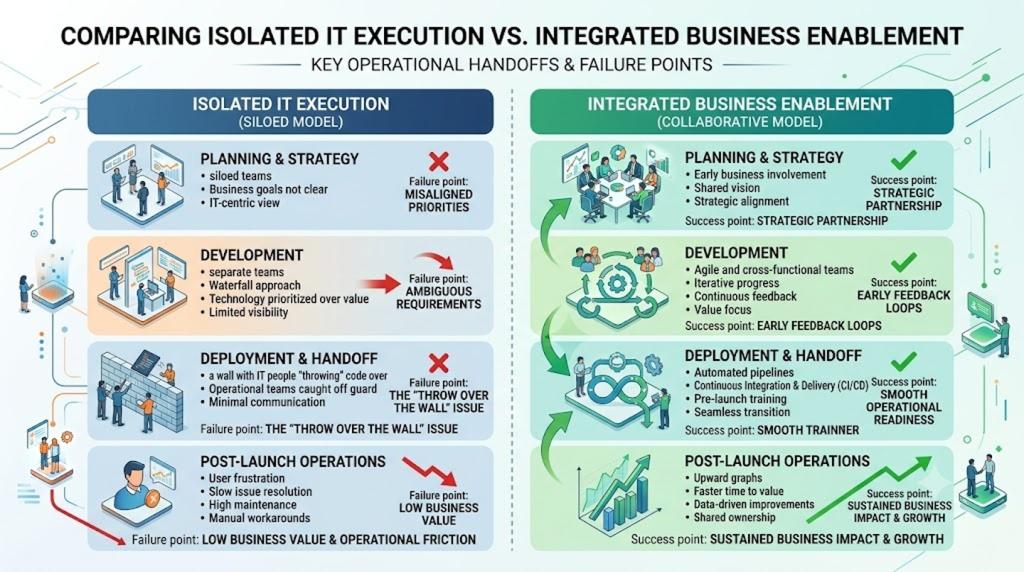
Business enablement is the strategic practice of designing, structuring, and executing technology implementations around actual operational workflows to directly empower downstream stakeholders. Rather than treating technology as an isolated function that processes technical requests, business enablement positions IT as an architectural partner responsible for driving cross-functional throughput.
In high-performing organizations, project management is not evaluated by code commits or ticket burndown rates. True project success is measured by operational velocity, data flow integrity across departments, and the elimination of workplace friction for the human beings using the systems.
The Failure of the Traditional Ticket-Driven Model
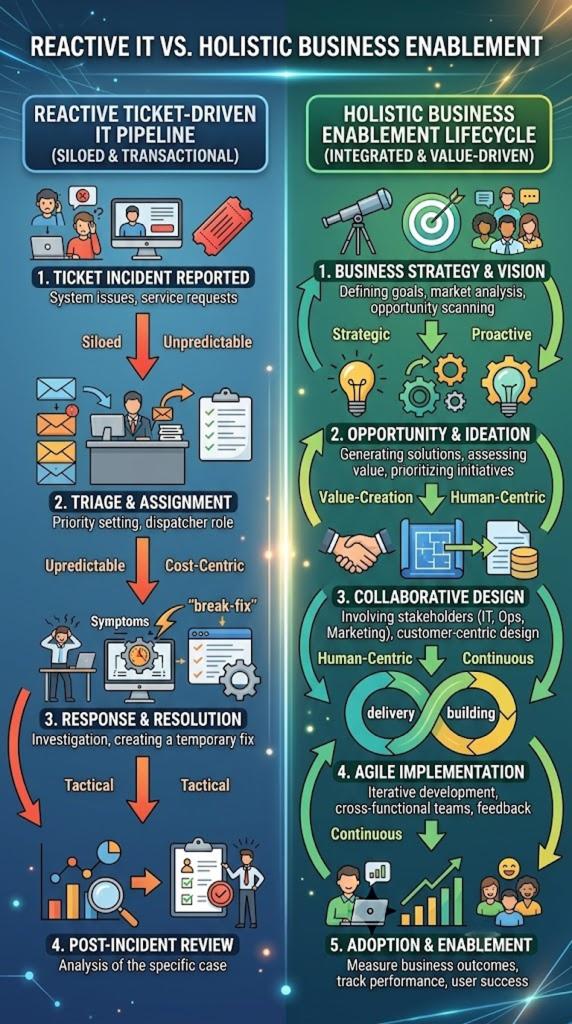
In legacy enterprise environments, IT operates on a reactive delivery pipeline:
Business units submit isolated software requests based on localized pain points.
Technical teams write functional specifications in isolation from daily operational realities.
Developers build features according to strict technical parameters without testing real-world usability.
Downstream teams inherit rigid, disjointed tools that hinder their daily output.
This disconnect creates severe operational debt. When technology implementations ignore how downstream stakeholders consume data, employees compensate by creating fragile manual workarounds. Shadow IT flourishes, spreadsheets become unofficial databases, operational costs skyrocket, and cross-departmental alignment breaks down completely.
The Core Mechanics of Technology-Driven Workflow Enablement
To construct technical systems that actively drive business outcomes, project managers must ground their projects in three non-negotiable mechanics.
1. Workflow-Centric Architecture
Every database field, API integration, and user interface element must map directly to a verified operational activity. If a technical configuration does not reduce cycle time, automate a manual handoff, or improve decision-making clarity for downstream users, its inclusion must be re-evaluated.
2. Downstream Dependency Orchestration
Upstream technical decisions dictate downstream business capabilities. When engineering teams alter a data schema, they directly impact how Finance runs billing automation, how Analytics builds predictive models, and how Customer Support resolves escalations. Enablement requires mapping these downstream dependencies before writing a single line of code.
3. Non-Functional Usability SLAs
Technical stability and system security are table stakes. Business enablement elevates non-functional requirements such as interface latency, search speed, and navigation intuitive design into critical launch criteria. A system that takes ten seconds to load a client record is an operational bottleneck, regardless of its underlying architectural sophistication.
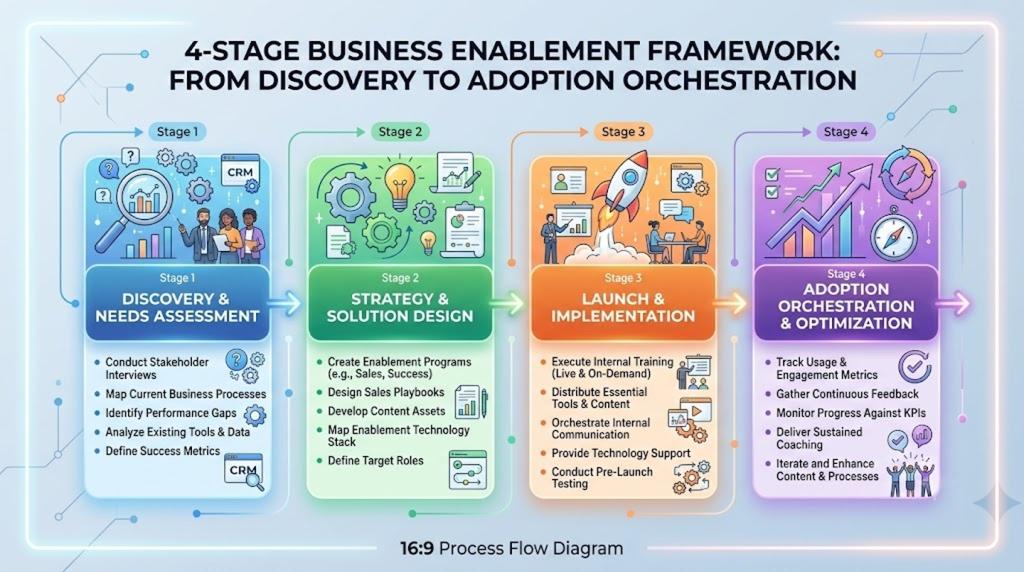
Step-by-Step Business Enablement Implementation Framework
To transition your projects from simple software delivery to high-impact business enablement, follow this four-stage execution framework designed for immediate enterprise application.
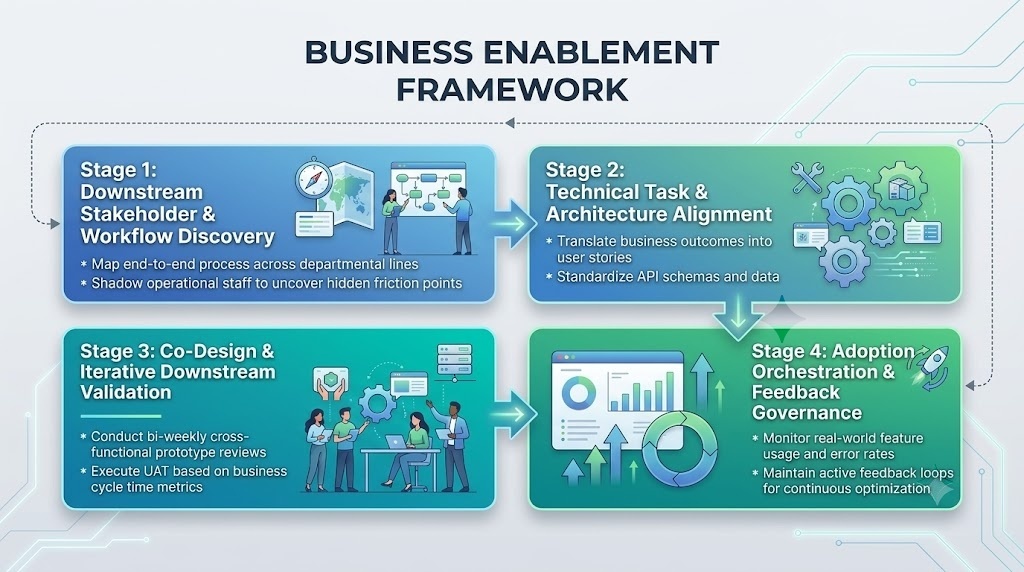
Stage 1: Downstream Stakeholder Discovery and Workflow Auditing
Before defining technical scope, map the complete end-to-end operational journey across departmental boundaries:
Map the Human Network: Identify every secondary and tertiary group that consumes, processes, or relies on system outputs downstream.
Conduct Direct Observational Audits: Shadow operational personnel to observe how they navigate current systems in their day-to-day work environment.
Quantify Current Friction: Document exact cycle times, manual copy-paste handoffs, spreadsheet dependencies, and operational delay points.
Stage 2: Technical Task and Architecture Alignment
Translate operational discoveries into structured, actionable technical implementation tasks:
Reframing Acceptance Criteria: Write user stories focused explicitly on operational task completion rather than technical capability. For example, specify: “Allow customer success agents to process a refund in under three clicks,” instead of “Build refund backend endpoint.”
Standardize Data Governance: Align data schemas across disparate platforms to ensure data generated by Sales flows seamlessly into Finance and Fulfillment without manual transformation.
Build Automated Middleware Pipelines: Prioritize robust API integrations that eliminate manual batch file exports and manual data re-entry.
Stage 3: Co-Design and Iterative Validation
Eliminate delivery risk by continually validating technical builds against real-world operational workflows:
Sprint Review Cross-Pollination: Mandate that downstream business representatives attend bi-weekly technical demonstrations to provide real-time usability feedback.
Business-Scenario UAT: Structure User Acceptance Testing around end-to-end business scenarios rather than isolated feature verification.
Pre-Mortem Risk Sessions: Conduct pre-launch scenario planning with operational managers to identify potential workflow disruptions before go-live.
Stage 4: Adoption Orchestration and Governance
Sustain long-term operational impact through structured post-deployment oversight:
Track Workflow Analytics: Deploy telemetry tools to monitor actual feature adoption rates, task completion speeds, and drop-off points.
Establish Rapid Post-Launch Sprints: Reserve dedicated engineering capacity immediately following go-live to resolve operational friction points discovered in production.
Publish Clear Operational SLAs: Maintain transparent service level agreements so downstream teams can rely on system uptime and data processing timeliness.
Essential Implementation Tasks for Technical Project Managers
When orchestrating technical teams toward business enablement, project leaders must focus on key tactical implementation levers:
API Mapping and System Interoperability: Validate that enterprise software components communicate natively, removing the need for manual CSV transfers between departments.
Unified Metadata Governance: Establish shared data definitions across systems so that Sales, Operations, and Accounting utilize consistent metrics and record formats.
Automated Data Validation Scripting: Deploy automated data checks upstream to prevent corrupt or incomplete data from reaching downstream reporting systems.
Operational Release Scheduling: Coordinate technical deployments around business operational cycles, avoiding system cutovers during end-of-month financial closes or peak sales events.
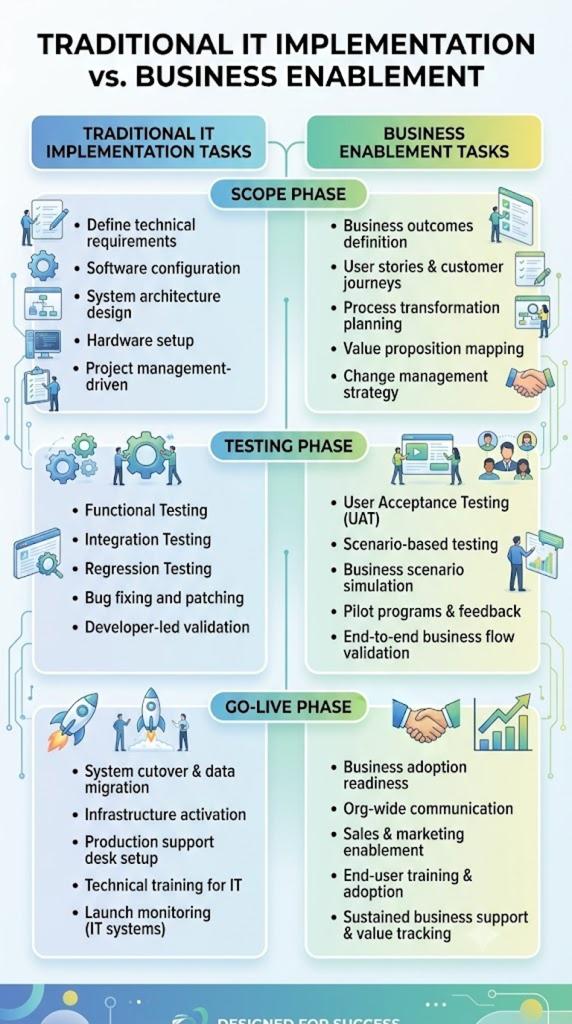
Eliminating Enterprise Enablement Anti-Patterns
Even experienced project managers can fall into structural traps that undermine enablement. Watch for these common enterprise anti-patterns:
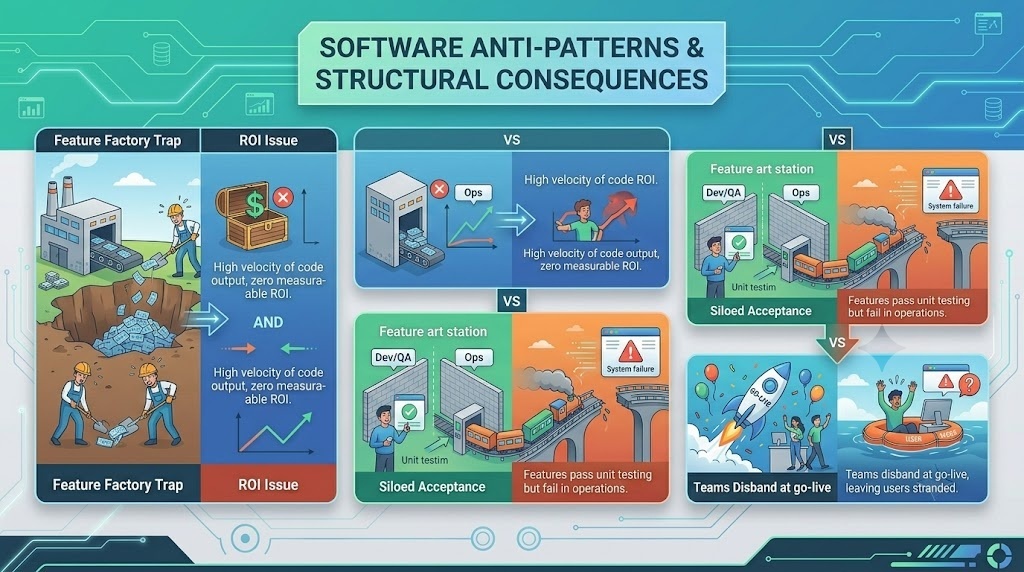
The Feature Factory Trap
Measuring project success purely by the volume of features shipped creates bloated software that confuses users. Prioritize feature impact over feature quantity.
Siloed Acceptance
Allowing IT to sign off on technical readiness without formal sign-off from downstream operational users leads to failed deployments. Downstream approval must remain a mandatory gate for production releases.
Launch-and-Leave Syndrome
Disbanding project teams immediately after deployment leaves operational users without support when real-world edge cases emerge. Enablement requires structured post-launch support and iterative refinement.
From Operational Chaos to Elite Project Delivery
When you shift from traditional technical management to holistic business enablement, the workplace transformation is profound.
Project delivery moves away from mid-sprint panics, scope creep disputes, and frustrated end users. System deployments transform into seamless organizational upgrades. Downstream teams experience reduced operational friction, minimal manual effort, and intuitive tools that enhance daily performance. Executive leadership sees immediate, measurable ROI through accelerated cycle times, lower operational costs, and reliable data visibility.
For project managers and technical leaders, mastering business enablement completely alters your career trajectory. You cease being a tactical coordinator who tracks task completion and updates Gantt charts. You become a strategic business leader who shapes technical architecture to drive organizational growth.
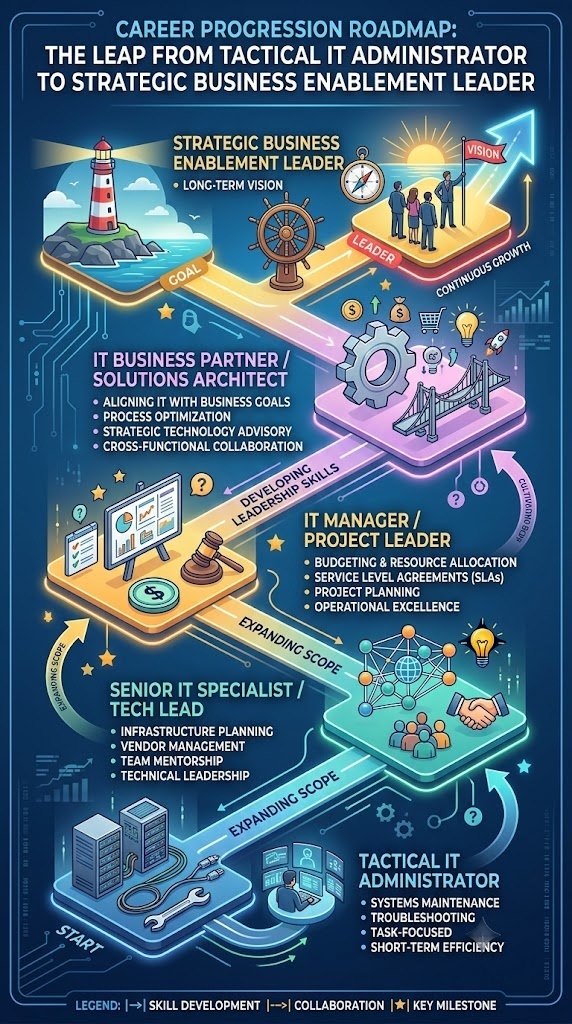
Organizations do not advance project managers simply because they know how to schedule meetings or move Jira tickets across a board. They promote professionals who know how to align technology structures with business strategy, optimize cross-functional workflows, and deliver tangible commercial value.
Elevate Your Project Leadership with Skillsetify
Technology structures deliver enterprise value only when they empower the people who rely on them. By aligning technical implementation tasks directly with downstream stakeholder needs, you eliminate operational bottlenecks and turn IT into a true catalyst for speed and efficiency.
If you are ready to stop guessing, move up the corporate ladder, and learn project management the right way, reach out to Skillsetify. We do not just teach frameworks: we show you your exact career growth trajectory.