Why Experienced Professionals Should Bypass CAPM and Target PMP Directly
The Stepping-Stone Trap and Corporate Reality
Imagine this scenario: You are a senior software developer, operations lead, or marketing manager with six years of cross-functional experience. You have spearheaded major system migrations, launched company-wide initiatives, and managed budgets worth hundreds of thousands of dollars. Yet, when you look at formalizing your credentials, hesitation creeps in. You browse project management certifications, see the Certified Associate in Project Management (CAPM), and assume: I should start at the beginning. I will get the CAPM first, and then, in a couple of years, I will apply for the Project Management Professional (PMP) certification.
Six months and over $1,000 later in exam fees, prep materials, and lost time, you present your shiny new CAPM badge to your executive team during your annual review. Instead of the promotion or 20% salary increase you expected, your VP nods politely and moves on. Meanwhile, a peer with identical operational experience enrolled directly in a PMP accelerator, translated their previous work into the Project Management Institute (PMI) framework, passed the PMP exam, and walked into a Senior Program Manager role with a significant pay bump.
Why does this happen? Because you fell for one of the most pervasive myths in modern professional development: The belief that CAPM is a mandatory or necessary stepping stone to the PMP.
For experienced working professionals, taking the CAPM is not a badge of honor. It is an unnecessary detour that signals entry-level status to hiring managers, delays your career growth, and wastes valuable financial resources.
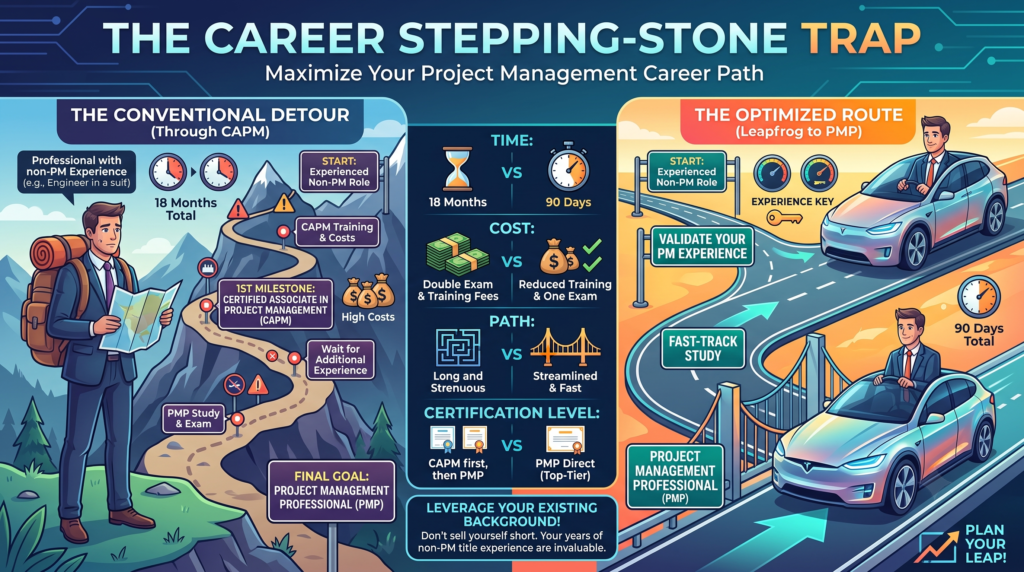
Decoupling Experience vs. Titles (The Direct PMP Path)
To understand why experienced professionals should bypass CAPM, you must first understand how PMI defines these two credentials and how recruiters evaluate them.
CAPM vs. PMP: The Structural Difference
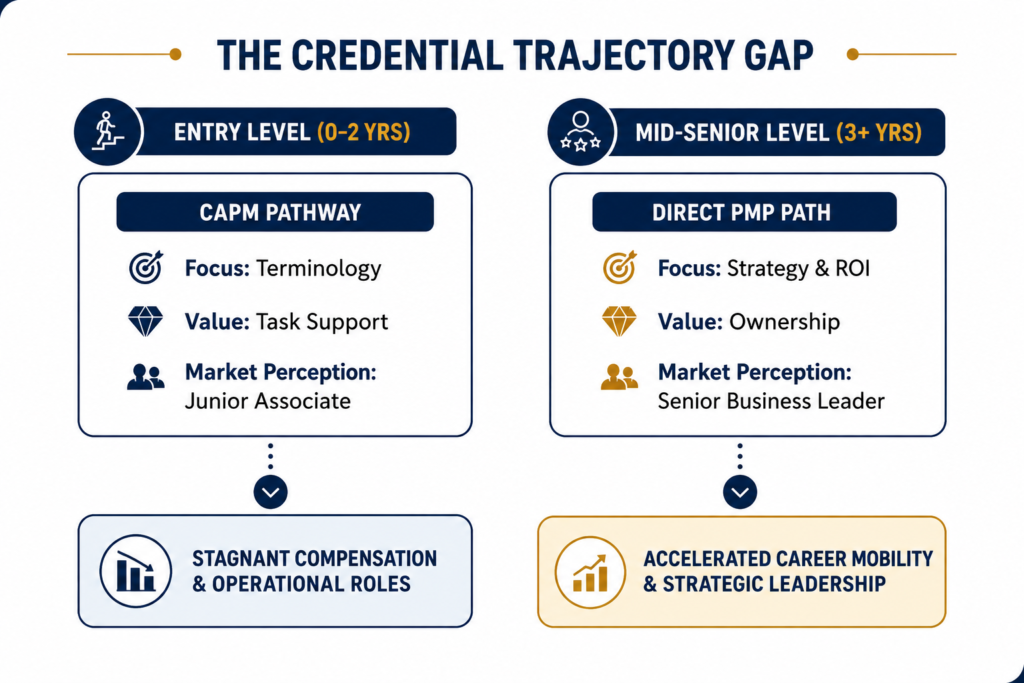
CAPM (Certified Associate in Project Management): Designed specifically for entry-level candidates, recent college graduates, or individuals transitioning into business roles with zero project leadership experience. It tests foundational knowledge of the PMBOK Guide, basic business analysis, and Agile concepts.
PMP (Project Management Professional): The global gold standard for project leaders. It tests practical execution across three domains: People (soft skills, team leadership), Process (predictive, Agile, and hybrid methodologies), and Business Environment (strategic alignment, compliance, and organizational value delivery).
| Feature | CAPM | PMP |
| Target Audience | Students, Entry-Level Professionals (0 to 3 years) | Experienced Professionals, Team Leads, Managers (3+ years) |
| Prerequisites | Secondary degree + 23 hours of PM education | Bachelor’s degree + 36 months PM experience + 35 contact hours (OR High School diploma + 60 months PM experience + 35 contact hours) |
| Primary Exam Focus | Terminology, framework definitions, fundamental concepts | Situational judgment, real-world application, hybrid delivery |
| Market Perception | “I understand project terminology.” | “I know how to deliver complex strategic projects successfully.” |
| Average Salary Impact | Minimal to moderate baseline entry | 16% to 32% increase on average (PMI Earning Power Survey) |
The "Hidden Experience" Realization
The biggest reason experienced leaders erroneously target CAPM is a misunderstanding of PMI’s definition of “project experience.”
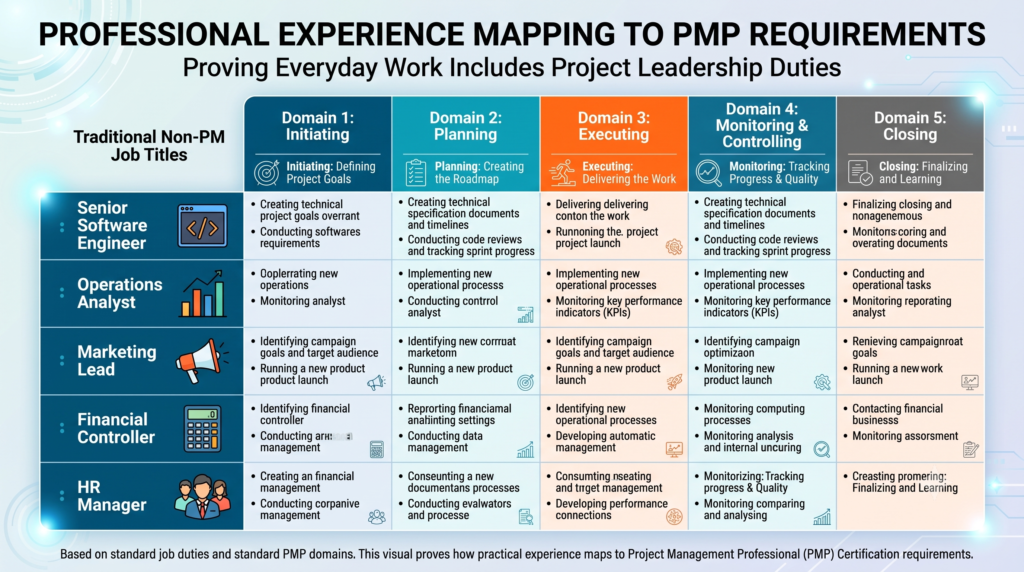
Many professionals assume that if their official job title was not “Project Manager,” their work does not count toward the PMP’s required 36 or 60 months of experience. This assumption is incorrect.
PMI defines a project as a temporary endeavor undertaken to create a unique product, service, or result. You do not need to have held the title of Project Manager. If you have done any of the following, you have led projects:
Engineered a new software feature rollout or system integration.
Managed an office relocation or operational restructuring.
Designed and launched a multi-channel marketing campaign.
Implemented a compliance framework or audit preparation workflow.
Developed a corporate training curriculum or onboarding program.
If you have led cross-functional efforts to achieve a specific business outcome over the last eight years, you likely already possess the experience required to qualify for the PMP exam directly.
The 4-Step Direct PMP Application Framework
If you have at least three years of professional work experience, follow this step-by-step framework to bypass CAPM and submit a bulletproof, audit-ready PMP application directly to PMI.
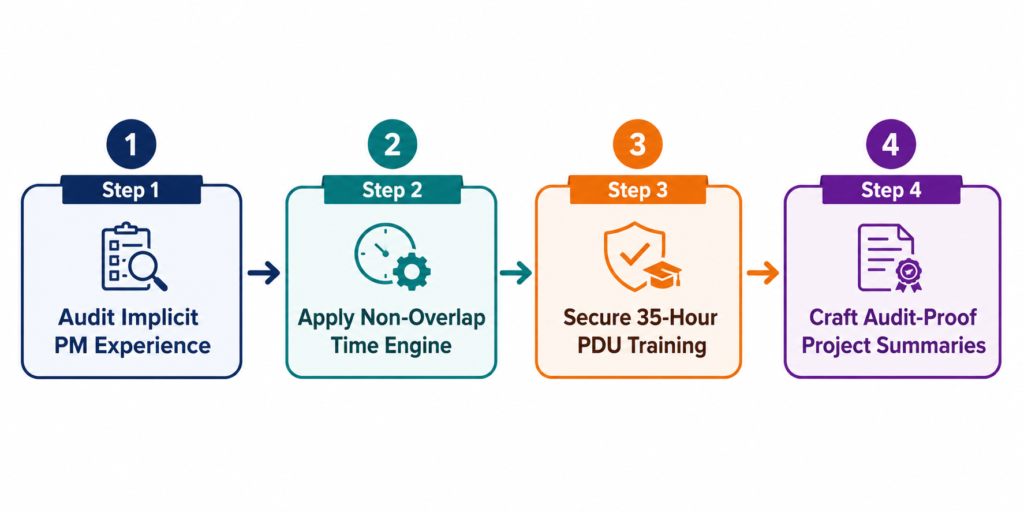
Step 1: Audit Your Implicit PM Experience
Map your career history against the three PMP performance domains. Group your past initiatives into discrete projects rather than daily operational tasks.
For instance, managing daily IT tickets is operations (does not count). Upgrading the entire company’s server infrastructure over four months is a project (counts fully).
Step 2: Apply the "Non-Overlap" Time Engine
PMI requires 36 unique months of project leadership experience within the last eight years (if you hold a four-year degree). Crucially, project months cannot overlap.
If you led Project A from January to June 2024 (6 months) and concurrently led Project B from April to September 2024 (6 months), PMI calculates your total experience for that timeframe as 9 months, not 12. Map your projects chronologically on a timeline to ensure you hit 36 unique, non-overlapping months.
Step 3: Secure Your 35 Contact Hours Efficiently
Instead of spending 23 hours studying basic terminology for the CAPM, invest directly in a PMI Authorized Training Partner (ATP) program that satisfies the required 35 contact hours of project management education for the PMP. This fulfills your educational prerequisite while simultaneously preparing you for the actual PMP exam.
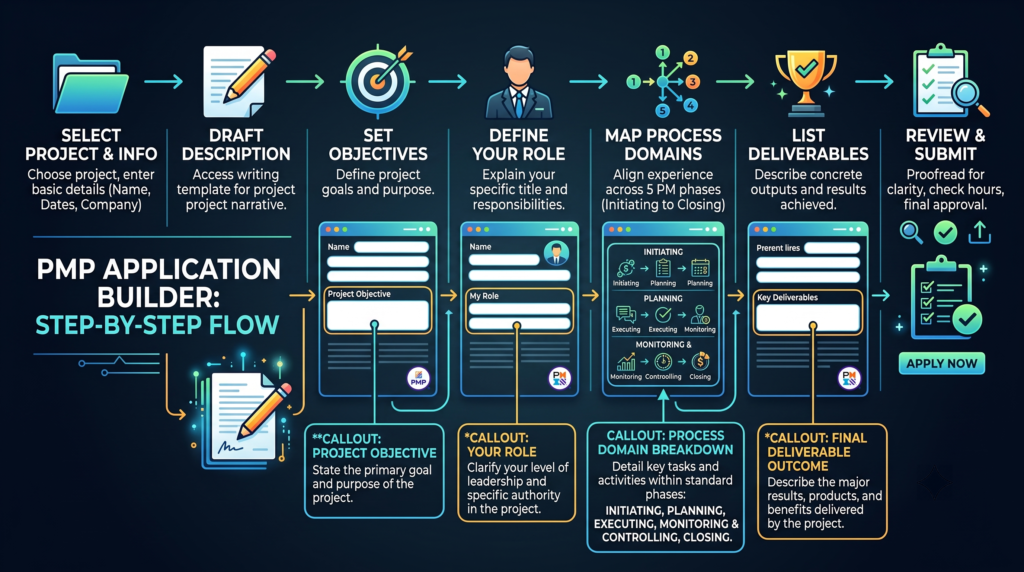
Step 4: Write Audit-Proof Project Summaries
When detailing your experience on the PMP application, structure every single project description using a clean, standardized formula:
Objective: The strategic goal of the project (1 to 2 sentences).
Role: Your specific leadership responsibility (e.g., Lead Project Manager, Technical Lead).
Responsibilities by Phase: Highlighting your work across Initiating, Planning, Executing, Monitoring/Controlling, and Closing.
Outcome: The tangible business impact delivered (1 sentence).
Example Application Snippet:
Objective: Implement an enterprise resource planning (ERP) system to centralize supply chain operations across three regional facilities.
Role: Lead Project Manager responsible for cross-functional alignment, budget control, and stakeholder management.
Execution: Initiated project charter and identified key stakeholders. Planned schedule, scope, and resource allocation. Executed sprint cycles with software vendors and internal IT teams. Monitored risk register and tracked earn value performance metrics. Controlled scope change requests. Closed project by conducting final user acceptance testing (UAT) and delivering handoff documentation to operations.
Outcome: Successfully reduced order processing friction by 28% and brought the platform live on schedule.
Elevating Your Trajectory and Market Value
Bypassing CAPM and securing your PMP directly transforms how executive leadership, talent acquisition teams, and clients view your capabilities.
The Perception Shift: From Task Doer to Strategic Leader
When you display a CAPM on your profile while holding six years of professional experience, recruiters assume you are still operating at an entry-level capacity. It inadvertently signals a lack of confidence in your real-world accomplishments.
Conversely, holding the PMP badge signals immediate authority. It proves that you do not just assist on projects: you own the vision, manage stakeholders, navigate complex political and technical constraints, and deliver measurable return on investment.
The Financial Advantage
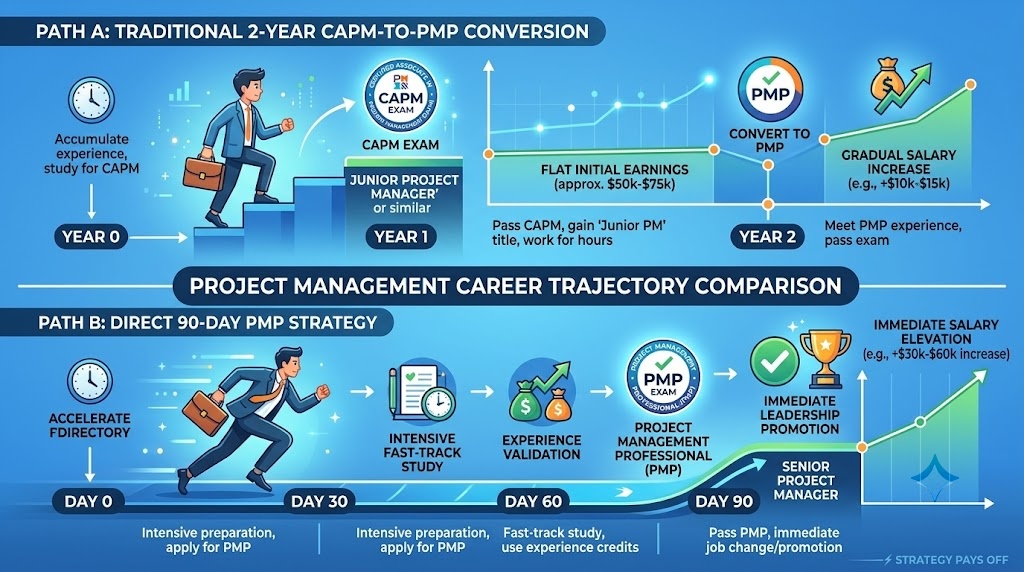
According to PMI’s Earning Power Salary Survey, professionals holding the PMP certification report median salaries significantly higher than non-certified peers: often earning between 16% and 32% more depending on the market and country.
The CAPM, while valuable for university graduates, carries negligible compensation leverage for experienced mid-career professionals. Spending six months preparing for CAPM costs you opportunity time: six months where you could already be earning at the higher PMP compensation tier.
By eliminating the unnecessary step, you compress your timeline to elite certification, position yourself for strategic leadership roles, and immediately align your credentials with the actual complexity of the work you perform every day.
Claim Your Seat at the Executive Table
Navigating your project management certification journey should not feel like guessing in the dark. If you have spent years leading teams, building products, optimizing processes, or driving business growth, you do not belong in an associate-level queue. You belong on the direct path to the PMP.
The choice is simple: You can spend the next year taking incremental, entry-level steps that hold your career back, or you can audit your real-world experience, build a strategic application, and earn the global gold standard in project leadership right now.
Accelerate Your Career with Skillsetify
Navigating PMP eligibility rules, translating non-standard work histories, and preparing for situational scenarios require expert guidance.
If you are ready to stop guessing, move up the corporate ladder, and learn project management the right way, reach out to Skillsetify. We do not just teach frameworks: we show you your exact career growth trajectory.
Contact our senior executive advisors today to receive a personalized, complimentary review of your project experience and fast-track your PMP journey.