Why Verbal Agile Estimation Is Ruining Your Sprint Budgets
It is the final day of sprint planning. Your product release deadline is locked in for the quarter, yet your engineering board is bleeding red. A critical user story for single sign-on integration, originally estimated at three story points during an open verbal session, has spiraled into a two-week architectural nightmare. Scope creep is consuming your budget, the QA team is blocked, and leadership demands answers. How did an entire engineering team miss a massive technical dependency?
The post-mortem reveals a painful truth. During the estimation meeting, the principal architect flippantly blurted out, “That’s easy, it’s a three.” The mid-level and junior developers, despite secretly knowing that the legacy authentication database had unmapped endpoints, stayed silent. Nobody wanted to contradict the most senior voice in the room or appear incompetent in front of peers. Group pressure won, accuracy lost, and the sprint crashed before it even began.
This crisis points directly to a pervasive corporate myth: the belief that open, verbal estimation discussions yield authentic consensus. Modern engineering management often assumes that getting everyone around a table or video conference to talk through story points will naturally surface all perspectives. In reality, unconstrained verbal estimation actively stifles critical technical insights through social pressure, authority bias, and cognitive anchoring.
Decoding Alternative Sizing Frameworks and Anonymous Card Mechanics
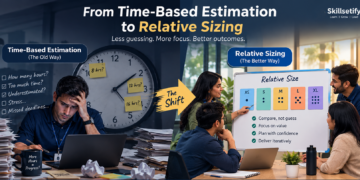
To eliminate estimation guesswork, project leaders must move away from absolute time predictions and open verbal declarations. Traditional software planning failed because human brains are fundamentally inefficient at predicting absolute time in uncertain environments. Estimating that a feature will take exactly 37.5 hours creates a false sense of precision. Agile methodology addresses this through relative sizing, comparing the complexity, risk, and volume of an unknown task against a well-understood reference baseline.
However, relative sizing only works if every developer provides an unvarnished, independent perspective. When team members hear another person’s number first, their subconscious instantly anchors to that value. To solve this, high-performing B2B organizations deploy structured card setups within alternative sizing frameworks.
The Psychology of Anchoring and Cognitive Bias in Estimation
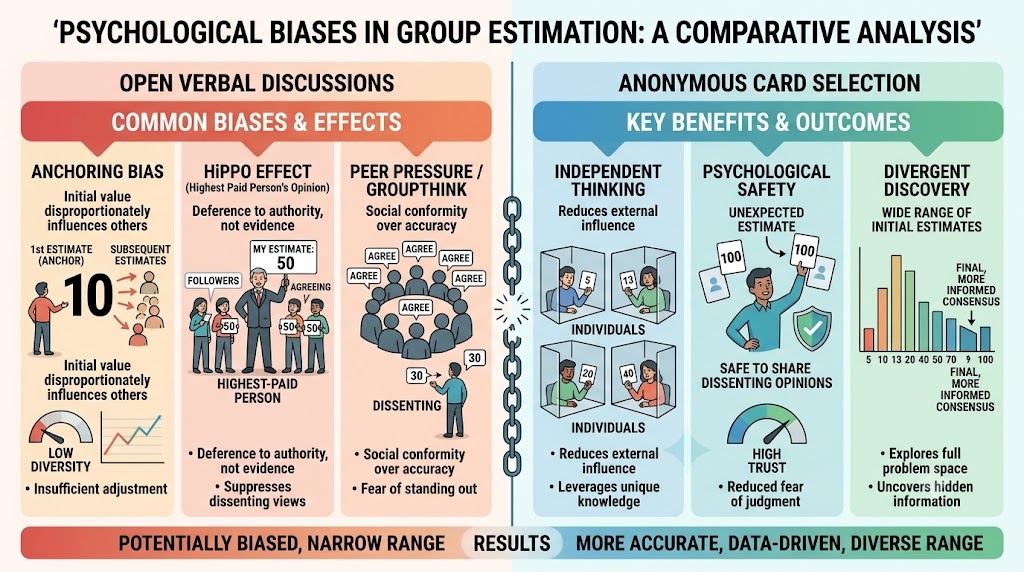
Group estimation dynamics are heavily impacted by three primary psychological phenomena:
Anchoring Bias: The tendency for individuals to rely heavily on the first piece of information received. When a lead developer suggests a story point value out loud, all subsequent votes skew toward that initial baseline.
The HiPPO Effect (Highest Paid Person’s Opinion): Junior team members frequently suppress valid technical warnings to align with the vocal predictions of senior management or team leads.
Social Loafing and Herd Mentality: In large verbal estimation meetings, passive participants simply agree with the majority opinion to avoid lengthy debate, hiding underlying implementation risks.
By decoupling the card selection process from immediate verbal communication, project managers can create a psychologically safe sandbox where every engineer reveals their honest technical assessment simultaneously.
Planning Poker Card Setup: The Anonymous Execution Protocol
Planning Poker, rooted in the Wideband Delphi estimation technique, uses a specialized card deck based on a modified Fibonacci sequence: 0, 1, 2, 3, 5, 8, 13, 20, 40, and 100. The non-linear progression between these numbers reflects the exponential growth of uncertainty as task complexity increases. Distinguishing between a 2 and a 3 is straightforward, but attempting to debate whether a massive epic is a 37 or a 40 is a waste of corporate resources. The jump from 20 to 40 forces teams to break down oversized stories into manageable user stories.
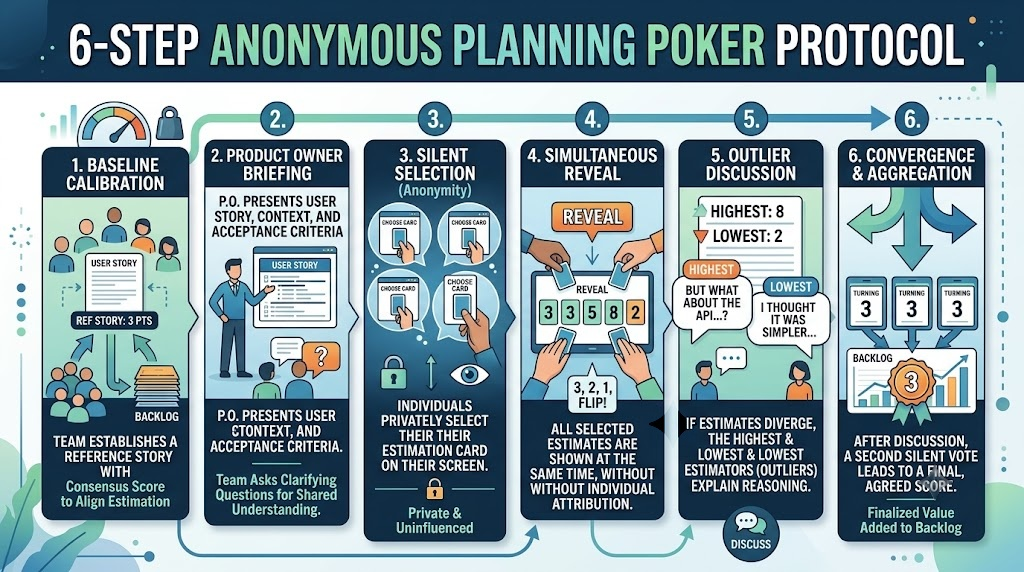
To execute an anonymous card setup effectively, Project Managers should follow this rigorous six-step implementation framework:
Baseline Calibration: Establish a shared reference story from a past sprint that the entire team understands. Assign this benchmark story a fixed point value, such as 5 points, to serve as the team’s universal measuring stick.
User Story Presentation: The Product Owner reads the backlog item clearly, detailing the acceptance criteria, user context, and definition of done without expressing any opinion on effort or timeframe.
Silent Technical Clarification: Engineers ask targeted questions regarding database schema changes, API endpoints, third-party integrations, and testing requirements. No numbers or effort terms may be uttered during this stage.
Blind Anonymous Selection: Each developer selects a card from their digital or physical Fibonacci deck in total silence. In remote settings, digital poker tools hide selections behind flipped virtual cards. In physical settings, cards are placed face down on the table.
Simultaneous Reveal: On the Project Manager’s cue, all cards are flipped simultaneously. This eliminates visual or verbal anchoring.
Divergence Discussion and Convergence: Rather than taking a mathematical average, the PM immediately directs the conversation to the extreme outliers: the lowest voter and the highest voter.
For example, if eight developers vote 3 points for an API update, but a junior tester votes 13, the PM asks the 13-voter to explain their perspective. The tester might point out that third-party sandbox rate limits require writing custom mock frameworks, a hidden bottleneck overlooked by the developers. After a brief discussion, the team conducts a second round of anonymous card voting until tight consensus is reached.
Evaluating Alternative Sizing Frameworks
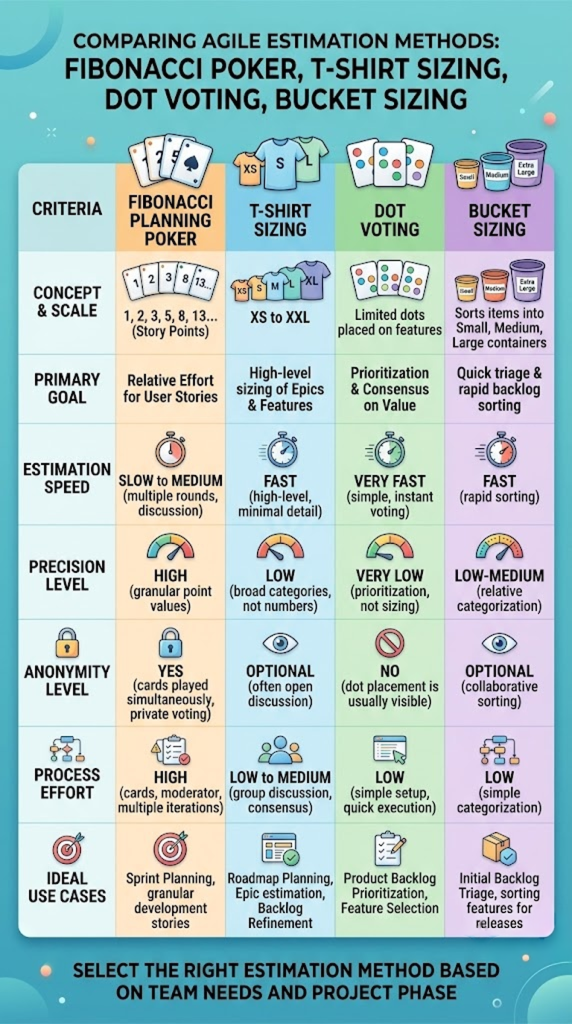
While Planning Poker with Fibonacci cards is the industry standard for detailed sprint planning, modern project management requires selecting the right framework for the right project stage. Below is a structural breakdown of alternative relative sizing methodologies:
Modified Fibonacci (Planning Poker): Ideal for granular sprint planning (1 to 2 week iterations). It provides precise relative complexity scoring while preventing artificial accuracy on large features.
T-Shirt Sizing (XS, S, M, L, XL): Best suited for high-level roadmap planning, epic sizing, and quarterly discovery. It allows teams to rapidly categorize 50 backlog items in an hour without getting bogged down in numeric debates. Each size represents an exponential tier of relative effort.
Dot Voting: A rapid prioritization and effort-weighting framework where team members distribute a fixed budget of visual tokens or “dots” across candidate backlog items. It is particularly effective when deciding which candidate features fit into a fixed delivery window when technical complexity is relatively uniform.
Bucket Sizing: A hybrid approach where cards are silently placed into labeled physical or virtual bins representing point values. It accelerates estimation for large backlogs containing hundreds of items.
To help select the appropriate approach for your operational context, review the framework breakdown below:
Framework | Best Use Case | Primary Benefit | Anonymity Level | Iteration Frequency |
| Modified Fibonacci Poker | Sprint Backlog Refinement | Prevents anchoring, uncovers hidden risks | High (via blind card reveal) | Bi-weekly / Per Sprint |
| T-Shirt Sizing | Quarterly Roadmap Planning | Eliminates numeric debate, fast setup | Medium (can be run silently) | Quarterly / Release |
| Dot Voting | Feature Prioritization & Allocation | Democratic consensus on value vs effort | High (via secret ballot) | On-demand / Workshops |
| Bucket Sizing | Large Backlog Grooming (>100 items) | High speed for massive work volumes | Low to Medium | Initial Discovery Phase |
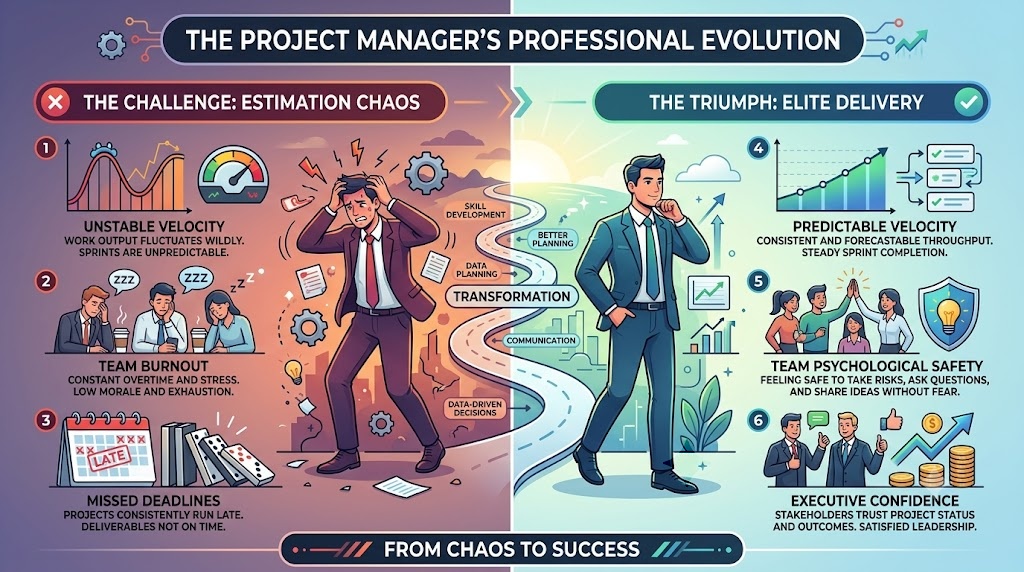
From Estimation Chaos to Predictable Elite Delivery
When you systematically eliminate group pressure and replace flawed verbal estimates with anonymous card selection, your software delivery engine transforms overnight.
Gone are the days of toxic retro meetings where engineers point fingers over missed sprint commitments. Gone is the chronic scope creep that forces developers into weekend crunch cycles and burns out your top talent. By capturing uncoerced technical perspectives, your estimation accuracy sharpens dramatically. Sprint velocity stabilizes from a chaotic rollercoaster into a predictable, smooth trendline.
Imagine entering executive quarterly business reviews with complete confidence in your delivery forecasts. When stakeholders ask if a high-stakes feature set will ship on time, you are no longer relying on senior developers’ optimistic hand-waving. Instead, you present data backed by true democratic consensus, calibrated baselines, and rigorous outlier analysis.
Mastering these subtle psychological and structural nuances of project management elevates your role from a reactive administrative task-tracker to a high-impact strategic leader. Organizations do not promote project managers simply because they update Gantt charts: they promote leaders who create operational predictability, foster psychological safety, and safeguard company resources through elite framework execution.
Elevate Your Career with Skillsetify
Establishing an anonymous Planning Poker card setup is more than just a slick facilitation technique: it is a foundational pillar of high-maturity Agile governance. By replacing loud verbal declarations with structured, secret card voting, you protect your team from anchoring bias, surface critical technical risks early, and build a resilient culture of transparent estimation.
If you are ready to stop guessing, move up the corporate ladder, and learn project management the right way, reach out to Skillsetify. We do not just teach frameworks: we show you your exact career growth trajectory.