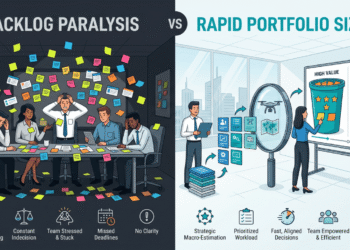
Mastering Rolling Wave Planning and Just-In-Time Estimation in Modern Enterprise Management
The 12-Month Gantt Chart Mirage
Picture this: It is Monday morning. The executive steering committee sits around a polished mahogany conference table, demanding a fixed, 18-month delivery schedule for a multi-million-dollar software platform overhaul. You are expected to estimate every work package, assign precise story points to epics scheduled two years out, and commit to a delivery date down to the exact Friday.
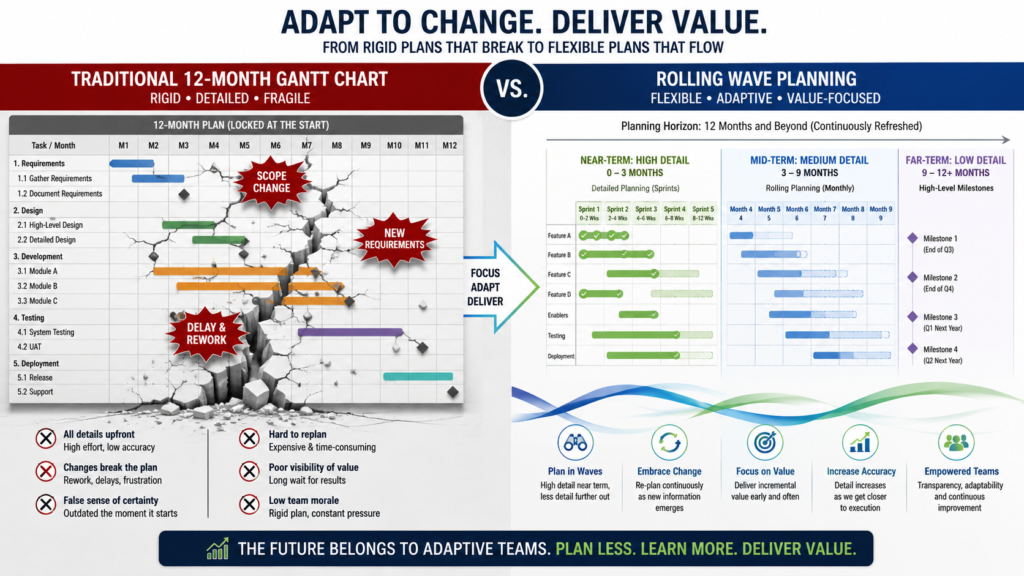
Fast forward six months. Market conditions shift dramatically, a competitor launches a game-changing feature, and core technological assumptions fall apart. Yet your team remains handcuffed to a rigid, year-old Gantt chart. Every release transforms into an exercise in emergency patch-work, team burnout escalates, and scope creep quietly erodes profitability.
This scenario plays out across enterprise organizations daily. The root cause is a fundamental misconception in modern project management: the false belief that detailing plans years in advance increases project predictability and control. In high-velocity, uncertain markets, long-term precision does not create control; it creates waste, rigidity, and administrative friction.
Decoding Progressive Elaboration: JIT and Rolling Wave Mechanics
To eliminate estimation waste, elite project organizations decouple near-term execution from far-term strategic vision. This balance relies on two core practices: Just-In-Time (JIT) Estimation and Rolling Wave Planning.
What is Rolling Wave Planning?
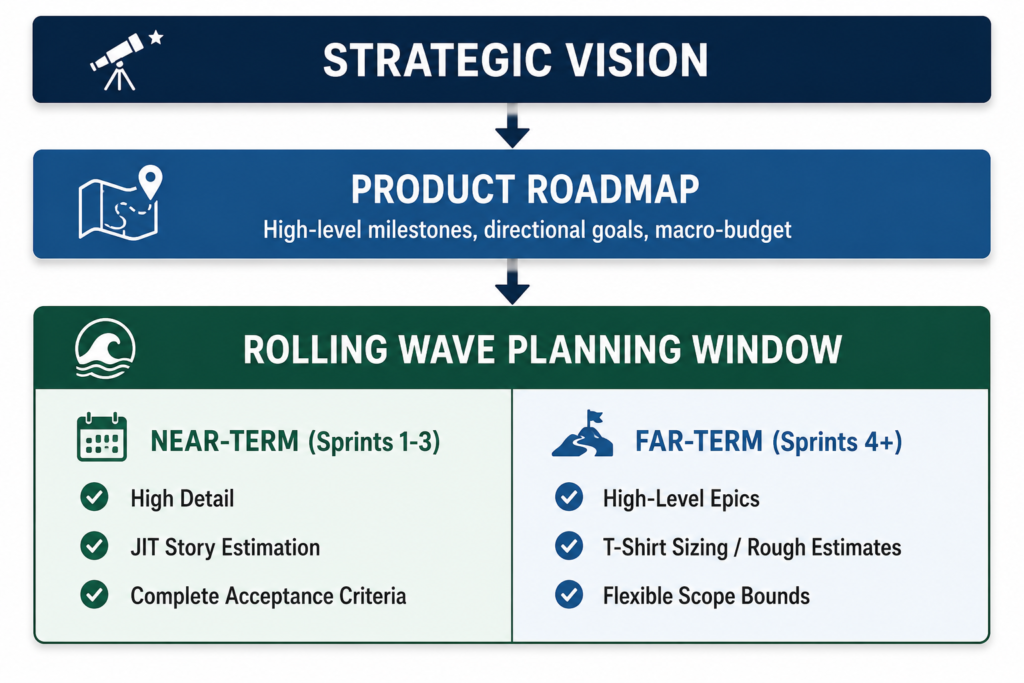
Rolling Wave Planning is an iterative planning technique where work to be performed in the near term is planned in detail, while work further in the future is planned at a higher level. It applies the principle of Progressive Elaboration, acknowledging that uncertainty is highest at the start of a project and decreases as work progresses.
What is Just-In-Time (JIT) Estimation?
JIT Estimation delays detailed work item sizing until right before execution. Instead of spending hundreds of engineering hours estimating backlog items that may be deprioritized or rewritten, teams estimate user stories during back-log refinement or sprint planning right before implementation.
Why Traditional Long-Term Estimation Fails
The Cone of Uncertainty: At project initiation, estimates carry a variance range of up to -50% to +200%. Detailing work at this stage relies on speculation rather than empirical data.
High Maintenance Costs: Detailed plans change constantly. Updating dependencies, resource allocations, and story points for far-term items creates unnecessary management overhead.
Psychological Anchoring: High-level estimates made early often get locked in as firm commitments by stakeholders, setting teams up for perceived failure when conditions evolve.
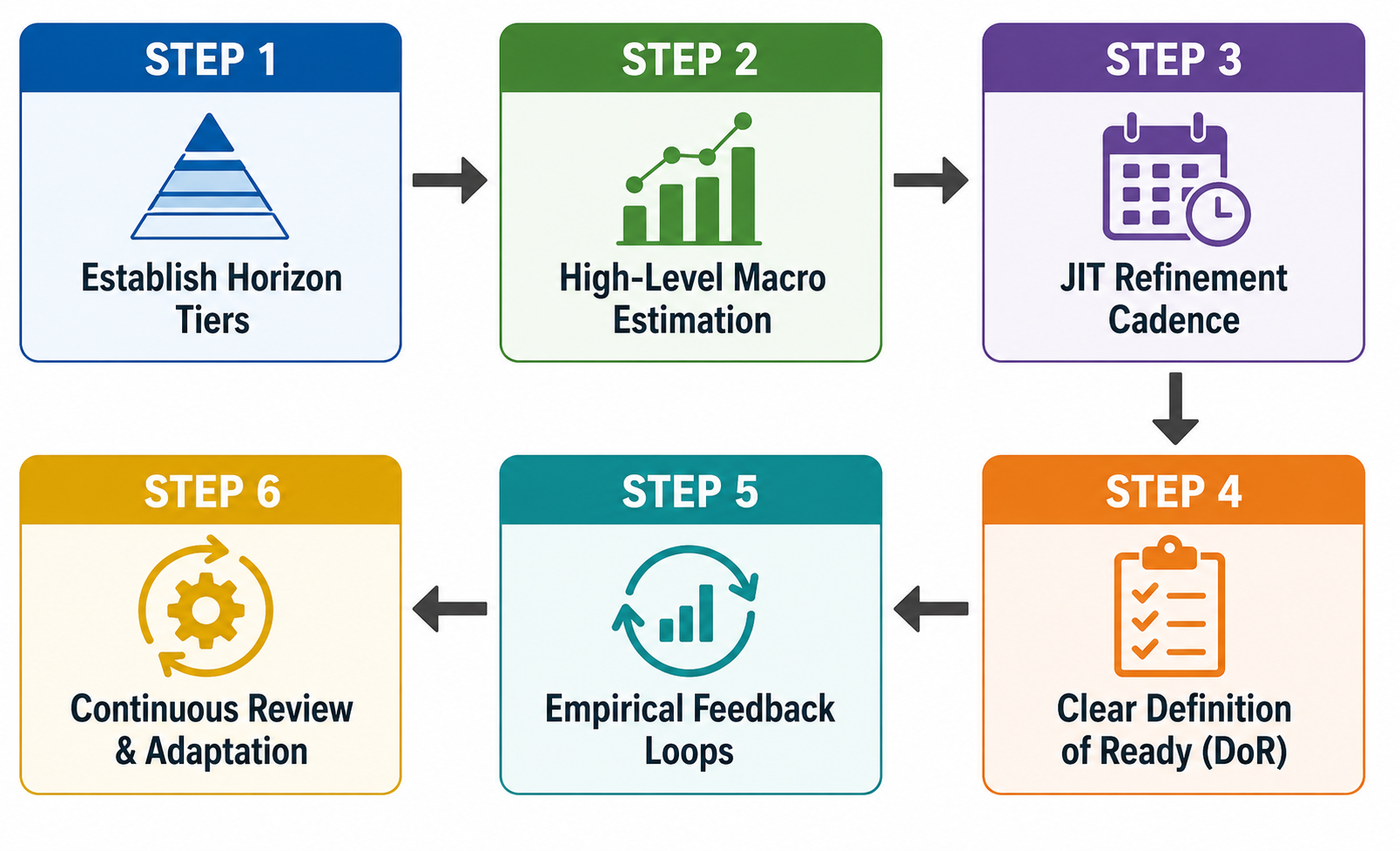
The Executive Step-by-Step Implementation Framework
Transitioning your enterprise to JIT estimation and Rolling Wave planning requires a structured approach. Here is an operational framework to deploy across your PMO.
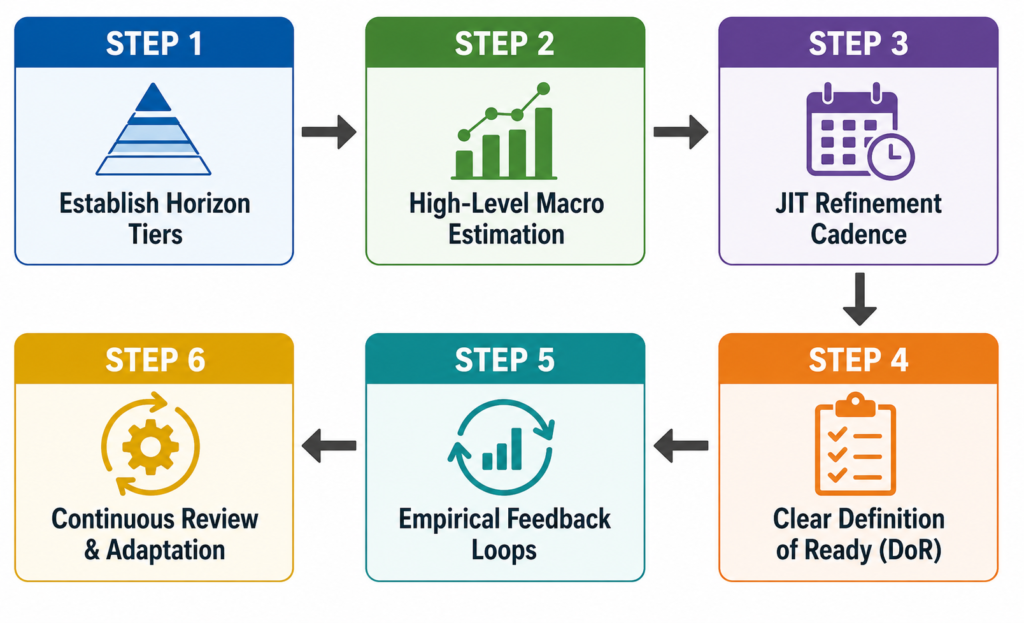
Step 1: Establish Planning Horizon Tiers
Divide your project timeline into distinct operational zones:
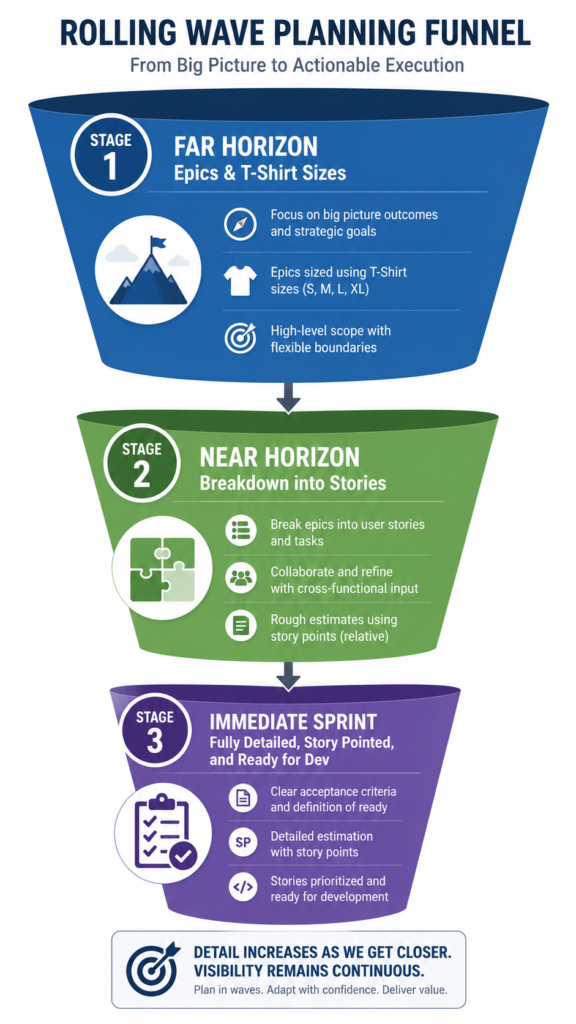
Immediate Execution Horizon (Current Sprint / Sprints 1 to 2): Fully refined user stories, definitive acceptance criteria, granular task breakdowns, and story point sizing.
Near-Term Horizon (Sprints 3 to 6 / Next Quarter): Coarse-grained user stories, epic-level breakdowns, and high-level complexity buckets.
Far-Term Horizon (Beyond 6 Sprints / Future Quarters): Strategic epics, broad outcome metrics, and rough T-shirt sizing (S, M, L, XL).
Step 2: Apply High-Level Macro Estimation for Long-Term Items
For far-term roadmap planning, avoid detailed story points. Use parametric estimation, historical velocity ranges, or T-shirt sizing. These methods provide budget and schedule boundaries without implying false accuracy.
Step 3: Implement a JIT Backlog Refinement Cadence
Establish a recurring, weekly or bi-weekly backlog grooming window. Only refine user stories entering the Immediate Execution Horizon (the next 2 to 4 weeks). This ensures engineering effort goes into estimating work that is well-understood and imminent.
Step 4: Enforce a Strict Definition of Ready (DoR)
A user story must satisfy entry criteria before detailed JIT estimation occurs:
Clear User Value: Defined purpose from the user’s perspective.
Explicit Requirements: Clear functionality boundaries.
Testable Acceptance Criteria: Explicit conditions for user acceptance.
Resolved External Dependencies: No blocking prerequisites.
Step 5: Establish Empirical Feedback Loops
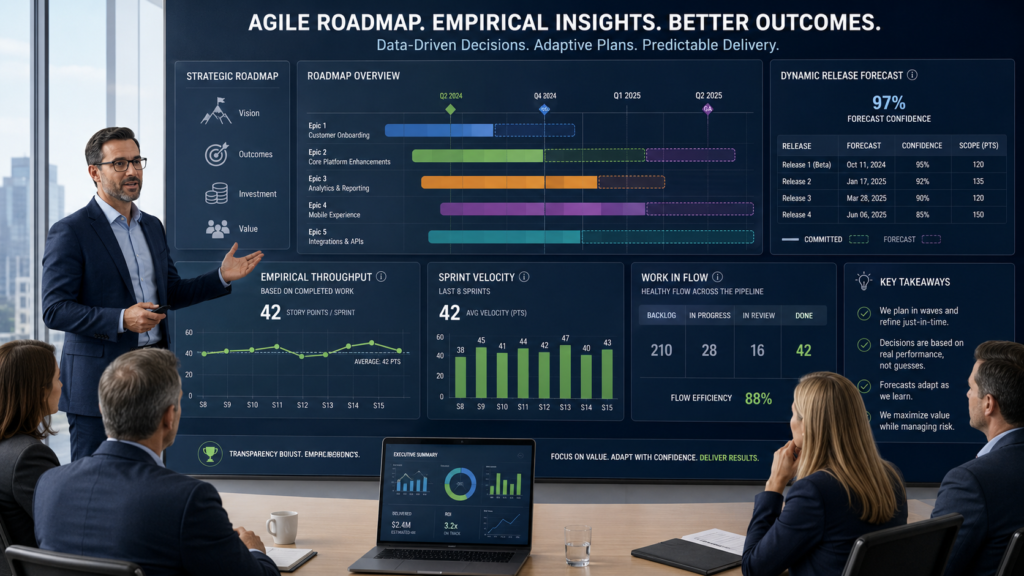
Replace speculative estimation with empirical team metrics. Use historical throughput, cycle time distributions, and team velocity to project future completion rates.
Step 6: Institute Rolling Horizon Reviews
At the conclusion of every milestone or release cycle, slide the planning window forward:
Convert near-term epics into refined user stories.
Re-evaluate far-term strategic objectives based on actual market feedback and empirical progress.
Adjust macro-budgets and release projections dynamically.
The Strategic Payoff: High-Velocity, Predictable Delivery
Adopting JIT estimation and Rolling Wave planning transforms enterprise delivery dynamics.
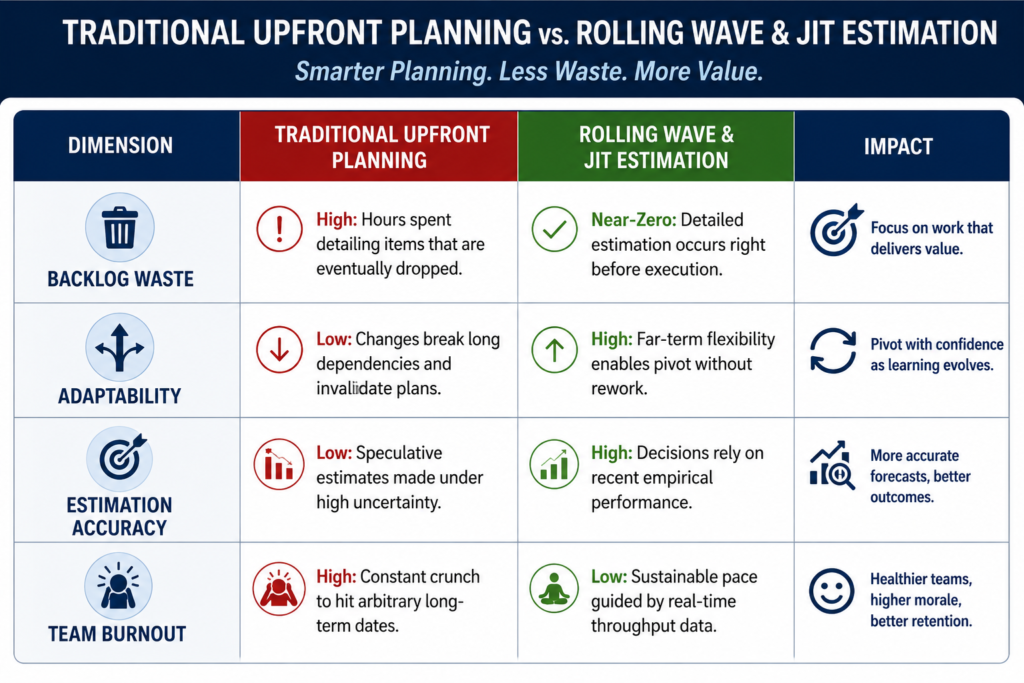
When you master this methodology, project management shifts from a defensive exercise in variance control into a strategic driver of enterprise agility. Scope creep ceases to be a crisis because future releases are designed to evolve based on incoming data. Team stress drops as developers work on well-defined, clear tasks, while executive leadership gains realistic, data-backed visibility into project trajectories.
For ambitious project leaders, mastering modern estimation and planning techniques is a critical career accelerator. Organizations do not reward managers who build perfect Gantt charts that fail upon market contact. They reward leaders who navigate uncertainty, minimize operational waste, and deliver value consistently.
Accelerate Your Leadership Trajectory with Skillsetify
The difference between managing projects and driving enterprise value comes down to methodology and leadership execution. Outdated estimation tactics and rigid planning models limit team efficiency and career growth.
To build predictable delivery systems, navigate corporate complexity, and step into senior leadership roles, you need practical, real-world instruction that goes beyond generic frameworks.
If you are ready to stop guessing, move up the corporate ladder, and learn project management the right way, reach out to Skillsetify. We do not just teach frameworks: we show you your exact career growth trajectory.
Visit Skillsetify today to explore our executive-level certifications and corporate training programs. Empower your team, elevate your career, and master modern delivery management.