Why Your Agile Transformation Is Failing (And How Mapping Principles to Values Fixes It)
Imagine this all-too-common executive nightmare. An enterprise organization invests $15 million into a multi-year digital transformation. The PMO mandates daily standups, installs enterprise Jira boards, enforces two-week sprints, and hires certified Scrum masters for every division. On paper, compliance is at 100 percent. Every single team is executing tactical ceremonies with military precision.
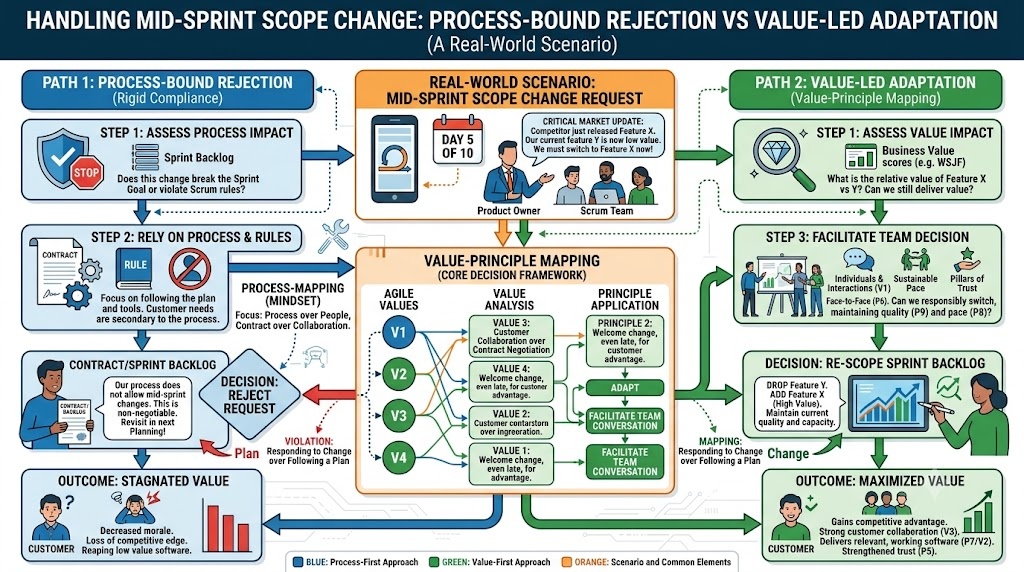
Yet, behind the scenes, chaos reigns supreme. Release dates slide every single quarter. Developers are burnt out from endless sprint commitments. Product leadership complains that delivered features do not match market needs, while technical debt mounts into an unmanageable tower. When a major client requests a critical mid-project adjustment, the program director points aggressively to the sprint backlog and declares that change requests cannot be entertained until the next release cycle.
What went wrong? The organization fell victim to the most pervasive corporate myth in modern project management: the belief that Agile is merely a collection of operational rules, frameworks, and meeting cadences.
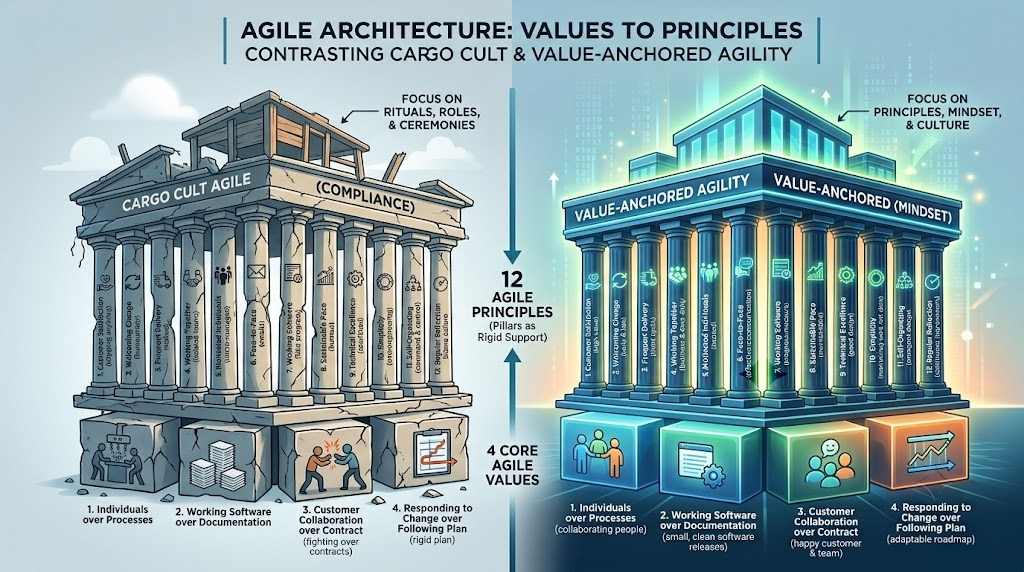
The reality is stark. Tactical principles do not live in an isolated vacuum. When project leaders enforce the 12 Agile principles as rigid compliance checklists without understanding how they map back to sustain the four core manifesto values, they do not build agility. They build a hyper-engineered, micromanaged process that wears an “Agile” badge while suffering from the exact same rigidity as traditional Waterfall delivery. True agility requires project managers to understand the architectural linkage: every single tactical principle exists solely to support, protect, and sustain a core manifesto value.
Deconstructing the Agile DNA: How Principles Serve Values
To move from mechanical compliance to elite delivery, project leaders must master the structural relationship between the foundational values articulated in the 2001 Agile Manifesto and the 12 supporting principles.
The four core values define the mindset: what we prioritize when trade-offs are required. The 12 principles define the operational mechanics: how we act in daily project environments. If you execute a principle without aligning it to its parent value, the practice degenerates into empty theater.
Let us examine how the 12 tactical principles map directly back to sustain the four core values.
Value 1: Individuals and Interactions Over Processes and Tools
This value asserts that human dynamics, psychological safety, and direct communication drive successful outcomes far more effectively than rigid toolchains or governance models. Four specific principles exist to protect this value:
Principle 4 (Daily Collaboration): Business stakeholders and developers must work together daily. This prevents formal status reporting tools from replacing real-time dialogue.
Principle 5 (Motivated Individuals and Trust): Build projects around motivated people, grant them the required environment, and trust them to deliver. This directly counters micromanagement and rigid process control.
Principle 6 (Face-to-Face Conversation): Direct conversation remains the most efficient transmission mechanism for complex ideas, minimizing reliance on heavy ticketing systems.
Principle 11 (Self-Organizing Teams): The best architectures and designs emerge from empowered, self-organizing teams, placing human collective intelligence over top-down process constraints.
Value 2: Working Software Over Comprehensive Documentation
This value shifts the ultimate measure of success from written promises and architectural specs to functional, deployed value. Four principles operationalize this core truth:
Principle 1 (Satisfy the Customer via Continuous Delivery): Early and continuous delivery ensures value reaches users rather than languishing in specification documents.
Principle 3 (Frequent Delivery Cycles): Delivering working solutions every few weeks forces the team to focus on tangible output over theoretical planning.
Principle 7 (Working Output as Primary Progress Metric): Working software is the single true measure of progress, rendering progress reports meaningless if no functional output exists.
Principle 9 (Technical Excellence and Good Design): Continuous attention to code quality ensures that working software remains scalable and maintainable over time.
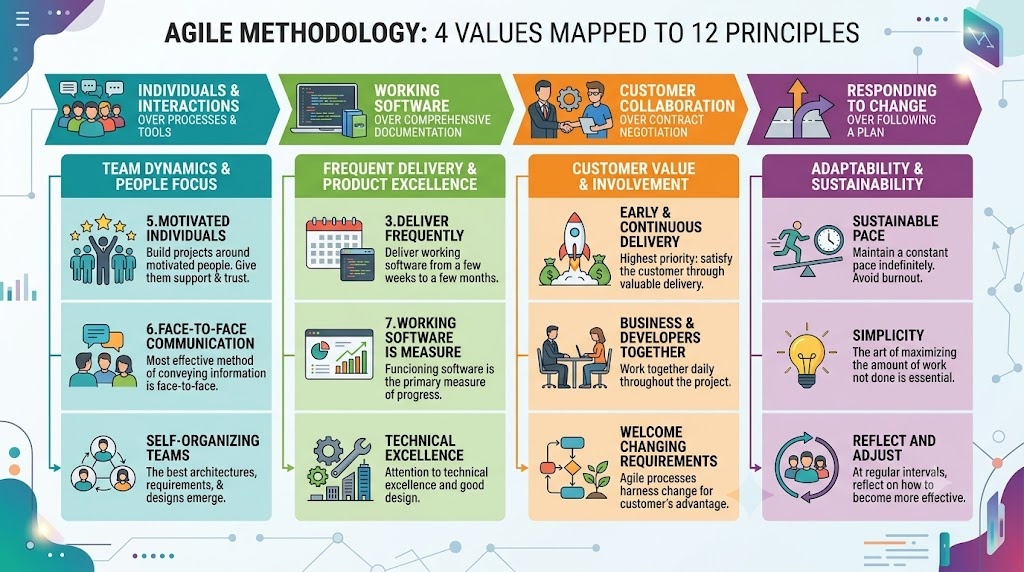
Value 3: Customer Collaboration Over Contract Negotiation
This value challenges the traditional adversarial relationship between delivery teams and business stakeholders, replacing rigid contractual scope boundaries with shared discovery. Three principles sustain this trust:
Principle 1 (Customer Satisfaction Focus): Prioritizing customer satisfaction keeps the focus on real outcome value rather than contractual scope defense.
Principle 4 (Cross-Departmental Unity): Daily interaction between business leaders and engineers breaks down organizational silos and eliminates “us versus them” dynamics.
Principle 10 (Simplicity and Work Maximization Not Done): Maximizing work not done eliminates bloated feature sets that customers do not actually need, preventing scope waste.
Value 4: Responding to Change Over Following a Plan
This value acknowledges that uncertainty is inevitable in modern business, making adaptability far superior to blind adherence to an obsolete baselined plan. Three principles empower this adaptability:
Principle 2 (Welcoming Changing Requirements): Harnessing change late in development provides competitive advantage, turning pivots into strategic opportunities rather than project failures.
Principle 8 (Sustainable Pace): Maintaining a constant, healthy velocity indefinitely ensures the team retains the cognitive bandwidth required to adapt to sudden changes.
Principle 12 (Regular Reflection and Tuning): Frequent retrospectives allow teams to analyze performance, learn from shifts, and adjust behaviors dynamically.
The Enterprise PM Implementation Framework: The Value-Principle Alignment Audit
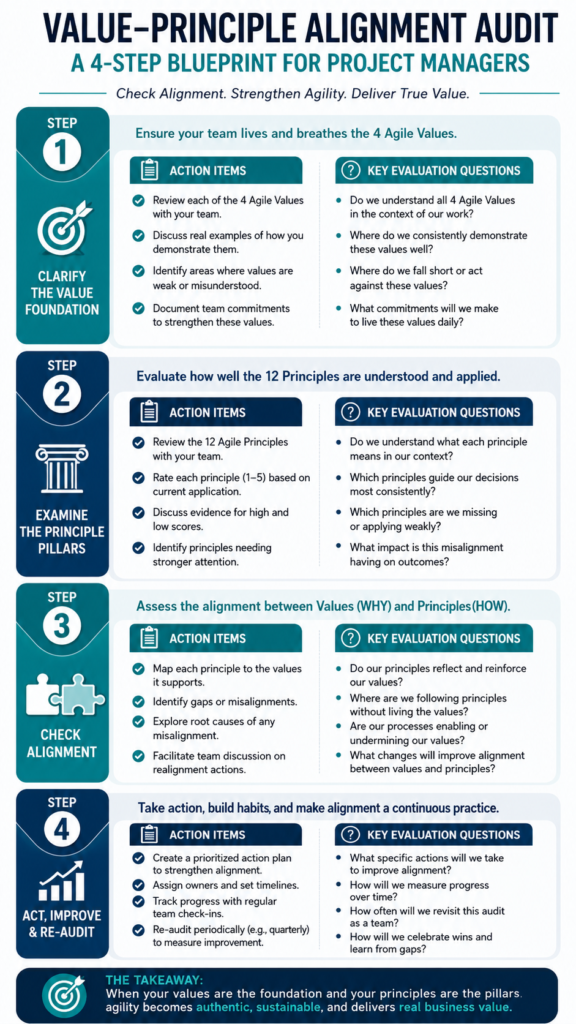
Knowing the theory is insufficient. Elite project leaders must actively audit and realign their delivery practices. Here is a four-step framework you can deploy immediately to ensure your team’s tactical principles are actively serving core manifesto values.
Step 1: Conduct a Ceremony vs. Culture Audit
Evaluate your current team ceremonies against their underlying values. Ask your team direct, candid questions:
Standups: Is our daily standup an interactive problem-solving session (supporting Individuals and Interactions), or is it a status reporting exercise for the PM (misaligned process)?
Sprint Demos: Are we demonstrating functional, working assets to stakeholders (supporting Working Software), or presenting slide decks detailing completed tasks?
Step 2: Map Organizational Friction Points
Identify where project friction occurs and trace it to a principle-value disconnect. For example, if business stakeholders complain about surprise delivery outcomes despite detailed sprint reviews, inspect Principle 4 (Daily Collaboration) and Value 3 (Customer Collaboration). The friction usually stems from replacing daily collaboration with isolated bi-weekly sign-offs.
Step 3: Recalibrate Governance Metrics
Replace traditional vanity metrics with value-anchored key performance indicators. Shift your reporting dashboards from tracking ticket velocity and story point burn-down (which measure process activity) to tracking functional release frequency, customer validation feedback, and cycle time (which measure working value and responsiveness to change).
Step 4: Institute Value-First Retrospectives
Transform your retrospectives from generic “what went well / what went wrong” lists into deliberate alignment checks. Structure your retrospective agenda around one of the four core values each sprint. Evaluate which supporting principles were honored, which were violated, and what tactical adjustments are required to restore balance.
From Project Chaos to Predictable, Elite Delivery
When you transition from managing Agile as a rigid tactical checklist to leading Agile as an anchored value system, the operational transformation is immediate and profound.
The toxic symptoms that plague traditional project environments vanish:
Scope creep battles transform into joint product discovery. Instead of fighting change requests with rigid change control boards, you evaluate pivots collaboratively based on customer value and technical reality.
Team burnout gives way to sustainable excellence. By anchoring team commitment to Principle 8 (Sustainable Pace) and Value 1 (Individuals and Interactions), you eliminate fire drills and cultivate high-performing, empowered engineering cultures.
Unpredictable releases turn into dependable, high-quality outcomes. By elevating working software as your primary metric of progress, executive stakeholders receive working value continuously, eliminating high-stakes end-of-year deployment panics.
This operational shift directly impacts your professional trajectory. Executive leaders do not evaluate high-potential project managers by their ability to run a frictionless Jira board or police sprint velocity. They promote leaders who can navigate ambiguity, bridge the gap between business strategy and execution, and deliver measurable business outcomes predictably.
Mastering the structural mapping between principles and values elevates you from a tactical coordinator to an indispensable strategic leader. It demonstrates that you understand the true mechanics of enterprise agility, positioning you for rapid career advancement and high-visibility leadership roles.
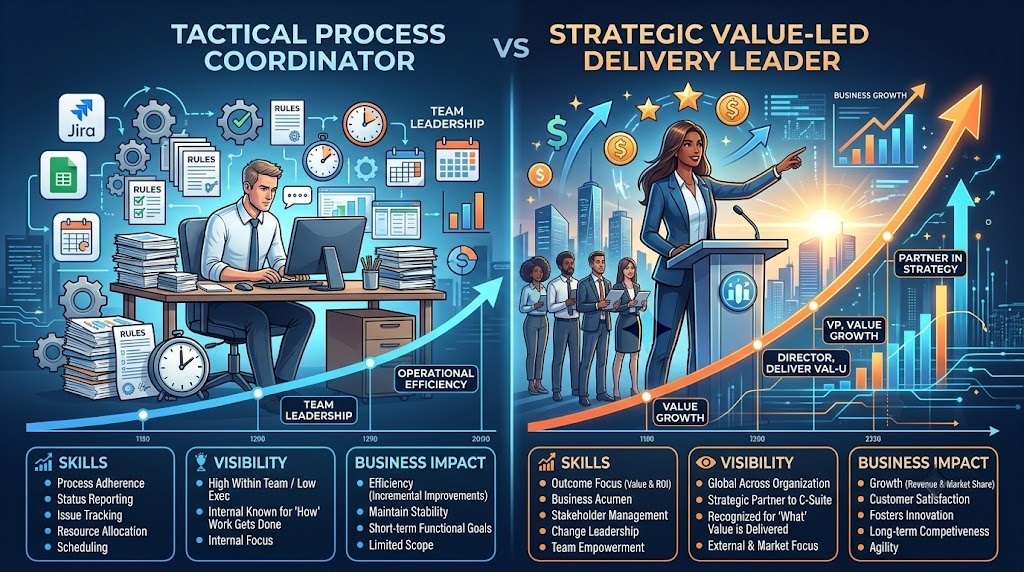
The difference between mediocre project delivery and elite enterprise leadership lies in foundational understanding. Anyone can learn to run a standup or create a Kanban board in an afternoon. True project leadership requires the expertise to architect delivery systems where tactical principles continuously nourish and protect core business values.
If you are ready to stop guessing, move up the corporate ladder, and learn project management the right way, reach out to Skillsetify. We do not just teach frameworks: we show you your exact career growth trajectory.