Why Interrelated System Regressions Are Killing Your Sprint Sizing
The staging environment was green, the deployment script executed without a single syntax error, and the engineering team went to bed at midnight celebrating a successful sprint close. By 4:00 AM, the emergency paging system was screaming. A critical hotfix designed to stabilize a minor memory leak in an interrelated database module had triggered a silent, catastrophic ripple effect. While the core database issue was successfully fixed, the modification unexpectedly stripped out browser cookie parameters from an completely independent, standalone user tracking function.
The checkout process completely froze, global single sign-on sessions collapsed across three companion platforms, and millions of dollars in transaction volume vaporized in a matter of hours. This is the standard corporate nightmare of unmapped regression testing failures. When system components are deeply interrelated, fixing a bug in one component can break completely standalone functions somewhere else entirely. Yet, when you look at how most software delivery organizations size their backlogs, you will discover a profound, pervasive systemic flaw.
There is a deeply damaging corporate myth that regression testing is an isolated quality assurance activity that occurs downstream from core development. Teams frequently size their user stories based solely on the isolated effort required to write new lines of code, completely ignoring the complex web of interrelated system dependencies. This short-sighted approach turns agile estimation into an exercise in pure fiction.
Regression testing issues are not execution bugs: they are estimation bugs failing to account for architectural interconnectedness during your initial estimation and sizing cycles is the primary reason why high-stakes software projects blow past their timelines, blow through their budgets, and cause severe team burnout.
The Silent Architecture of Regression Chaos
To build a genuinely predictable and resilient delivery engine, project managers must deeply understand the technical mechanics of regression failures and how they interact with relative estimation.
Why standalone functions break when interrelated parts are modified
Modern software systems are rarely built from truly isolated modules. Even when organizations claim to run pure, decoupled microservices architectures, deep underlying interdependencies remain. These dependencies hide within shared data schemas, global variable states, authentication workflows, and browser session configurations. When an engineering team attempts to fix an issue within an interrelated component, they are altering a shared architectural framework.
If the estimation process fails to account for this framework, the developer will write a localized fix that satisfies the immediate criteria but inadvertently breaks the implicit contracts relied upon by standalone, legacy functions elsewhere. For example, optimizing a global single sign-on cookie wrapper to enhance security might instantly invalidate session states inside an older analytics portal that cannot parse the new security token format.
The Estimation Deficit: Sizing the feature vs Sizing the system
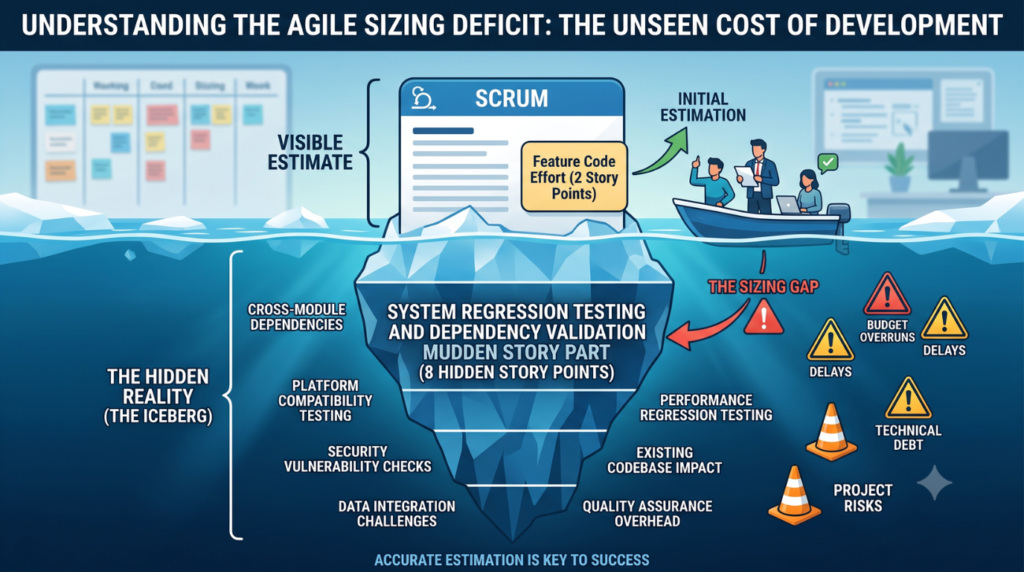
The true breakdown in agile delivery happens during backlog refinement. When a team assigns a story point value to a requirement using standard scales, they are supposed to account for three specific vectors: effort, complexity, and uncertainty. However, psychological anchoring forces developers to look at the explicit feature request in a vacuum.
If the story asks for a new dropdown option on a profile page, the team might call it a simple 2-point effort. What they fail to size is the reality that this profile data feeds a massive legacy reporting module that must now be exhaustively regression tested across multiple environment matrices to ensure nothing has broken. The localized work is minor, but the systematic regression impact is immense. If your estimation model does not capture system-level regression risk, your sprint capacity planning will collapse.
The Regression-Aware Sizing Matrix: A Structural Framework
Elite project management leaders do not leave quality to chance, nor do they treat regression testing as an unpredictable tax paid at the end of a sprint. They integrate dependency analysis directly into their baseline estimation frameworks.
To systematically address this within an organization, project managers must replace abstract guessing with a structured framework that explicitly forces the identification of interrelated dependencies before any point values are assigned.
REGRESSION RISK CARDINALITY MATRIX |
||
Interaction Level |
Impact Scope |
Sizing Buffer Baseline |
| Isolated Module | Localized Function | No Adjustment Required |
| Shared Data Layer | Cross-Functional Standalone Apps | Apply 1.5x Fibonacci Complexity Multiplier |
| Global State / SSO | Enterprise System Critical Path | Minimum 8-Point Floor; Mandatory Pre-Sprint Architecture Review |
By institutionalizing a standard matrix, the estimation process evolves from a guessing game into a repeatable architectural audit. When a developer understands that touching a shared code path instantly alters the story’s baseline sizing, the team inherently prioritizes regression avoidance from day one.
Step-by-Step Guide to Implementing Regression-Inclusive Sizing
To inoculate sprints against unexpected regression rollbacks, project managers can copy and use this actionable, step-by-step sizing framework during the upcoming backlog refinement cycle.
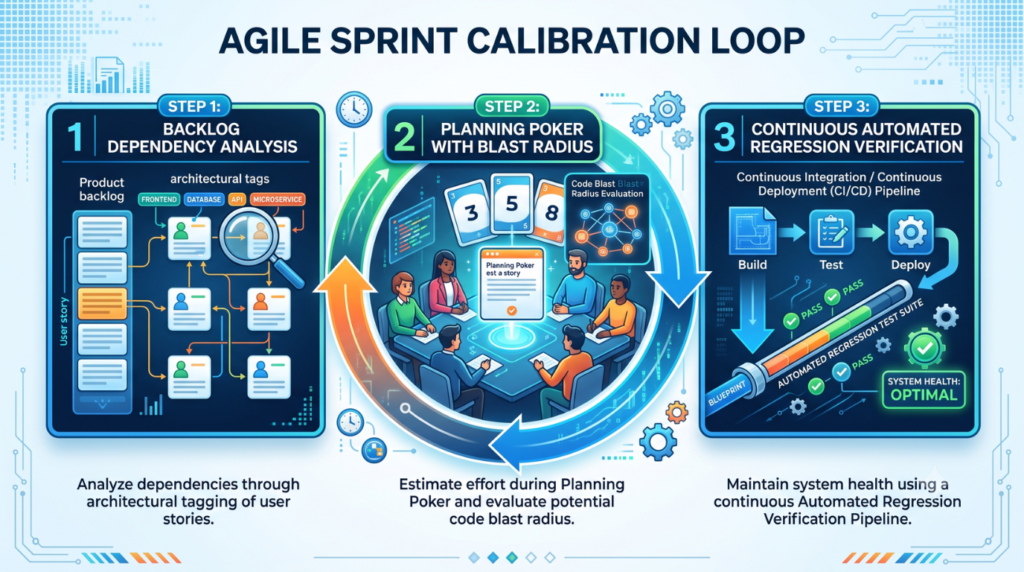
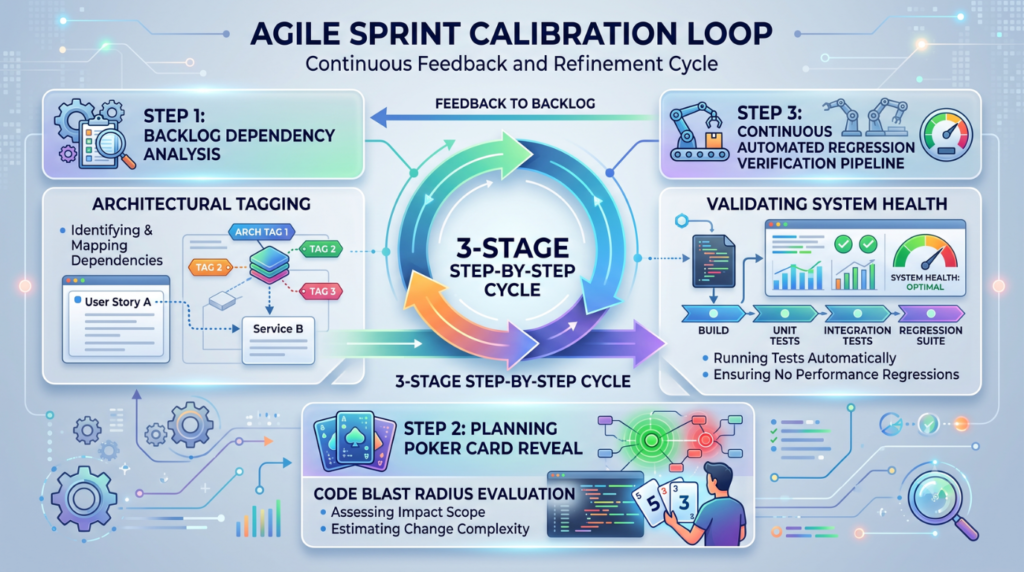
Step 1: Institutionalize Architectural Tagging in the Product Backlog
Before any team places a single estimate card on a user story, the requirement must pass through a strict dependency classification filter. The product owner and lead architect must evaluate if the item touches any core interrelated systems.
- Mark user stories with explicit metadata attributes, such as Shared Data Layer, Core Identity Component, or Third-Party API Consumer.
- If a card bears a dependency tag, it is barred from being estimated as an isolated function, automatically signaling to the team that a broader system review is required.
Step 2: Establish "Definition of Done" Regression Testing Benchmarks
An estimate is completely invalid if the team is not aligned on what complete truly means. You must refine the team’s shared Definition of Done to explicitly include regression boundaries.
- Ensure the criteria clearly state that a story cannot be closed until all modified interrelated components pass automated regression test suites.
- Require that any standalone function identified as high-risk within the dependency map must undergo targeted verification, ensuring that a fix in one area has not silently broken performance parameters somewhere else.
Step 3: Run Blind "Impact Complexity" Planning Poker Sessions
When facilitating planning poker sessions, alter the core questioning technique. Do not simply ask, “How long will this take to build?” Instead, mandate that the team evaluate the blast radius of the proposed code changes.
- Instruct developers to privately select cards that reflect the technical uncertainty of the underlying architecture, not just the writing of the specific function.
- When a major divergence in scores occurs, immediately isolate the highest estimator. Avoid the temptation to average the numbers out. Instead, challenge the team to uncover if the outlier developer has spotted an unmapped systemic relationship where an interrelated fix could cause a standalone function to fail.
Step 4: Map and Track the Velocity Deficit in Sprint Retrospectives
If an engineering team routinely falls short of their sprint velocity goals despite clean, isolated development cycles, run a regression-focused root cause analysis.
- Quantify exactly how many story points were lost due to emergency bug fixes, unexpected patches, and broken standalone functionalities discovered mid-sprint.
- Use this direct historical data to adjust future estimation factors, ensuring the team builds a realistic capacity buffer that honors the true complexity of their interrelated codebase.
From Chaotic Hotfixes to Elite, Predictable Delivery
When you build a robust, regression-aware estimation framework into the software delivery workflow, the day-to-day culture of an ambitious tech organization shifts dramatically.
The frantic, high-stress cycle of weekend deployments and 4:00 AM hotfixes disappears. The team stops looking through a narrow lens that treats every software modification as an isolated patch. Instead, developers and project stakeholders see the system as an organic whole, understanding how a change in an interrelated identity wrapper can ripple outward to break a standalone, downstream analytics component. Sprints stabilize, product quality skyrockets, and your team’s historical velocity metrics become an exceptionally reliable guide for future long-term forecasting.
For the ambitious project management professional, mastering this system-level thinking is a massive career milestone. You stop operating as a generic task-tracker who is constantly blindsided by unexpected development setbacks and cascading technical debt. Instead, you evolve into a highly authoritative, strategically minded technical leader who speaks rationally about systemic dependencies, root cause analysis, and value-driven engineering practices. This deep structural competence earns true respect from executive leadership and accelerates your rise up the corporate ladder into major program management and product leadership roles.
Accelerate Your Corporate Trajectory with Skillsetify
The difference between an average project manager and an elite technology director comes down to how they approach complex operational realities. If you are completely done with basic, surface-level certifications that only teach rigid textbooks, it is time to master real-world software governance with Skillsetify.
Skillsetify is a premium enterprise learning accelerator designed for ambitious leaders who want to run hyper-predictable projects and deliver unmatched business value. We completely bypass generic frameworks to show you the precise technical strategies, risk management models, and estimation principles that drive global software scale.
If you are ready to stop guessing, take control of your delivery pipelines, and rapidly advance up the corporate ladder, connect with the leadership team at Skillsetify today. We do not just teach standard agile frameworks: we map out your exact, step-by-step career growth trajectory.