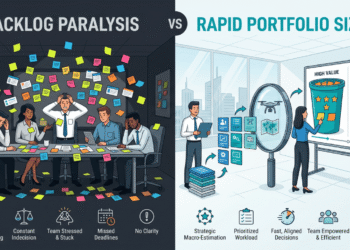
Why Your Daily Scrum Is Broken (And How the Inner Core of the Agile Planning Onion Fixes It)
It is 9:15 AM on a critical product release day in a high-stakes corporate environment. The executive leadership team expects a flagship software feature to launch before midnight. The project manager enters the morning meeting expecting routine operational alignment. Instead, a senior engineer casually drops a project-ending bomb: an unresolvable API integration error occurred four days ago, pushing the launch back by an entire month.
Panic erupts across Slack channels, stakeholder calls multiply, and the project manager faces a damning question: Why was a month-long delay completely invisible until the morning of release?
The root cause is a quiet crisis happening across corporate enterprises every single morning. For two full weeks, the project team’s Daily Scrum was nothing more than an automated, lifeless roll call. Engineers took turns looking at their laptops, mechanically reading three hollow phrases:
“Yesterday I worked on ticket 201. Today I am working on ticket 202. I have no blockers.”
This scenario plays out across countless enterprises. Organizations confuse passive compliance with active collaboration, mistaking raw activity for true progress.
The Great Corporate Standup Myt
A destructive corporate myth continues to sabotage modern project delivery: the myth that the Daily Scrum is a status report for project managers.
When management treats daily standups as a mechanism for logging working hours, auditing task velocity, or enforcing attendance, the event loses its agile value. Team members stop coordinating with each other and start performing for the manager. Critical blockers are hidden out of fear, technical debates derail the agenda, and collective team accountability vanishes.
The reality is simple: The Daily Scrum is not a status meeting. It is a time-boxed, tactical micro-planning event run by the development team, for the development team. Its sole purpose is to inspect daily progress toward a shared Sprint Goal, adjust the immediate tactical plan, and aggressively swarm active impediments before they transform into organizational disasters.
Understanding the Agile Planning Onion
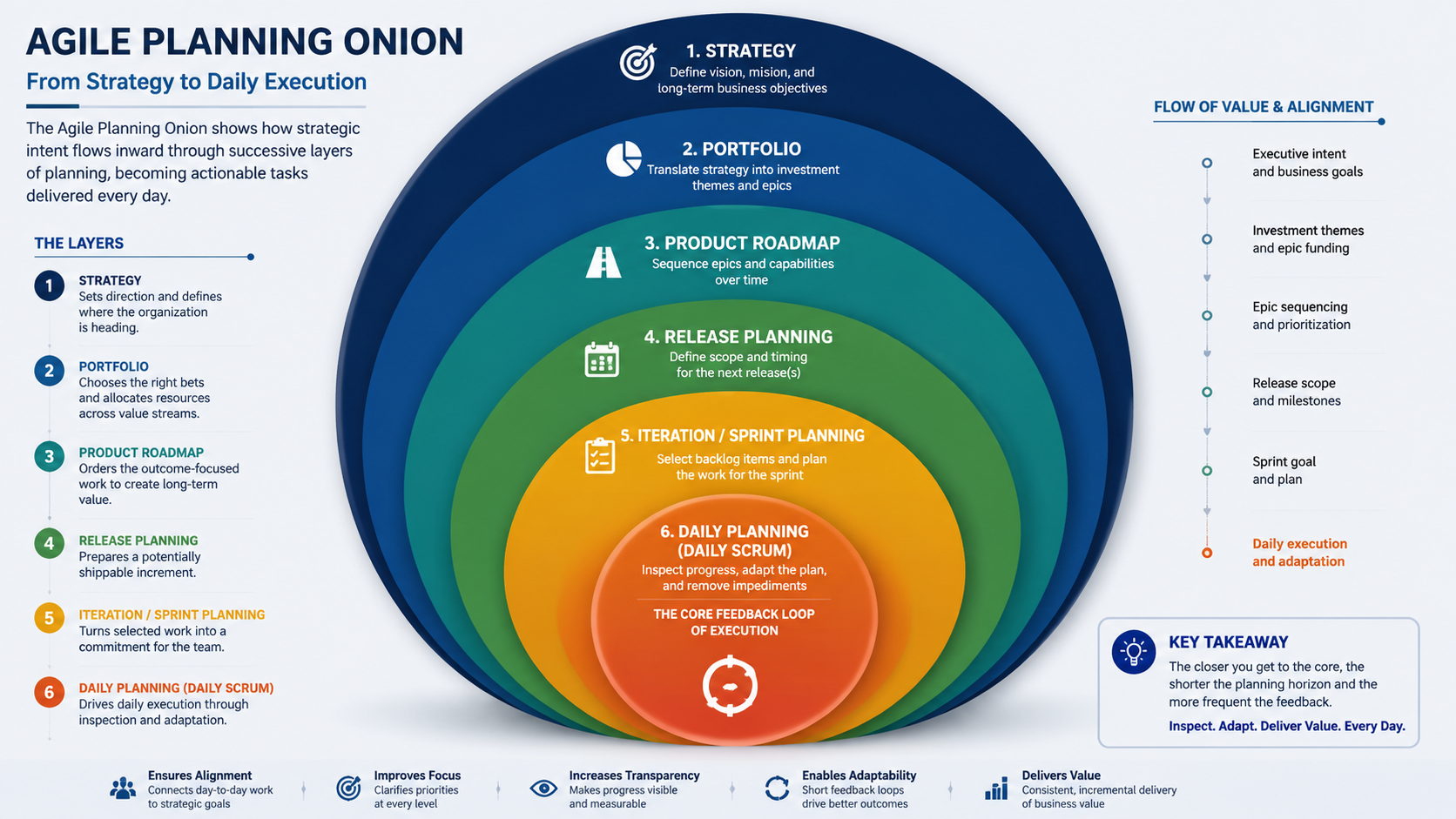
To execute high-impact daily planning, project leaders must master where this event resides within the broader methodology: The Agile Planning Onion.
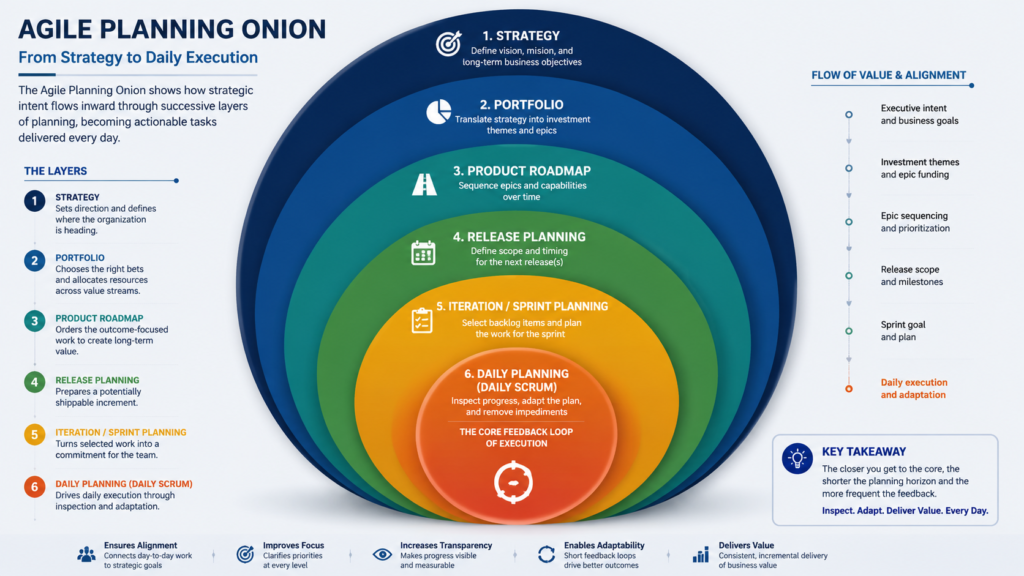
Agile planning is not a static document written at project initiation. It is an interconnected system structured across six distinct planning horizons:
Strategy: The macro-level corporate vision and business direction.
Portfolio: The collection of products, programs, and initiatives aligned to fulfill enterprise strategy.
Product Roadmap: The high-level timeline showing feature releases and customer value horizons over quarters or years.
Release Planning: The defined scope and target dates for delivering usable increments of value to end users.
Iteration / Sprint Planning: The short-term commitment (1 to 4 weeks) to complete a targeted batch of prioritized work items.
Daily Planning (Daily Scrum): The innermost, tightest feedback loop running on a 24-hour cycle.
The Daily Scrum represents the center core of the Agile Planning Onion. While the outer layers define where the enterprise intends to travel over the next year, daily planning governs how the team navigates the immediate 24 hours of execution.
If the inner core of the onion fails, the outer layers collapse automatically. The most brilliant product roadmap or beautifully refined Sprint Backlog is useless if the delivery team cannot execute today’s work effectively.
The Core Mechanics of the 15-Minute Sync
The Daily Scrum is strictly time-boxed to 15 minutes, regardless of team size. Time-boxing is an execution tool. It eliminates meeting fatigue, prevents cognitive drift, and forces participants to distill information down to its most crucial elements.
To convert a passive status call into a delivery engine, high-performing teams reframe the three classic Scrum questions away from task updates toward value creation:
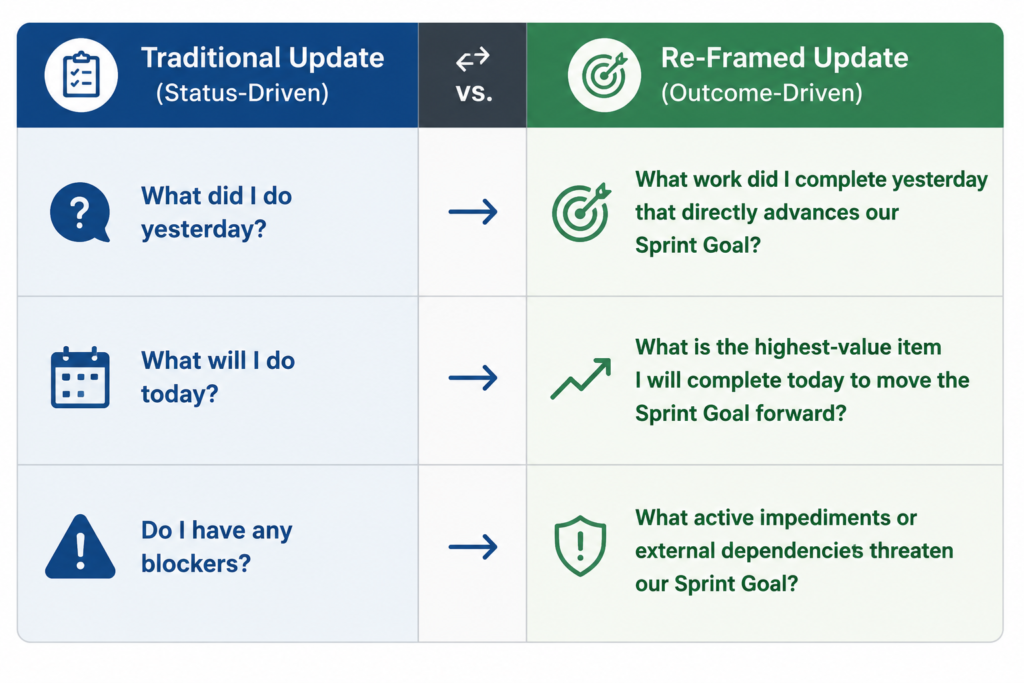
By anchoring every update to the overarching Sprint Goal rather than individual task lists, the focus instantly shifts from individual activity to collective delivery.
The Step-by-Step PM Implementation Framework
The Golden Rule: Never waste standup minutes moving digital cards or updating work tickets on Jira, Azure DevOps, or Trello.
Execution: Team members must update work statuses, attach pull request links, and log technical notes 10 minutes prior to the meeting. The visual board must represent complete operational truth the moment the standup clock starts.
Step 1: Asynchronous Pre-Scrum Board Hygiene
The Golden Rule: Never waste standup minutes moving digital cards or updating work tickets on Jira, Azure DevOps, or Trello.
Execution: Team members must update work statuses, attach pull request links, and log technical notes 10 minutes prior to the meeting. The visual board must represent complete operational truth the moment the standup clock starts.
Step 2: The 15-Minute Precision Agenda
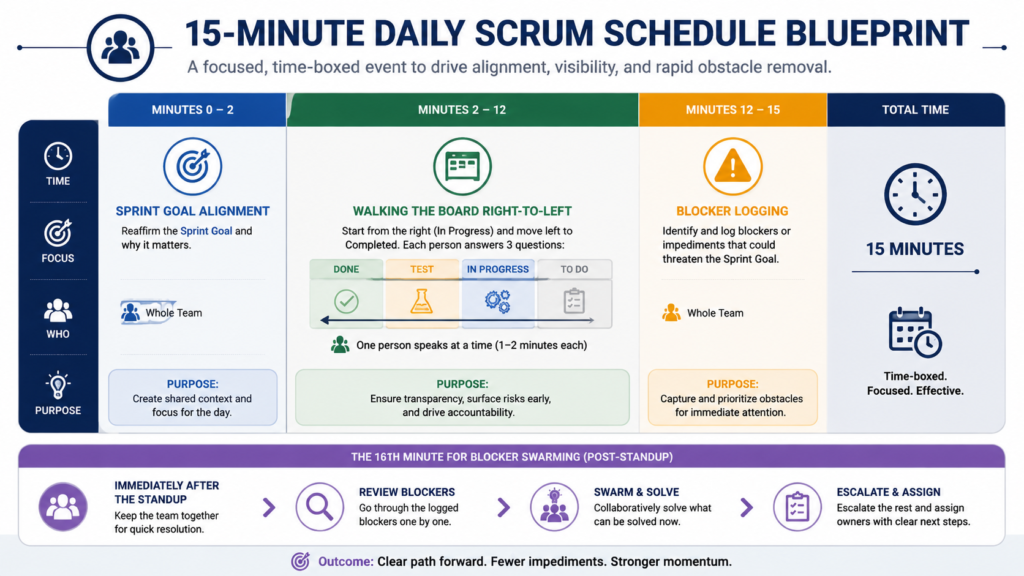
Execute the 15-minute window with strict operational timing:
Minutes 0-2: Sprint Goal Alignment The team reviews the Sprint Burndown chart and explicitly re-states the primary Sprint Goal to set the meeting’s tactical context.
Minutes 2-12: Walk the Board Right-to-Left
Avoid going person-by-person, which leads to team members tuning out until their turn to speak. Instead, walk the Kanban or Scrum board from right to left (starting at “Ready for QA” and moving backward to “In Progress”). This forces the team to focus on finishing open work before pulling new work into the pipeline.
Minutes 12-15: Blocker Logging and Parking Lot Creation Capture every impediment raised during the walk-through. Do not solve complex technical issues during these three minutes. Document the blocker on a central “Impediment Board” and assign an owner for post-standup resolution.
Step 3: The "16th Minute" (Blocker Swarming)
Once the 15-minute time-box ends, formally conclude the Daily Scrum and release non-essential team members. The remaining sub-group stays on the call for “The 16th Minute” to swarm technical roadblocks, align cross-functional support, and clear the execution path
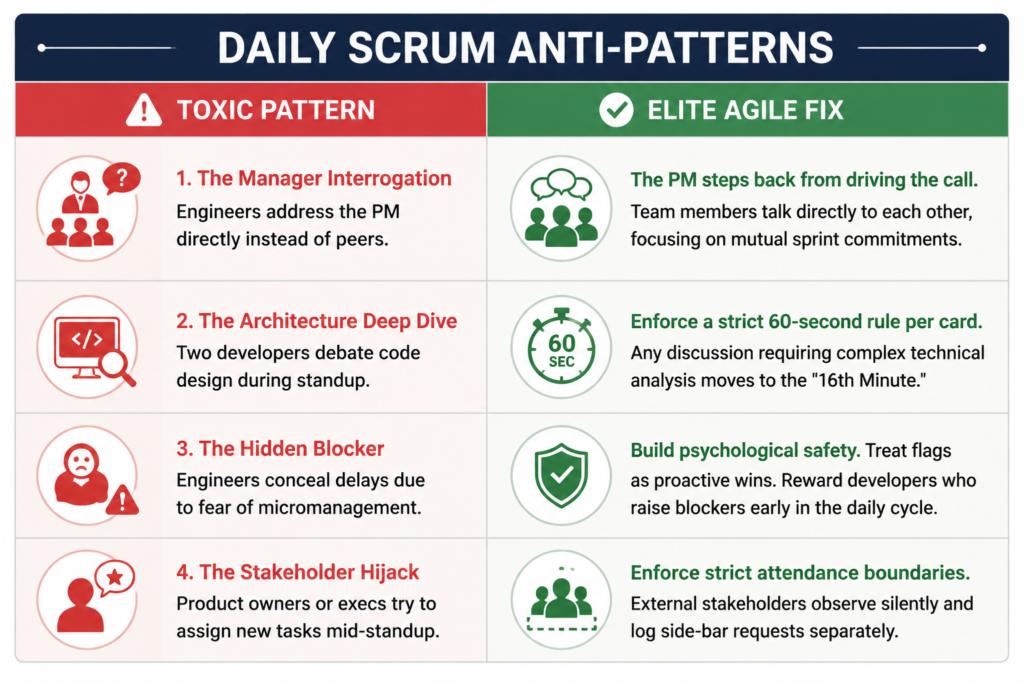
Identifying and Eradicating Daily Scrum Anti-Patterns
From Firefighting Chaos to Strategic Delivery
When you master the innermost layer of the Agile Planning Onion, your operational reality undergoes a permanent transformation.
Imagine managing an organization where release surprises are eradicated entirely. Scope creep is identified within 24 hours of emergence, long before it threatens target launch dates. Engineering teams stop viewing daily meetings as administrative tax: they rely on them as an essential tactical huddle that removes friction from their workday.
In this optimized delivery environment:
Scope Creep Is Contained: Daily alignment catches unapproved work additions before they ruin sprint capacity.
Predictability Soars: Commitments are met consistently because delivery blockers are resolved within hours rather than weeks.
Team Burnout Collapses: Engineers operate with clear daily priorities, protected from continuous mid-day shifts and goalpost changes.
Accelerating Your Career Trajectory
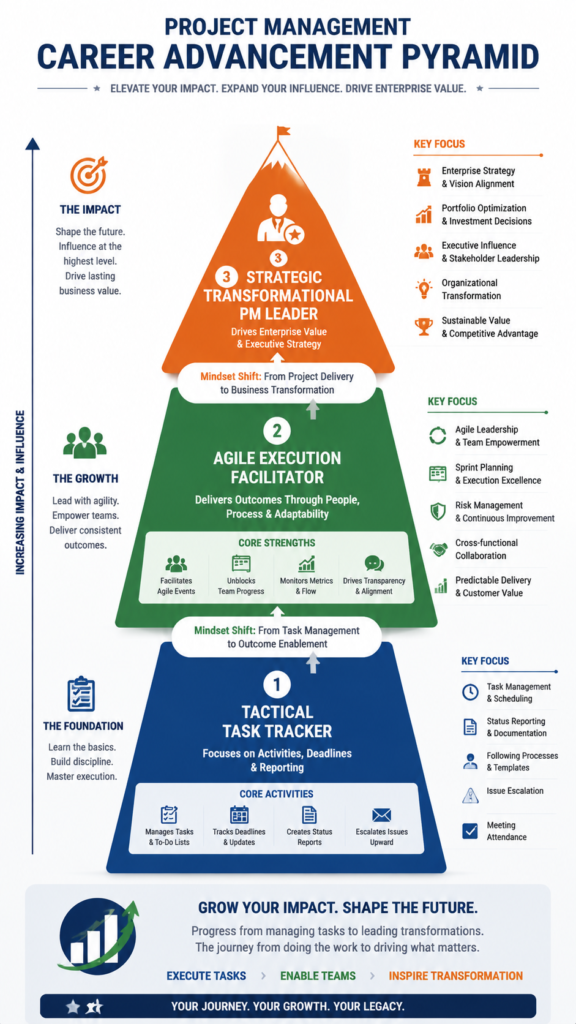
In the modern enterprise landscape, executives do not promote project managers who merely update spreadsheets, forward emails, and ask “what is the status?” in team calls. Tactical task-trackers are administrative, easily replaced, and often overlooked during talent reviews.
Organizations promote transformational delivery leaders: professionals who build high-performing execution systems, eliminate organizational friction, and translate strategic corporate goals into predictable daily outcomes.
By mastering daily planning within the Agile Planning Onion, you demonstrate mastery at both macro and micro operational levels. You prove that you can protect enterprise investments, optimize engineering capacity, and drive continuous value. That specific capability propels ambitious professionals directly into Senior Program Director, Head of PMO, and VP of Operations roles.
Master the Frameworks That Drive High-Value Careers
Daily planning is not a routine check-in: it is the operational heartbeat of high-performing enterprise organizations. When you align your daily execution events with the broader layers of the Agile Planning Onion, you transform chaotic project delivery into a predictable, high-output value engine.
Understanding the theory behind Agile is a start, but knowing how to execute these frameworks seamlessly in high-pressure corporate environments is what separates average project managers from elite, highly compensated project leaders.
If you are ready to stop guessing, move up the corporate ladder, and learn project management the right way, reach out to Skillsetify. We do not just teach frameworks: we show you your exact career growth trajectory.