• Pricing Policy
  • Privacy Policy
  • Refunds Policy
  • Terms of Service
  • Contact Support
Wednesday, August 26, 2026
Skillsetify Blog
No Result
View All Result
  • Home
  • About
  • Webinar
  • PMP
  • Learn
  • Home
  • About
  • Webinar
  • PMP
  • Learn
No Result
View All Result
Skillsetify
No Result
View All Result
Home Blog

The $10 Million Governance Blindspot

Sushma Doti by Sushma Doti
July 23, 2026
in Blog
0
The $10 Million Governance Blindspot

How Strategic Portfolio Management Eliminates Corporate Friction and Drives Measurable Value

magine it is Monday morning at 8:30 AM in the executive boardroom. The C-suite, board members, and senior directors are assembled around the table. The Chief Executive Officer slides a spreadsheet across the table, displaying a $50 million investment line item spanning 45 active technology and business initiatives. The CEO asks a devastatingly simple question:

“We are burning capital at record rates, yet our flagship product launch is seven months behind schedule, our engineering team is burning out, and two separate divisions just spent $2 million building identical internal AI platforms. Who is responsible for this, and where is our return on investment?”

Silence fills the room. Engineering blames Product for perpetual scope creep. Product points at Finance for delayed budget releases. Operations blames HR for headcount constraints. Everyone is managing their individual projects with textbook precision, yet the organization as a whole is bleeding capital and missing strategic targets.

This nightmare scenario unfolds daily in modern enterprises. The underlying cause is rarely bad project management: it is a fundamental misinterpretation of corporate structure and strategic governance.
Dispelling the Great Corporate Myth

A pervasive myth haunts executive leadership teams: the belief that executing individual projects with agility automatically translates to organizational success. Companies flood their departments with Scrum Masters and Project Managers, hoping that localized efficiency will magically synthesize into enterprise strategy.

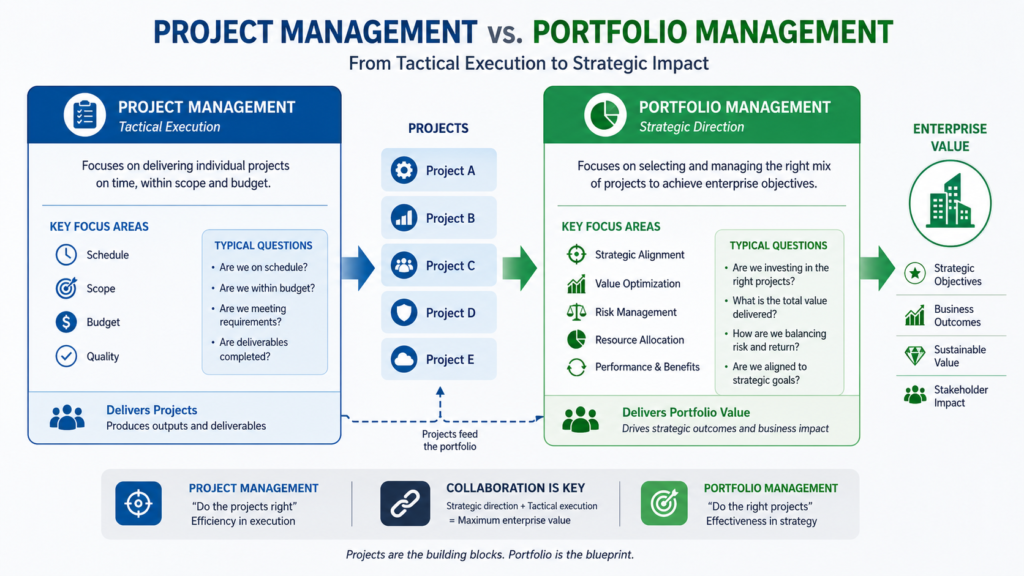
This is fundamentally false. Executing a flawed or misaligned initiative with operational efficiency simply means failing faster and more expensively. Individual project management answers the tactical question: “Are we building this project right?” Portfolio Management, by contrast, answers the strategic question: “Are we building the right projects, at the right time, with the right resources, to achieve our long-term corporate vision?”

Project Management Vs Portfolio Managment

Decoding Portfolio Value: The Strategic Translation Layer

To understand why portfolio management is the ultimate lever for strategic execution, one must first master how modern corporate structures operate. Organizations naturally divide into functional departments such as Finance, HR, IT, Legal, and Marketing. While these operational silos maintain daily business-as-usual (BAU) activities, strategic growth demands cross-cutting initiatives that span across departments, business units, and global regions.

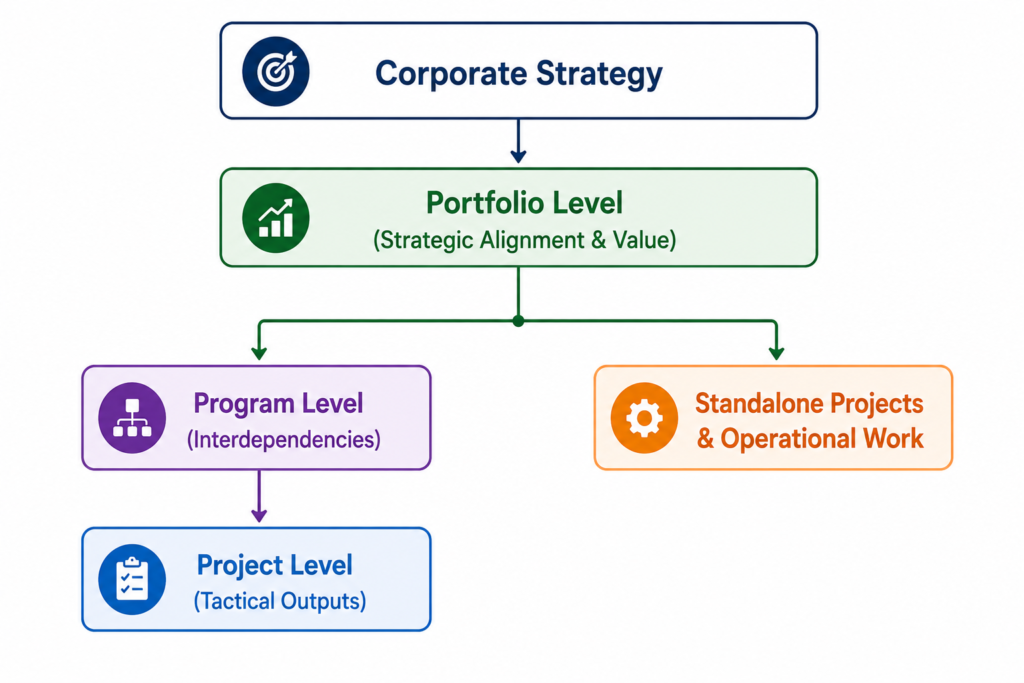
A Portfolio acts as a centralized strategic bucket: a curated collection of programs, individual projects, and operational work managed collectively to maximize return on investment, optimize shared capacity, and minimize systemic enterprise risk.

The strategic Translaation Layer

The Four Pillars of Enterprise Portfolio Value

1. Strategic Alignment

Every dollar spent and every engineering hour invested must directly map to executive strategy. Portfolio management provides continuous line-of-sight governance, ensuring that lower-level tactical execution directly feeds upper-level enterprise vision. If a proposed initiative does not align with core business goals, it is eliminated before consuming organizational bandwidth.

2. Streamlined Capacity Management & Resource Optimization

Human capital is finite. When multiple independent projects compete for the same specialized talent, multi-tasking and cognitive overload degrade delivery speed. Portfolio management pools shared resources, maintains healthy talent benches, and balances workload distribution across initiatives, eliminating resource cannibalization and preventing employee burnout.

3. Standardized Governance & Operational Efficiency

Without portfolio-level oversight, every department invents its own reporting standards, metrics, and approval gates. Portfolio management establishes uniform stage-gate criteria, standardized metrics, and clear entry and exit standards (such as Definition of Ready and Definition of Done) across the entire initiative pipeline.

4. Systemic Risk Mitigation

Projects do not fail in isolation: systemic risks aggregate across interconnected systems and dependencies. By grouping initiatives into logical portfolios, leadership can identify cross-project dependencies, track resource bottlenecks early, and make proactive calls to pivot, pause, or sunset failing endeavors before they cause catastrophic operational losses.

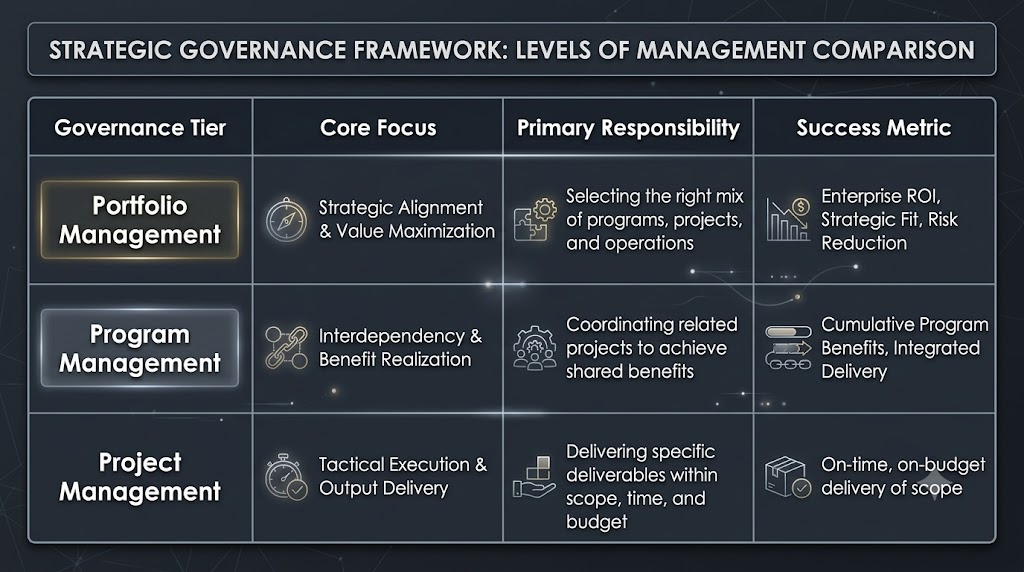
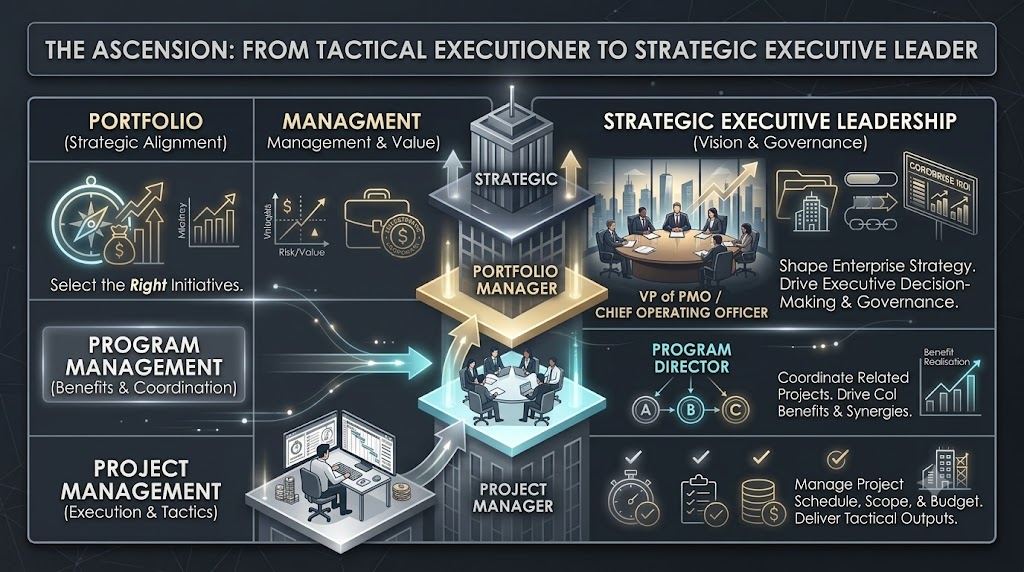
Project vs. Program vs. Portfolio Management: The Structural Hierarchy

To establish clear accountability, leaders must distinguish between the distinct tiers of execution governance:

Strategic Governance Framework

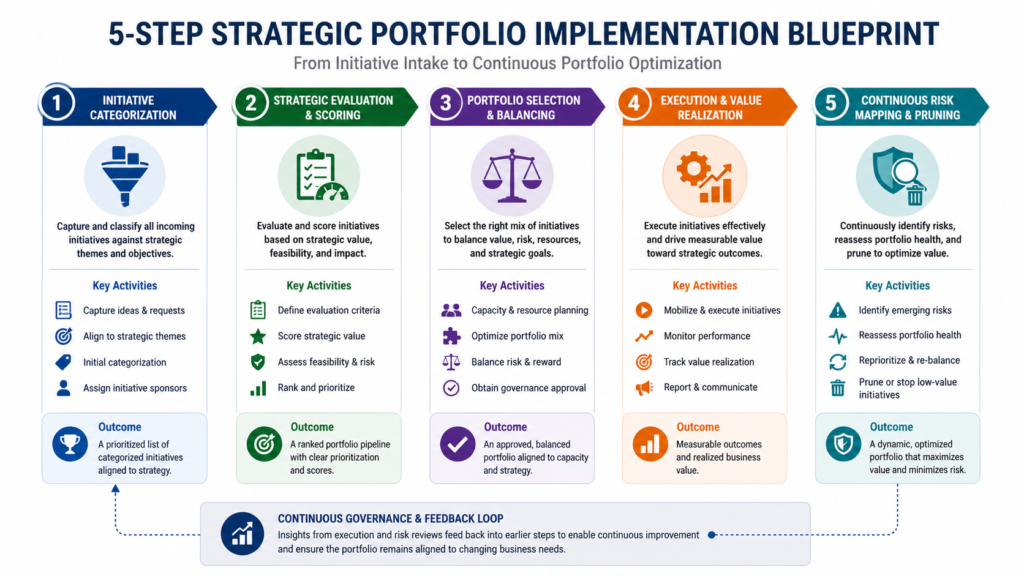
The 5-Step Strategic Portfolio Implementation Framework

For Project Managers, Program Directors, and PMO Leaders looking to transform tactical project chaos into structured portfolio value, here is an actionable, step-by-step framework for immediate deployment:

Step 1: Initiative Categorization & Portfolio Structuring

Begin by auditing all active endeavors across the enterprise. Group initiatives into logical, manageable portfolios based on strategic intent:

  • Product Portfolios: Grouping offerings by customer solutions or core software application lines.

  • Vertical Industry Portfolios: Grouping client-facing initiatives by sector (e.g., Healthcare, BFSI, Retail).

  • Regional Portfolios: Structuring efforts by geographical footprints (e.g., APAC, EMEA, LATAM).

  • Horizontal Functional Portfolios: Structuring cross-departmental application platforms or operational services.

Step 2: Capital Budgeting & Strategic Prioritization

Establish rigorous financial and qualitative criteria to evaluate candidate initiatives before funding. Do not rely on intuition: evaluate every business case using capital budgeting metrics:

  • Net Present Value (NPV):
    $$ NPV=\sum_{t=1}^{n}\frac{R_t}{(1+i)^t}-C_0 $$
    Where \(R_t\) represents net cash inflow during period \(t\), \(i\) is the discount rate, and \(C_0\) is the initial capital investment.

Payback Period & Strategic Fit Score: Quantify the time required to recover initial investment while weighting initiatives against strategic business imperatives.

Step 3: Shared Capacity & Resource Pool Balancing

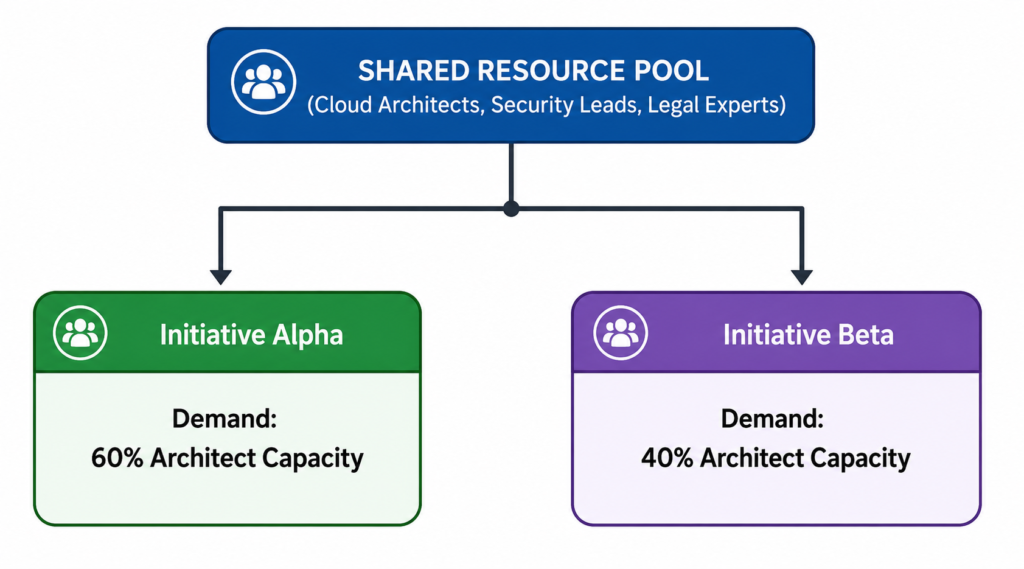
Establish centralized resource management across the portfolio. Instead of allowing individual project managers to hoard specialized talent, pool high-demand specialists (such as Cloud Architects, Legal Counsel, or Senior Developers). Map total required capacity against true available capacity to prevent over-allocation.

Shared Resource Pool

Step 4: Standardized Cadence & Stage-Gate Governance

Implement consistent governance gates across all portfolio initiatives:

1. Business Case Approval: Verifying technical feasibility and financial viability prior to charter approval.

2. Definition of Ready (DoR): Enforcing clear entry criteria, user story completeness, and dependency resolution before sprint or project allocation.

3. Definition of Done (DoD): Setting non-negotiable quality, testing, code review, and compliance gates before release deployment.

Step 5: Continuous Risk Mapping & Portfolio Pruning

Conduct quarterly portfolio review cycles to assess ongoing performance and strategic relevance. Track project velocity, benefits realization, and emerging systemic risks. If a project no longer aligns with shifting market dynamics or fails to meet financial performance thresholds, execute a planned decommissioning or sunsetting protocol. Free up capital and talent to redeploy into high-performing initiatives.


5 - Step Strategic Portfolio Implementation Blu print

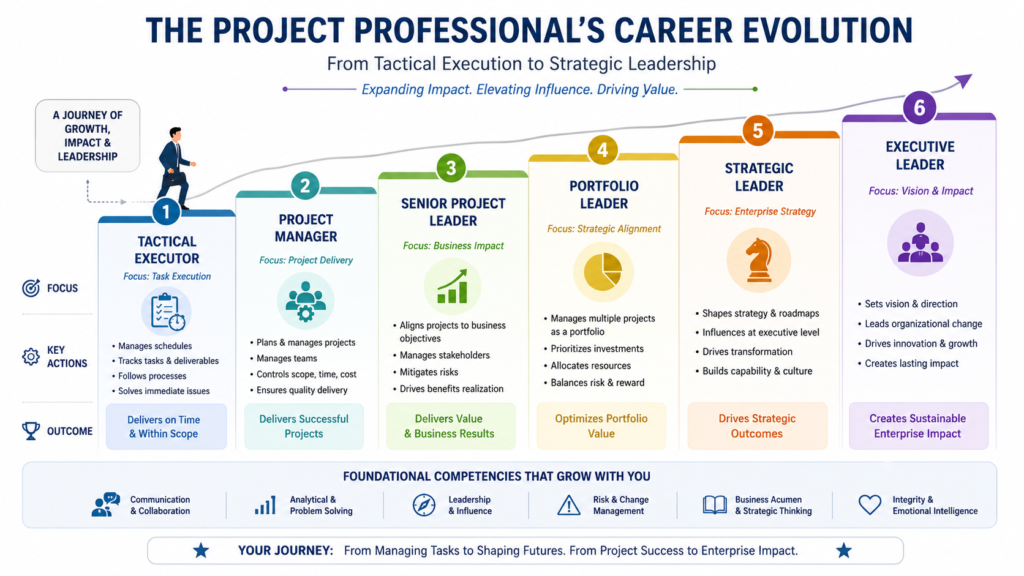
The Professional Transformation: From Tactical Executioner to Strategic Leader

Imagine transforming your daily corporate reality.

No longer are you trapped in endless firefighting, managing overlapping schedules, mediating team burnouts, or defending budget overruns for projects that should never have been approved in the first place. Instead, you operate with absolute clarity and executive authority. You lead an integrated portfolio where strategic goals flow seamlessly into execution roadmaps, resource allocations are optimized, risks are identified months before impact, and every completed release delivers measurable business value.

This is the power of mastering project and portfolio management the right way.

When you elevate your skills from localized tactical tracking to executive portfolio governance, your professional positioning changes completely. You cease being viewed as an administrative taskmaster who tracks Gantt charts: you become recognized as an indispensable strategic operator who drives enterprise profitability, shapes corporate decision-making, and sits at the decision table with C-suite executives.

Mastering high-level portfolio management is the single fastest catalyst to accelerate your career trajectory from Project Manager to Senior Director, VP of PMO, or Chief Operating Officer.

Master Strategic Leadership with Skillsetify

Navigating complex corporate structures, optimizing enterprise capacity, and governing high-value portfolios requires more than basic project management theory. It demands real-world strategic mastery, practical frameworks, and elite mentorship.

If you are ready to stop guessing, move up the corporate ladder, and learn project management the right way, reach out to Skillsetify. We do not just teach frameworks: we show you your exact career growth trajectory.

ShareTweet
Sushma Doti

Sushma Doti

Related Posts

The Agile Mirage: Why Your Enterprise Implementation Is Failing (And How Mindset Fixes It)
Blog

The Agile Mirage

The Stake Holder Perception Gap
Blog

The Perception Trap

5-STEP IMPLEMENTATION FRAMEWORK
Blog

Stop Mixing Up Frameworks and Methodologies

The Framework Fallacy
Blog

The Framework Fallacy

Mastering the PMP Exam Architecture: Timing, Strategic Breaks, and Performance Grading
Blog

Mastering the PMP Exam Architecture: Timing, Strategic Breaks, and Performance Grading

comparing home online proctored exam risks
Blog

The 450-Dollar Logistics Misstep

Load More
Next Post
The Strategic Architecture: PMP vs. PgMP vs. PfMP

The Career Ceiling Trap

Popular News

  • Backlog Paralysis

    The Backlog Paralysis

    0 shares
    Share 0 Tweet 0
  • The Watermelon Effect

    0 shares
    Share 0 Tweet 0
  • The Headcount Trap

    0 shares
    Share 0 Tweet 0
  • The Scope Visibly Exploded

    0 shares
    Share 0 Tweet 0
  • The Project Manager’s Dilemma

    0 shares
    Share 0 Tweet 0

By Categories

  • Blog
LinkedIn Twitter Youtube

Your Next Career Move Starts Here

Policy Links

  • Pricing Policy
  • Privacy Policy
  • Refunds Policy
  • Terms of Service
  • Contact Support

Navigation Menu

  • Home
  • About
  • Webinar
  • PMP
  • Learn

© 2026 Skillsetify Private Limited. All rights reserved. All content and materials on this site are the property of Skillsetify and protected by applicable intellectual property laws.

No Result
View All Result
  • Home
  • About
  • Webinar
  • PMP
  • Learn

© 2026 Skillsetify Private Limited. All rights reserved. All content and materials on this site are the property of Skillsetify and protected by applicable intellectual property laws.