Decoding the PMP, PgMP, and PfMP Leadership Tracks
Picture a senior project leader with over a decade of experience, a flawless record of on-time software deliveries, and a shiny PMP credential attached to their email signature. They apply for a Director of Program Management role at an enterprise software firm. During the final interview round with the Chief Operating Officer, they are asked:
“How do you govern cross-project dependencies across multiple product lines to maximize benefits realization, and how do you align those dependencies with our overall portfolio budget constraints?”
The candidate freezes. They respond by talking about Gantt charts, critical path methods, and team velocity metrics.
Two weeks later, the rejection email arrives. The candidate is left wondering why ten years of execution experience and a prestigious certification failed to secure the role.
This workplace reality plays out across global enterprises daily. A dangerously persistent corporate myth claims that project credentials are a linear scale: that a PMP credential is all you ever need for your entire career, and higher-level certifications like the Program Management Professional (PgMP) or Portfolio Management Professional (PfMP) are just administrative add-ons.
In reality, project, program, and portfolio management are fundamentally different operational domains requiring completely different mindsets, skill sets, and strategic responsibilities.
Understanding the precise leadership targets for the PMP, PgMP, and PfMP certification tracks is what separates a mid-level execution manager from an indispensable executive leader.
The Strategic Architecture: PMP vs. PgMP vs. PfMP
To navigate your career progression effectively, you must understand how Project Management Institute (PMI) certifications map directly to corporate governance structures.
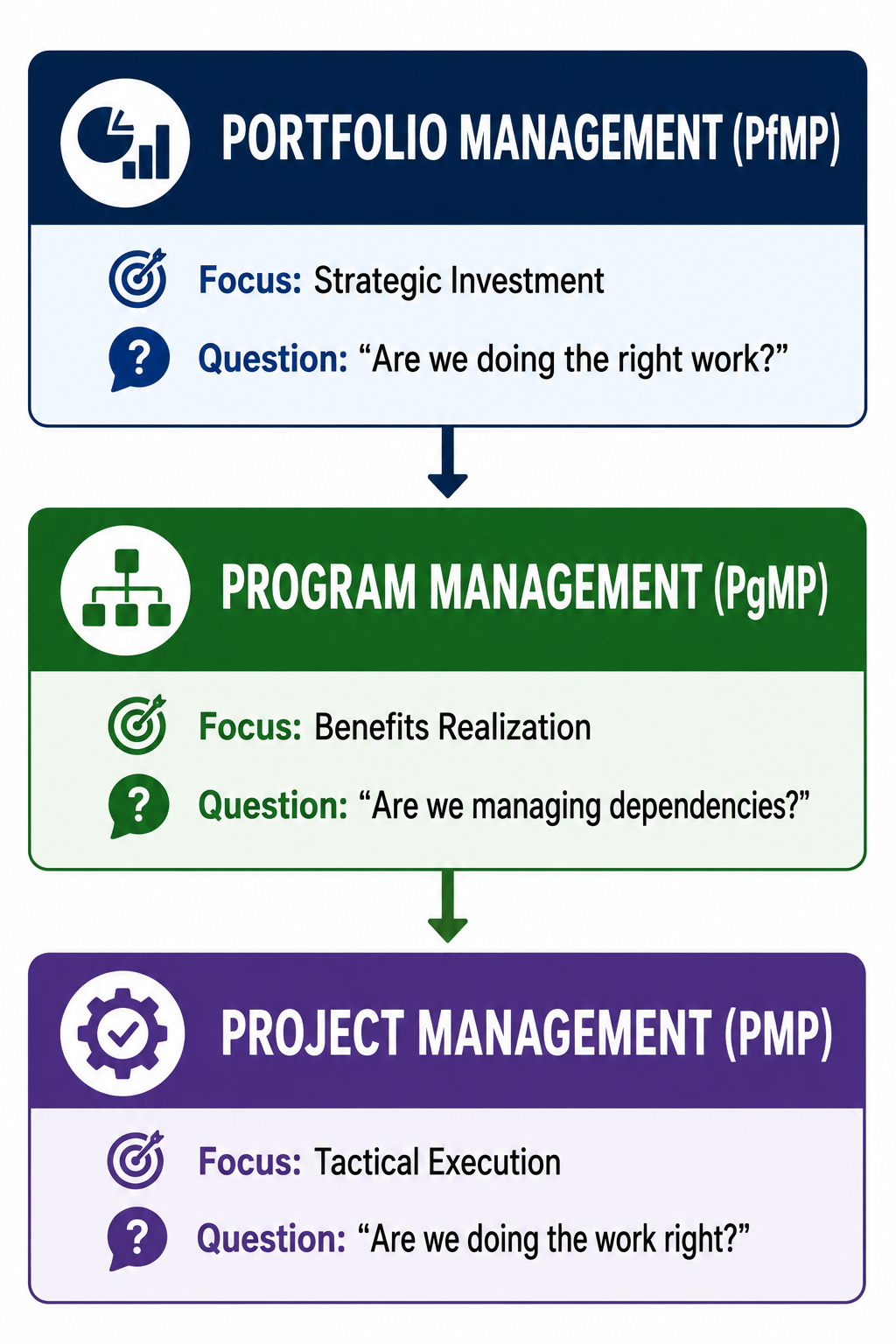
1. Project Management Professional (PMP): Tactical Execution & Output
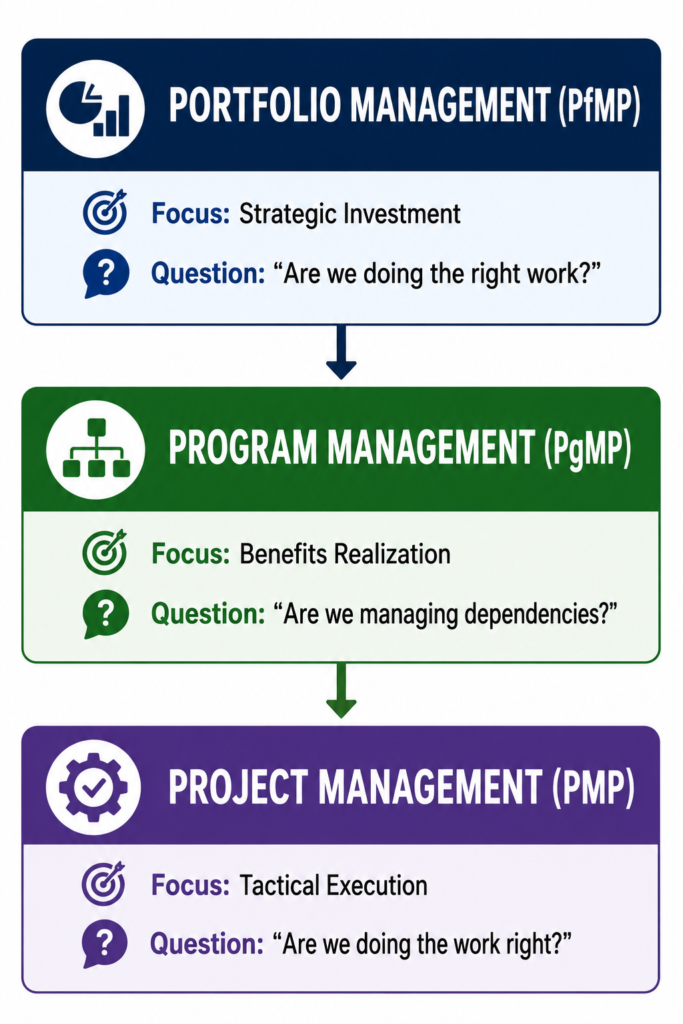
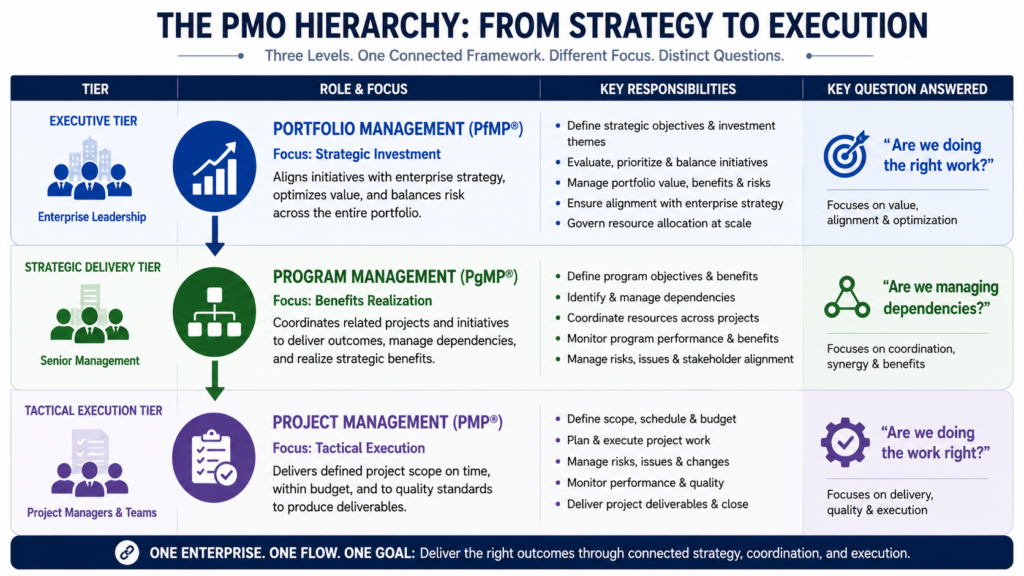
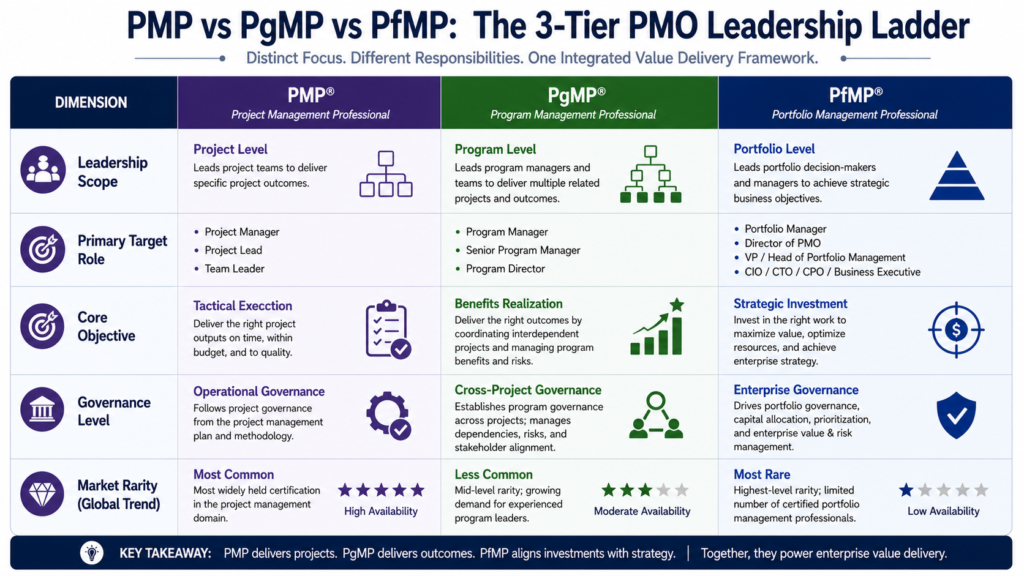
The Core Focus: Delivering a specific output, product, or service within defined constraints of time, cost, and scope.
The Central Question: “Are we doing the work right?”
Target Leadership Role: Project Manager, Scrum Master, Technical Lead, Implementation Consultant.
Primary Responsibility: Leading cross-functional teams to execute detailed project plans, manage sprint iterations, track deliverables, and satisfy immediate project acceptance criteria.
2. Program Management Professional (PgMP): Synergy & Benefits Realization
The Core Focus: Managing a group of related, interdependent projects in a coordinated way to obtain benefits and control not available from managing them individually.
The Central Question: “Are we managing dependencies to maximize overall business benefits?”
Target Leadership Role: Program Manager, Senior Program Lead, Director of Delivery, PMO Manager.
Primary Responsibility: Resolving inter-project conflicts, managing complex stakeholder expectations across projects, and driving benefits realization.
3. Portfolio Management Professional (PfMP): Strategic Alignment & Capital Allocation
The Core Focus: Managing a collection of portfolios, programs, projects, and operational units to align investments directly with enterprise strategy.
The Central Question: “Are we investing capital in the right initiatives?”
Target Leadership Role: Portfolio Manager, Director of Strategic Execution, VP of Strategy, Chief Project Officer (CPO), Chief Executive Officer (CEO) / C-Suite Executives.
Primary Responsibility: Balancing corporate risk, allocating finite organizational capacity, making strategic buy/kill investment decisions, and maximizing overall business return.
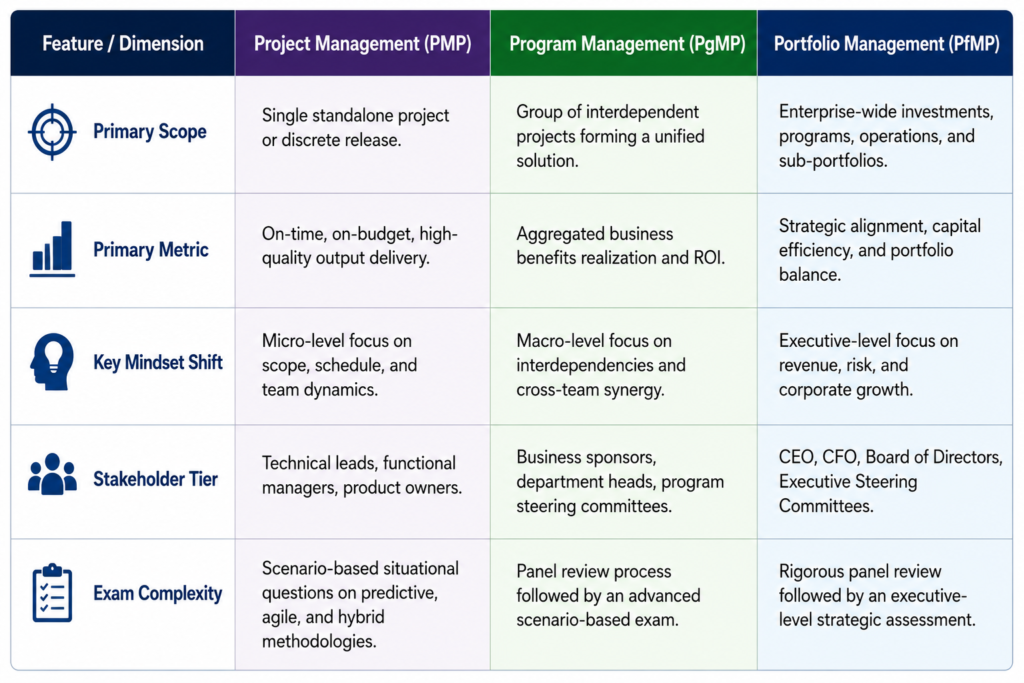
Comparative Breakdown of Leadership Tracks
Step-by-Step Implementation Framework: Mapping Your Credential Trajectory
Advancing your career requires choosing the right certification track at the right career milestone. Use this five-step framework to determine your optimal professional path.
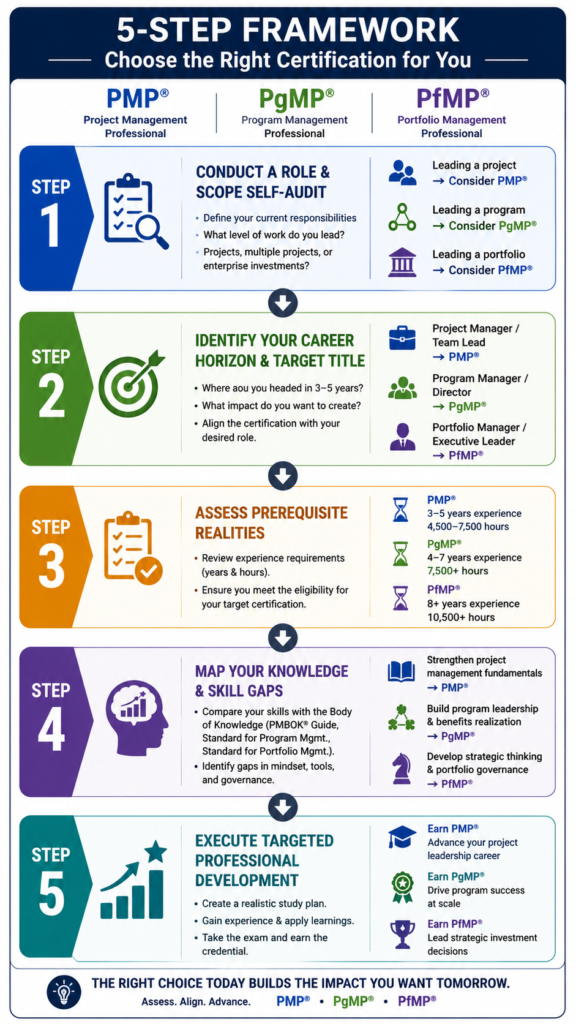
Step 1: Conduct a Role & Scope Self-Audit
Evaluate the true nature of your day-to-day responsibilities:
Are you managing individual deliverables and sprint schedules? Focus on PMP.
Are you coordinating multiple project teams, managing cross-project dependencies, and driving business benefits? Focus on PgMP.
Are you evaluating business cases, making funding decisions, and prioritizing capital allocations for executive leadership? Focus on PfMP
Step 2: Identify Your Target Executive Horizon
Map out where you want your career to be in 3 to 5 years:
Path A (Delivery Excellence): Senior PM ➔ Lead PM ➔ PMO Lead (PMP Focus).
Path B (Operational Scale): Program Manager ➔ Director of Program Management ➔ VP of Operations (PgMP Focus).
Path C (Strategic Leadership): Enterprise Portfolio Manager ➔ Head of Strategic Execution ➔ Chief Project Officer / C-Suite (PfMP Focus).
Step 3: Assess Prerequisite Realities
Understand that PMI credentials enforce strict, non-negotiable experience requirements:
PMP: Requires 36 to 60 months of project leadership experience alongside formal project management education.
PgMP: Requires 48 to 84 months of project management experience PLUS 48 to 84 months of program management experience.
PfMP: Requires 96+ months of professional business experience alongside 48 to 84 months of documented portfolio management experience.
Step 4: Address the Mindset Transition Gap
The biggest barrier candidates face when attempting PgMP or PfMP is failing to shed their “project manager” mindset:
Moving from PMP to PgMP: Stop thinking about work breakdown structures and task deadlines. Start thinking about program governance, benefits realization architecture, and stakeholder engagement across multiple business units.
Moving from PgMP to PfMP: Stop thinking about delivery schedules entirely. Start thinking like an investor: evaluate portfolio risk, resource capacity management, capital allocation, and strategic value alignment.
Step 5: Execute a Structured Certification Roadmap
Partner with an elite learning institution to prepare for the rigorous panel reviews and multi-stage evaluation processes required for advanced credentials like PgMP and PfMP.
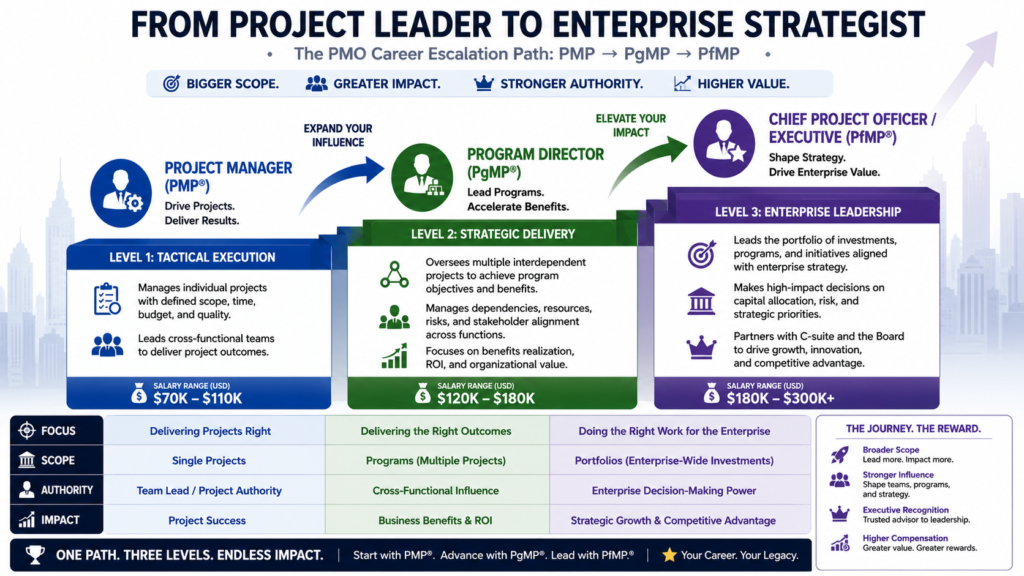
Shift From Operational Execution to Strategic Authority
When you understand the distinct levels of project, program, and portfolio planning, your value to an enterprise changes dramatically.
You no longer view your career through the narrow lens of tactical execution. You gain the holistic clarity required to converse fluently with executive leadership, department heads, and C-suite decision-makers.
By mastering the right certification track at the right stage of your career, you elevate yourself from an administrative scheduler to a strategic business leader who shapes corporate resource allocation and drives real value.
Transform Your Strategic Leadership with Skillsetify
If you are ready to stop guessing, move up the corporate ladder, and learn project management the right way, reach out to Skillsetify. We do not just teach frameworks: we show you your exact career growth trajectory.
Mastering advanced project, program, and portfolio governance is the fastest route to high-impact corporate leadership. Contact Skillsetify today to chart your professional trajectory, master elite leadership frameworks, and command authority in every stage of your career.