Why Cross-Functional Diversity is the Engine of High-Performing Agile Teams
The Corporate Crisis of Functional Silos
Your backend engineering lead posts a message in Slack celebrating a major technical milestone: the development team has successfully built an exceptionally complex, high-throughput database schema capable of processing 50,000 requests per second.
Minutes later, the principal user experience (UX) designer chimes in, raising an emergency red flag. The newly finalized API completely ignores the multi-factor user onboarding flow that the design team spent three months validating through customer testing. Meanwhile, the product marketing manager enters the thread expressing complete shock: the landing page value propositions highlight a key feature set that engineering quietly deprioritized three sprints ago due to technical debt.
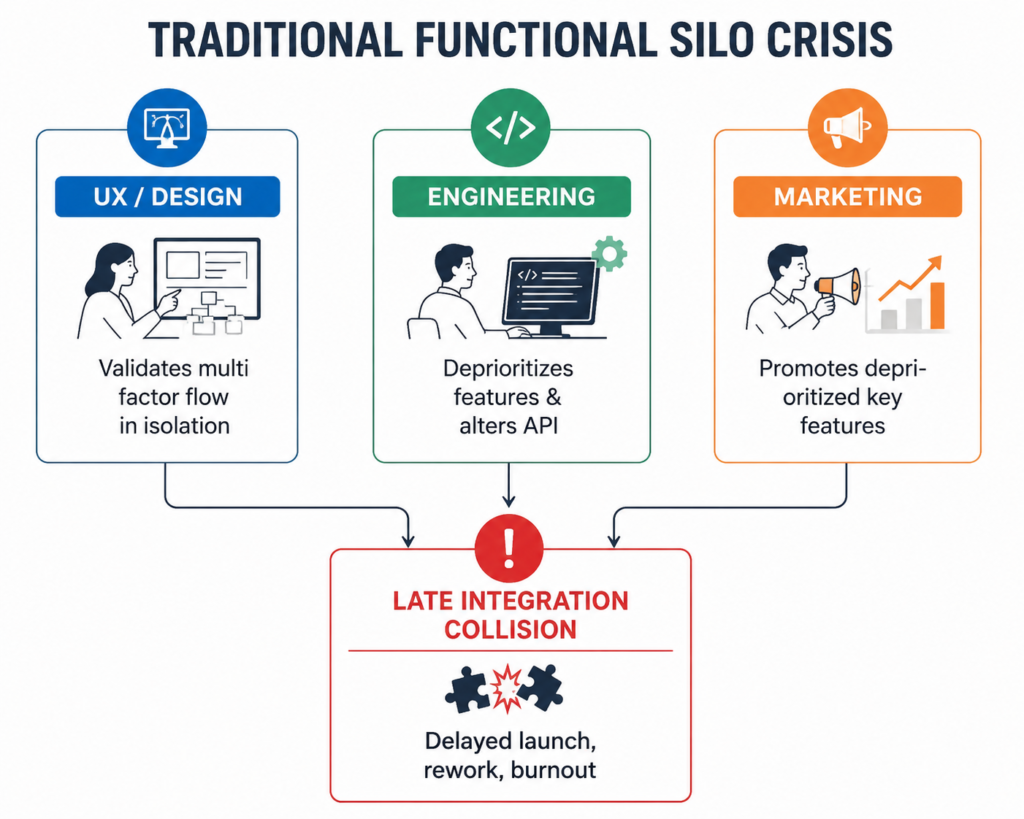
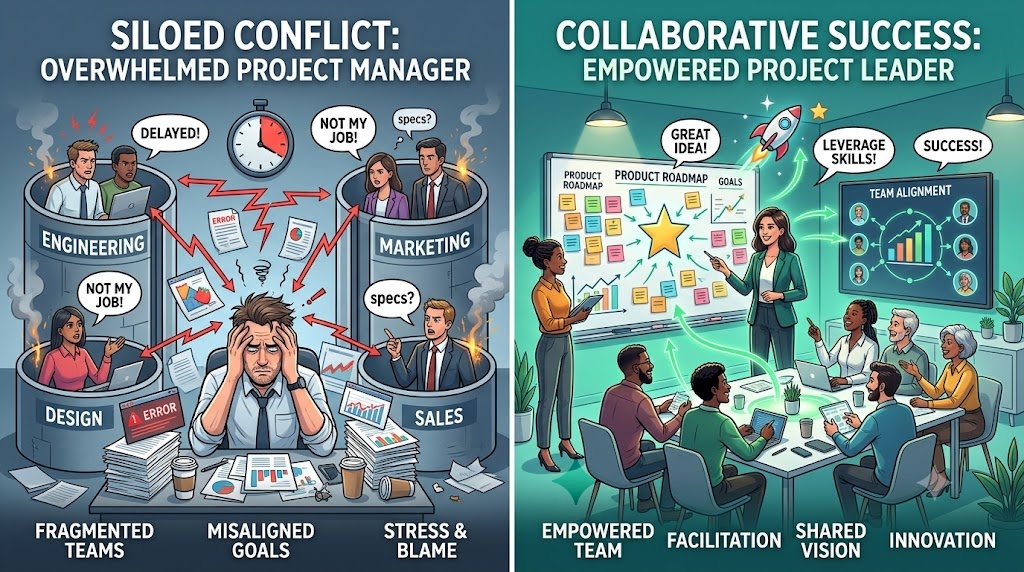
What happened? Every department executed their job with dedication, yet the collective project is on the brink of absolute failure. This is the tragic, recurring reality of functional silos. When product development occurs in isolated departmental chambers, individual teams achieve localized optimization at the direct expense of systemic project failure. The end product is essentially designed three separate times: once by design, once by engineering, and once by marketing.
To fix this chaos, corporate leadership must dismantle a deeply embedded organizational myth: the false belief that functional specialization produces the fastest, highest-quality delivery.
Traditional management theory suggests that grouping backend developers together, designers together, and marketers together maximizes domain expertise and operational speed. In reality, functional isolation introduces massive hand-off friction, context fragmentation, and endless rework. True speed, resilience, and innovation emerge only when multi-disciplinary team members sit in the same metaphorical room, co-creating features from day one.
The Mechanics of Multi-Disciplinary Excellence
What is Cross-Functionality in Agile?
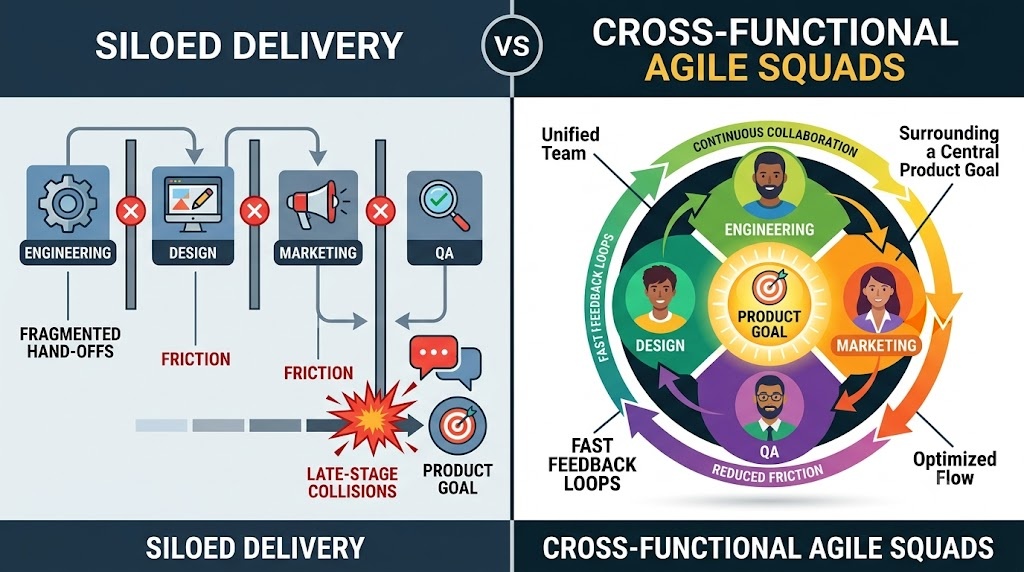
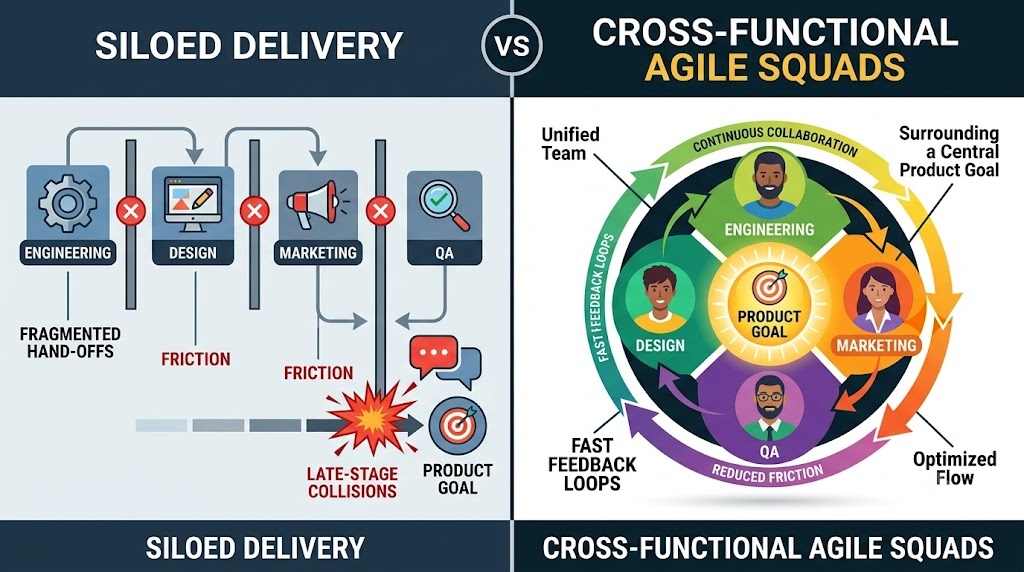
Cross-functionality is far more than an operational buzzword. It is an architecture of collaboration where a single team possesses all the diverse skills required to take a feature increment from initial concept to live production. Rather than passing deliverables over metaphorical walls between departments, a cross-functional Agile team embeds software engineering, user experience design, quality assurance, product management, and commercial strategy directly into a single autonomous squad.
When teams lack cross-functional diversity, features are built through narrow, biased lenses:
Engineering Isolation: Developers naturally evaluate features through an IT infrastructure standpoint, prioritizing backend performance, system architecture, and code cleanliness above user workflows.
Design Isolation: Designers prioritize aesthetic elegance, interface fluidity, and complete user journeys without full context on system scalability or backend technical constraints.
Commercial Isolation: Marketers and product managers focus on conversion metrics, value messaging, and customer acquisition, sometimes overlooking technical debt or architectural limitations.
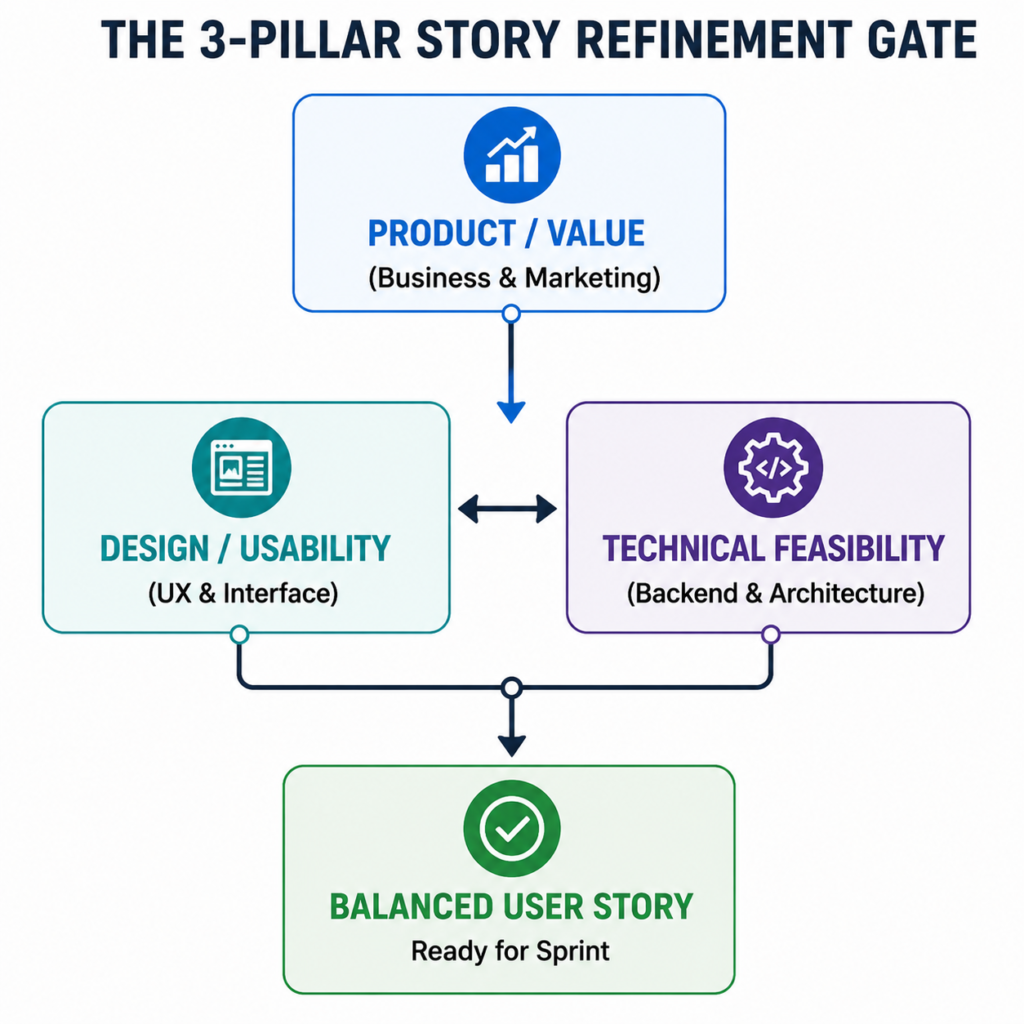
When these disciplines operate separately, competing priorities inevitably collide during late-stage integration testing. Embedding multi-disciplinary members directly into the core team creates balanced conversations from the very beginning. By bringing diverse perspectives into early backlog refinement and architecture planning, the squad evaluates every story from product, technical, and user standpoints simultaneously.
Core Metric to Remember: Research across enterprise software teams consistently demonstrates that cross-functional feature teams reduce late-stage rework by up to 40% and cut total time-to-market in half compared to functionally siloed organizations
The T-Shaped Skill Model and Cognitive Diversity
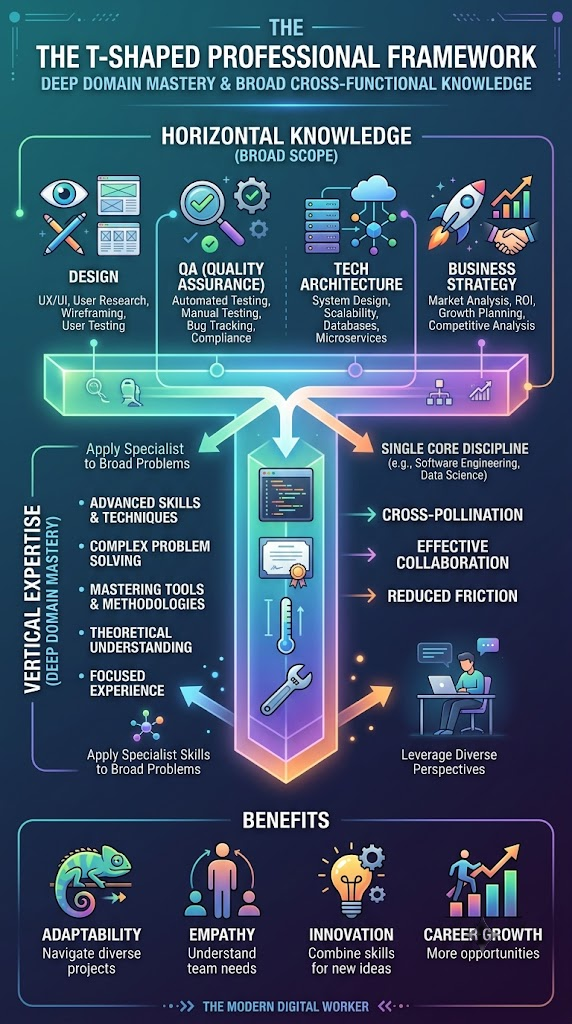
To build a functional Agile squad, modern project leaders prioritize T-shaped professionals:
The Vertical Bar: Represents deep, specialized expertise in a core domain (e.g., backend Node.js development, qualitative UX research, or performance marketing).
The Horizontal Bar: Represents broad, cross-disciplinary empathy and foundational skills across adjacent fields.
A T-shaped developer understands fundamental UX principles and commercial objectives. A T-shaped designer understands database constraints and frontend framework capabilities.
Furthermore, high-performing teams actively leverage cognitive diversity. Different functional backgrounds bring distinct problem-solving frameworks. An engineer naturally searches for failure modes and edge cases. A marketer searches for friction-free adoption paths. A designer searches for intuitive human psychology. When these distinct mindsets collaborate continuously, potential architectural flaws and user experience oversights are caught during initial whiteboard sketching rather than pre-production testing.
Step-by-Step Implementation Framework for Project Managers
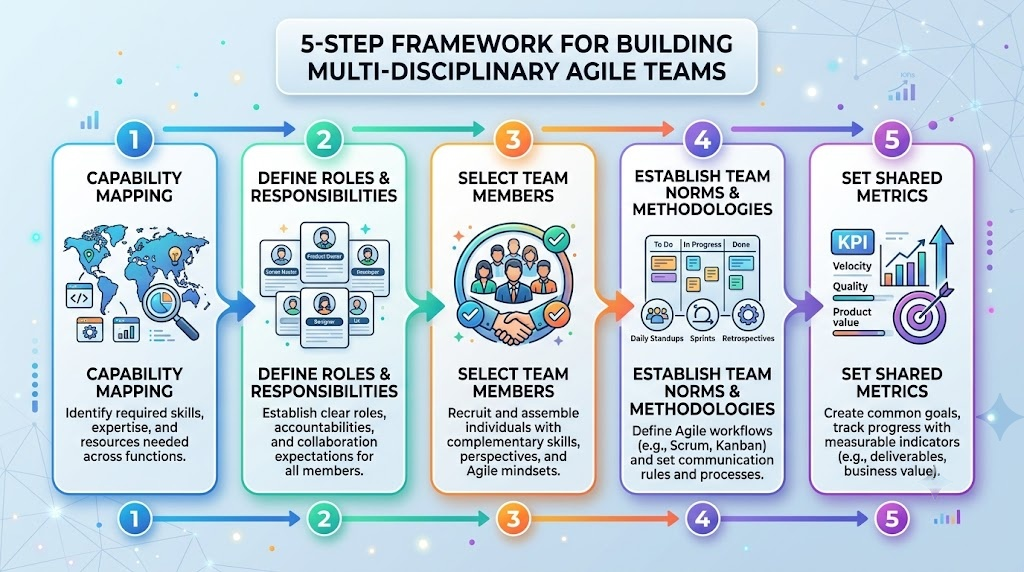
Begin by mapping the skill distribution across your product ecosystem. Create a visual competency matrix listing primary skills, secondary capabilities, and functional gaps.
Step 1: Conduct a Capability Mapping & Skill Matrix Audit
Begin by mapping the skill distribution across your product ecosystem. Create a visual competency matrix listing primary skills, secondary capabilities, and functional gaps.
| Team Member | Core Domain (Vertical) | Secondary Skills (Horizontal) | Cross-Functional Exposure |
| Engineer A | Java / Microservices | Basic SQL, API Design | UX Design System Basics |
| Designer B | UI / Interaction Design | HTML/CSS, User Research | Frontend Framework Constraints |
| Marketer C | Product Marketing | Data Analytics, Copywriting | Agile Backlog Refinement |
Step 2: Form Autonomous Mission-Driven Squads
Reorganize departmental structures into dedicated, multi-disciplinary squads centered around specific customer journeys or product capabilities. A standard enterprise feature squad must include:
Product Owner: Defines the commercial vision and prioritized feature value.
UX/UI Designer: Drives user flow validation and interface design.
Software Engineers (Frontend/Backend): Architects and writes production code.
QA/Test Automation Engineer: Ensures continuous quality validation.
Embedded Business/Marketing Liaison: Aligns feature design with go-to-market strategies.
Step 3: Institute Balanced "3-Pillar" Backlog Refinement
Reframe user story refinement sessions into collaborative co-creation workshops. Enforce a strict governance rule: No user story enters a sprint backlog without active review and approval from the Three Pillars: Product/Commercial, Design, and Engineering.
Step 4: Establish a Unified Definition of Done (DoD)
Eliminate fragmented criteria for completion. Traditional silos consider work “done” when departmental hand-offs occur. A cross-functional squad utilizes an all-encompassing Definition of Done:
[ ] Code refactored, peer-reviewed, and merged.
[ ] Automated unit and integration tests passing.
[ ] UX interface verified against design tokens.
[ ] Product release notes and marketing claims validated.
[ ] Feature deployed to staging and accepted by the Product Owner.
Step 5: Shift to Shared Outcome Metrics
Align team performance incentives around shared squad goals rather than functional outputs. Replace siloed metrics (like lines of code written or wireframes completed) with team-level success indicators:
End-to-End Cycle Time: Time elapsed from story commitment to production deployment.
Customer Satisfaction (CSAT) & Net Promoter Score (NPS): User reception of delivered features.
Defect Escape Rate: Quality of software reaching production environments.
The Transformation from Chaos to Elite Delivery
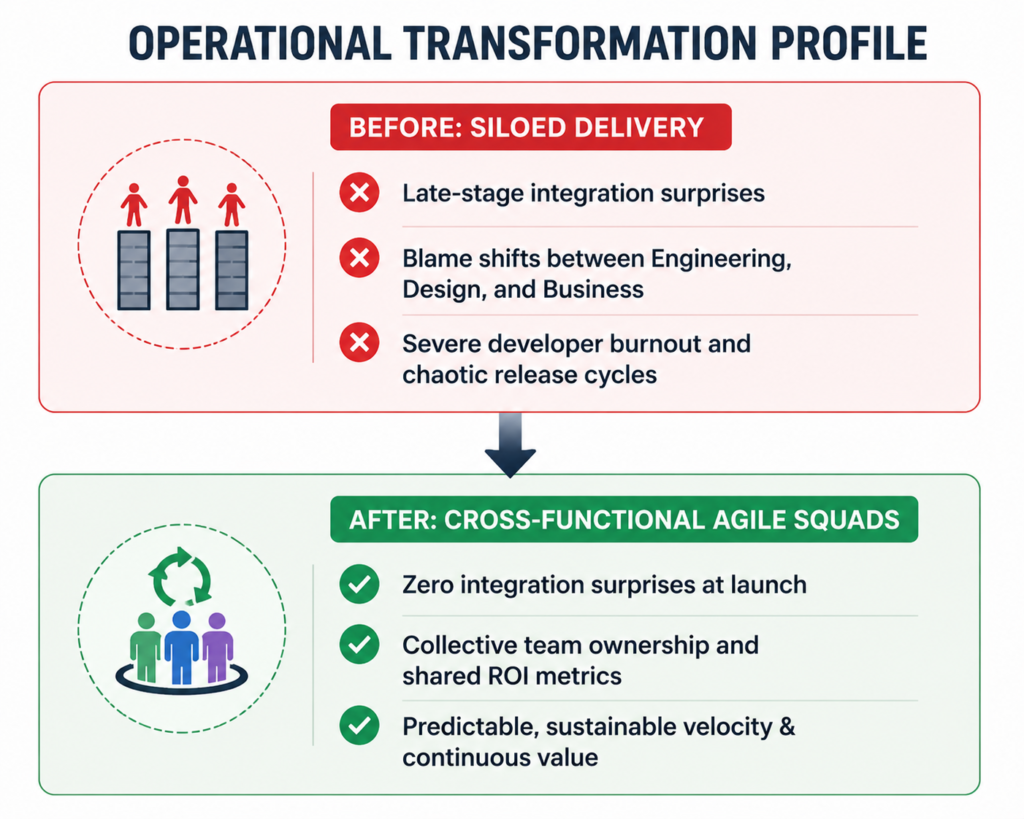
When organizations commit to embedding cross-functionality and diversity into their Agile architecture, the daily environment undergoes a profound transformation. The chronic headaches that plague traditional delivery vanishing completely:
No More Scope Creep Collisions: Misalignments are resolved upfront during co-creation rather than through emergency change requests during release week.
Elimination of Blame Culture: Departmental finger-pointing gives way to collective team accountability. When a bug arises, the team owns the resolution together.
Drastically Reduced Burnout: Engineers, designers, and project leads stop working frantic 80-hour release weeks to fix avoidable integration oversights.
Predictable, High-Quality Velocity: Features flow smoothly into production because dependencies and edge cases are identified months in advance.
For ambitious Project Managers, mastering the orchestration of cross-functional teams is the single most effective career accelerator in modern enterprise environments. Executive leadership rarely promotes project managers who act as passive schedule trackers or administrative status reporters.
Instead, organizations reward strategic delivery leaders: professionals who can navigate complex interpersonal dynamics, break down departmental empires, unite diverse skill sets around shared business visions, and consistently deliver high-impact product outcomes. By mastering these cross-functional team dynamics, you elevate your role from a tactical coordinator to an indispensable corporate strategist.
Master Elite Project Leadership with Skillsetify
Achieving true cross-functionality requires far more than updating job titles on an organizational chart. It demands deep structural understanding, masterful change leadership, and an intimate command of modern Agile frameworks. Building high-performing teams is a deliberate science that separates industry-leading delivery executives from average managers.
If you are ready to stop guessing, move up the corporate ladder, and learn project management the right way, reach out to Skillsetify. We do not just teach frameworks: we show you your exact career growth trajectory.