You’re Just Drowning in 15 Meetings a Week
Your quarterly flagship software release is scheduled for launch in three business days. In your inbox, a frantic email chain from executive leadership demands to know why the core payment gateway integration is only half-built. Meanwhile, your engineering lead is privately messaging you, confessing that the development team is burnt out, having logged 19 hours this week across fragmented status calls, urgent alignment syncs, and emergency war rooms.
Nobody knows what is actually finished, who owns the critical path blocking issues, or what tomorrow’s priorities are. Stakeholders are panicking, developers are demoralized, and scope creep has silently swallowed your sprint.
This breakdown stems from a pervasive corporate myth: “Adopting Agile means eliminating meetings and letting teams work organically.”
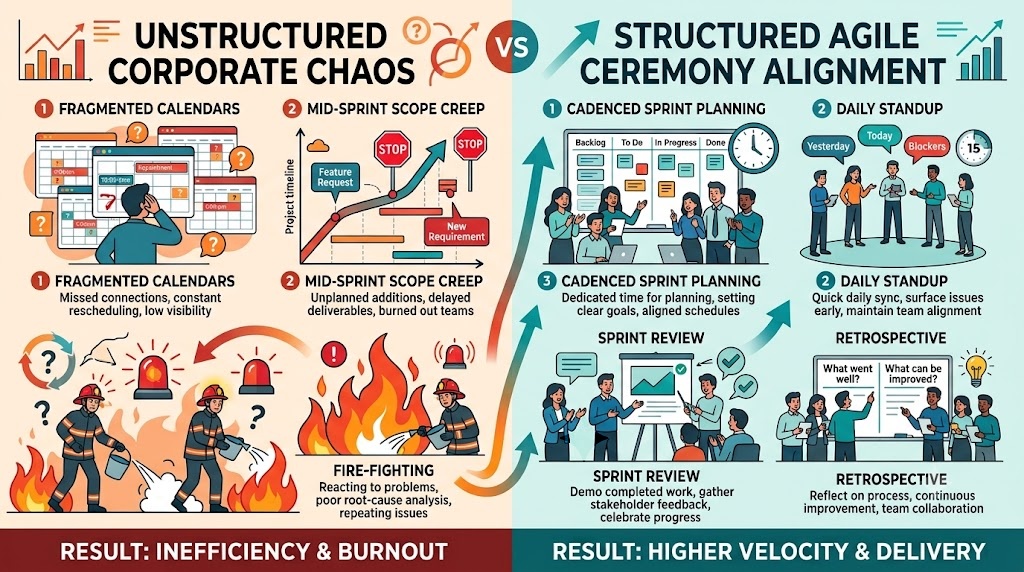
Organizations frequently confuse Agile collaboration with unstructured, ad-hoc chaos. When traditional project management structures are dismantled without establishing disciplined communication rhythms, communication does not vanish: it metastasizes. Status updates spill into perpetual chat threads, quick check-ins derail focused deep work, and critical delivery risks remain hidden until launch day.
Agile ceremonies are not extra meetings added to your calendar. They are structured, purpose-driven events engineered to replace unstructured noise with predictable, timeboxed alignment. When executed correctly, these ceremonies protect engineering focus, create total transparency across leadership, and guarantee that team energy translates into shipped product value.
Deconstructing Agile Ceremonies: Purpose, Mechanics, and Execution
Agile ceremonies are specific, recurring events prescribed within iterative frameworks like Scrum and Kanban. Their primary mandate is to provide structured forums where cross-functional teams inspect progress, adapt to changing requirements, and continuously optimize their delivery pipeline.
Rather than scheduling reactive status meetings whenever issues arise, Agile operates on a fixed cadence. Every ceremony serves an explicit operational purpose, enforces strict timeboxing, and generates tangible artifacts that drive accountability.
The Five Essential Agile Ceremonies
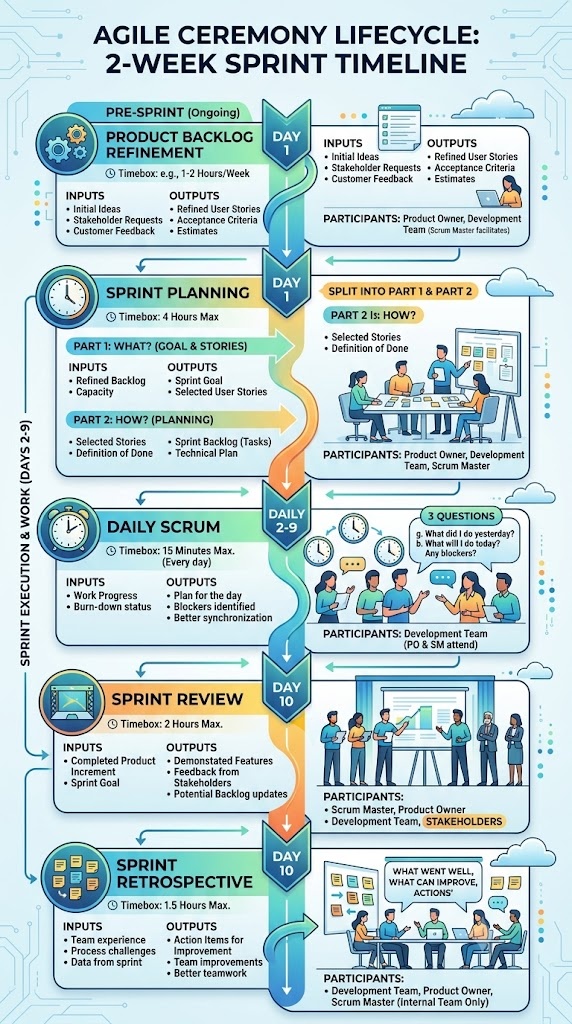
1. Sprint Planning: Setting the Operational North Star
Primary Objective: Define the Sprint Goal and select the prioritized work items from the product backlog that the team commits to delivering.
Recommended Timebox: Maximum of 2 hours per week of sprint duration (e.g., 4 hours for a 2-week sprint).
Key Participants: Scrum Master, Product Owner, Engineering/Development Team.
Core Mechanics: The Product Owner presents prioritized user stories that meet the Definition of Ready (DoR). The engineering team evaluates capacity, reviews past velocity, estimates task effort, and commits to a realistic subset of work. The ceremony concludes with an agreed-upon Sprint Goal and a finalized Sprint Backlog.
2. Daily Standup (Daily Scrum): Synchronizing Tactical Progress
Primary Objective: Maintain daily alignment, inspect progress toward the Sprint Goal, and uncover operational impediments early.
Recommended Timebox: Exactly 15 minutes daily, occurring at the same time and location.
Key Participants: Development Team, Scrum Master (facilitator). The Product Owner is optional but encouraged to observe.
Core Mechanics: Each team member concisely answers three core questions:
What did I accomplish yesterday that contributed to the Sprint Goal?
What will I focus on today to advance the Sprint Goal?
What blockers or impediments are standing in my way?
Critical Guardrail: The Daily Standup is a sync, not a problem-solving session or status report to management. Tactical discussions and blocker resolutions are immediately moved to post-standup “parking lot” conversations involving only relevant personnel.
3. Sprint Review: Inspecting Deliverables with Stakeholders
Primary Objective: Demonstrate completed, working software to business stakeholders, gather feedback, and adapt the product backlog based on strategic shifts.
Recommended Timebox: 1 hour per week of sprint duration (e.g., 2 hours for a 2-week sprint).
Key Participants: Scrum Master, Product Owner, Development Team, Executive Stakeholders, End Users.
Core Mechanics: The team presents only work that meets the strict Definition of Done (DoD). This is a functional product demonstration, not a static slide deck presentation. Stakeholders test features, offer real-time feedback, and discuss market updates. The Product Owner adjusts the overarching Product Backlog based on insights gathered during the session.
4. Sprint Retrospective: Optimizing Process and Team Dynamics
Primary Objective: Inspect how the team worked during the previous sprint regarding people, relationships, processes, and tools, and identify targeted actionable improvements.
Recommended Timebox: 45 minutes to 1 hour per week of sprint duration (e.g., 1.5 hours for a 2-week sprint).
Key Participants: Scrum Master (facilitator), Product Owner, Development Team. External stakeholders are explicitly excluded to maintain psychological safety.
Core Mechanics: The team analyzes the past iteration across key categories: What went well? What did not go well? What experiments should we try next? The session produces 1 to 3 high-impact, actionable improvement items that are immediately prioritized in the upcoming Sprint Backlog as work tasks.
5. Backlog Refinement (Grooming): Fueling Future Iterations
Primary Objective: Review, break down, re-estimate, and prioritize upcoming Product Backlog items to ensure they are fully prepared for future Sprint Planning sessions.
Recommended Timebox: 1 to 2 hours per 2-week sprint (conducted mid-sprint).
Key Participants: Product Owner, Scrum Master, Lead Developers / Core Engineering Team.
Core Mechanics: The Product Owner introduces raw epics or feature requests. Engineers clarify technical requirements, define acceptance criteria, decompose large stories into manageable units, and assign relative effort estimates using story points or t-shirt sizing.
| Ceremony | Recommended Duration | Primary Goal | Key Inputs | Key Outputs |
| Sprint Planning | 2 hrs / 2-wk sprint | Commit to a feasible Sprint Goal and Sprint Backlog | Prioritized Product Backlog, Team Velocity, Capacity | Sprint Goal, Finalized Sprint Backlog |
| Daily Standup | 15 minutes daily | Sync progress and identify active blockers | Previous day’s commitments, Active Board updates | Blocker identification, Daily coordination plan |
| Sprint Review | 1 hr / 2-wk sprint | Demo completed work and gather stakeholder feedback | Potentially Shippable Product Increment | Updated Product Backlog, Stakeholder alignment |
| Sprint Retrospective | 1 hr / 2-wk sprint | Inspect process and commit to team improvements | Sprint data, Burndown charts, Team observations | Actionable Improvement Backlog (1-3 items) |
| Backlog Refinement | 1-2 hrs / mid-sprint | Ensure backlog items are clear, estimated, and ready | Raw feature requests, Stakeholder requests | Groomed user stories meeting Definition of Ready |
The Project Manager's Step-by-Step Ceremony Implementation Framework
Transitioning a struggling organization to high-performing Agile cadences requires deliberate execution. Use this step-by-step framework to audit, structure, and optimize your team’s ceremonies.
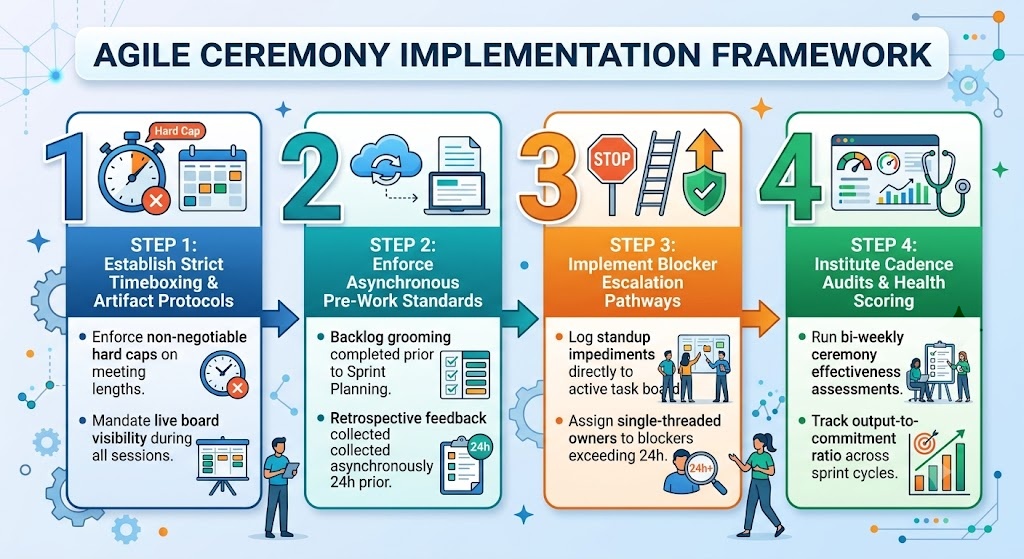
Step 1: Establish Strict Timeboxing & Artifact Protocols
Define non-negotiable start and end times for every ceremony.
Ensure that every session relies on live visual management tools (such as Jira, Azure DevOps, or physical Kanban boards) rather than verbal status reports.
Require every story under discussion to possess a written Definition of Ready before entering planning.
Step 2: Enforce Asynchronous Pre-Work Standards
Require Product Owners to publish finalized backlog priorities at least 24 hours prior to Sprint Planning.
Collect Sprint Retrospective feedback using digital boards (e.g., Miro or EasyRetro) asynchronously before entering the live Retrospective session.
This shifts live ceremony time from passive data collection to active strategic discussion.
Step 3: Implement Blocker Escalation Pathways
When a developer flags an impediment during the Daily Standup, the Scrum Master logs it immediately to the active project board.
If an impediment cannot be resolved within 24 hours by the immediate team, establish a formal escalation route to functional managers or external technical leads.
Protect team members from spending standup time debating solutions: mandate a follow-up “Parking Lot” meeting for involved parties only.
Step 4: Institute Cadence Audits and Health Scoring
Evaluate your ceremonies monthly against key metrics:
Standup Time Variance: Are 15-minute standups consistently running over to 30 minutes?
Say/Do Ratio: Is the team completing at least 85% of the story points committed to during Sprint Planning?
Retrospective Action Completion: Are retrospective improvement items actually completed in the subsequent sprint, or do they languish in the backlog?
From Calendar Chaos to Elite Delivery Leadership
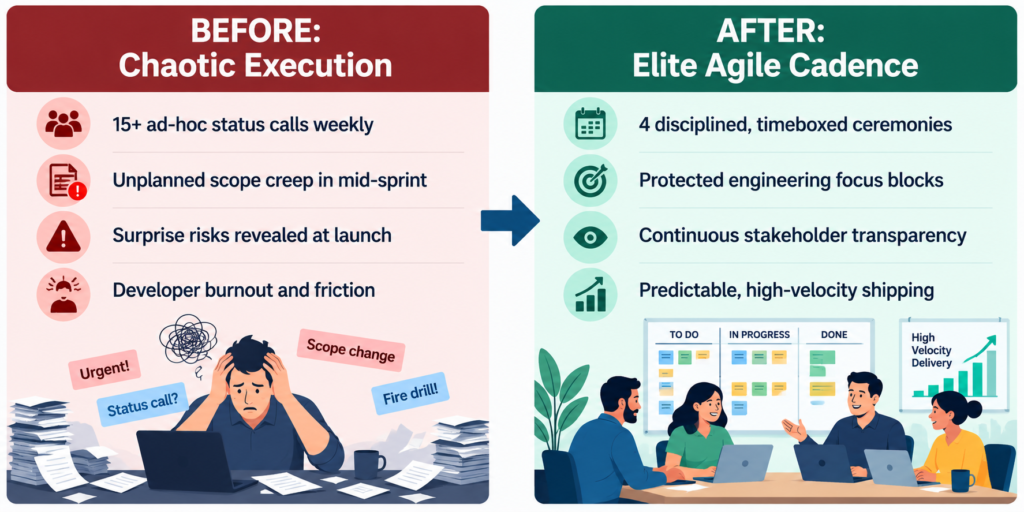
Imagine running a project ecosystem where surprise launch delays, toxic late-night fire-fighting, and vague status reports disappear completely.
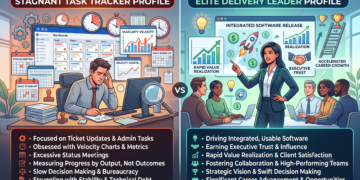
When you master Agile ceremonies, your role shifts from an exhausted calendar coordinator constantly chasing status updates to a strategic delivery architect. Your development teams operate in a protected flow state because low-value meetings are eliminated. Executive stakeholders trust your timelines because working software is demonstrated predictably at every Sprint Review. Scope creep is caught and managed systematically during backlog refinement long before it threatens your budget.
Mastering communication cadences is the single fastest differentiator for project managers seeking career advancement. Senior leaders do not promote managers who simply record meeting minutes or forward status emails. They promote leaders who build self-sustaining, high-velocity operational engines.
By mastering the mechanics of Agile ceremonies, you demonstrate the executive maturity required to manage multi-million dollar portfolios, lead cross-functional global teams, and consistently turn strategic intent into operational reality.
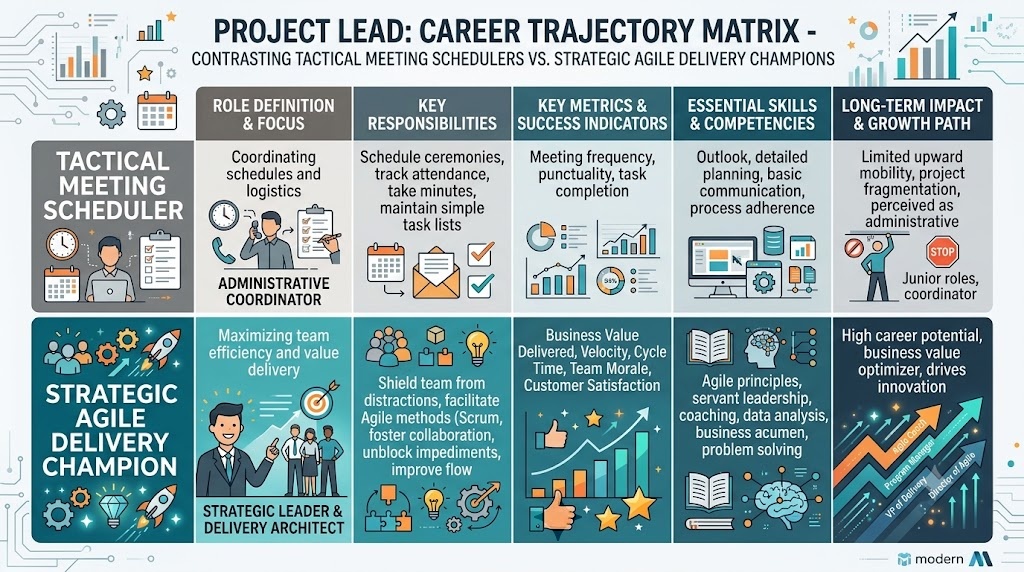
Transforming high-level Agile concepts into flawless, real-world execution requires more than reading frameworks online. It demands structured mentorship, practical execution blueprints, and expert guidance tailored to complex enterprise environments.
By implementing strict timeboxing, explicit artifact definitions, and disciplined blocker escalation across your Agile ceremonies, you reclaim engineering focus and build total operational transparency.
If you are ready to stop guessing, move up the corporate ladder, and learn project management the right way, reach out to Skillsetify. We do not just teach frameworks: we show you your exact career growth trajectory.