How Fibonacci Mechanics Eliminate Planning Friction and Restore Agile Delivery
Your quarterly enterprise release is about to go live, but your core software engineers are locked in a tense, exhausting messaging thread. The payment gateway integration module is failing final end-to-end testing. When you trace the root cause back to Sprint Planning, the breakdown follows a painfully familiar script. The team spent a draining session arguing over whether that payment story should be estimated at 6, 7, or 8 hours. To reach a compromise, they logged it as a 7, converted that number directly into a linear hourly commitment, and ignored the underlying architectural ambiguity. When unexpected API rate-limiting issues emerged, the sprint burned down, taking down your launch timeline with it.
This failure scenario plays out across technology organizations every single week. It stems from a deeply entrenched corporate myth: the belief that precision in project estimation is achieved by breaking complex tasks down into granular, linear numbers or exact hours. Executives and project managers naturally crave linear precision because it feels controllable. However, software development and complex knowledge work are inherently non-linear, high-uncertainty endeavors. Applying linear estimation scales to complex work creates a dangerous illusion of certainty while breeding massive cognitive friction during planning meetings.
The Cognitive Science of Non-Linear Estimation
To fix estimation paralysis, elite project leaders must look beyond basic administrative frameworks and understand the psychophysics of human judgment. Human perception does not operate on a linear scale when assessing relative scale, effort, or risk.
The Weber-Fechner Law and Cognitive Friction
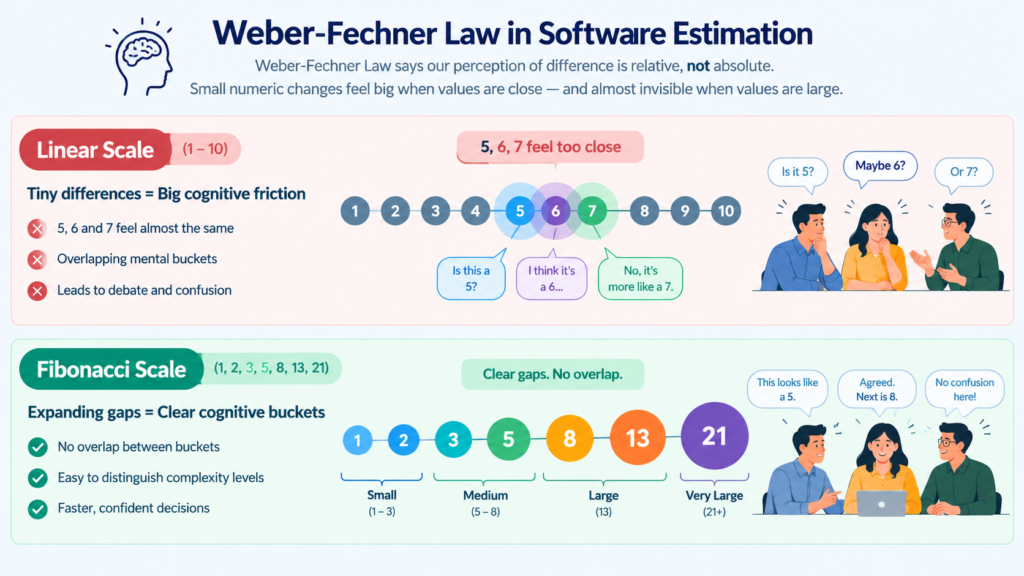
In experimental psychology, the Weber-Fechner law dictates that the ability to perceive differences between two stimuli is proportional to the magnitude of the stimuli themselves. If you hold a one-pound weight in one hand and a two-pound weight in the other, your brain instantly recognizes that one is double the weight of the other. However, if you hold a twenty-pound weight in one hand and a twenty-one-pound weight in the other, distinguishing between the two by feel alone is virtually impossible, even though the absolute difference (one pound) remains identical.
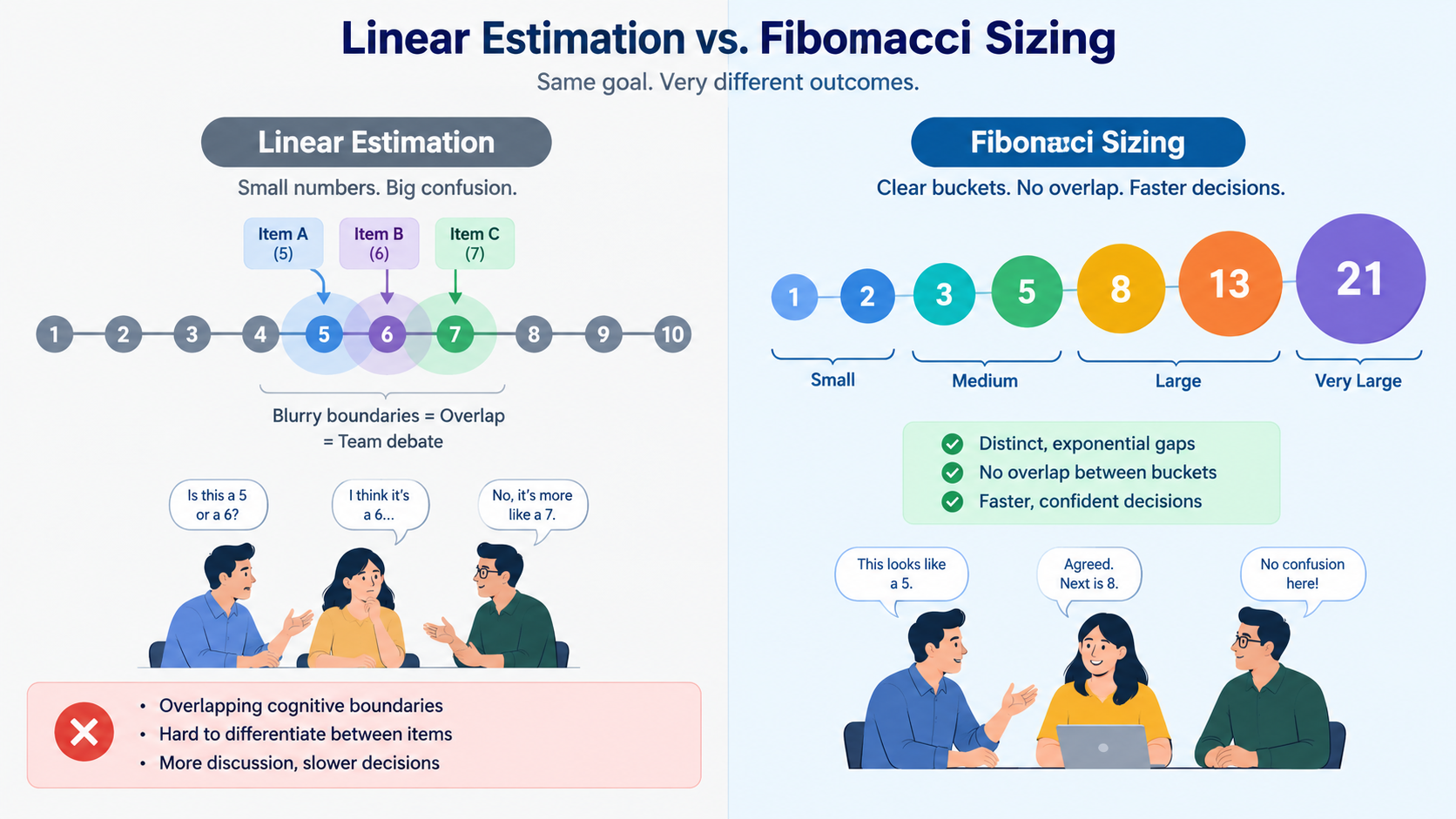
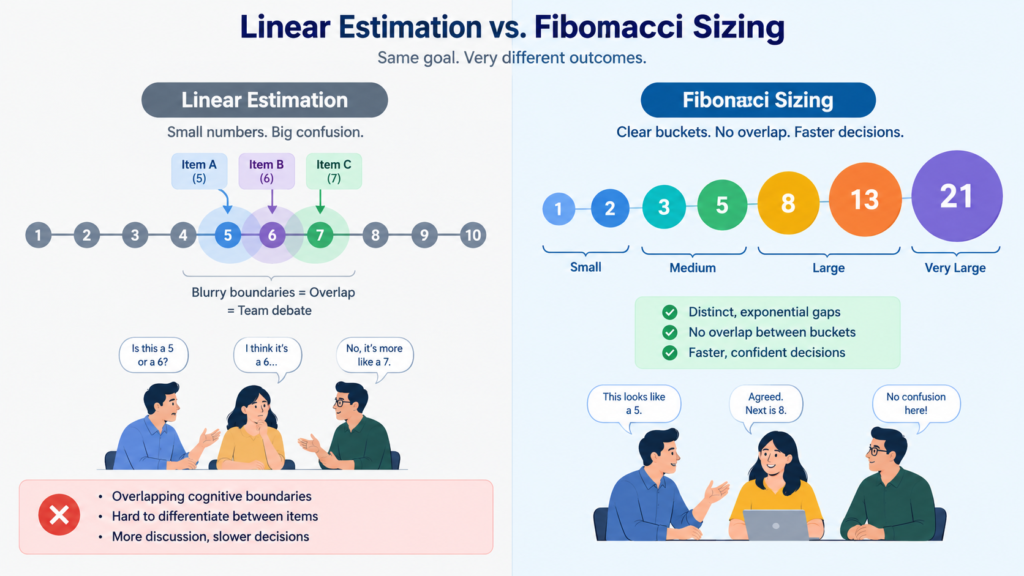
When project managers ask software developers to choose between estimating an item at 5, 6, or 7 points, they are forcing the team into the cognitive equivalent of weighing twenty versus twenty-one pounds. The relative distinction between 5 and 6 is negligible, yet linear scales force teams to debate these microscopic gaps. This creates severe cognitive friction, elongates backlog refinement sessions, and provides zero additional accuracy.
Why the Fibonacci Sequence Architecturally Forces Clarity
The Fibonacci sequence (0, 1, 1, 2, 3, 5, 8, 13, 21, 34…) solves this perceptual flaw by embedding exponentially expanding gaps between adjacent estimation numbers. Each term in the sequence is calculated as fₙ = fₙ₋₁ + fₙ₋₂. As values increase, the percentage difference between sequential items stabilizes around the Golden Ratio (~61.8% jump).
This non-linear progression aligns perfectly with human cognitive scaling and uncertainty dynamics.
Small Scale (1, 2, 3): Gaps are tight because work in this realm is simple, well-understood, and low-risk.
Medium Scale (5, 8): Gaps widen noticeably. The jump from 5 to 8 represents a 60% increase in effort and complexity, reflecting growing architectural uncertainty.
Large Scale (13, 21, 34): Gaps expand exponentially. A 13-point item is not merely “a little bigger” than an 8-point item; it represents an order-of-magnitude leap in unknown variables and complexity.
By stripping away arbitrary intermediate options like 4, 6, 7, 9, or 10, the Fibonacci sequence forces teams to make definitive, macroscopic sizing decisions. A team member cannot get stuck debating whether a feature is a 6 or a 7. They are forced to decide: Is this manageable enough to be a 5, or does the uncertainty push it into an 8?
The Step-by-Step Framework for Fibonacci Estimation
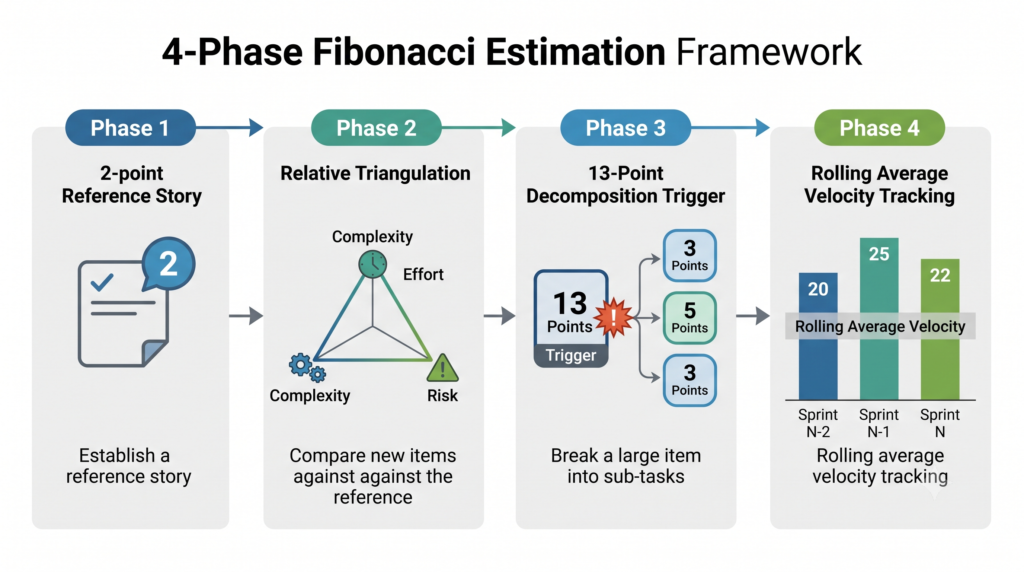
Transitioning a corporate delivery team from linear hour guessing to non-linear Fibonacci story mechanics requires a structured execution framework. Project managers can deploy this four-stage operational process immediately.
Stage 1: Establish the Canonical Reference Baseline
Never begin an estimation session in a vacuum. Select a well-understood, historically completed user story from a past sprint that required minimal effort and had zero architectural surprises. Define this story as the team’s permanent 2-point reference item. Every future story will be evaluated exclusively against this baseline.
Stage 2: Execute Relative Triangulation
During backlog refinement, present a new user story and direct the team to compare it strictly to the reference baseline. Instruct team members to ignore hours completely and focus on three core dimensions:
Complexity: How many moving parts, dependencies, or external integrations exist?
Effort: How much sheer work is required to build and test the item?
Uncertainty/Risk: How much unknown technical debt, undocumented API architecture, or business logic ambiguity is involved?
Stage 3: Apply the 13-Point Decomposition Trigger
Establish an unyielding operational rule: any user story estimated at a 13, 21, or higher cannot be pulled into an active sprint. A 13-point score is a red flag indicating that the story contains too many unknown variables to be predictably delivered within a single sprint boundary. Mandate that any 13+ story be immediately decomposed into multiple smaller user stories (e.g., splitting a 13-point epic into a 5-point backend story, a 3-point frontend story, and a 3-point testing story).
Stage 4: Track Empirical Velocity Calibration
Calculate team capacity based on completed Fibonacci story points across three consecutive sprints. Do not adjust point values mid-sprint. If a team completes 34 points in Sprint 1, 38 points in Sprint 2, and 36 points in Sprint 3, their rolling average empirical velocity is 36 points. Use this empirical number—rather than arbitrary executive deadlines—for capacity planning in Sprint 4.
The Executive Transformation: Moving from Planning Chaos to Predictable Delivery
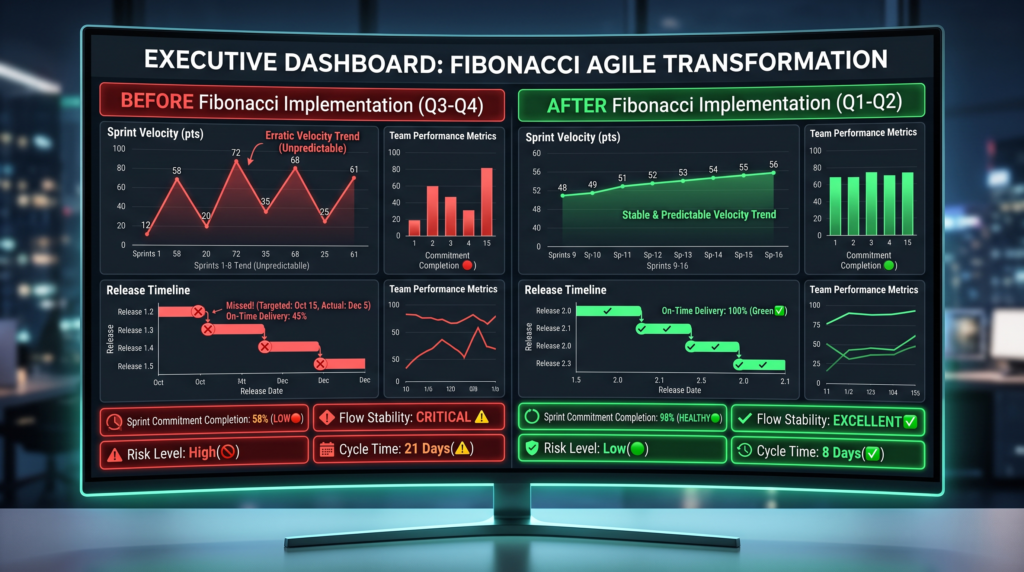
Mastering non-linear estimation mechanics completely transforms the operational trajectory of a delivery organization. When teams stop debating minor numerical differences and adopt Fibonacci relative mechanics, sprint planning meeting duration drops by over 50%. Planning sessions shift from exhausting hourly negotiations into strategic discussions focused on risk mitigation and architectural clarity.
For project managers and Scrum leaders, the professional benefits are immediate:
Elimination of Sprint Commitment Slippage: By enforcing the 13-point decomposition trigger, teams stop pulling massive, risky items into sprints, dramatically lowering failure rates.
Data-Driven Stakeholder Alignment: PMs can replace defensive, opinion-based release projections with mathematically sound, empirical velocity data.
Protection Against Team Burnout: Teams operate within predictable, sustainable bounds rather than rushing to fulfill artificial, linear hour estimates.
When you master these mechanics, leadership stops viewing you as a passive schedule coordinator and starts recognizing you as an elite delivery strategist capable of orchestrating complex software releases with surgical precision. This mastery is what distinguishes mid-level project managers from high-earning VP-level delivery directors.
Master Elite Agile Execution with Skillsetify
Linear estimation scales and hour-based guessing are relics of traditional waterfall thinking disguised as Agile execution. By leveraging the Fibonacci sequence’s non-linear gaps, project leaders eliminate cognitive friction, respect psychophysical judgment limits, and establish truly predictable delivery cadences.
If you are ready to stop guessing, move up the corporate ladder, and learn project management the right way, reach out to Skillsetify. We do not just teach frameworks: we show you your exact career growth trajectory.