Why Your Agile Teams Are Drowning in Hidden Work and How Core Kanban Principles Restore Elite Delivery
A major strategic product deployment is scheduled for midnight, but your delivery board displays 42 active tickets stuck in “In Progress.” Nobody knows who owns what, developers are frantically cherry-picking hotfixes, QA is inundated with untested code, and executive sponsors are bombarding your inbox with desperate requests for status updates. The release deadline passes, coffee grows cold, and team morale plummets.
This high-stress workplace crisis is not a resource problem: it is an invisible workflow problem.
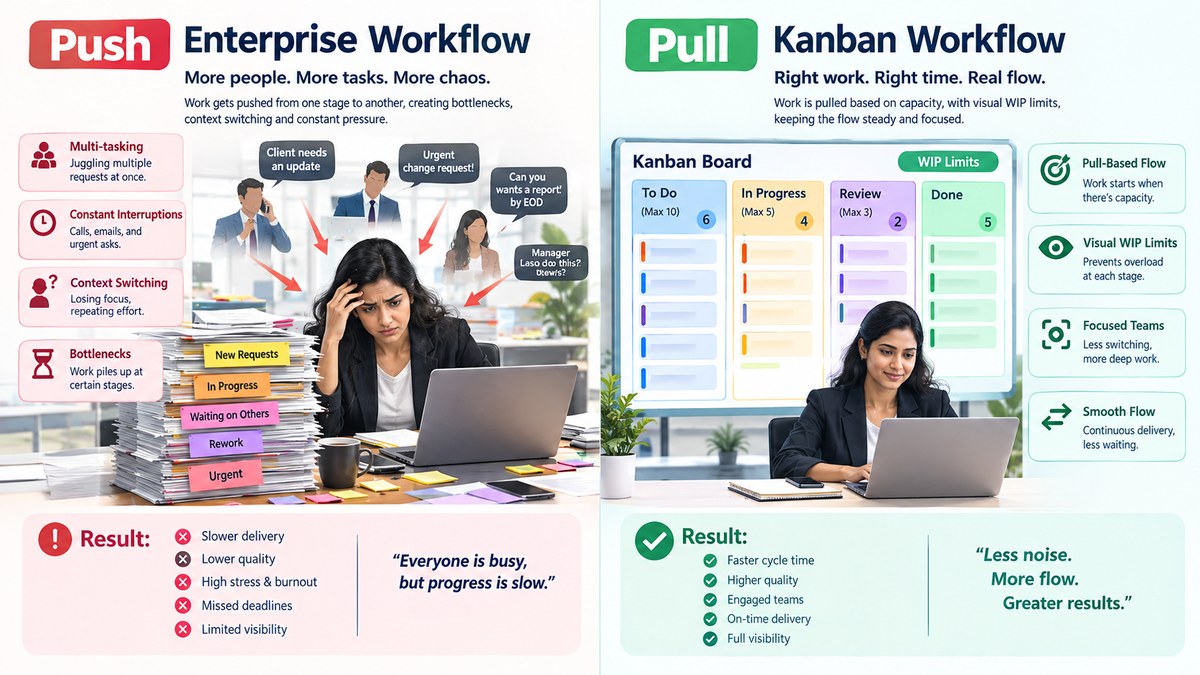
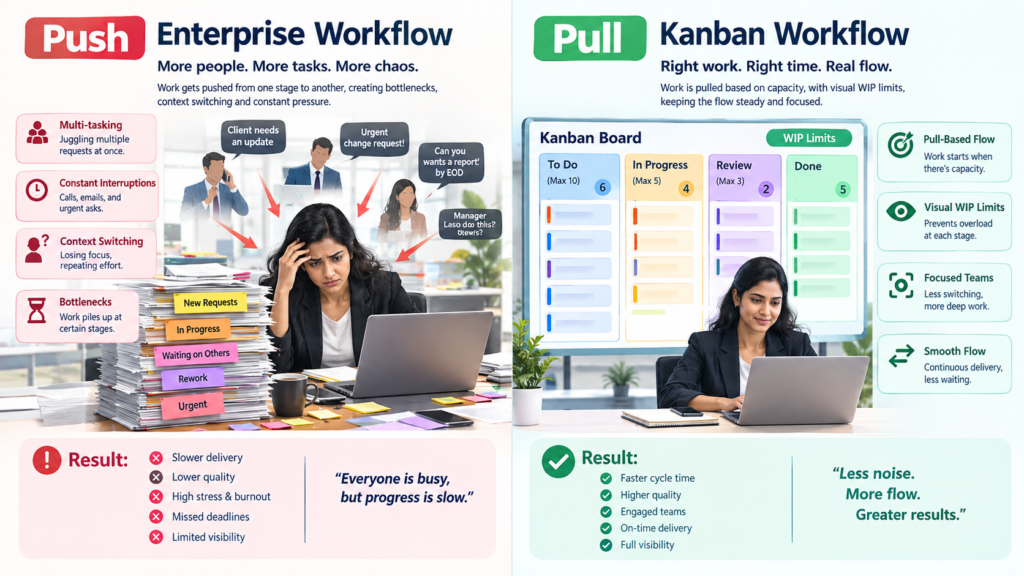
The most pervasive myth in modern corporate project management is that high activity equals high productivity. Enterprise organizations routinely pile project after project onto team backlogs, pushing work onto engineers and operational teams under the dangerous assumption that starting more work means finishing more work. The reality is far more brutal: when everything is a priority, nothing gets delivered. Uncontrolled multi-tasking creates massive cognitive friction, context switching, and hidden bottlenecks that paralyze organizational throughput.
What is Kanban? From Toyota's Shop Floor to the Enterprise PMO
Derived from Lean manufacturing principles pioneered by Taiichi Ohno at Toyota in the 1940s, Kanban (literally translating to visual sign or card in Japanese) was originally developed to align factory production capacity with actual consumer demand. In modern knowledge work and enterprise project management, Kanban serves as a visual workflow management method designed to make work visible, restrict work-in-progress, and optimize end-to-end value delivery.
Unlike rigid push systems where management assigns work regardless of actual capacity, Kanban is fundamentally a pull system. Team members pull new work into active stages only when capacity becomes available. This fundamental shift eliminates work-in-progress overload and forces organizations to confront operational realities before taking on scope creep.
The Structural Anatomy: Boards, Cards, and Swimlanes
To move work efficiently from concept to cash, project managers must structure a Kanban environment using three core architectural components:
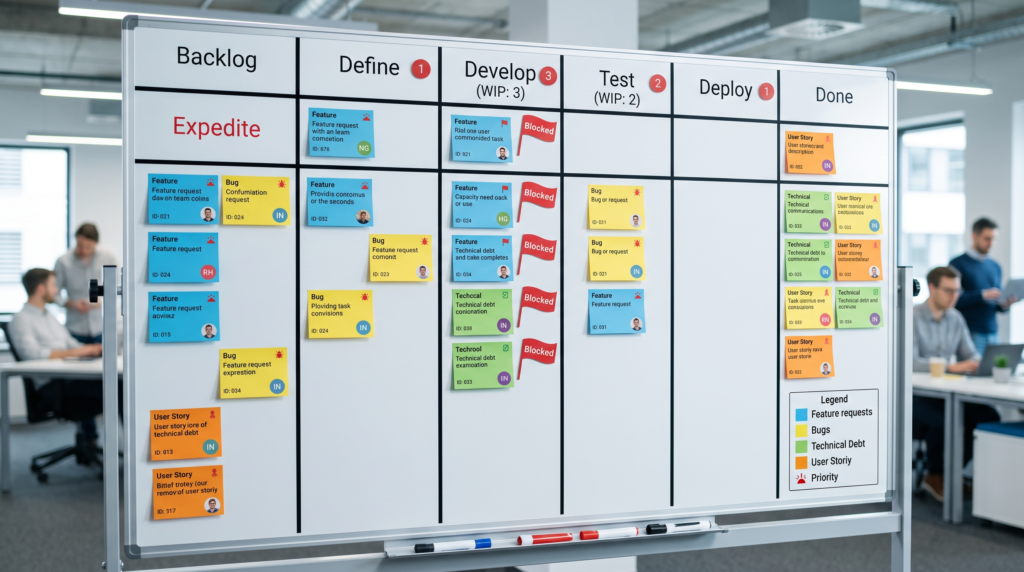
Kanban Cards: Individual visual tokens representing discrete deliverables or user stories. A well-designed card holds crucial metadata: work item owner, effort estimate, priority class, and current blocker status. Crucially, teams must avoid gaming the system by breaking work into microscopic, non-valuable sub-tasks simply to artificially inflate board movement. Every card must represent genuine, measurable customer value.
Columns: Vertical stages representing specific operational steps in your team’s workflow. While simple boards utilize basic “To-Do,” “In Progress,” and “Done” states, enterprise teams customize columns to mirror actual functional handoffs, such as “Design,” “Development,” “Code Review,” and “Regression Testing.”
Swimlanes: Horizontal channels running across columns used to categorize work by service class, strategic alignment, or priority. Swimlanes allow teams to establish dedicated fast-track lanes for critical production outages or high-priority security fixes without disrupting standard feature workflows.
The Metrics of Mastery: WIP Limits, Lead Time, and Cycle Time
To turn a simple visual board into a high-performance delivery engine, project managers must master three core analytical mechanics:
1. Work in Progress (WIP) Limits
WIP limits are explicit numerical caps placed on specific workflow columns. A WIP limit of 3 on a development column means no team member can pull a fourth task into development until one of the existing three items moves forward into code review. Restricting WIP eliminates multi-tasking, reduces cognitive overload, and forces team members to collaborate on clearing active blockers rather than starting new, uncommitted work.
2. Lead Time vs. Cycle Time
Measuring delivery performance requires understanding the precise distinction between system responsiveness and execution efficiency:
Lead Time: The total elapsed time from the moment a stakeholder submits a request (entering the backlog) until its final delivery to the end user.
Cycle Time: The active execution time measured from when a team member begins actively working on a task (pulling it into an active column) until it reaches completion.
Mathematically, Lead Time will always exceed Cycle Time due to backlog waiting states:
Lead Time = Wait Time + Cycle Time
Reducing queue wait times through capacity alignment yields far greater delivery speed improvements than attempting to force faster active execution.
3. Cumulative Flow Diagrams (CFD)
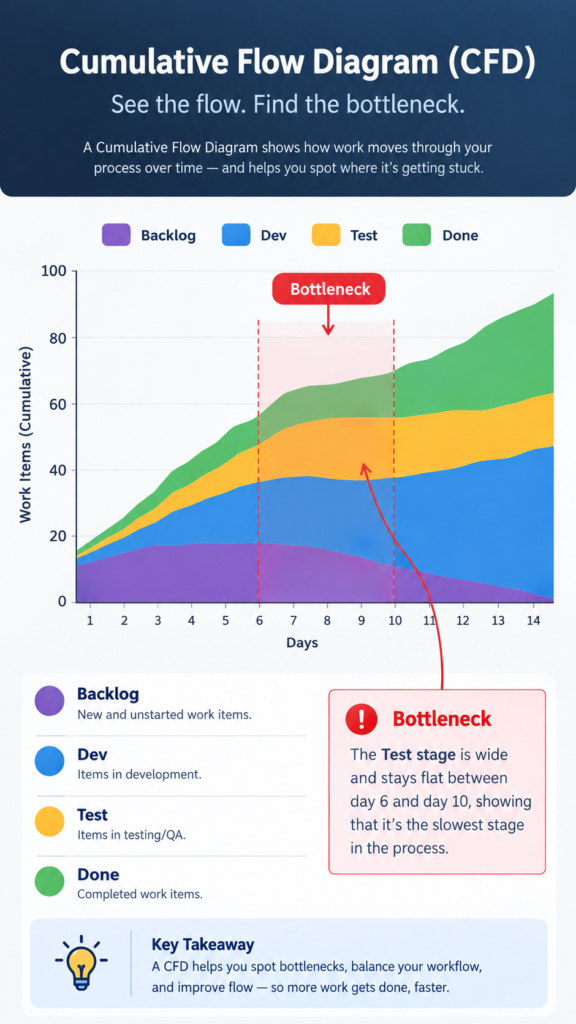
A Cumulative Flow Diagram is a visual metric tracking total card volumes across all workflow states over time. Smooth, parallel bands on a CFD signal stable, predictable delivery velocity. Conversely, widening bands reveal immediate operational bottlenecks, such as work piling up in testing due to QA understaffing or delayed stakeholder sign-offs.
The 5-Step Kanban Implementation Framework for Project Managers
Transitioning an enterprise team to Kanban requires an evolutionary approach rather than a chaotic organizational overhaul. Project leaders can copy and execute this step-by-step framework immediately:
Map Your Current Process As-Is: Do not invent idealized steps. Document the exact operational workflow your team uses today, including informal review gates and handoffs. Respect existing roles and processes while establishing visual baseline visibility.
Define Explicit Stage Policies: Establish explicit, public rules for every column. Define precisely what criteria must be met for a task to be marked “Ready for Review” or “Definition of Done.” Explicit policies eliminate ambiguity and standardize quality across functional handoffs.
Apply and Enforce WIP Limits: Calculate active team capacity and assign realistic WIP limits to in-progress columns. If a column hits its WIP limit, institute a policy where team members swarm to help clear existing work rather than pulling new items from the backlog.
Implement Feedback Loops: Replace lengthy status meetings with brief daily flow standups focused strictly on the board. Ask three flow-centric questions: What items are blocked? Where is work piling up? What cards can we move to “Done” today?
Evolve Experimentally (Kaizen): Conduct regular retrospectives using Lead Time and CFD data. Identify recurring process friction, formulate targeted hypotheses, and execute small, experimental process tweaks to drive continuous improvement.
From Firefighting Chaos to Predictable Elite Delivery
Imagine stepping into your Monday morning standup where daily syncs take less than ten minutes because the visual board tells the entire operational story. Blocker cards flash clearly in red, WIP limits prevent scope overload, and team members automatically swarm onto clogged testing lanes without waiting for managerial directives. Executive status reports disappear entirely because leadership can assess real-time release velocity with a single glance at your CFD metrics.
This transformation from chaotic firefighting to calm, predictable execution is not just a win for project health: it is the ultimate career accelerator. Senior executives do not promote project managers who merely manage task lists and circulate manual weekly status spreadsheets. They promote strategic leaders who build resilient, scalable delivery systems capable of consistent enterprise value creation. Mastering core Kanban principles establishes you as an operational authority capable of transforming sluggish business units into high-throughput engines.
Visualizing workflow, limiting work in progress, and governing continuous flow are the foundational pillars of modern project leadership. By replacing push-driven overburden with pull-driven efficiency, you reclaim team sanity, eliminate delivery risk, and establish complete operational transparency across your organization.
If you are ready to stop guessing, move up the corporate ladder, and learn project management the right way, reach out to Skillsetify. We do not just teach frameworks: we show you your exact career growth trajectory.