How Master Project Managers Adapt Civil Blueprints When Ground Realities Break
The boardroom is dead silent. Millions of dollars in structural steel, concrete aggregates, and heavy machinery leases sit locked in procurement pipelines. You are standing at the head of the executive table, and the chief engineer has just handed you the geotechnical lab report: soil samples from site sector four show soft, highly expansive clay. The load-bearing capacity of the earth is far lower than initial surveys predicted.
The baseline design called for a five-story corporate facility. The reality on the ground dictates that the foundation cannot support a five-story layout without an immediate, catastrophic risk of structural failure and building subsidence.
What do you do?
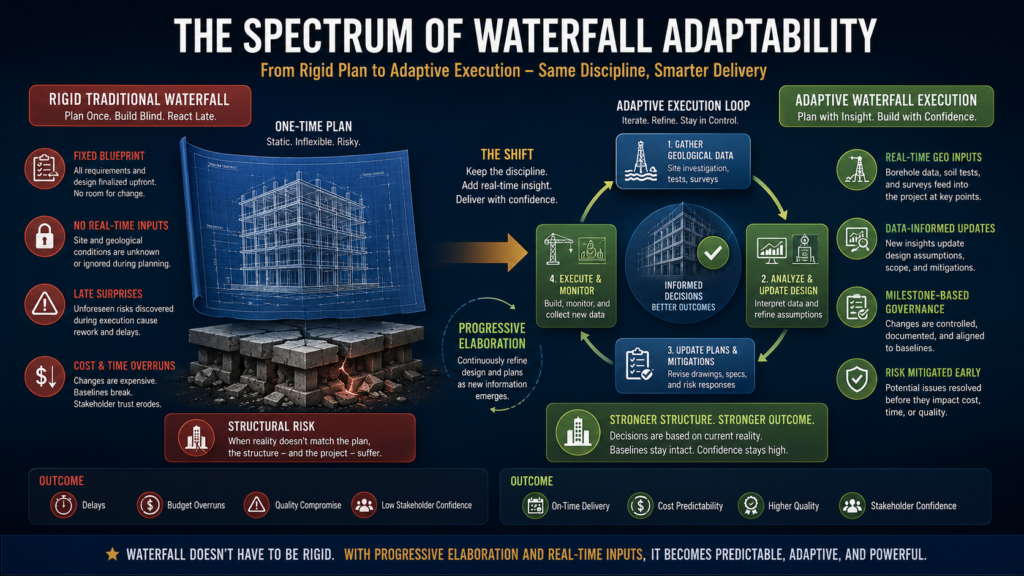
If you listen to modern tech lore, conventional wisdom tells you that traditional Waterfall project management is an unyielding, brain-dead relic. The popular narrative claims that once a Waterfall project plan is baselined, the project manager must blindly drive the team over the financial cliff, sticking to outdated blueprints regardless of what reality throws in their path.
That myth costs global enterprises billions of dollars annually in botched capital expenditure, abandoned initiatives, and crushed careers.
Traditional project management was never meant to be blind or inflexible. Heavy civil construction, nuclear power infrastructure, and massive hardware manufacturing have successfully navigated shifting real-world variables for decades. The secret lies in a fundamental principle that elite project leaders master early in their careers: Waterfall methodologies possess robust, structured mechanisms for adaptability. Chief among these are Progressive Elaboration and Rolling Wave Planning.
When soil conditions break your five-story vision, rigid stubbornness causes total project collapse. True PM mastery lies in knowing how to evolve the blueprint without losing control of the build.
Decoding Waterfall Adaptability: Progressive Elaboration vs. Rolling Wave Planning
To lead high-stakes projects, you must eliminate the false belief that planning is a one-time event completed during project initiation. In complex traditional environments, detailed planning is an ongoing discipline.
When unexpected ground conditions emerge, amateur project managers panic because they treat initial estimates as immutable laws. Elite leaders recognize that initial estimates are merely hypotheses waiting for field verification. To govern this dynamic balance between structure and change, you must master two core methodologies.
What is Progressive Elaboration?
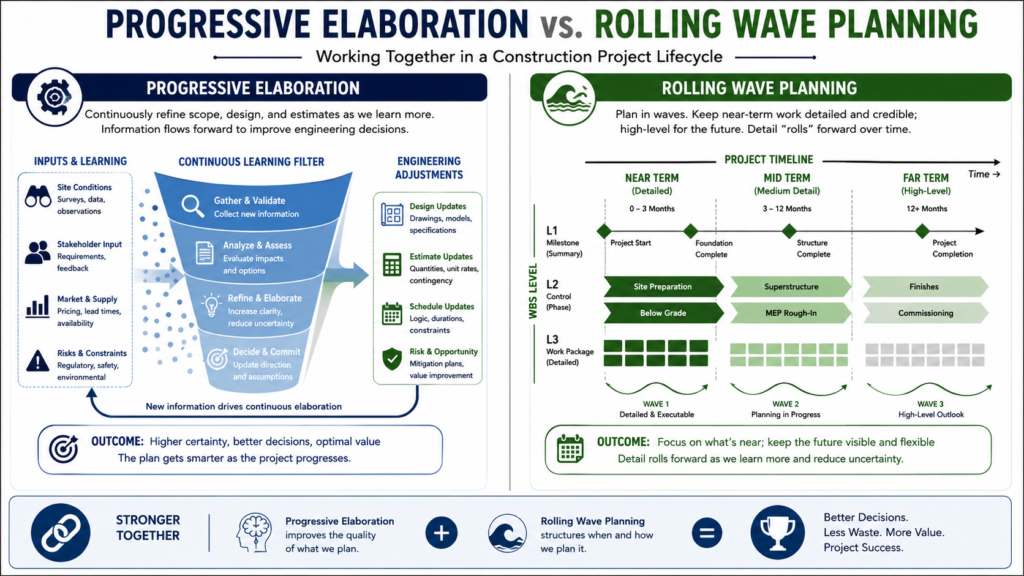
Progressive Elaboration is the strategic process of continuously refining, detailing, and expanding a project plan as clearer, more accurate empirical data becomes available. It acknowledges a basic truth: you know less about a project during initiation than you will during execution.
In our civil construction scenario, you do not detail every single rebar tie, concrete pour spec, or interior finish on day one. You establish high-level strategic objectives, macro budget constraints, and major milestones. As site excavation begins and physical soil borings are analyzed in the laboratory, you progressively elaborate the engineering specifications. If the soil reveals insufficient load-bearing strength for five stories, Progressive Elaboration provides the formal mechanism to refine the engineering scope, adjusting structural calculations and floor layouts before pouring a single cubic yard of deep foundation concrete.
What is Rolling Wave Planning?
While Progressive Elaboration is the overarching strategy of continuous refinement, Rolling Wave Planning is its tactical scheduling counterpart.
Rolling Wave Planning is a time-phased planning technique where work to be accomplished in the near term is planned in granular detail, while work further in the future is kept at a high level on the Work Breakdown Structure (WBS).
Near-Term Wave (0 to 60 Days): Planned down to WBS Level 5 or 6. Task duration, specific crew assignments, equipment rentals, and exact material specifications are completely locked in.
Medium-Term Wave (60 to 180 Days): Planned at WBS Level 3 or 4. Subcontractor packages are broadly outlined, major long-lead items are identified, and preliminary milestone dates are set.
Far-Term Wave (180+ Days): Planned at WBS Level 1 or 2. Defined strictly by major phase gates, target completion windows, and high-level deliverables.
As time advances, the project wave rolls forward. Work that was once far-term enters the near-term window, where it is broken down into granular detail using the latest insights gathered from earlier phases.
The Critical Distinction
Project managers often conflate these two concepts, but their operational roles are distinct:
Progressive Elaboration is about depth of knowledge. It answers the question: How do we incorporate new technical insights, scope adjustments, or site conditions into our engineering designs?
Rolling Wave Planning is about temporal granularity. It answers the question: How do we structure our schedule so we do not waste time detailing activities six months out that are subject to change?
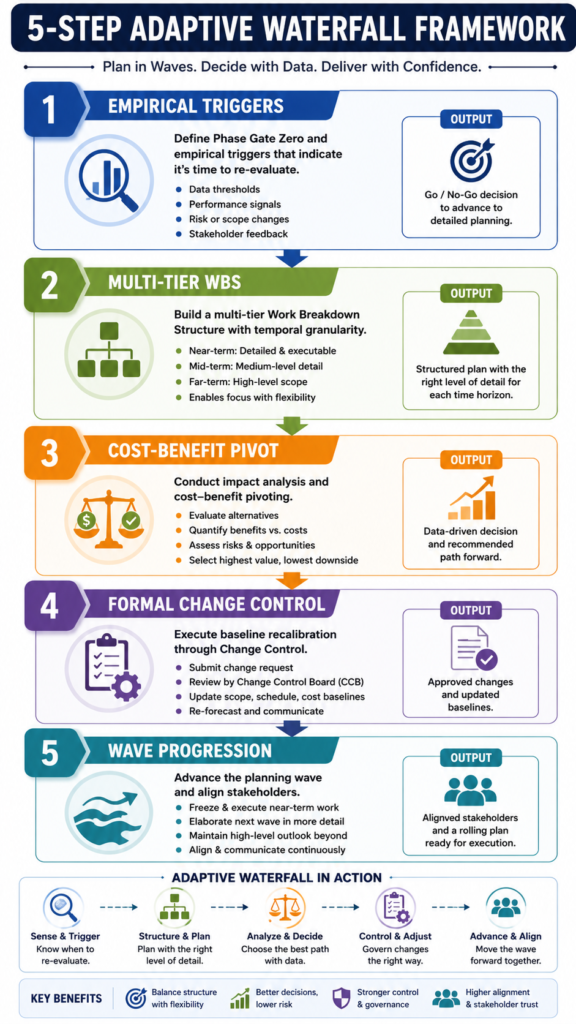
The 5-Step Execution Framework for Adaptive Traditional PMs
When soil samples invalidate your five-story building plan, you cannot simply throw up your hands or start sprinting in chaotic Agile iterations without governance. Civil engineering requires absolute physical precision. You must pivot structured work predictably.
Here is the exact step-by-step implementation framework elite project managers use to adapt traditional projects under pressure:
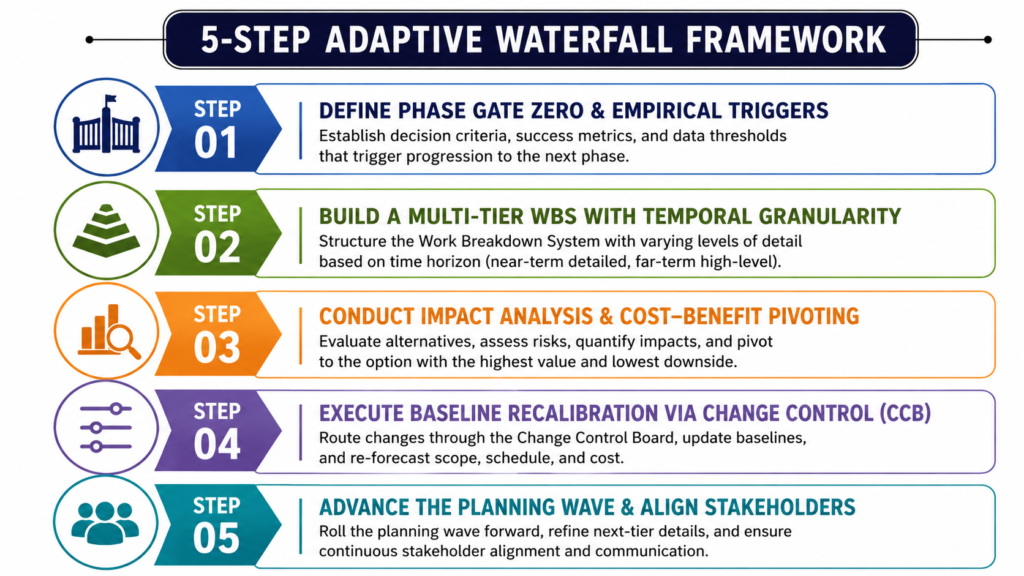
Step 1: Define Phase Gate Zero & Empirical Triggers
Establish explicit empirical triggers in your initial project management plan. Do not commit financial capital to future phases until physical verification gates are cleared. In construction, your schedule must explicitly gate foundation design approval behind physical soil load testing reports.
Step 2: Build a Multi-Tier WBS with Temporal Granularity
Structure your Work Breakdown Structure so that immediate excavation and sub-grade preparation are fully detailed, while superstructure framing for upper floors remains in high-level work packages. This ensures that when soil testing reveals anomalies, you can refine future work packages without tearing up hundreds of active work orders.
Step 3: Conduct Impact Analysis & Cost-Benefit Pivoting
When bad soil data arrives, immediately execute a structured impact analysis comparing primary engineering alternatives:
Option A (Structural Redesign): Drive deep friction piles down to bedrock to retain the original five-story vertical layout. Calculate the additional capital cost, equipment mobilization time, and long-term structural risk.
Option B (Scope Realignment): Re-engineer the layout into a four-story vertical build with an expanded horizontal footprint across stable site sectors. Calculate the cost of architectural redesign versus foundation savings.
Present concrete, data-backed tradeoffs to leadership rather than presenting a single broken plan.
Step 4: Execute Baseline Recalibration via Change Control
Adaptability in traditional project management is not chaotic scope creep; it is governed evolution. Take the selected pivot option through your formal Change Control Board (CCB). Update the scope baseline, cost baseline, and schedule baseline simultaneously. Document why the change occurred, how Progressive Elaboration justified the design shift, and obtain formal sign-off from key sponsors.
Step 5: Advance the Planning Wave & Align Stakeholders
With the baseline updated, roll your next detailed planning wave forward. Decompose the newly approved structural specifications into immediate, executable work packages for sub-contractors. Communicate the refined roadmap clearly to executives, field superintendents, and investors, demonstrating that the structural change was handled with deliberate control.
From Project Chaos to Elite Delivery: Your Professional Transformation
When you learn to bridge the gap between rigorous structure and flexible execution, your daily experience as a project leader changes completely.
Instead of living in constant dread of unexpected field data, vendor delays, or technical surprises, you welcome empirical insights as the raw material for better decision-making. You stop fighting fire with fire, and start managing project evolution with cool, calculated confidence.
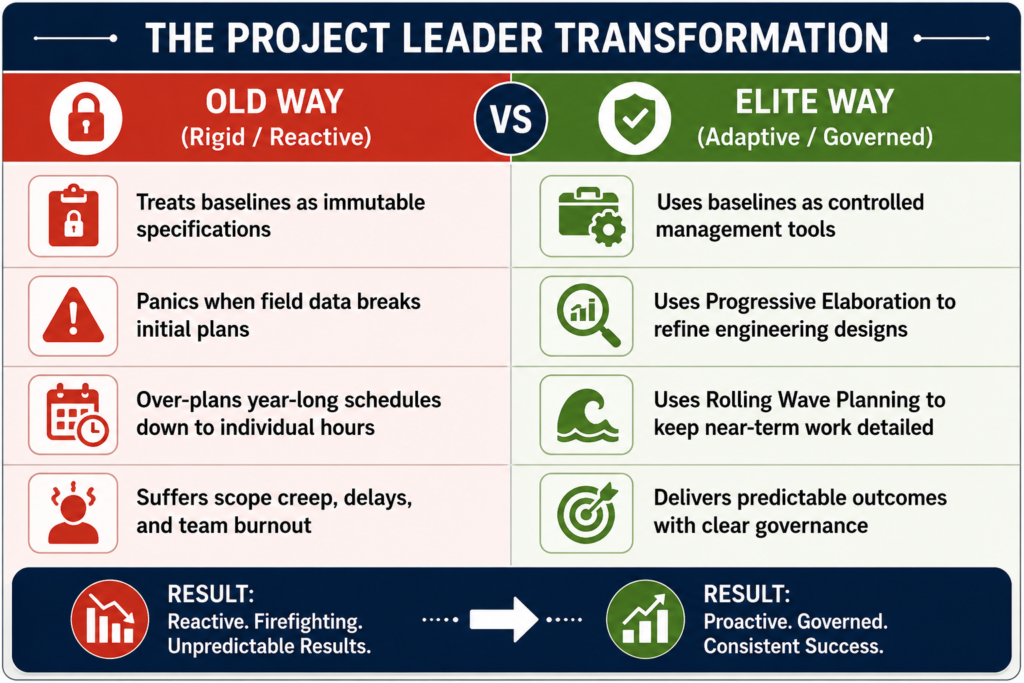
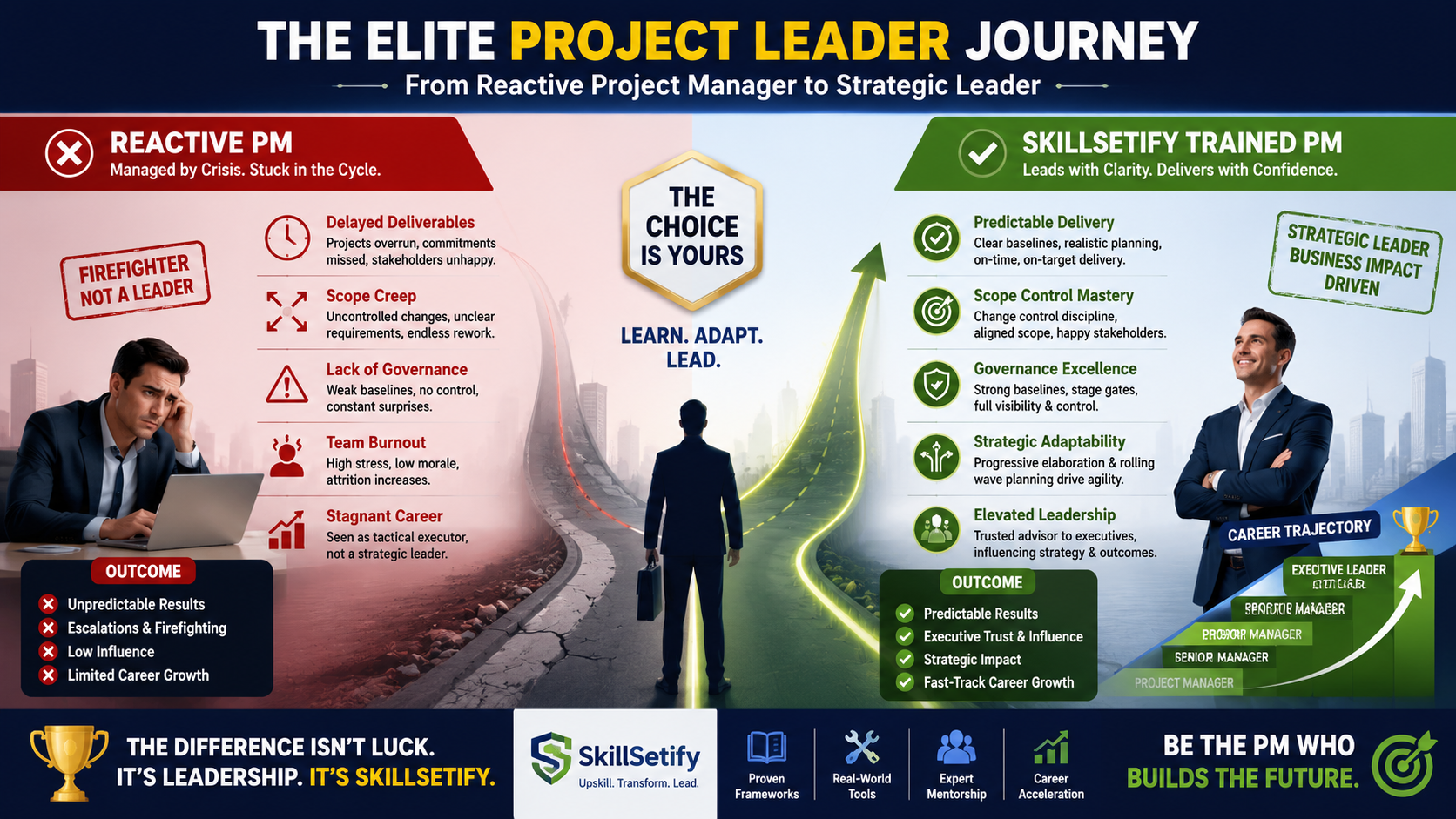
Mastering adaptive traditional execution lifts you out of the reactive cycle of missed deadlines, budget overruns, and team burnout. It elevates you into the top tier of project management talent: the rare professionals who can navigate multi-million dollar capital investments, heavy infrastructure projects, and complex enterprise transformations with absolute predictability.
When executives see a project manager who can take a major crisis like an unstable foundation, run it through a governed adaptation framework, and deliver a safe, financially viable facility on time, that project manager stops being an administrative resource. They become an indispensable strategic partner.
That level of executive trust accelerates career growth. It opens the door to director-level positions, complex global portfolios, and executive leadership roles.
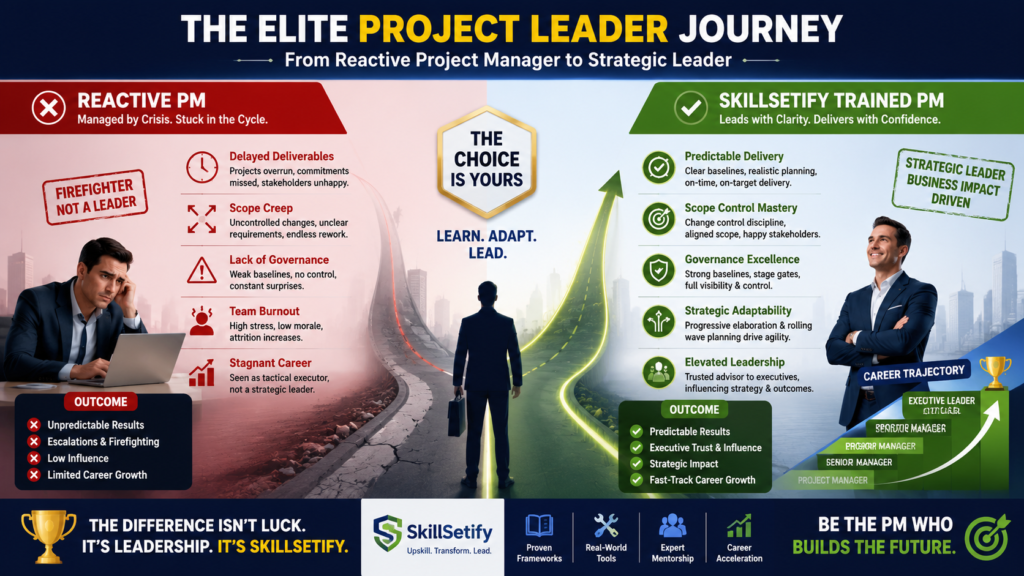
Mastering progressive elaboration and rolling wave planning turns potential site disasters into clear demonstrations of leadership control. True adaptability in enterprise project management is not about abandoning structure; it is about knowing how to govern change when complex realities hit the ground.
If you are ready to stop guessing, move up the corporate ladder, and learn project management the right way, reach out to Skillsetify. We do not just teach frameworks: we show you your exact career growth trajectory.