Master the Mechanics of Rolling Wave Execution
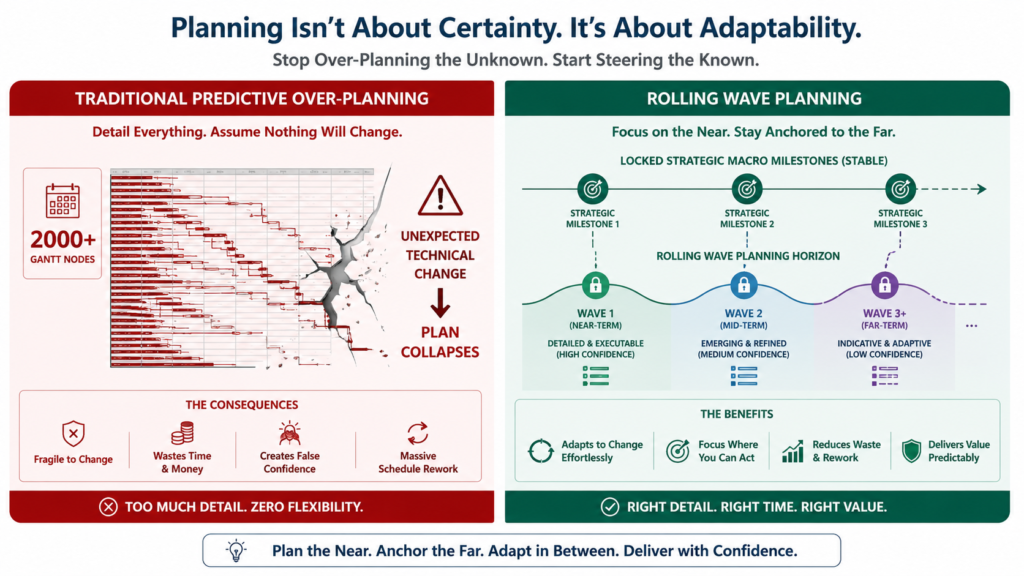
A multinational enterprise launches a $12 million legacy core modernization project spanning 24 months. In month one, the Project Management Office (PMO) presents a beautifully formatted, 2,200-line Gantt chart. Every database migration task, integration touchpoint, and user interface test scheduled for month 21 is meticulously mapped with strict finish-to-start dependencies.
It looks like a masterclass in governance. It feels secure.
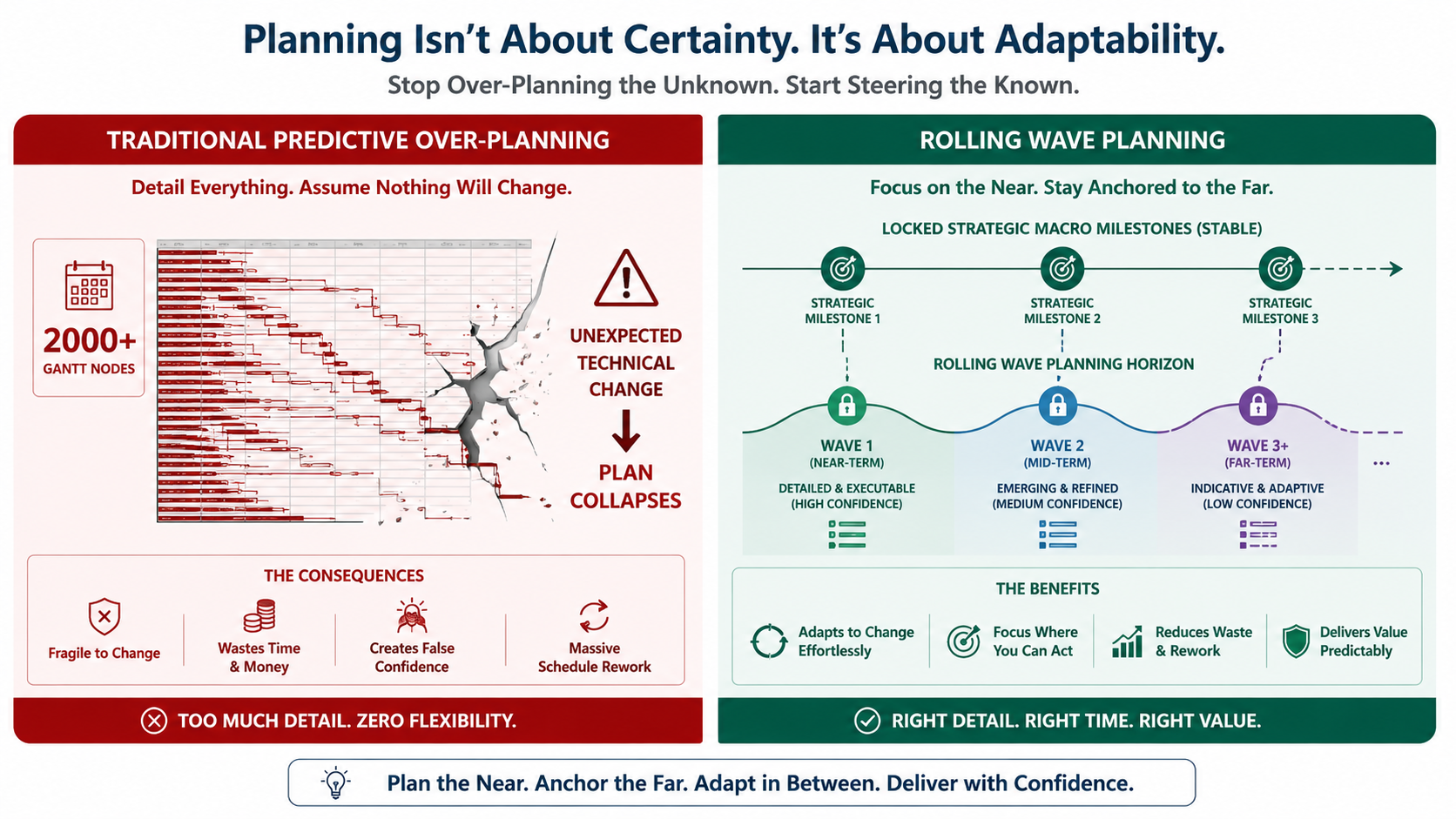
By month four, reality strikes. The architecture team uncovers unexpected API limitations within the legacy mainframe. A minor 5-day shift in early database schema definition cascades across the entire network diagram. Because every task two years down the line was hard-coded with granular dependencies, over 600 downstream activities break overnight.
The PMO spends the next three weeks working 14-hour days re-baselining micro-tasks scheduled for two years out. Project velocity drops to zero. Development teams sit idle waiting for revised schedules. Executive leadership loses confidence, demanding to know why a five-day delay in month four completely invalidated the two-year roadmap.
This crisis occurs in enterprise organizations every single day because of one fundamental misunderstanding: confusing upfront planning detail with project control.
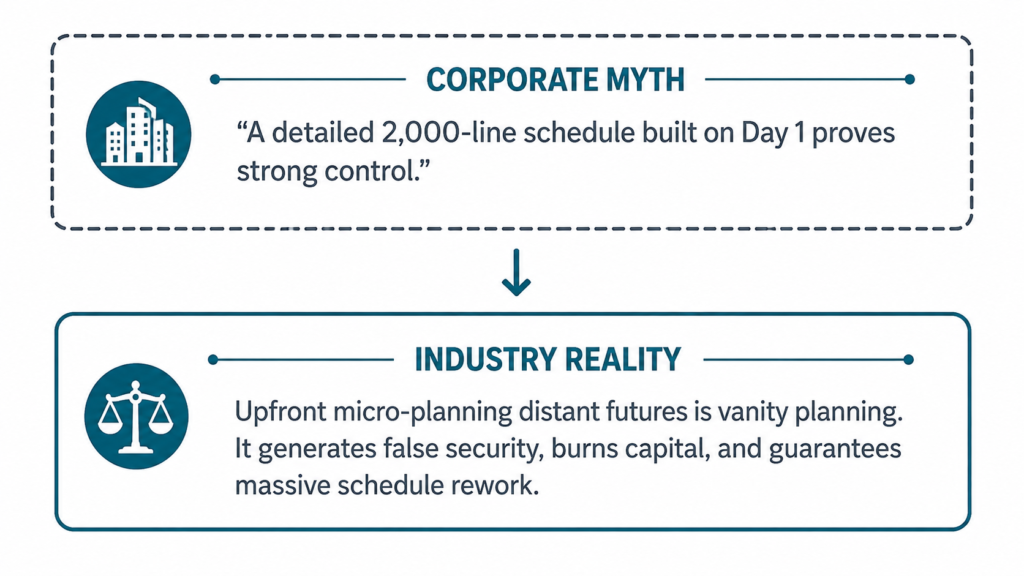
The pervasive corporate myth dictates that a fully detailed, micro-estimated task list covering a multi-year project proves thoroughness. In reality, attempting to detail-plan distant phases before near-term technical and operational variables are validated is vanity planning. It creates a fragile illusion of certainty while guaranteeing administrative overhead and systemic delivery failure.
Defining the Concept: Progressive Elaboration vs. Rolling Wave Mechanics
To eliminate schedule fragility, elite project leaders decouple near-term execution detail from long-term strategic milestones. This requires mastering two deeply related, yet distinct project management concepts: Progressive Elaboration and Rolling Wave Planning.
Progressive Elaboration is the overarching management philosophy. It recognizes that as a project moves forward, information, requirements, and environmental variables become clearer. Therefore, project artifacts, estimates, and scope definitions are continuously refined in controlled iterations rather than locked prematurely.
Rolling Wave Planning is the specific, tactical schedule management technique used to operationalize progressive elaboration. It is a form of iterative planning where work to be performed in the near term is planned in granular detail, while work further in the future is held at a high-level Work Breakdown Structure (WBS) level.
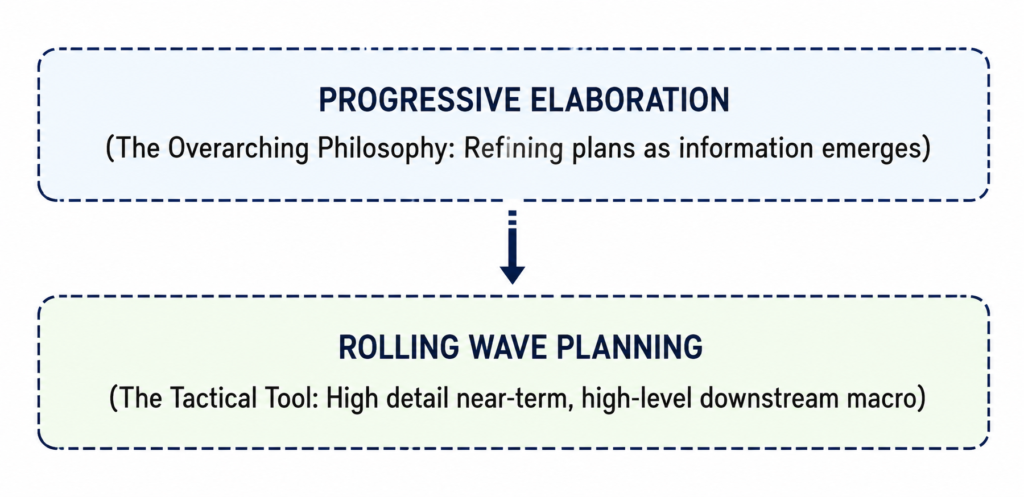
In simple terms: Progressive Elaboration is the mindset that accepts increasing clarity over time. Rolling Wave Planning is the practical mechanics of structuring your schedule into distinct “waves” of detail.
The Dual-Horizon Architecture: Near-Term Precision vs. Downstream Stability
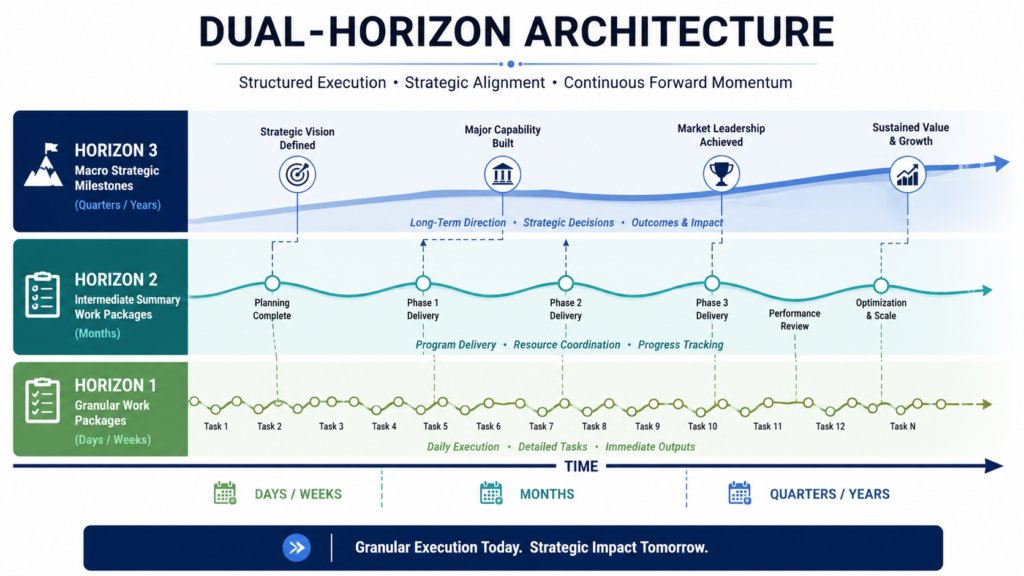
The core engine of Rolling Wave Planning relies on a dual-horizon schedule structure. Instead of treating every project month with identical granularity, the schedule is split into two distinct operational layers:
The Near-Term Interval (Granular Horizon 1): This covers the immediate execution window, typically spanning 2 to 6 weeks (or 1 to 3 Agile sprints, depending on organizational cadence). Tasks in Horizon 1 are fully decomposed into discrete work packages with deterministic duration estimates, individual resource assignments, clear acceptance criteria, and explicit task-level dependencies.
The Strategic Macro Horizon (Downstream Horizons 2 & 3): This covers intermediate phases (3 to 6 months out) and long-term milestones (6 to 24+ months out). Downstream phases are locked to macro milestones such as regulatory gates, funding release points, integration deadlines, or market launch windows. However, the internal activities required to reach those milestones remain aggregated into high-level WBS summary packages.
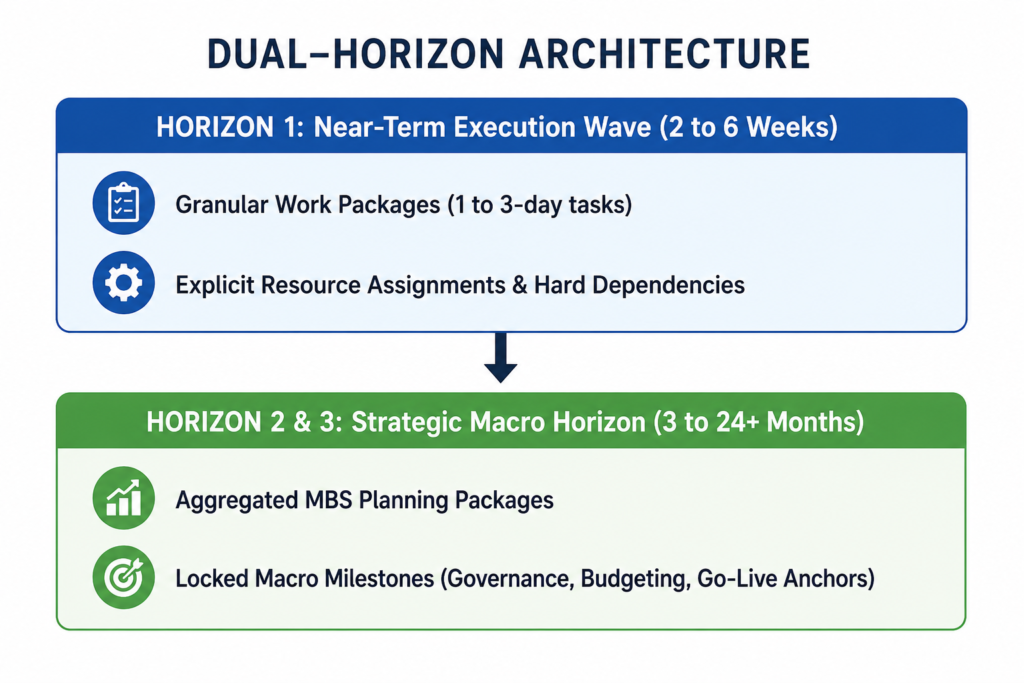
This dual-horizon architecture preserves executive control while granting execution flexibility. Downstream delivery commitments are anchored to strategic outcomes, but execution teams are saved from the futile exercise of estimating sub-tasks whose preconditions do not yet exist.
The 5-Step Implementation Framework for Enterprise Project Managers
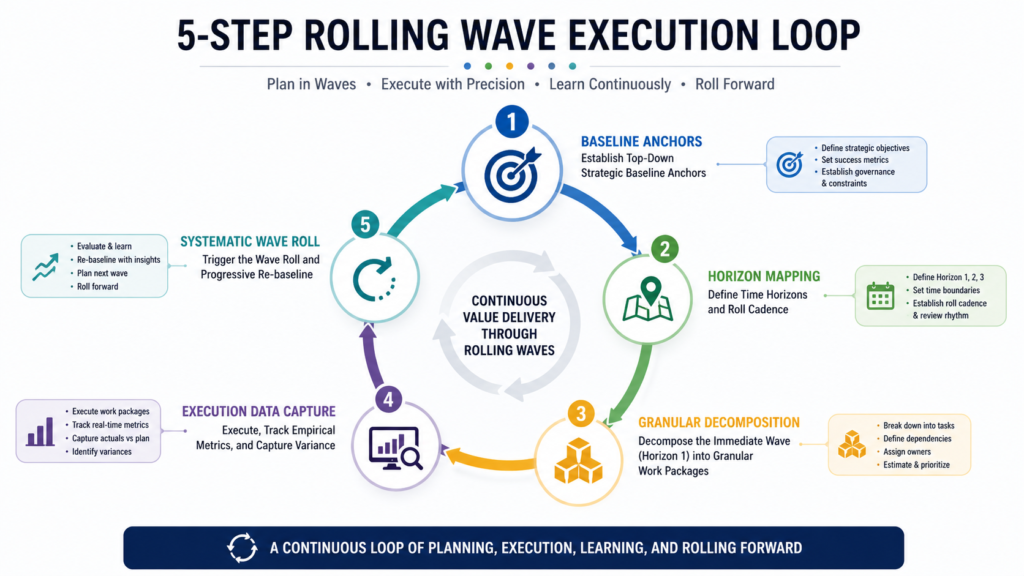
To implement Rolling Wave Planning effectively within an enterprise enterprise environment, follow this structured five-step framework:
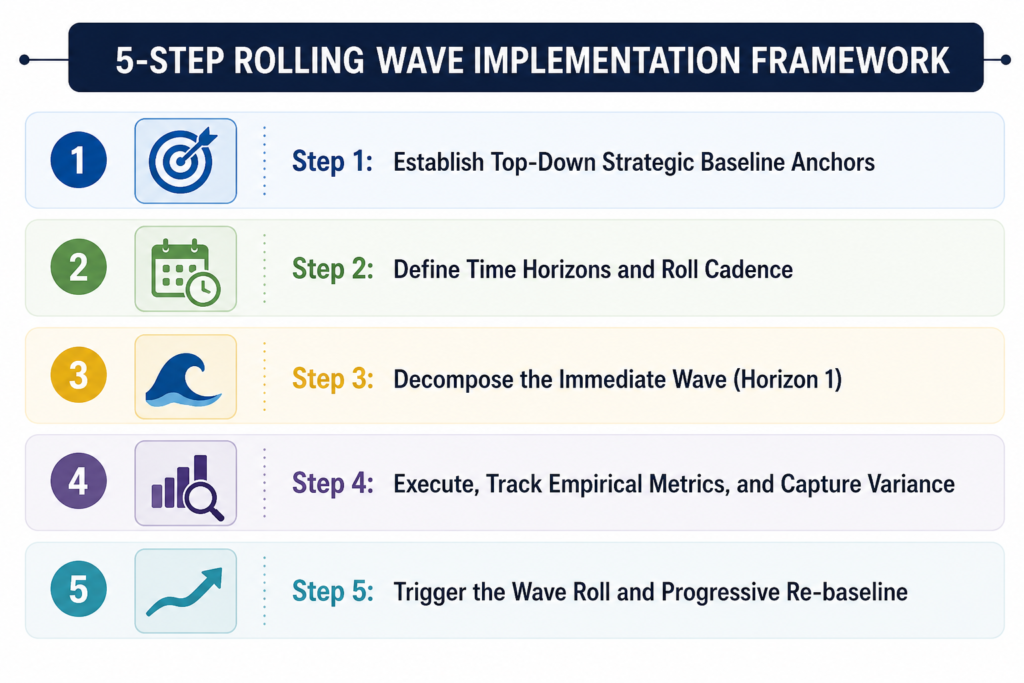
Step 1: Establish Top-Down Strategic Baseline Anchors
Before detailing any individual activities, define the top-level Work Breakdown Structure and lock major strategic milestones. Identify critical governance anchor points such as budget approval gates, regulatory compliance deadlines, enterprise release cycles, and key stakeholder sign-offs. These anchors form the baseline framework that remains stable throughout project execution.
Step 2: Define Time Horizons and Roll Cadence
Set explicit time boundaries for your planning horizons based on your industry’s level of uncertainty:
Fast-paced software or digital product development: 2 to 4-week detailed wave horizon.
Complex enterprise system integrations (ERP/CRM): 6 to 8-week detailed wave horizon.
Heavy infrastructure or engineering projects: 60 to 90-day detailed wave horizon.
Establish a recurring schedule update rhythm. For instance, set a monthly planning cadence where the team expands the upcoming horizon wave.
Step 3: Decompose the Immediate Wave (Horizon 1)
Take the planning packages designated for the immediate horizon and break them down into granular activities. At this stage, tasks should be sized between 8 to 40 hours of effort. Assign named resources, verify technical dependencies, validate vendor lead times, and confirm team capacity.
Step 4: Execute, Track Empirical Metrics, and Capture Variance
Execute work within Horizon 1. Rather than relying on subjective status updates, track empirical metrics such as earned schedule, burn-up rates, actual resource velocity, and emerging risk triggers. Use variance data captured in this window to inform estimates for upcoming waves.
Step 5: Trigger the Wave Roll and Progressive Re-baseline
As the current wave nears completion (typically at the midpoint of the final week of Horizon 1), trigger the formal wave roll. Convert the next downstream WBS summary package into fully defined activities for the upcoming interval. Incorporate real-world learnings, performance velocity, and scope adjustments discovered in the previous wave into the revised plan.
Comparative Methodology Matrix
The following table contrasts Rolling Wave Planning against rigid traditional planning and unstructured execution models:
| Governance Dimension | Traditional Predictive (Waterfall Over-Planning) | Unstructured Agile | Rolling Wave Planning (Hybrid Mastery) |
| Scope Definition | 100% micro-detailed on Day 1 across all project years. | Evolving backlog, long-term scope defined loosely. | Granular detail for near-term waves; locked macro milestones for downstream scope. |
| Schedule Baselines | Rigid, multi-year single baseline prone to systemic breakage. | Sprint-level commitments, overall completion date fluid. | Fixed macro baseline anchors with rolling execution baselines. |
| Administrative Rework | Massive; hours wasted updating distant tasks after small changes. | Minimal; minimal long-term dependency tracking. | Controlled; updates focused exclusively on rolling horizon boundaries. |
| Stakeholder Trust | High initially, rapidly degrades as baseline shifts occur. | Variable; finance teams often worry about lack of fixed cost/date anchors. | High continuously; reliably hits near-term commitments while honoring macro launch targets. |
| Risk Management | Theoretical upfront risk assumptions. | Reactive handling as items hit sprint backlogs. | Empirical risk mitigation built into each upcoming planning wave. |
Mastering the mechanics of Rolling Wave Planning completely transforms a project manager’s career trajectory and operational reality.
Imagine stepping into your next executive steering committee meeting. Instead of making excuses for why a minor technical roadblock in month two broke your three-year schedule, you present a rock-solid dual-horizon status report. You demonstrate 100% schedule reliability over the immediate 6-week window, backed by empirical velocity data. Simultaneously, you show executive leaders that downstream strategic launch dates remain fully anchored and governed.
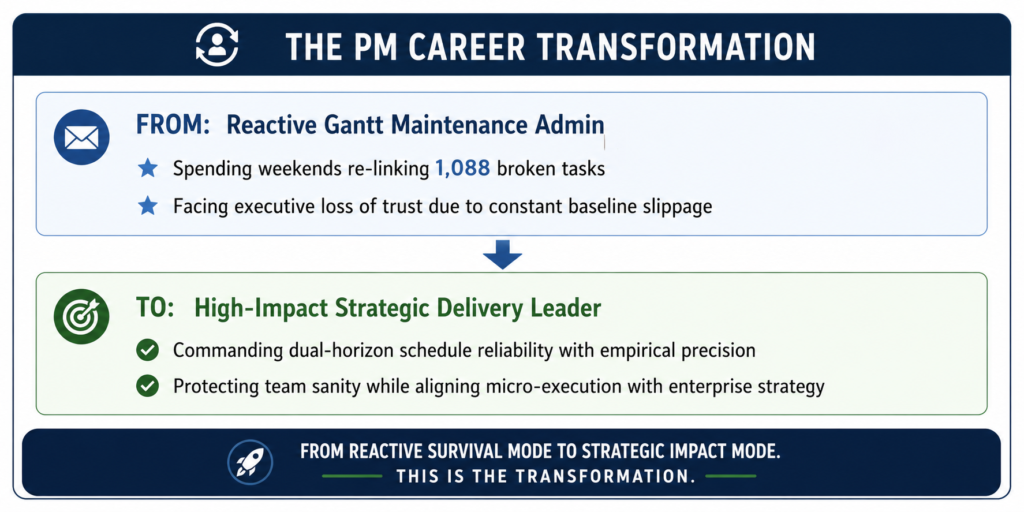
This operational shift brings profound benefits:
Elimination of Schedule Burnout: No more spending weekends re-linking thousands of broken dependencies in complex schedule software.
Protection Against Scope Churn: Downstream stakeholders are prevented from altering immediate execution tasks while having a structured, transparent mechanism to refine future waves.
Enhanced Executive Credibility: C-suite leaders do not value false precision; they value predictable execution. Delivering near-term commitments consistently while safeguarding strategic milestones positions you as an elite delivery leader.
Great project managers do not just maintain static administrative plans: they build resilient, adaptive delivery systems. Transitioning from rigid over-planning to Rolling Wave mastery elevates you from a tactical scheduler to a high-impact strategic business partner.
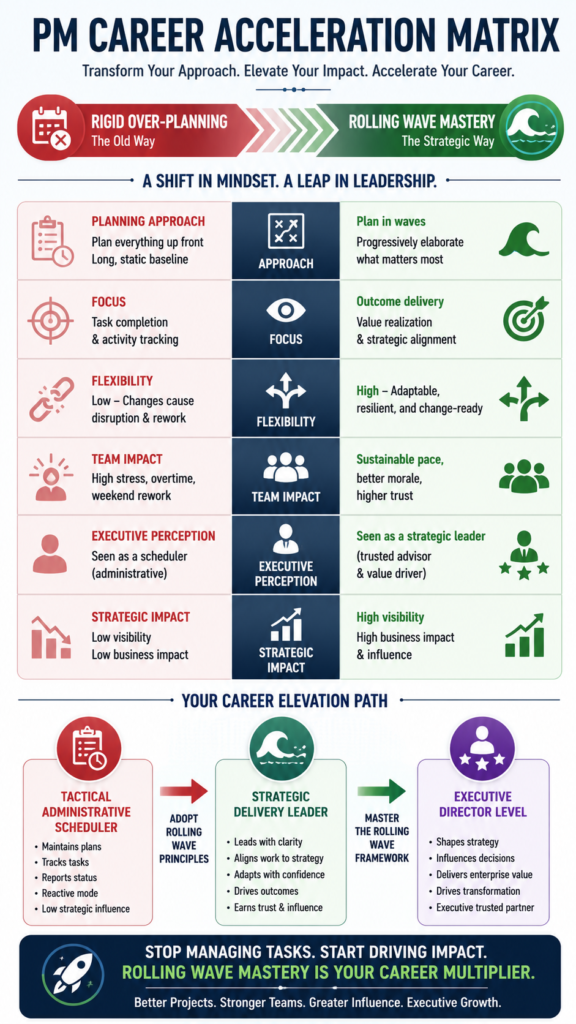
Rolling Wave Planning provides the perfect balance between executive baseline governance and adaptive, real-world execution. By anchoring downstream macro milestones while systematically elaborating near-term intervals, you eliminate schedule fragility, protect capital, and drive predictable enterprise outcomes.
However, moving from theoretical knowledge of PM concepts to real-world operational execution requires structured, elite-level coaching.
If you are ready to stop guessing, move up the corporate ladder, and learn project management the right way, reach out to Skillsetify. We do not just teach frameworks: we show you your exact career growth trajectory.
Take the Next Step in Your Career
Connect with senior industry mentors at Skillsetify today to audit your delivery toolkit, master advanced enterprise planning methodologies, and accelerate your path to senior project leadership.