Inside the war room of a Fortune 500 financial tech firm is suffocatingly tense. A $12 million cloud transformation platform was slated to launch six hours ago. Instead, database queries are timing out, core transaction engines are dropping requests, and customer support channels are flooding with error tickets. The chief technology officer sits in the corner, head in hands, demanding to know how a project with forty senior engineers and an army of contractors managed to derail so catastrophically.
The post-mortem revealed a painfully common corporate reality: the project team spent nine months sprinting through development without establishing formal project baselines, risk registers, or change control protocols. The team confused activity with progress. They believed that daily standups and bi-weekly software demos constituted complete project governance. Budgets expanded like gas in a vacuum, scope creep infiltrated every sprint, and technical debt compounded until the entire launch collapsed under its own weight.
Corporate boardrooms often perpetuate a dangerous operational myth: traditional project management frameworks are rigid, obsolete relics of a bygone era, rendered useless by modern Agile methodologies. Organizations abandon structured process groups under the guise of speed, believing that documentation and formal oversight slow down innovation.
This perspective fundamentally misinterprets the PMBOK (Project Management Body of Knowledge) architecture. The five traditional Process Groups—Initiation, Planning, Execution, Monitoring and Controlling, and Closing—are not linear, bureaucratic Waterfall phases. They are continuous, overlapping operational engines that provide the structural foundation for predictive, Agile, and hybrid project delivery alike. Ignoring them does not accelerate delivery: it guarantees organizational chaos.
Decoding the Architecture: The 5 PMBOK Process Groups
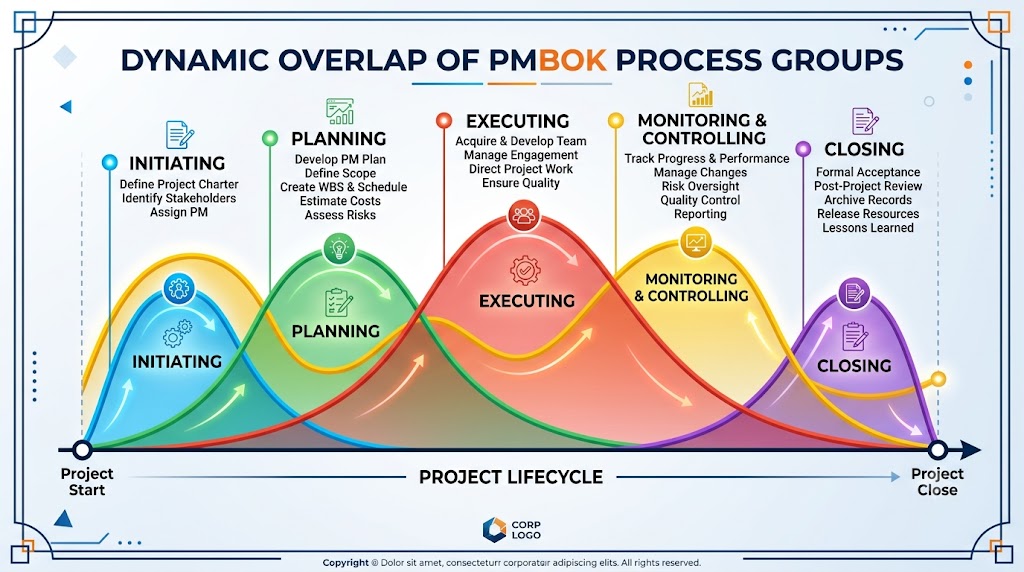
To master project delivery, executive leaders and project professionals must distinguish between a project lifecycle and project process groups. A project lifecycle defines the sequential phases a product moves through from concept to deployment. Process Groups, conversely, represent clusters of interconnected inputs, tools, techniques, and outputs that occur within every single phase of that lifecycle.
Process Groups run concurrently. While Execution peaks during the middle stages of a project lifecycle, Monitoring and Controlling operates continuously from day one until project shut down. Understanding the distinct mechanics of each Process Group is what separates reactive firefighters from world-class project leaders.
1. Initiation: Defining the Strategic North Star
Initiation is the formal authorization gate for any business initiative. Without a rigorous Initiation Process Group, projects spawn organically across departments, consuming resource capacity without clear strategic alignment.
The primary objective of Initiation is establishing business value and securing executive commitment. This process group answers two non-negotiable questions: Why are we doing this project? and Who will be impacted by its execution?
The Project Charter: The foundational legal and administrative contract of the project. It explicitly defines business objectives, high-level requirements, constraints, assumptions, summary budgets, and measurable success criteria. Crucially, it assigns the project manager formal authority to apply organizational resources to project activities.
Stakeholder Identification: A comprehensive mapping of internal and external stakeholders. Using tools like the Power/Interest Grid, project managers analyze stakeholder expectations, influence vectors, and potential resistance points to build proactive engagement strategies.
2. Planning: Engineering the Operational Blueprint
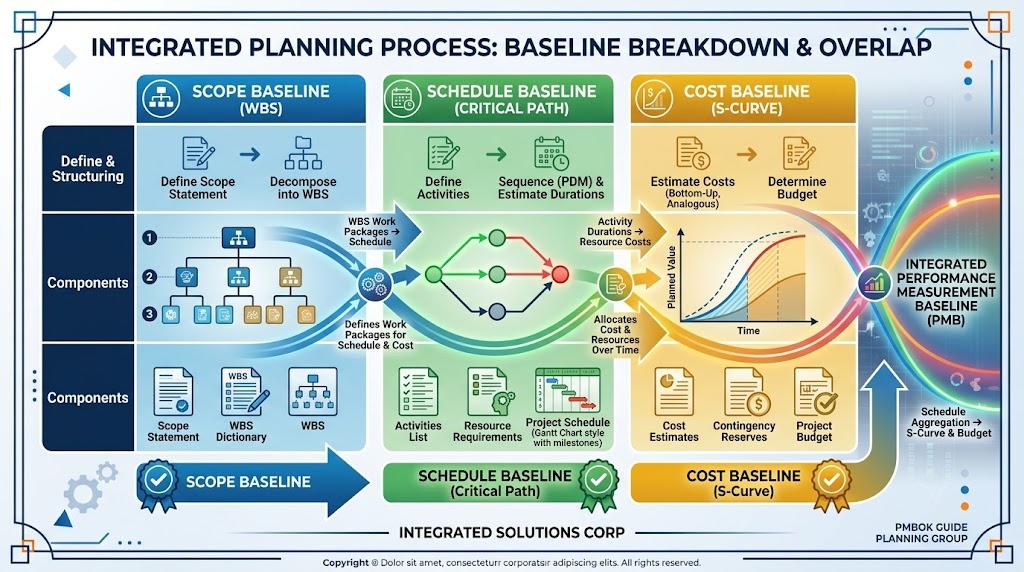
Planning is the most cognitively intensive Process Group within the PMBOK architecture. A common organizational failure is jumping directly from Initiation into Execution. Planning establishes the performance baselines against which all actual progress will be evaluated.
Rather than creating a single static document, Planning creates an integrated suite of management plans that undergo progressive elaboration as project parameters become clearer.
Scope Baseline Definition: Deconstructing broad corporate vision into actionable components via the Work Breakdown Structure (WBS). The WBS breaks down deliverables into manageable work packages, establishing the scope dictionary and preventing scope creep before code is written or infrastructure is provisioned.
Schedule and Cost Baselines: Establishing activity dependencies using the Critical Path Method (CPM) and estimating resource requirements. Cost baselines aggregate activity cost estimates into cumulative cash-flow projections.
Risk Management Architecture: Identifying qualitative and quantitative risks, assigning risk owners, and formulating pre-calculated response strategies (Avoid, Mitigate, Transfer, Accept) before threats materialize.
3. Execution: Orchestrating People, Resources, and Delivery
Execution is where project plans translate into tangible organizational assets. It represents the highest expenditure of human capital, financial budget, and operational bandwidth.
The focus of the project manager shifts during Execution from analytical design to active leadership, communication, resource management, and conflict resolution.
Resource Mobilization and Team Development: Assembling multidisciplinary teams, managing cross-functional dependencies, and guiding group dynamics through team development stages to achieve high-performance execution.
Quality Assurance Delivery: Auditing quality requirements and quality control measurement results to ensure that operational processes are actually generating deliverables that conform to enterprise standards.
Stakeholder Engagement Management: Executing the structured communications plan to maintain executive alignment, manage expectations, and mitigate organizational friction.
4. Monitoring & Controlling: Maintaining Operational Equilibrium
Monitoring and Controlling operates as the central governance brain of the project. Running in parallel with all other Process Groups, it tracks, reviews, and regulates project progress against established baseline plans.
If a project drifts off course, the Monitoring and Controlling Process Group detects variances early, triggering corrective actions before minor issues snowball into business failures.
Variance Analysis via Earned Value Management (EVM): Integrating scope, schedule, and cost metrics to quantitatively measure project health. EVM provides objective performance indexes that strip away subjective status reporting.
Integrated Change Control: Evaluating every proposed scope, schedule, or budget adjustment through a formal Change Control Board (CCB). No change enters the execution stream without documented impact assessments and formal stakeholder approval.
5. Closing: Securing Value and Archiving Organizational Knowledge
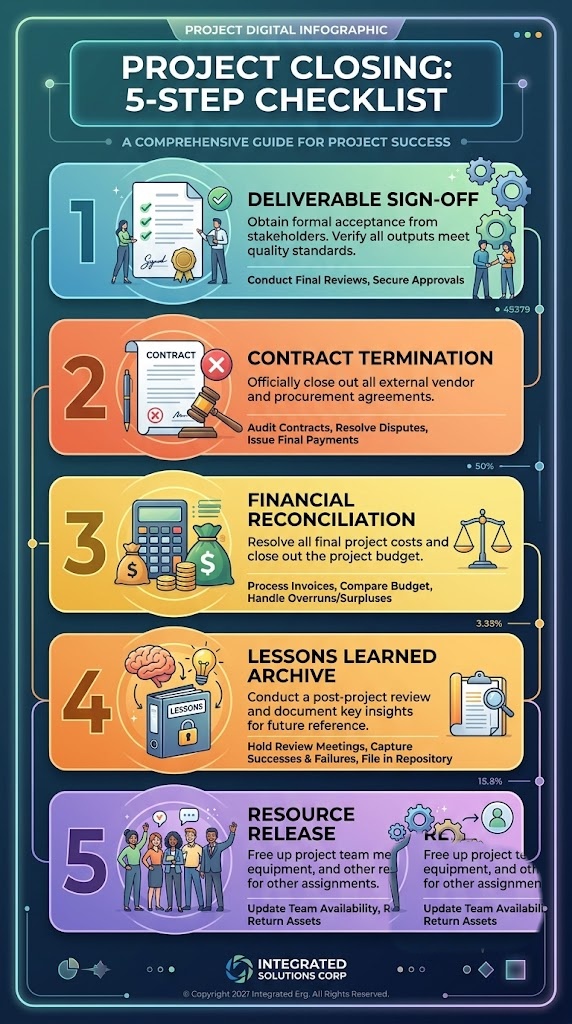
Closing is the most frequently bypassed Process Group in corporate environments. When execution deliverables are handed off, project teams often scatter immediately to new fires, leaving contracts open, budgets un-reconciled, and valuable institutional knowledge un-captured.
Formal closing ensures that business value is verified, legal liabilities are terminated, and organizational process assets are updated for future initiatives.
Administrative and Contractual Closeout: Formally validating customer acceptance of deliverables, closing out vendor procurement contracts, releasing project resources, and settling final financial accounts.
Lessons Learned Repository: Conducting structured project retrospectives to document operational bottlenecks, successful techniques, and process gaps, populating the enterprise knowledge base.
The Practical Implementation Framework for Elite Project Leaders
To transform these theoretical concepts into immediate corporate results, project managers require a repeatable, structured framework. The matrix below outlines how elite project managers execute the five Process Groups across key project metrics:
| Process Group | Core Focus Area | Key Output Deliverable | Primary Success Metric |
| Initiation | Strategic Alignment | Project Charter & Stakeholder Register | Executive Sign-off & Clear Business Case |
| Planning | Baseline Definition | Integrated Project Plan & WBS | Approved Scope, Schedule, & Cost Baselines |
| Execution | Value Delivery | Verified Deliverables & Performance Data | Conformance to Quality & Resource Utilization |
| Monitoring/Controlling | Performance Governance | Variance Reports & Change Logs | CPI / SPI Stability (EVM Variance < 5%) |
| Closing | Asset Handover | Final Sign-off & Retrospective Archive | Formal Stakeholder Acceptance & Contract Closure |
Step-by-Step Execution Protocol
Establish Stage-Gate Governance: Mandate explicit executive review gates between Initiation, Planning, and Execution. Never allow resources to be consumed in Execution until the integrated Planning baseline is signed off by key sponsors.
Deploy Objective Health Tracking: Implement Earned Value Management (EVM) early in the Monitoring and Controlling cycle. Track Schedule Performance Index ($SPI = \frac{EV}{PV}$) and Cost Performance Index ($CPI = \frac{EV}{AC}$). An index below $1.0$ demands immediate intervention.
Enforce Integrated Change Control: Treat the project scope baseline as a strict operational boundary. Require all change requests to pass through a formal Change Control Board impact analysis, detailing exact impacts to cost, schedule, and quality.
Codify Organizational Process Assets: End every project phase with a mandatory lessons learned session. Index these assets in a centralized knowledge repository so future project teams avoid repeating historical mistakes.
From Firefighter to Strategic Executive: The PM Transformation
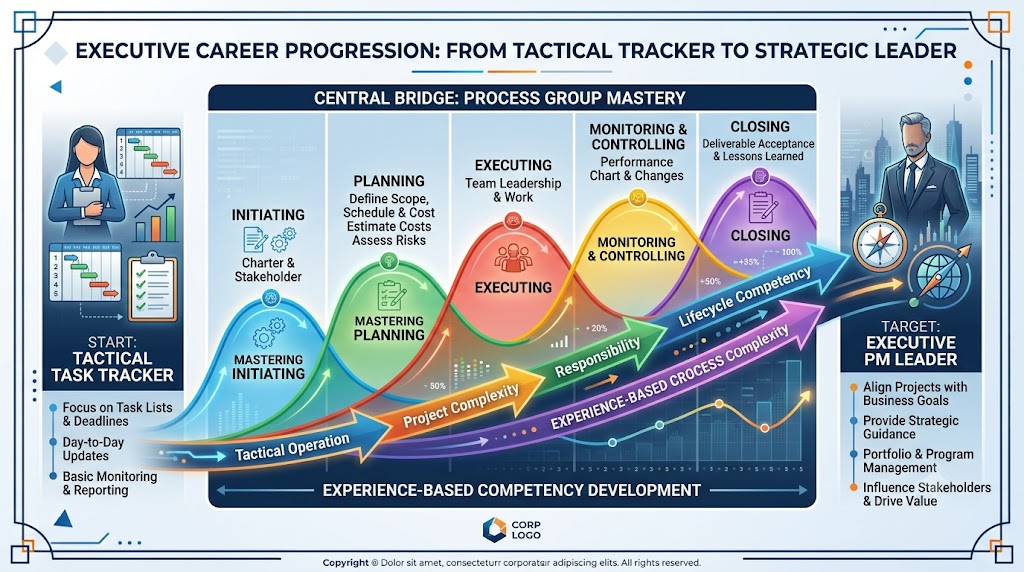
Mastering the five PMBOK Process Groups completely alters a professional’s career trajectory. Without a structured framework, project leaders spend their days trapped in reactive firefighting. They are perpetually stressed, working late nights to manage un-scoped changes, defending budget overruns to angry sponsors, and watching team members burn out.
When you implement Process Groups correctly, project delivery shifts from chaos to structured predictability. Scope creep is arrested before it begins. Cost variances are detected when they are cheap to fix. Executives stop viewing you as a glorified administrative task-tracker and start recognizing you as a dependable strategic business operator.
This structural mastery is precisely what bridges the gap between mid-level delivery roles and senior executive leadership. Organizations do not promote project managers because they can update a Jira board or organize a meeting. They promote project leaders who can predictably translate corporate capital into operational strategy with minimal risk.
By mastering PMBOK architecture, you elevate your professional standing, gain ultimate control over complex enterprise environments, and command respect across all corporate tiers.
Elevate Your PM Career with Skillsetify
Navigating the complexities of modern project execution requires more than basic project tracking tools: it requires deeply understanding time-tested global frameworks applied with modern corporate agility. By mastering the five PMBOK Process Groups, you position yourself as an authority capable of steering high-stakes corporate initiatives through turbulent market conditions.
If you are ready to stop guessing, move up the corporate ladder, and learn project management the right way, reach out to Skillsetify. We do not just teach frameworks: we show you your exact career growth trajectory.