Why Product Owners Must Master Dual-Language Communication
The executive demo room is tense. The Vice President of Sales sits at the head of the table, eager to see a promised enterprise checkout feature designed to stem customer churn. Across the room, the lead software architect launches the demonstration. Instead of presenting an intuitive, frictionless user interface, the architect proudly highlights a set of back-end microservices, complex API contracts, and low-latency database queries.
The VP is bewildered and furious: “Where is the checkout button my sales team needs?”
The architect is equally frustrated: “You asked for scalable data handling, and that is precisely what we built.”
This corporate disaster unfolds every day in enterprise organizations. The root cause is almost never technical incompetence or business negligence. It is a total breakdown in dual communication.
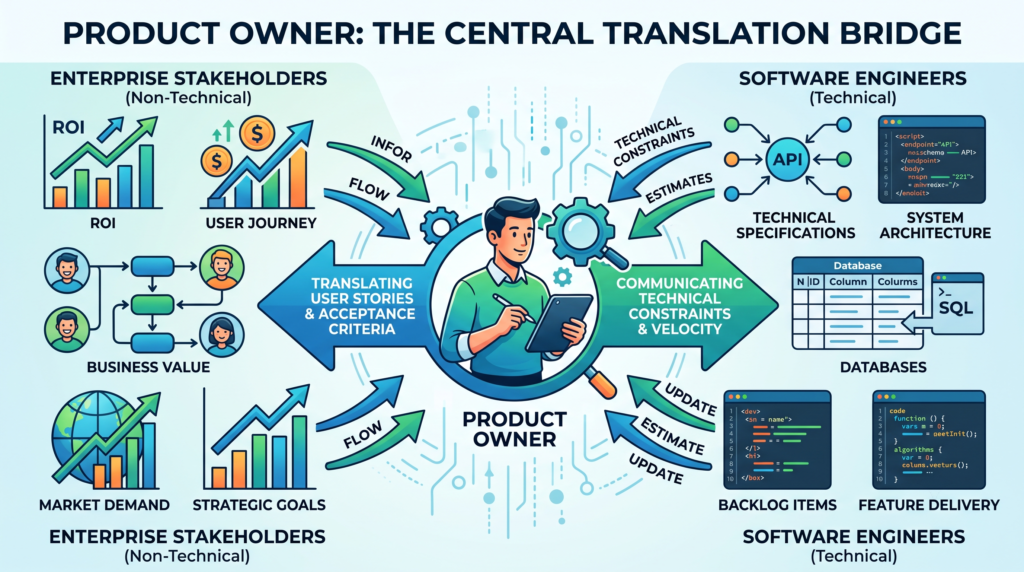
A ubiquitous myth across corporate product management is that a Product Owner is merely an administrative order-taker: someone who collects a wish list from executives and pastes it into Jira as user stories. In reality, treating the Product Owner as a passive ticket writer guarantees scope creep, wasted engineering hours, and political friction. The Product Owner is an essential, singular translation bridge between high-level business strategy and deep technical architecture. When a Product Owner fails to operate as a bi-directional translator, projects collapse under the weight of misaligned expectations.
The Mechanics of Product Owner Dual Communication
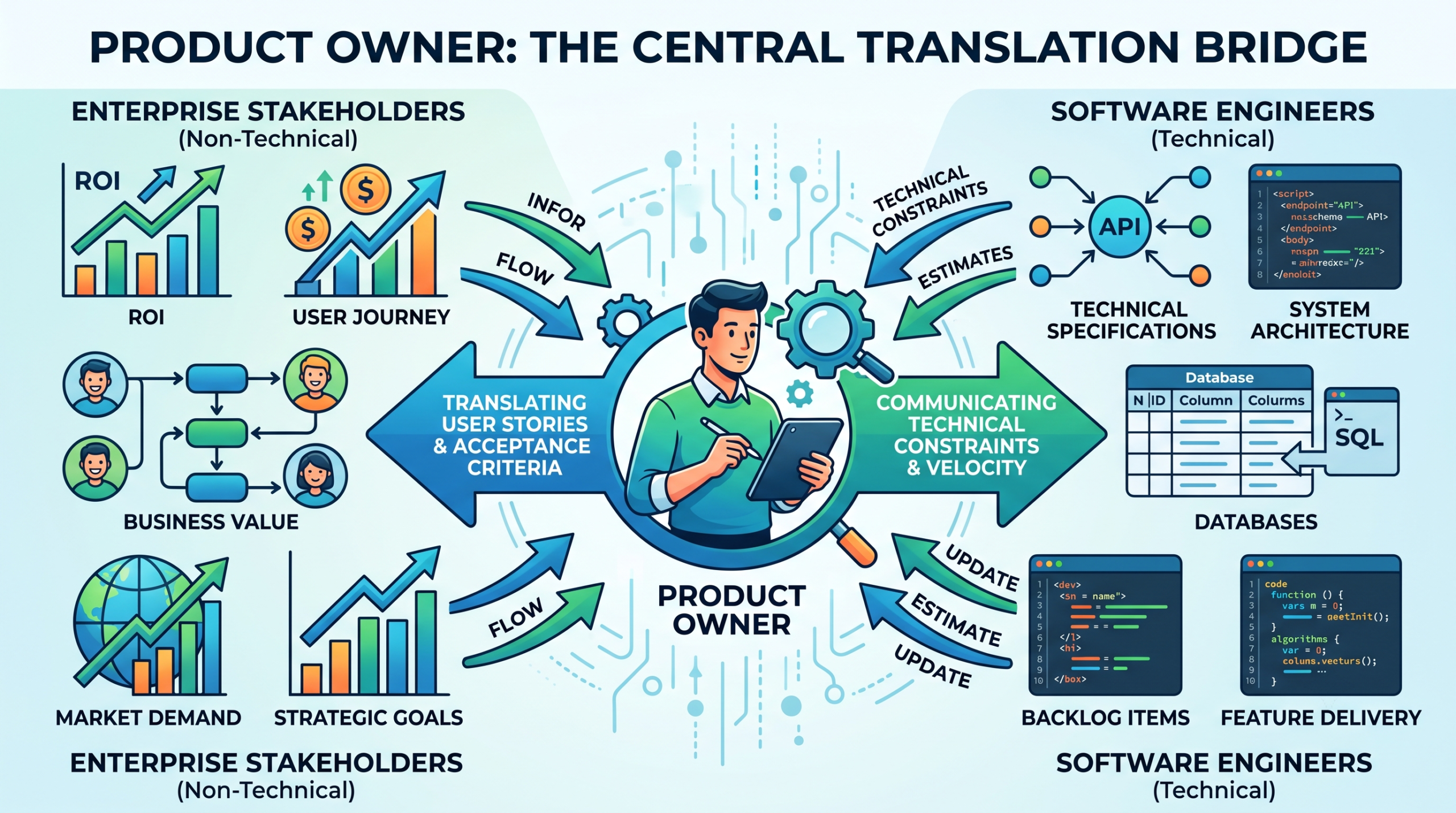
To lead successful Scrum deliveries, a Product Owner must master two fundamentally different dialects: Stakeholder Domain Language and Developer Technical Language.
Stakeholders speak in business outcomes: return on investment (ROI), customer acquisition cost, time-to-market, regulatory compliance, and operational efficiency. They rarely understand microservice dependencies, schema migrations, or technical debt. Conversely, developers speak in system architecture: database normalization, API payload structures, refactoring, build pipelines, and sprint capacity.
When these two groups attempt to communicate directly, critical nuances are lost. A stakeholder requesting a simple drop-down menu may unwittingly ask for a complete rewrite of a core database schema. A developer estimating three weeks for a refactoring task may fail to explain that this work prevents catastrophic system downtime during peak sales volume. The Product Owner serves as the single individual accountable for synthesizing these opposing perspectives into a unified product trajectory.
Why Single Accountability Matters: The RACI Safeguard
A common structural error in enterprise product development is managing product decisions through a committee. When multiple stakeholders push competing priorities directly onto the engineering team, development velocity plummets due to conflicting requirements.
Scrum establishes that the Product Owner must be a single individual, not a committee. This single-point accountability establishes absolute authority over backlog prioritization. By utilizing a RACI matrix (Responsible, Accountable, Consulted, Informed), the organization designates the Product Owner as uniquely Accountable for defining product value and scope. Stakeholders are Consulted for domain insight, but they do not dictate backlog order directly to developers.
The 3-Phase Implementation Framework for Product Leaders
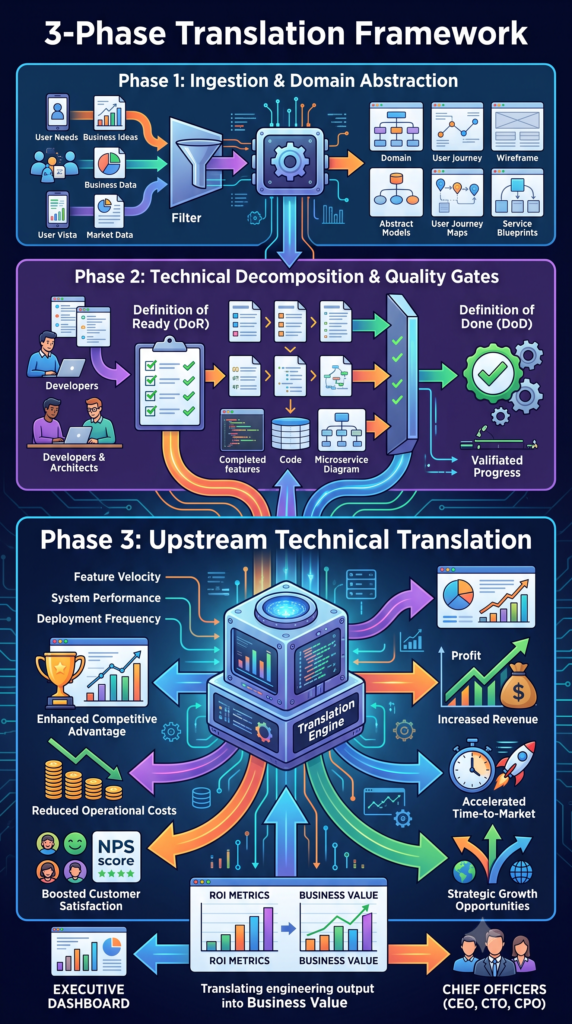
To turn dual communication into a repeatable operational discipline, project managers and product owners must execute a three-phase translation framework.
Phase 1: Ingestion and Domain Abstraction
When engaging business stakeholders, the Product Owner must extract functional objectives using consumer and domain language. Instead of accepting feature requests verbatim, the Product Owner asks probing questions:
What business outcome does this feature drive?
What manual process or user friction does this eliminate?
What are the non-negotiable business rules and regulatory boundaries?
During this phase, the Product Owner strips away technical assumptions from the stakeholder and distills raw requests into clear business user journeys.
Phase 2: Technical Translation and Decomposition
Once business needs are codified, the Product Owner translates consumer requirements into precise technical specifications for the development team. This relies heavily on decomposition, the process of breaking high-level domain vision down into small, actionable user stories and technical tasks.
To ensure the engineering team can execute effectively, the Product Owner applies two crucial quality gates:
Definition of Ready (DoR): A user story cannot enter sprint planning unless it includes clear acceptance criteria, understood business context, and actionable technical scope.
Definition of Done (DoD): A standardized agreement defining what constitutes fully functional, tested, and deployable software.
Phase 3: Upstream Technical Translation
Dual communication is a two-way street. When technical constraints, architecture bottlenecks, or technical debt threaten sprint timelines, the Product Owner translates engineering realities back to non-technical executives.
Instead of telling a VP of Marketing that “the team needs two sprints for backend refactoring,” an elite Product Owner translates: “Investing four weeks into infrastructure automation right now will reduce future feature deployment times by 40% and eliminate system crashes during peak traffic volume.” By expressing technical necessities in financial and strategic terms, the Product Owner secures executive buy-in for engineering health.
Operationalizing Backlog Quality: The DEEP Framework
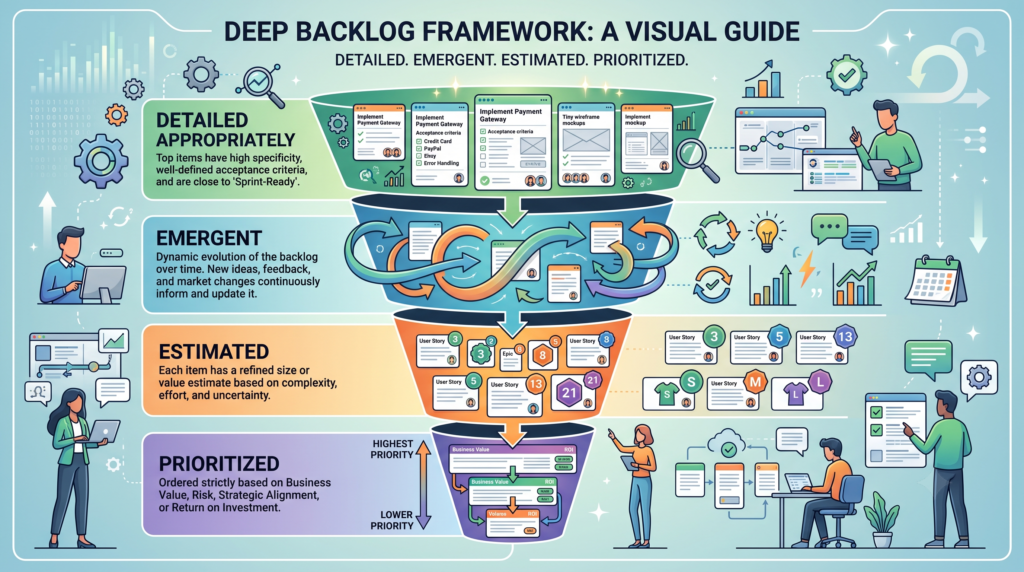
A Product Owner’s backlog is the ultimate single source of truth for project scope. If a requirement is not in the product backlog, it does not exist in the project scope. To maintain alignment across both business and engineering groups, the backlog must adhere to the DEEP criteria:
Detailed Appropriately: High-priority items near the top of the backlog contain refined technical acceptance criteria, while lower-priority items remain high-level concepts.
Emergent: The backlog is dynamic, continuously evolving based on stakeholder feedback, market shifts, and technical discoveries.
Estimated: Backlog items possess relative effort estimates (such as story points) to inform release planning and trade-off decisions.
Prioritized: Items offering the highest business value and strategic impact are positioned at the top for immediate delivery.
The Professional Transformation: From Chaos to Elite Delivery
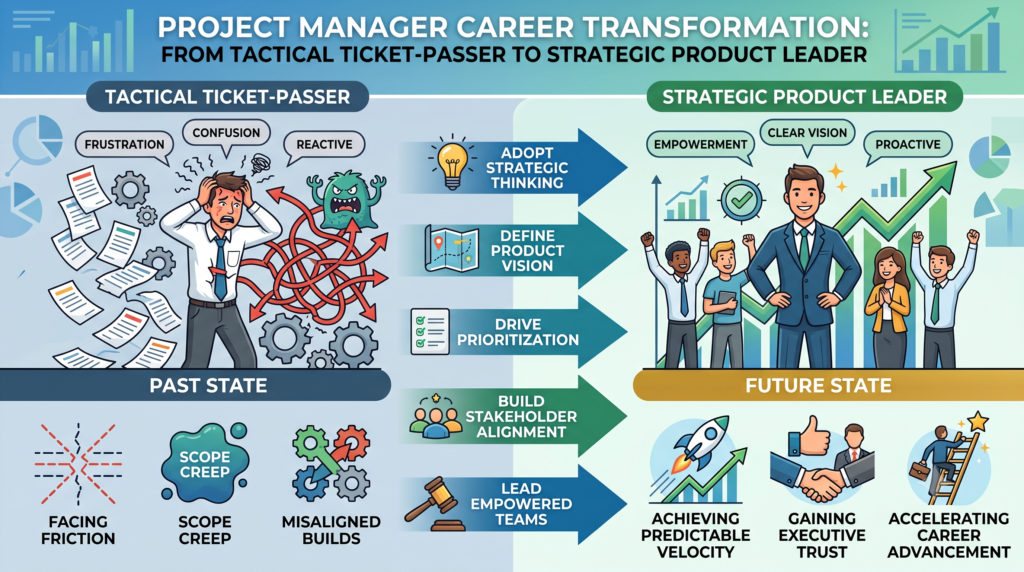
When you master Product Owner dual communication, the operational environment undergoes a dramatic shift. Project chaos, constant scope creep, and hostile sprint review meetings disappear.
Instead of developer burnout and executive frustration, your product ecosystem achieves predictable, high-velocity delivery. Engineering teams gain complete clarity on what they are building and why, empowering them to self-organize and design optimal technical solutions within defined boundaries. Meanwhile, enterprise stakeholders gain total transparency into product progress, receiving incremental value early and often.
For project managers and product professionals, mastering this dual-language translation capability is the single fastest catalyst for career advancement. Organizations do not promote tactical task managers who simply forward tickets. Executive leadership elevates strategic product leaders who can bridge corporate strategy with technical execution, manage executive alignment, and consistently drive measurable business outcomes.
Drive Your Career Forward with Skillsetify
Bridging domain strategy and engineering delivery is not an innate talent: it is a high-level professional discipline built on proven methodologies, rigorous communication frameworks, and strategic product governance.
If you are ready to stop guessing, move up the corporate ladder, and learn project management the right way, reach out to Skillsetify. We do not just teach frameworks: we show you your exact career growth trajectory.