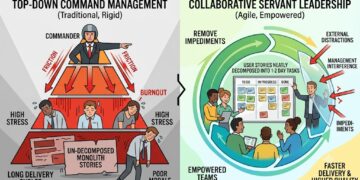
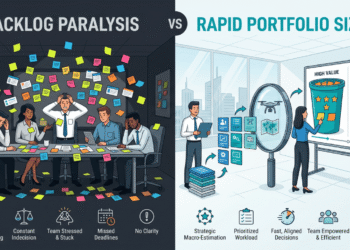
How to Structure 3–9 Member Units That Deliver Real Increments
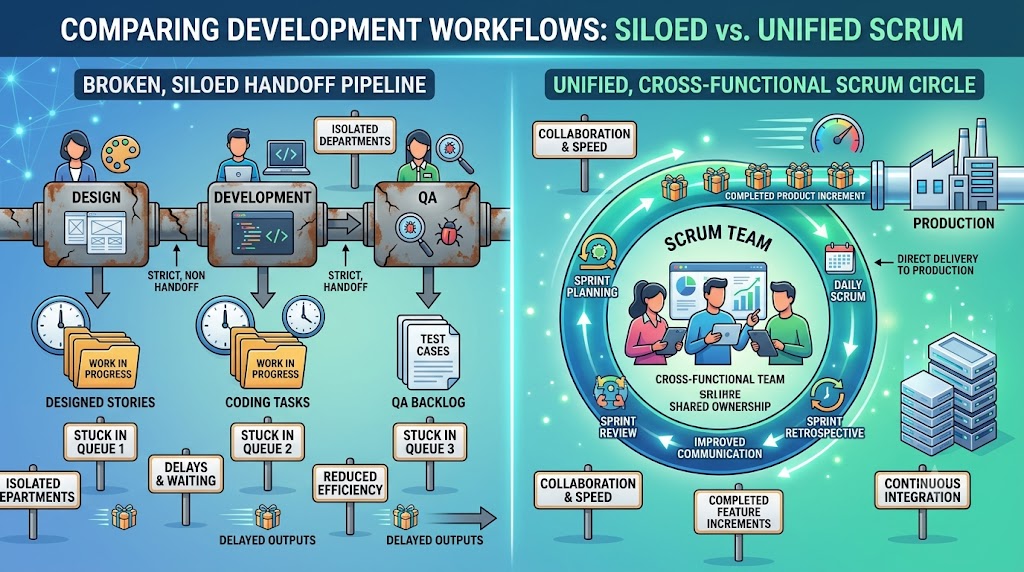
The executive leadership team gathers in the boardroom expecting a live demonstration of a new automated payment gateway. Instead, they receive a forty-minute slideshow explaining why the backend API is ready, the frontend interface is almost complete, and the database schema is pending security review. The handoffs stalled, the QA analyst never received a testable build, and the feature remains unusable.
This scenario plays out in enterprise organizations every single week. Leaders mistakenly believe that assembling a group of talented engineers into a shared messaging channel creates an Agile team.
The prevalent corporate myth suggests that a development team is simply a pool of technical coders who receive requirements from above and hand off completed code to testing. In reality, a Scrum development team is not a collection of mono-skilled specialists waiting for work tickets. It is a dedicated, self-organizing unit of three to nine professionals holding every single technical and domain skill required to turn an idea into a fully functional, potentially shippable product increment without relying on external handoffs.
The Architecture of True Cross-Functional Scrum Teams
To eliminate deliverable bottlenecks, organizations must move away from functional silos and restructure around cross-functional delivery capability.
Sizing the Engine: The 3 to 9 Member Rule
Team size in Scrum is not arbitrary. Maintaining a core development team between three and nine members optimizes communication bandwidth while preserving operational capacity.
When a team drops below three members, skill diversity drops significantly, resulting in technical bottlenecks and reduced sprint output. Conversely, when a team exceeds nine members, communication complexity grows exponentially. The formula for calculating potential communication channels across a network of N individuals is:
A team of 5 people requires 10 communication lines, whereas a team of 12 requires 66 lines. This exponential growth introduces context switching, alignment overhead, and coordination drag that actively destroys sprint velocity.
Blending Technical and Domain Competencies
Cross-functional capabilities extend beyond traditional software engineering titles. A complete Scrum team requires a horizontal balance of technical skills alongside deep functional domain expertise:
Front-End and Interface Engineering: Delivering intuitive user experiences, accessibility standards, and client-side logic.
Back-End and Infrastructure Systems: Building secure microservices, API integrations, and scalable server architectures.
Quality Assurance and Automation: Embedding continuous testing, automated suite execution, and acceptance criteria verification directly into the build pipeline.
Domain and Business Context: Possessing specific operational knowledge in areas like financial compliance, healthcare regulations, or supply chain logic. If an IT team builds a commercial lending engine without embedded finance domain knowledge, the delivered code often fails business validation despite passing unit tests.
Core Mechanics: Self-Organization Within Boundaries
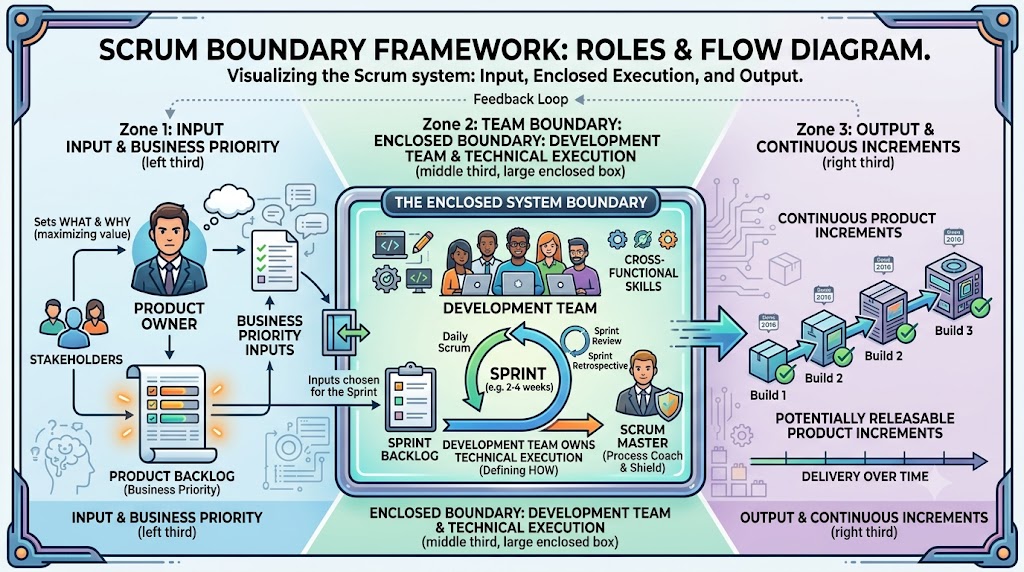
A fundamental misunderstanding in modern enterprise management is confusing team self-organization with total anarchy. High-performing Scrum teams do not operate without governance: they operate with high autonomy within clear boundaries.
Defining the "What" Versus the "How"
The structural alignment of a Scrum ecosystem relies on a strict separation of accountabilities:
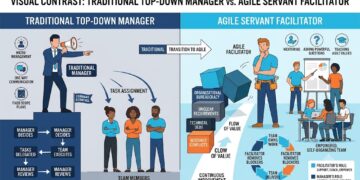
The Product Owner defines the WHAT: The Product Owner manages the Product Backlog, sequences user stories based on business value, and translates stakeholder needs into clear requirements.
The Development Team decides the HOW: The development team holds absolute authority over technical implementation, architectural decisions, and effort estimation within the sprint framework.
Autonomy Within Thresholds
Self-organization functions effectively through predefined operational thresholds. Teams are empowered to make technical trade-offs, alter database configurations, or refactor code structures without seeking external approvals, provided those decisions fit within enterprise security policies, budget constraints, and compliance frameworks. When boundary guidelines are clear, teams eliminate administrative wait states and maintain high-speed iteration cycles.
Step-by-Step Implementation Framework for Project Leaders
Transitioning an organization from siloed functional departments to cross-functional Scrum teams requires deliberate structural design.
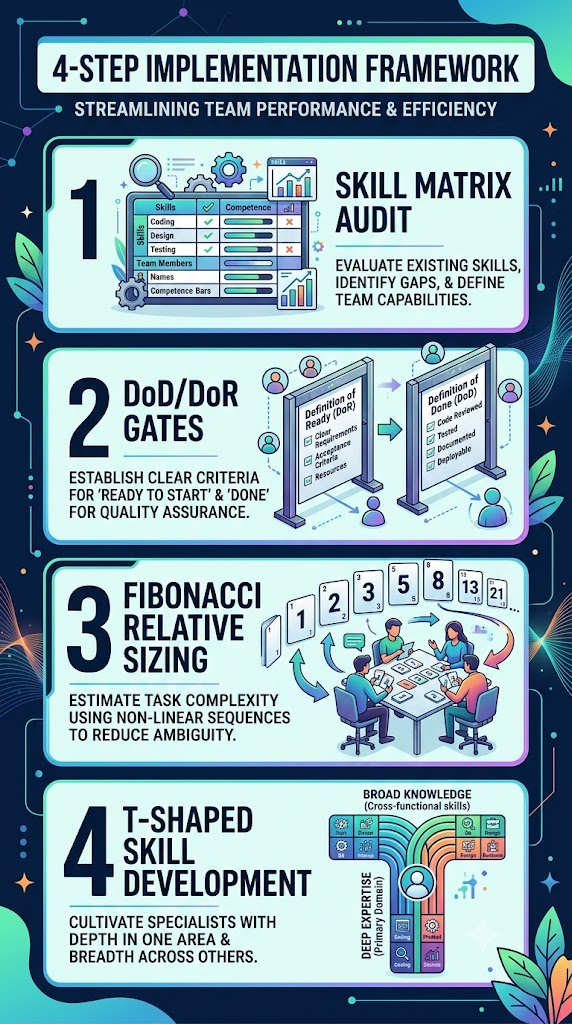
Step 1: Execute a Skill-Matrix Dependency Audit
Map out every skill mandatory for moving a user story from concept to production deployment. Identify missing competencies across software development, data design, quality testing, and domain knowledge. Group resources so that each 3 to 9 person unit can deliver an end-to-end increment independently.
Step 2: Establish Uncompromising Definitions of Ready (DoR) and Done (DoD)
Eliminate ambiguous handoffs by setting explicit quality gates:
Definition of Ready (DoR): Ensures a user story contains clear acceptance criteria, business intent, and technical feasibility before entering sprint planning.
Definition of Done (DoD): Establishes that code is written, peer-reviewed, integrated, automated-tested, documented, and ready for immediate deployment.
Step 3: Shift from Hour-Based Estimates to Relative Sizing
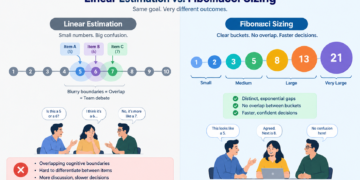
Human minds struggle to accurately estimate complex technical tasks in absolute hours. A task estimated at 6 hours by a senior developer might take 20 hours for a junior developer.
To build accurate team velocity, utilize relative sizing with the Fibonacci sequence (1, 2, 3, 5, 8, 13, 21). The mathematical progression reflects the growing uncertainty and complexity of larger tasks. Relative story points evaluate effort, complexity, and risk rather than individual labor hours, standardizing estimation across differing skill levels.
Step 4: Institute T-Shaped Capability Development
Encourage team members to build T-shaped skill profiles: deep specialization in a primary discipline (the vertical bar) paired with broader working knowledge across adjacent disciplines (the horizontal bar). When back-end developers can write basic automated QA tests, or QA specialists can review API configurations, single-point dependencies disappear.
Comparative Matrix: Traditional Siloed vs. Cross-Functional Scrum Teams
| Organizational Dimension | Traditional Siloed Teams | Cross-Functional Scrum Teams |
| Team Structure | Grouped by functional title (DBA, QA, Dev) | Grouped by product or value stream capability |
| Delivery Focus | Output of functional tasks or code modules | Complete, working product increments |
| Dependency Handling | Inter-departmental handoffs and ticketing queues | Integrated skill execution within the core unit |
| Hand-off Velocity | High latency; long wait times between phases | Near-zero latency; real-time intra-team alignment |
| Estimation Method | Absolute man-hour projections per specialist | Relative story point estimation using Fibonacci |
| Accountability | Isolated individual liability | Shared team accountability for DoD delivery |
From Operational Chaos to Predictable Elite Delivery
When you successfully implement cross-functional, self-organizing Scrum teams, the day-to-day reality of project management transforms completely.
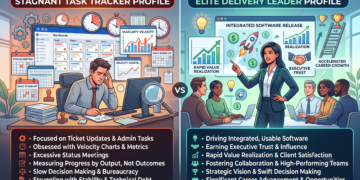
The endless cycles of status meetings, inter-departmental friction, scope disputes, and missed release deadlines give way to a stable, highly predictable operational cadence. Instead of managing individual tasks and chasing status updates across isolated departments, project leaders oversee a self-correcting delivery engine. Sprint reviews shift from defensive slide presentations to dynamic live software demonstrations.
For ambitious project leaders, mastering the architecture of cross-functional teams elevates your career trajectory. Enterprise organizations do not struggle with finding individual technical coders; they struggle with orchestrating cross-disciplinary execution. Demonstrating the ability to structure, guide, and scale high-performing, autonomous delivery units positions you as a strategic leader capable of driving large-scale digital transformation.
Elevate Your Project Leadership with Skillsetify
Building truly cross-functional teams requires moving far beyond theoretical frameworks and textbook jargon. Real organizational success demands actionable blueprints, precise matrix design, and proven governance strategies tailored to modern enterprise complexities.
Skillsetify provides project professionals with the exact tools, advanced methodologies, and strategic frameworks needed to master cross-functional team architecture. We do not just teach Agile concepts: we map out your explicit career trajectory, equipping you to eliminate project delivery bottlenecks, lead high-value initiatives, and step confidently into executive leadership roles.
If you are ready to stop guessing, master team architecture the right way, and accelerate your executive career path, connect with Skillsetify today.