How Elite Leaders Use "The World Tour Analogy" to Deliver High-Stakes Projects
Your executive leadership team, steering committee, and key stakeholders sit around a mahogany board table, staring at a massive red cell on your project status dashboard.
Six months ago, your team kicked off a multi-million-dollar cloud integration and infrastructure overhaul. The project charter promised a clean, linear rollout across five global business units over 18 months. You built a pristine, 2,000-line Gantt chart. You locked in vendor contracts, booked capital expenditures, and mapped out exact dates for every milestone through next year.
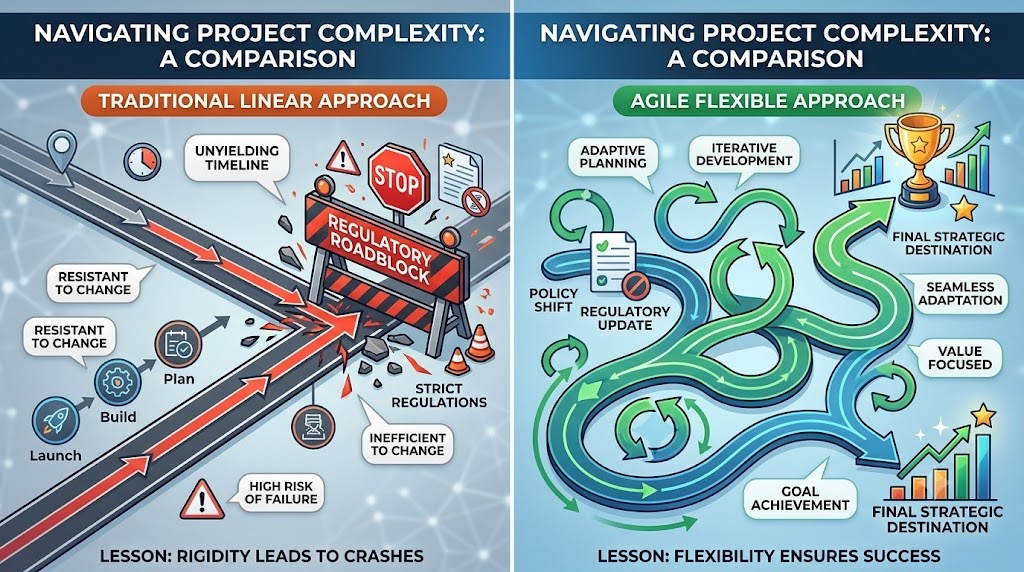
Then reality hit. A sudden change in international data sovereignty laws created a legal roadblock in your primary deployment region. Concurrently, a critical vendor revised their API pricing model, rendering your planned backend integration economically unviable.
Because your baseline plan assumed zero friction, your team is now in a complete tailspin. Thousands of engineering hours are stalled. Capital is burning at $50,000 a week in idle resource costs. You are forced to explain to C-level executives why a single geopolitical or technical blocker has brought a multi-million-dollar program to a grinding halt.
This crisis stems from one of corporate leadership’s most dangerous myths: the belief that a successful project manager is one who executes the original plan without deviation.
In reality, rigid adherence to an initial route in a volatile business landscape is not discipline: it is enterprise negligence. High-performing project leaders do not treat roadmaps like fixed train tracks. They treat them like an international journey, employing a strategy known as The World Tour Analogy.
Deconstructing "The World Tour Analogy": Vision vs. Route
To understand how elite project managers maintain predictability without sacrificing agility, imagine planning a 5-country world tour.
Your overarching vision is crystal clear: you intend to visit Country 1, Country 2, Country 3, Country 4, and Country 5 over the next six months. You know the strategic purpose of visiting each destination, the total budget required, and the high-level dates for the entire journey.
However, no seasoned traveler books every internal train ticket, hotel reservation, and local tour excursion six months in advance across five unpredictable nations. Why? Because political instability, weather anomalies, visa delays, or geographic transport blockers can materialize at any moment.
If a political storm brews in Country 3 while you are completing your itinerary in Country 2, a novice traveler panics because their pre-booked itinerary is ruined. An elite traveler simply re-sequences the journey: they skip or postpone Country 3, dynamically alter their flight paths to visit Country 4 first, and revisit Country 3 once the geopolitical landscape stabilizes.
The ultimate destination vision (visiting all five countries) remains 100% intact. Only the routing and tactical execution order are modified based on real-time intelligence.
In enterprise project management, this operational philosophy relies on two distinct yet complementary methodologies: Progressive Elaboration and Rolling Wave Planning.
Progressive Elaboration vs. Rolling Wave Planning
Many project managers incorrectly treat Progressive Elaboration and Rolling Wave Planning as identical terms. While closely related, they perform different strategic functions in project governance.
Progressive Elaboration (The Strategic Umbrella): This is the macro-level commitment to refining plans continuously as new data, technical insights, or market conditions emerge. It accepts that initial project requirements are educated hypotheses. As execution progresses, team understanding deepens, forcing scope, architecture, or sequencing adjustments to ensure optimal value delivery. The primary focus of Progressive Elaboration is continuous plan refinement.
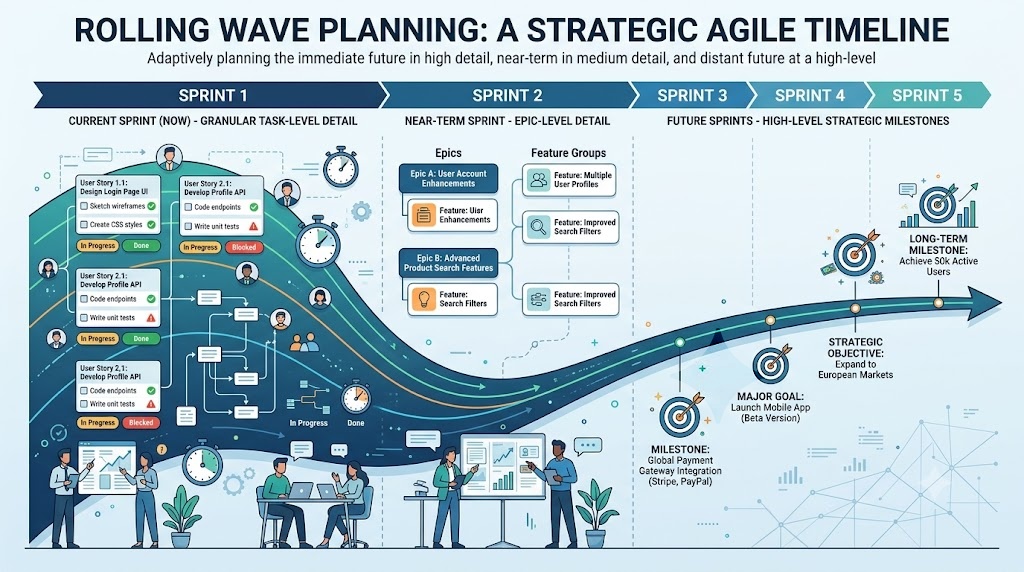
Rolling Wave Planning (The Tactical Mechanics): This is the operational execution technique where near-term work is planned in microscopic detail, while future work is maintained at a conceptual, high level. For example, if your project spans five phases, you plan the active wave (the next 2 to 3 weeks) down to individual daily tasks and resource hours. For phases three months away, you maintain high-level milestones and refuse to waste energy mapping low-level dependencies that will inevitably change.
Rolling Wave Planning acts as the operational engine that powers Progressive Elaboration. By keeping future waves liquid, you create the organizational bandwidth needed to absorb change when blockers arise, avoiding the catastrophic sink of rework.
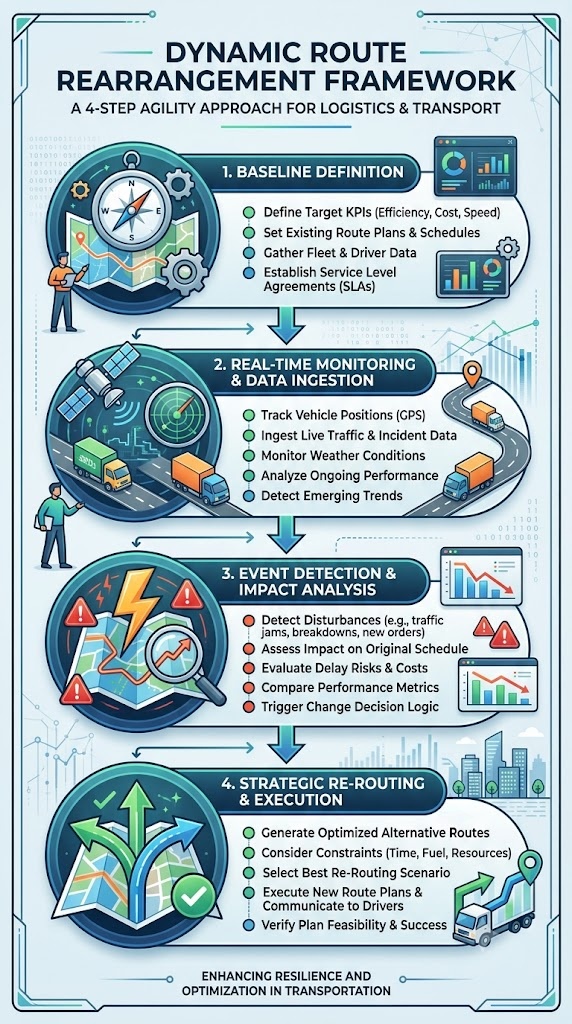
The 4-Step Dynamic Route Rearrangement Framework
To implement the World Tour Framework within your organization, you must move beyond abstract concepts and establish a structured operational system. Below is a step-by-step framework you can deploy immediately to manage high-stakes, uncertain projects.
Step 1: Define the Non-Negotiable 5-Country Vision Baseline
Before opening a single backlog or scheduling a kickoff, establish the macro-level destination outcomes. What are the five core, high-level deliverables or capability leaps the business must achieve?
Document the business outcomes, not rigid technical specifications.
Define the global constraints: total budget cap, final target completion year, and compliance mandates.
Secure executive agreement that while the ultimate destinations are fixed, the sequence and tactical path are subject to dynamic optimization.
Step 2: Implement Rolling Wave Cadences
Structure your planning horizons into distinct time waves to prevent over-planning artifacts.
Immediate Horizon (0 to 30 Days): Full task breakdown, explicit resource allocation, concrete acceptance criteria, and daily dependency management.
Mid-Term Horizon (31 to 90 Days): Epic-level mapping, major interface definitions, key milestone targets, and preliminary risk assessments.
Far-Term Horizon (90+ Days): Strategic objectives, rough order-of-magnitude estimates, and broad capability targets.
Step 3: Establish Continuous Blockade Discovery Protocols
Do not wait for a crisis to reveal that a route is blocked. Build proactive discovery mechanisms into every operational cycle.
Technical Spikes: Allocate engineering time in current sprints to investigate architectural unknowns in future phases.
Regulatory Scans: Conduct bi-weekly risk reviews with legal, security, and procurement teams to identify impending compliance shifts.
Vendor SLA Tracking: Monitor vendor delivery health continuously to catch lead-time delays before they disrupt upcoming phases.
Step 4: Execute Strategic Re-Routing Without Scope Loss
When a political, technical, or resource blocker hits a specific project wave, execute a controlled pivot using three clear rules:
Rule A (Isolate the Blocker): Freeze the impacted sub-stream immediately to prevent financial burn.
Rule B (Pull Forward Future Waves): Identify downstream dependencies or parallel country deliverables that can be accelerated while the blocker is resolved.
Rule C (Re-baseline Transparently): Communicate the sequence shift to stakeholders focusing on value retention, demonstrating how dynamic routing protects the final launch date.
From Firefighting Chaos to Predictable, Strategic Delivery
Imagine leading projects where unexpected surprises no longer trigger panicky late-night emails or emergency steering committee calls.
When you master Progressive Elaboration and Rolling Wave Planning, your entire professional experience transforms. Scope creep ceases to be a chaotic threat and becomes a controlled, evaluated variable. Engineering teams stop burning out on frantic rework caused by obsolete long-term plans. Financial sponsors gain absolute confidence in your estimates because your near-term commitments are backed by empirical data, not guesswork.
You step out of the exhausting cycle of firefighting task management and step into the role of a strategic business partner.
Executive leadership does not promote project managers who simply check off tasks on a decaying spreadsheet. They promote leaders who navigate ambiguity, protect capital, and consistently deliver strategic outcomes regardless of market headwinds. Mastering these methodologies elevates you from an administrative coordinator to an indispensable driver of enterprise strategy.
Elevate Your Project Leadership with Skillsetify
Navigating complex enterprise environments requires more than theoretical knowledge: it demands battle-tested methodologies, strategic clarity, and modern execution frameworks. By treating your strategic roadmap as a flexible world tour rather than a rigid rail line, you unlock the ability to deliver quality outcomes consistently under any market condition.
If you are ready to stop guessing, move up the corporate ladder, and learn project management the right way, reach out to Skillsetify. We do not just teach frameworks: we show you your exact career growth trajector