Why "Imagining How Something Works" Is Killing Your Agile Delivery
The war room is dead silent, save for the rhythmic clicking of a product owner frantically updating status tickets. It is 2:00 AM on the eve of a major application release. The staging environment is live, but the integration points are completely failing. The business stakeholders are furious because the system does not align with their core regulatory requirements. Meanwhile, the engineering team is exhausted, arguing that they built exactly what was wireframed.
This is the classic corporate crisis born from a single, catastrophic mistake: treating requirement analysis and solution design as the exact same thing.
Many modern enterprise teams fall victim to a seductive corporate myth: in a fast paced Agile environment, heavy upstream analysis is dead, and sprinting straight into mapping out user interfaces or “imagining how something will work” is the supreme path to efficiency. This is completely false. When teams conflate understanding the problem with imagining the solution, they build beautiful, high performing engines for cars that have no wheels. Rushing past the analysis scope into the design scope does not accelerate velocity: it merely fast tracks your budget toward catastrophic rework.
Decoding the Dichotomy: Analysis vs. Design Scope
To run projects like an elite leader, you must draw an ironclad boundary between the problem space and the solution space.
What Is Analysis Scope? Understanding the Problem Space
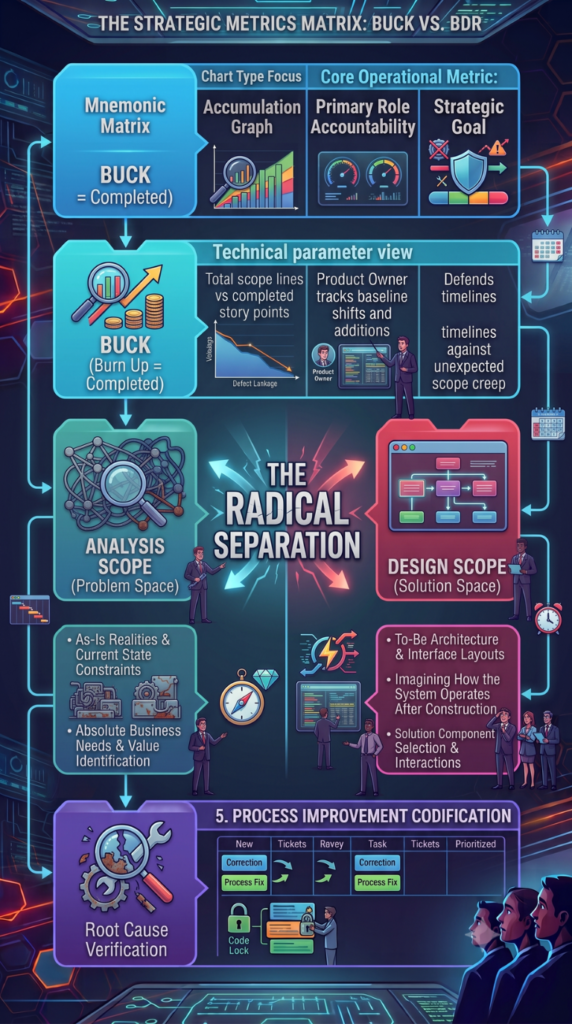
Analysis scope is entirely dedicated to uncovering absolute clarity from baseline ambiguity. It requires deep customer empathy, process diagnostic rigor, and intense strategic alignment. When executing within the analysis scope, your sole objective is to dissect the current state realities, identify the fundamental business needs, and map out constraints.
Analysis scope answers the questions: What is the true pain point we are trying to solve? Why does this problem exist? Who are the real human actors involved, and what are their operational parameters? If a team does not completely map the boundaries of the problem, any solution designed will fail to achieve true business value.
What Is Design Scope? Imagining the Solution Space
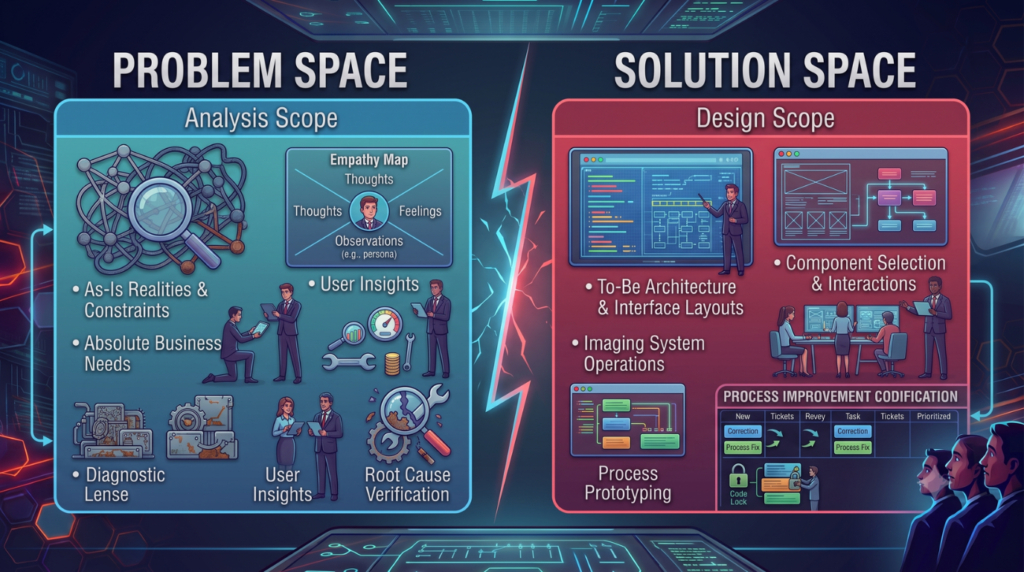
Design scope, by contrast, is the structured act of imagining how something will work once it is actually built. It transitions the team from the conceptual domain into the logical and physical domains. Design scope focuses on selecting components, modeling user interactions, defining technical architectures, and mapping data relationships.
While analysis determines the minimum parameters that a system must fulfill, design determines the optimal vehicle to deliver those results. It is the process of rummaging through your technological toolbox to engineer the interfaces, workflows, and protocols that bring the analyzed requirements to life.
Why the Boundary Shifts in Agile Requirement Analysis
In legacy software delivery models, requirement analysis was handled as a static, document heavy phase that terminated before design began. Agile methodologies radically transform this sequence. Analysis is no longer a historical event: it is a continuous, living capability woven into every single iteration.
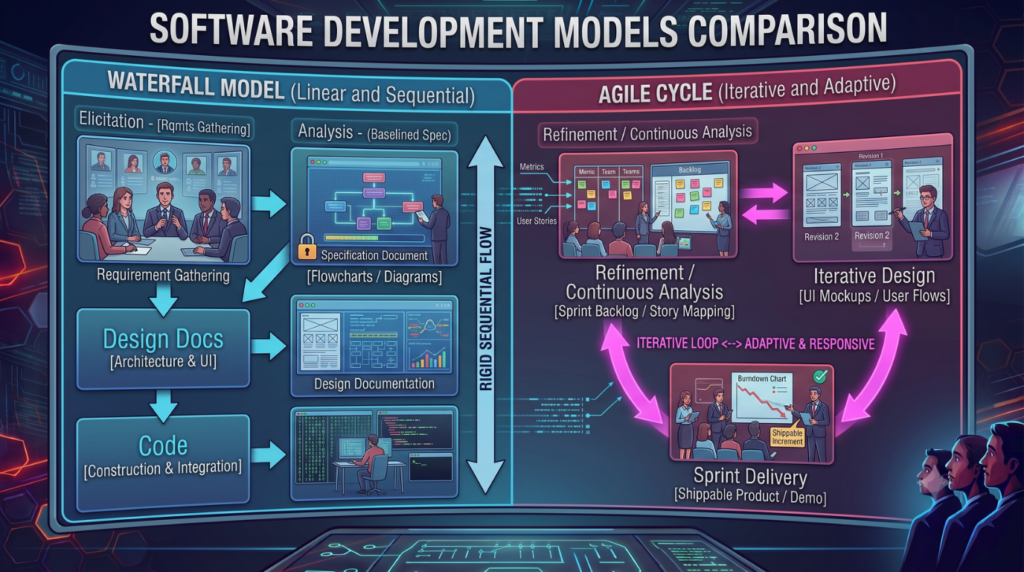
Without a clear strategic understanding of this boundary, Agile teams experience severe delivery fragmentation. The product owner writes superficial user stories without higher level context, the developers jump directly into logical code architecture, and the user experience team designs interactive elements based on complete guesswork. The result is a total disconnect between business intent and engineered execution.
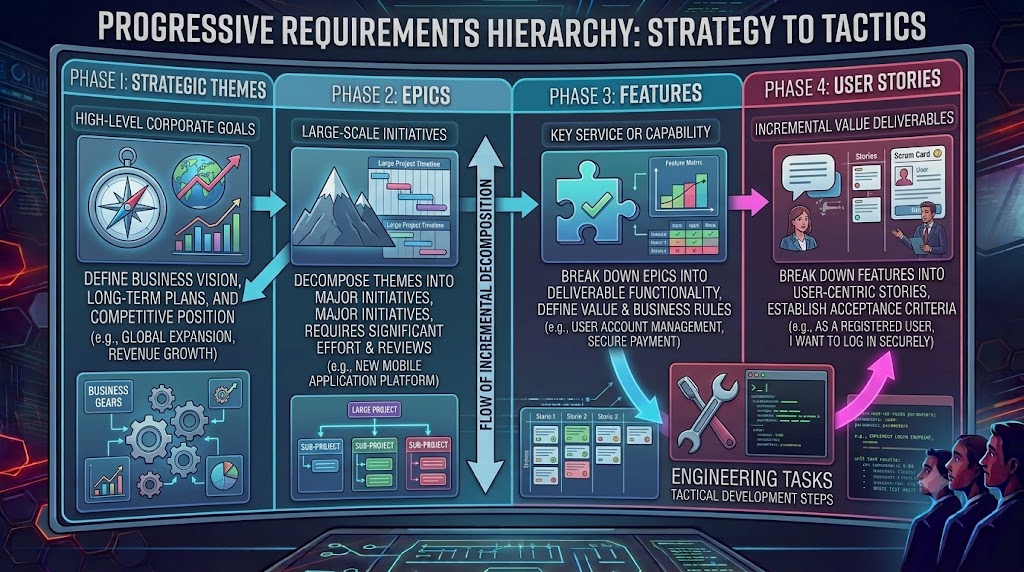
To prevent this misalignment, elite project leaders use structured frameworks to progressively refine their requirements, ensuring that analysis always informs design without choking execution momentum.
The Blueprint Framework: Step-by-Step Requirement Dissection
Here is the exact framework utilized by top tier B2B project managers to systematically separate and execute analysis and design scope throughout the product lifecycle.
Step 1: Establish High Level Strategic Theming
Before writing a single user story, group the broad operational needs of the enterprise into strategic buckets or domains. Themes represent the macro realities of your business landscape. For example, if you are working to optimize vendor delivery pipelines, your overarching themes might be Process Performance, Technological Infrastructure, and Knowledge Retention. Theming provides structural guardrails for your scope, ensuring that the team stays anchored to the ultimate business objectives.
Step 2: Map the Visual User Journey with Story Maps
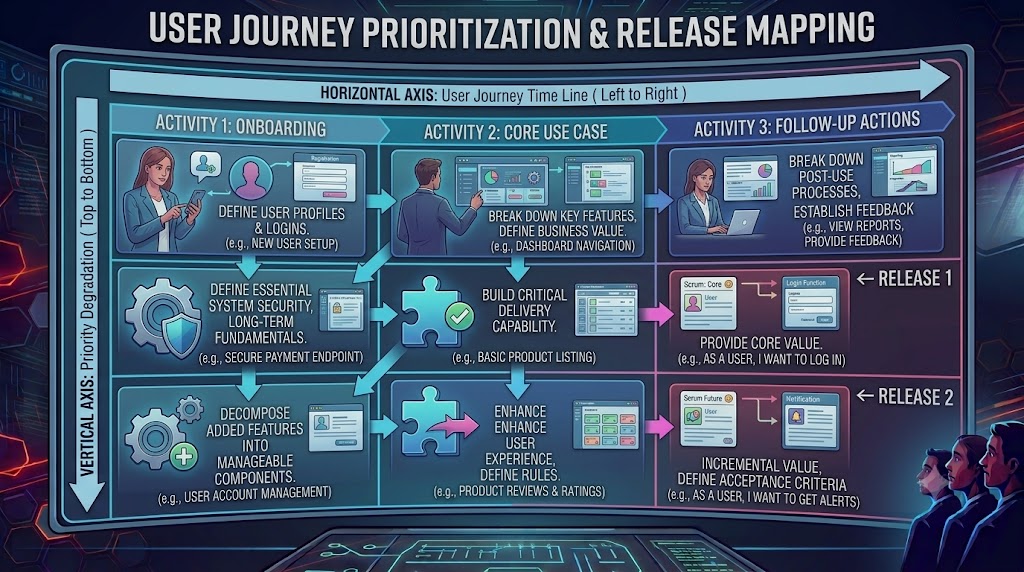
Once themes are locked, build out an end to end visual map of the ideal user journey from left to right across a horizontal axis. This tool allows the entire team to see the big picture. Write out the major activities across the top: this forms the backbone of your system.
Underneath this backbone, list the specific tasks and functions required to support that journey, prioritizing them vertically down the vertical axis. This clear breakdown visually defines your release boundaries, allowing you to explicitly see which features comprise your minimal functional skeleton and which elements belong in future iterations.
Step 3: Flesh Out Low Fidelity Wireframes and Storyboards
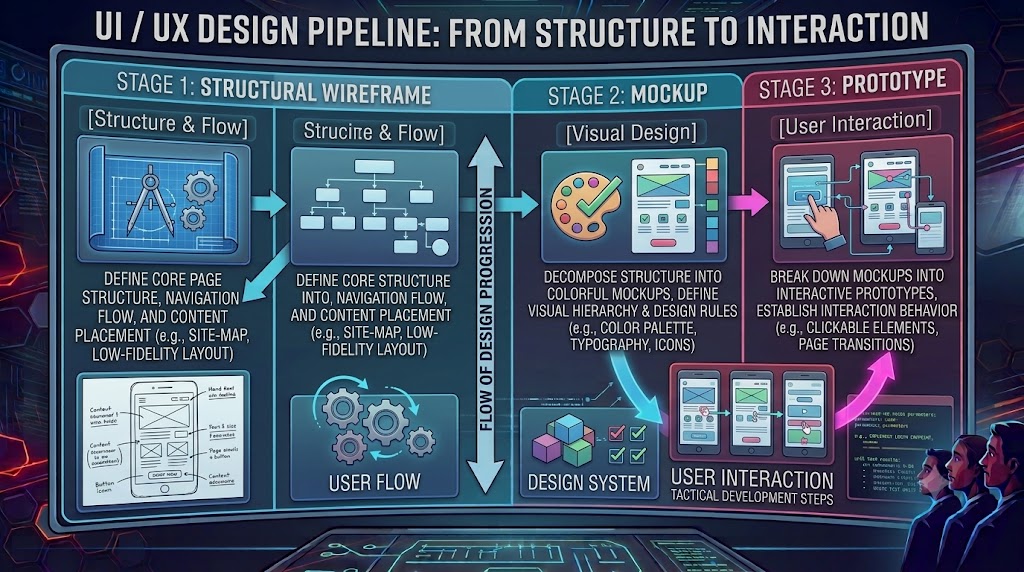
With your visual backbone firmly established, transition seamlessly into the design scope by mapping out low fidelity storyboards. A storyboard acts like a conceptual comic strip, visualizing exactly how a user interacts with the system step by step across specific scenarios.
Directly support these storyboards with structural wireframes: quick, black and white layout sketches completely devoid of custom brand colors, custom typography, or complex graphics. Wireframes serve as the architectural blueprint of the interface. They prevent costly downstream changes by allowing stakeholders to critique structural layouts and system behaviors long before code is written.
Step 4: Trace from Strategic Intent to Tactical Engineering Tasks
The final step is translating your validated user stories into precise, executable engineering tasks. Every user story must be framed explicitly from the target user persona standpoint. Never write stories from the technical perspective of the developer or the internal preferences of the product owner.
Break each user story down into its core functional criteria, then map out the discrete engineering steps required to build it. This precise lineage ensures complete visibility, guaranteeing that every single line of code written by your engineering team traces back directly to an analyzed business need.
The Professional Transformation: Shifting from Chaos to Elite Delivery
When you establish this precise operational discipline, the fundamental dynamics of your project management office change completely.
Elimination of Scope Creep: By locking down the analysis scope before investing heavy cycles into visual layout design, you eliminate the constant stream of late stage changes that derail delivery schedules.
Drastic Reduction in Development Rework: Engineers no longer waste time building elegant features that miss the mark strategically. Design artifacts are validated against documented analytical needs, ensuring accuracy on the first pass.
Predictable Velocity and Metrics: Your sprint cycles stop fluctuating wildly. The team knows exactly what needs to be understood and exactly how it needs to be imagined, leading to stable burn charts and rock solid delivery timelines.
For the ambitious project manager, mastering this boundary is the absolute key to rapid career progression. Corporate executives do not reward managers who simply track velocity tickets and moderate internal engineering arguments. They elevate strategic project leaders who can step into highly ambiguous operational chaos, systematically deconstruct complex business problems, and guide cross functional teams toward flawless execution.
Building Your Elite Project Strategy
Agile success demands a masterful balance between deep analytical understanding and creative solution design. Rushing directly into wireframing or backend architecture without systematically mapping out the baseline problem parameters is a guaranteed recipe for enterprise friction, blown budgets, and team burnout. True delivery velocity is achieved only when your engineers build on a foundation of absolute analytical clarity.
Are You Ready to Scale Your Corporate Impact?
If you are completely done with guessing your way through complex deliverables, ready to escape the loop of endless project fire drills, and determined to accelerate your corporate ladder trajectory, reach out to Skillsetify today. We do not just teach generic framework definitions: we actively analyze your unique professional skills, map out your precise career growth roadmap, and equip you with the advanced tactical toolsets required to command elite, multi million dollar enterprise initiatives with total confidence.