Why Scaled Projects Collapse and How Scrum of Scrums Restores Elite Execution
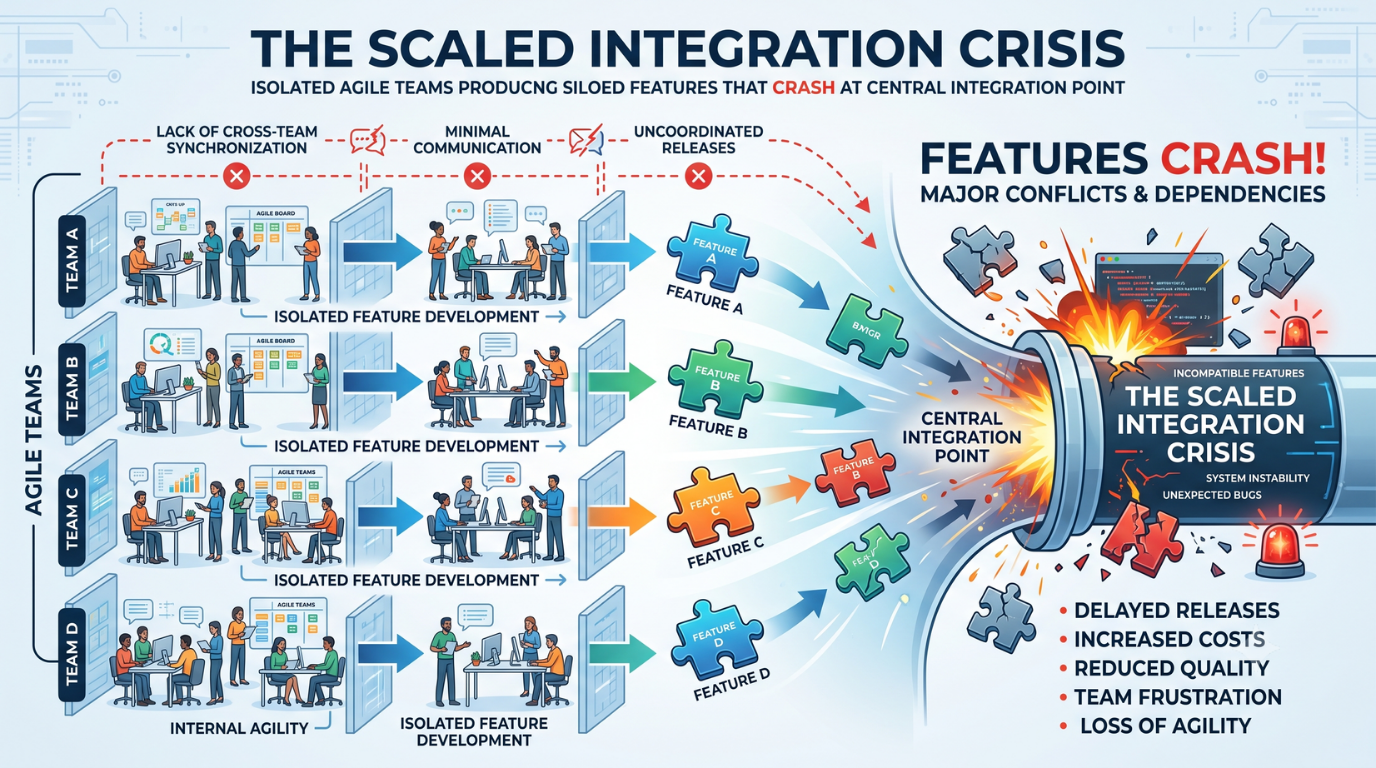
It is 11:30 PM on the night before a major product release. Your corporate dashboard shows flashing green lights across five independent, cross-functional product teams. Each team has successfully zipped through its individual sprint backlog. On paper, everything is perfect.
Then comes the integration phase.
The security team’s new authentication protocol locks out the user interface team’s data pipeline. Simultaneously, the core engine team realizes the API endpoints provided by the database group were built on outdated specifications. Within minutes, the green dashboard transforms into a sea of critical errors. The deployment crashes, finger-pointing floods the corporate messaging channels, and the scheduled launch is postponed indefinitely.
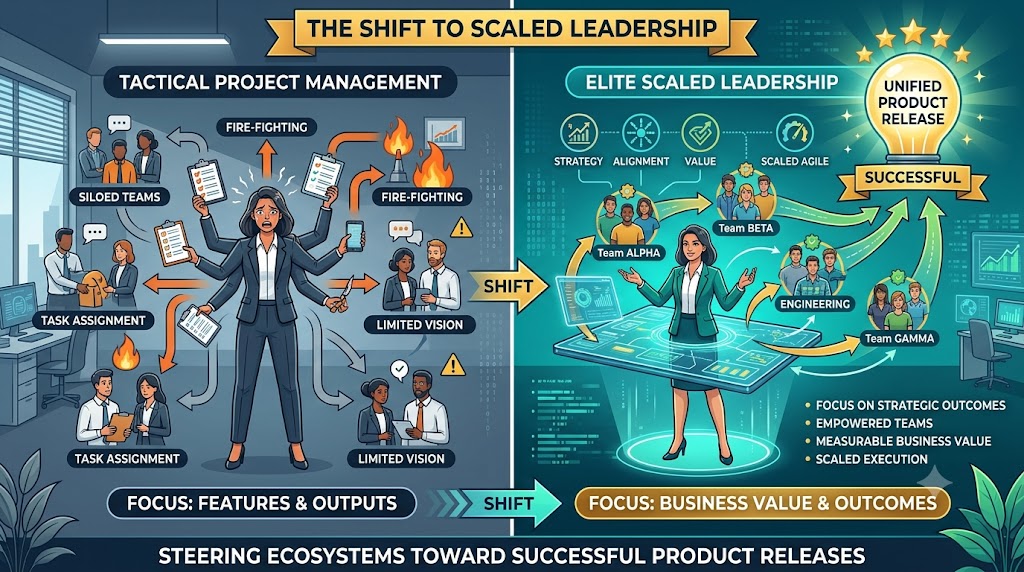
This stressful, highly relatable corporate crisis is the direct result of a failure in scaling architecture. When independent product teams operate as isolated silos, local optimization inevitably leads to global catastrophic failure.
Many enterprise leaders try to fix this by relying on a dangerous corporate myth: the belief that scaling agile delivery simply requires adding more people to existing status meetings or expanding the daily scrum to include everyone. In reality, forcing fifty people into a single meeting kills productivity and dilutes accountability. True agile scaling is not about magnifying the size of your meetings. It is a deliberate architecture designed to synchronize independent teams without destroying their autonomy. To achieve this synchronization, elite project leaders deploy a specific framework: the Scrum of Scrums.
Decoding the Scrum of Scrums Architecture
The Scrum of Scrums framework is an operational scaling architecture used to synchronize independent, cross-functional product teams working toward a single, cohesive product release. In traditional agile settings, a single scrum team functions optimally with a small footprint, historically constrained to a range of three to nine members. This compact size ensures tight alignment and minimal conversational friction.
However, modern enterprise initiatives frequently demand the collective brainpower of thirty, fifty, or even one hundred professionals. When you scale an operation to this magnitude, you cannot simply bundle everyone into a massive room and hope for self-organization.
Instead, the Scrum of Scrums model allows individual teams to maintain their hyper-focused, independent structures. Each team runs its own sprints, utilizes its own product backlog, and maintains its specific scrum master, product owner, and developers. The framework then introduces a secondary layer of thin, highly directed synchronization where representatives from each team meet systematically to manage dependencies, align architectural tracks, and aggressively dissolve cross-team blockers.
The Exponential Math of Communication Overhead
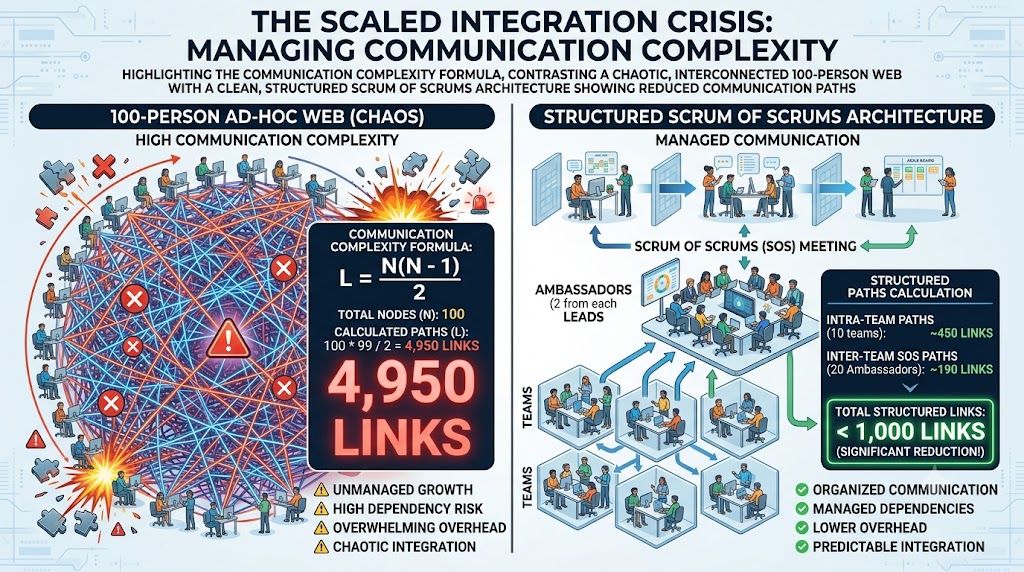
To understand why this scaling architecture is non-negotiable, we must examine the underlying mathematical reality of communication scaling. Communication complexity does not increase linearly with the addition of new team members, it increases exponentially.
The total number of unique communication channels within any project ecosystem is calculated using the formal algebraic formula:
Where $n$ represents the number of active stakeholders in the communication network.
In a small, traditional scrum team of 5 professionals, the communication network remains simple with exactly 10 active channels.
If you expand that team size to 10 stakeholders, the channels skyrocket to 45.
If an enterprise mistakenly attempts to manage a massive 100-person initiative as a single flat group, the network fractures under the weight of 4,950 unique communication paths.
When a project accumulates thousands of communication channels, clear messaging becomes impossible. Critical directives turn into rumors, misconceptions multiply, and team members collapse under the weight of cognitive overload.
The Scrum of Scrums framework strategically solves this mathematical crisis by dividing the enterprise into small, self-contained units. If you divide one hundred people into ten distinct teams of ten, each team internally navigates only forty-five communication channels. Then, by taking one designated ambassador from each of those ten teams to form a centralized Scrum of Scrums, you establish an overarching synchronization group containing only forty-five external channels. This deliberate structural division reduces communication complexity, keeping cross-functional operations stable and aligned.
Roles and Mechanics of Scaled Synchronization
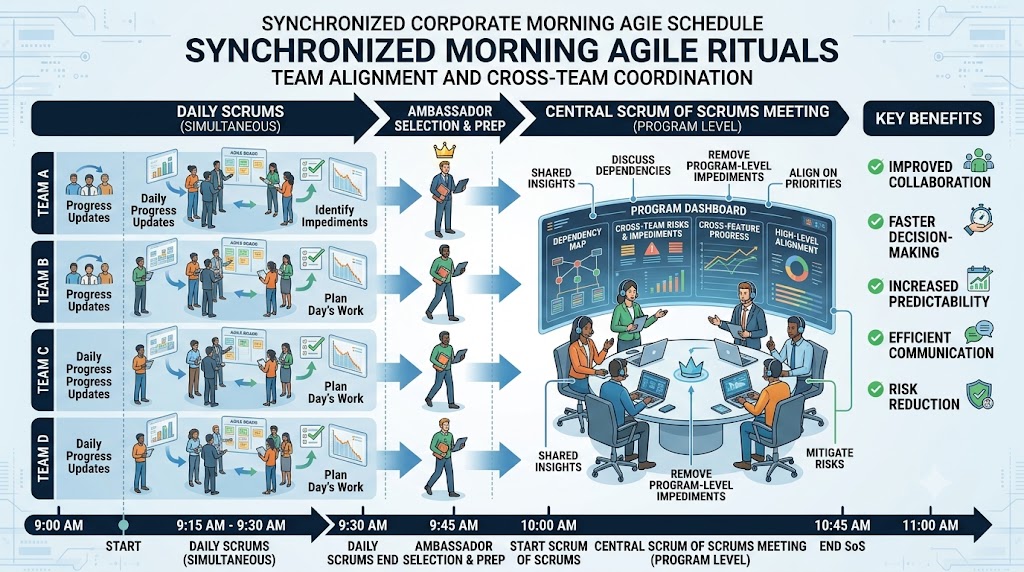
The mechanics of a Scrum of Scrums meeting differ substantially from a standard daily standup. While the daily scrum focuses on tactical, intra-team tasks, the Scrum of Scrums focuses strictly on inter-team integration, cross-boundary dependencies, and systemic organizational impediments.
The Ambassador (Representative): Each team selects an ambassador to attend the Scrum of Scrums sessions. This choice is dynamic and depends entirely on the current challenges of the sprint. If a team is navigating complex infrastructure upgrades, a senior architect or technical lead serves as the ambassador. If the focus is on business logic or interface design, a product owner or scrum master can step in.
The Scrum of Scrums Master (SoSM): This role functions as a master facilitator. The SoSM does not act as a manager. Rather, they are a servant-leader tasked with maintaining the meeting’s strict timebox, tracking cross-team impediments on a centralized dashboard, and clearing organizational blockers that require executive intervention.
Frequency and Cadence: Unlike the daily scrum, the Scrum of Scrums typically takes place two to three times a week, though highly complex software integrations may require a daily touchpoint. The session is rigorously timeboxed, usually lasting between fifteen and thirty minutes, ensuring the conversation remains high-level, strategic, and hyper-focused on cross-team problem-solving.
The Four Scaled Questions for Cross-Team Alignment
To drive explicit, action-oriented communication during the session, every ambassador must articulate answers to four distinct questions. These questions shift the focus away from individual updates and toward collective release velocity:
What milestones has your team successfully achieved since we last met that directly impact or influence the work of other product teams?
What specific operational tasks does your team commit to completing before our next scheduled session that could potentially affect or create dependencies for other groups?
What internal or external impediments is your team currently experiencing that are limiting your velocity and require active collaboration or assistance from another team here?
Are there any upcoming architectural decisions, code changes, or deployment paths your team is exploring that could inadvertently block, delay, or conflict with another team’s immediate roadmap?
The Step-by-Step Scrum of Scrums Implementation Framework
Implementing a Scrum of Scrums scaling architecture across a complex corporate landscape requires a structured approach. Project managers can immediately copy and deploy this step-by-step framework to transition their organizations from chaotic, siloed engineering into elite, scaled delivery.
(3–9 members per distinct team)
(e.g., Tuesday/Thursday, 30 minutes)
Step 1: Establish Boundaries and Cross-Functional Composition
Audit your existing engineering footprint. If you have a massive, single team struggling to collaborate, break it down into self-contained, cross-functional units of three to nine professionals. Ensure each distinct team contains all the skills required (such as front-end developers, back-end engineers, QA specialists, and a dedicated product owner) to deliver a fully functional slice of software without relying on external handoffs.
Step 2: Establish the Ambassador Selection Protocol
Create a clear policy stating that the ambassador role is dynamic, not a fixed title. The team must choose its representative based on the upcoming sprint’s architectural focus. If Team Alpha’s primary goal is integrating an external payment API built by Team Beta, Team Alpha’s ambassador for that cycle should be the engineer spearheading that specific integration task.
Step 3: Align Cadence and Timeboxes
Align the sprint cadences of all participating teams. They must operate on identical sprint cycles, preferably two-week durations, with synchronized start and end dates. Schedule the Scrum of Scrums meeting to occur directly after the individual teams finish their daily scrums. For example, if individual teams meet from 9:00 AM to 9:15 AM, the Scrum of Scrums should kick off at 9:30 AM on
Step 4: Map the Scaled Impediment Backlog
Build a visible, centralized Scrum of Scrums Kanban board. This board tracks cross-team dependencies and shared blockers. It must categorize impediments by priority, ownership, and target resolution date. If an ambassador raises a block where Team C needs environment access from Team D, this blocker is formally logged on the centralized board, assigned to Team D’s ambassador, and tracked transparently until it is cleared.
Step 5: Execute Joint Sprint Reviews and Retrospectives
At the end of each synchronized sprint cycle, run a unified Sprint Review. Instead of holding five separate review meetings for five different teams, bring all teams and enterprise stakeholders together into a single session. Here, the cross-functional groups demonstrate how their individual features combine into a single product increment. Follow this review with a scaled Retrospective, where ambassadors analyze systemic coordination friction and continually refine the organization’s scaling architecture.
Shifting from Operational Chaos to Elite Delivery
When enterprise organizations implement the Scrum of Scrums framework correctly, the professional transformation is profound. The predictable friction of multi-team execution gives way to a highly synchronized rhythm of continuous delivery.
| Before Scrum of Scrums | After Scrum of Scrums |
| Integration Hell at the end of releases | Continuous, micro-integrations every week |
| Out-of-control scope creep and confusion | Clear visibility of cross-team roadmaps |
| High burnout from late-stage re-work | Balanced velocity and clear blockers |
| Silent dependencies crashing deployments | Proactive mitigation of technical risks |
Prior to adopting this framework, leadership teams live in a state of constant reactivity. Scope creep sneaks in through uncoordinated architectural changes, and teams experience high burnout caused by late-stage code rewrites. Siloed development models give teams a false sense of security, which quickly shatters the moment individual code components collide during integration.
By introducing a scaling architecture, you build an environment of continuous validation. Teams catch integration mismatches within hours rather than weeks, cross-team roadmaps stay transparent, and engineers operate with the psychological safety that comes from balanced velocity. This proactive risk mitigation transforms project execution from a chaotic guessing game into an elite, highly predictable engine of enterprise value.
For an ambitious project manager or agile leader, mastering this architectural orchestration is a powerful career accelerator. The corporate landscape is filled with tactical task-masters who can run a simple, ten-person standup. However, executives look for leaders who can orchestrate massive organizational systems, synchronize fifty-person engineering engines, and deliver complex products on schedule without burning out the workforce. By positioning yourself as a scaling architect who understands both the human elements and the underlying mathematical realities of communication networks, you elevate your profile from a standard project manager to a strategic organizational leader. You become the person who steps into enterprise chaos and creates an elite system of predictable, high-velocity corporate execution.