Why Exam Delivery Selection Can Make or Break Your Leadership Career
Imagine this scenario: After months of dedicated preparation, a rising Senior Project Lead schedules their high-stakes PMP certification exam from home on a Thursday morning. Halfway through the 180-question test, an IT security background process on their corporate laptop initiates a forced system update. The proctoring software freezes, the session is terminated for policy violations, and the attempt is forfeited. Worse yet, the candidate had already promised executive sponsors that their formal certification would be finalized before the upcoming quarterly portfolio review.
When project delivery fails, it is rarely due to a total lack of technical knowledge. Far more often, failure stems from mismanaged operational risks, poor logistics, and misaligned stakeholder expectations. A prevalent myth in corporate professional development is that taking a certification exam from home is simply a more convenient version of testing at a physical center. In reality, home testing shifts 100 percent of the technical infrastructure, environmental compliance, and operational risk directly onto the candidate.
Choosing the wrong exam delivery environment introduces unforced operational errors that can delay your career growth, damage your professional credibility, and undermine executive perception.
Deconstructing Exam Logistics: Online Proctoring vs. Testing Centers
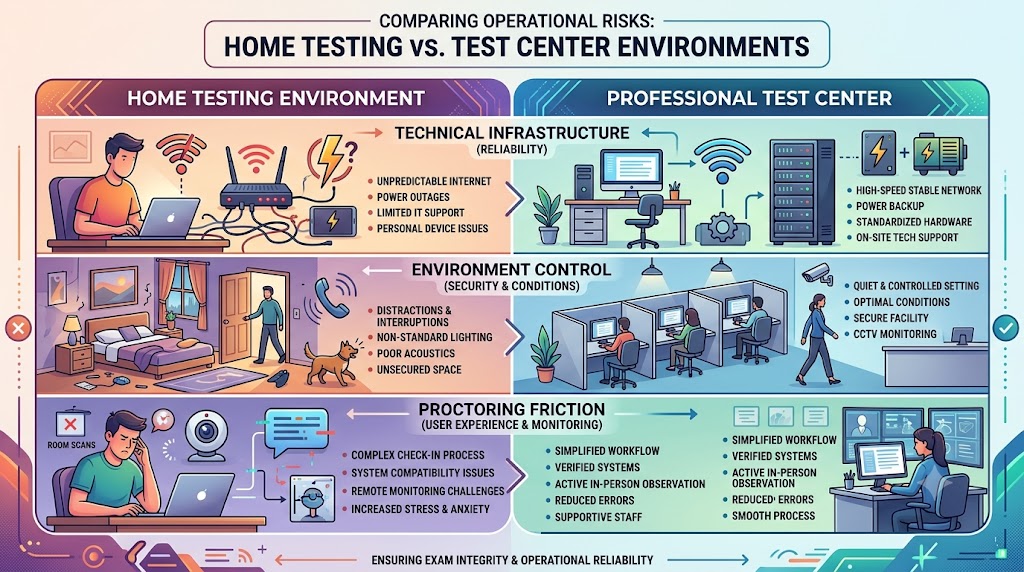
To make an informed strategic decision, project leaders must evaluate exam delivery mechanics through the lens of risk management. Professional certification bodies like the Project Management Institute design rigorous testing protocols to safeguard exam integrity. However, the operational execution of these protocols differs drastically between an at-home environment and a dedicated testing center
The Operational Friction of Home Testing
While testing from home eliminates commute time, it introduces severe infrastructure vulnerabilities that are often outside your control:
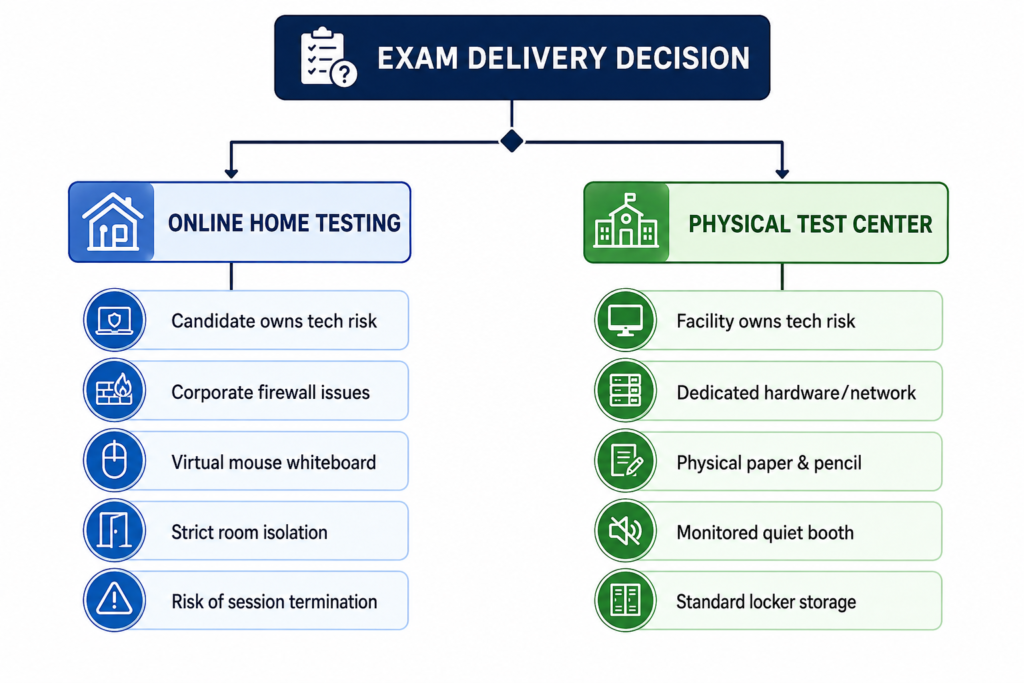
Corporate Security Software & Firewalls: Attempting to take an exam on a company-issued laptop routinely triggers administrative security blocks. Corporate firewalls, anti-virus agents, and background monitoring tools frequently conflict with secure proctoring browsers, leading to sudden test terminations.
Environmental Rigidity: Online proctors enforce zero-tolerance environmental rules. Your physical workspace must be completely clear of secondary monitors, paper, pens, and personal items. If an unexpected visitor enters the room, or if you momentarily move out of the webcam frame, the proctor holds the authority to instantly revoke your exam session without a refund.
The Virtual Whiteboard Barrier: Quantitative questions requiring calculations present a major friction point during home exams. Candidates are prohibited from using physical scratch paper or pens. Instead, you must use an on-screen digital whiteboard, drawing formulas like Cost Performance Index (CPI = EV/AC) or Earned Value metrics manually with a computer mouse, consuming valuable minutes.
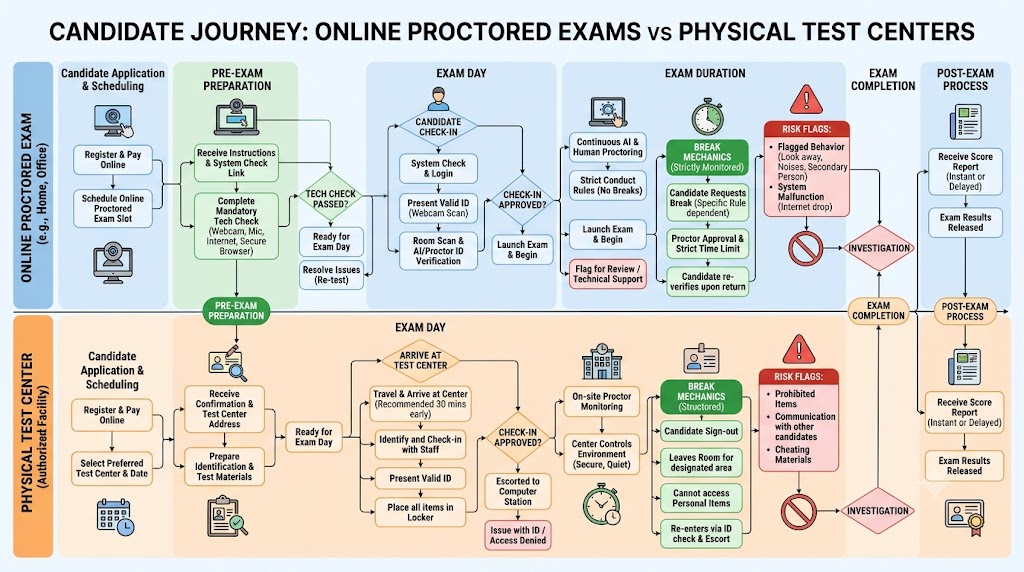
Break Mechanics and Question Locking: Modern certification exams of 180 questions across 230 minutes typically grant two scheduled 10-minute breaks. On home exams, taking a break requires you to permanently submit your current block of questions (e.g., questions 1 to 60). Once you step away from the camera, those questions are permanently locked and cannot be reviewed again.
The Controlled Environment of Testing Centers
In contrast, taking an exam at a professional Pearson VUE or Prometric testing center transfers operational risk away from you and onto the facility facility:
Standardized Hardware and Connectivity: Test centers operate on dedicated, high-speed networks with isolated hardware designed specifically to run examination software without interruption.
Physical Scratchpads and Markers: Centers provide physical writeable booklets or scratch paper with markers. This allows candidates to quickly draft network diagrams, perform mathematical equations, and map out complex decision trees without struggling against digital mouse-drawing tools.
Structured Administrative Isolation: Upon arrival, candidates store all personal belongings in secure lockers, present government identification, undergo standard security screening, and enter a quiet, climate-controlled testing environment free from household distractions.
Strategic Comparison: Center vs. Home Testing
Evaluating these two options requires balancing personal convenience against operational risk tolerance.
| Evaluation Parameter | Online Home Proctoring | Physical Testing Center | Strategic Impact |
| Hardware & Network Control | Candidate responsibility; prone to firewall/software conflicts. | Facility responsibility; dedicated commercial infrastructure. | Lowers technical failure risk to near zero at physical centers. |
| Scratchpad & Calculation Usability | Virtual digital whiteboard using a mouse or trackpad. | Physical paper/booklet and pencil/marker provided. | Physical tools drastically speed up quantitative problem solving. |
| Environmental Distractions | High risk (family, pets, ambient noise, delivery drivers). | Controlled quiet environment with noise-canceling headsets. | Center provides superior focus and reduced psychological stress. |
| Proctoring Friction | High monitoring sensitivity; strict gaze and movement rules. | Standard room monitoring; clear physical boundaries. | Home testing introduces artificial anxiety around minor movements. |
| Contingency Support | Technical glitches often lead to immediate session cancellation. | On-site staff can resolve hardware issues or restart sessions. | Test centers provide human intervention during technical anomalies. |
The 4-Step Implementation Framework for Exam Readiness
Managing exam logistics effectively is an exercise in core project management. To guarantee a smooth testing experience while safeguarding stakeholder confidence, project managers should execute the following four-step operational playbook.
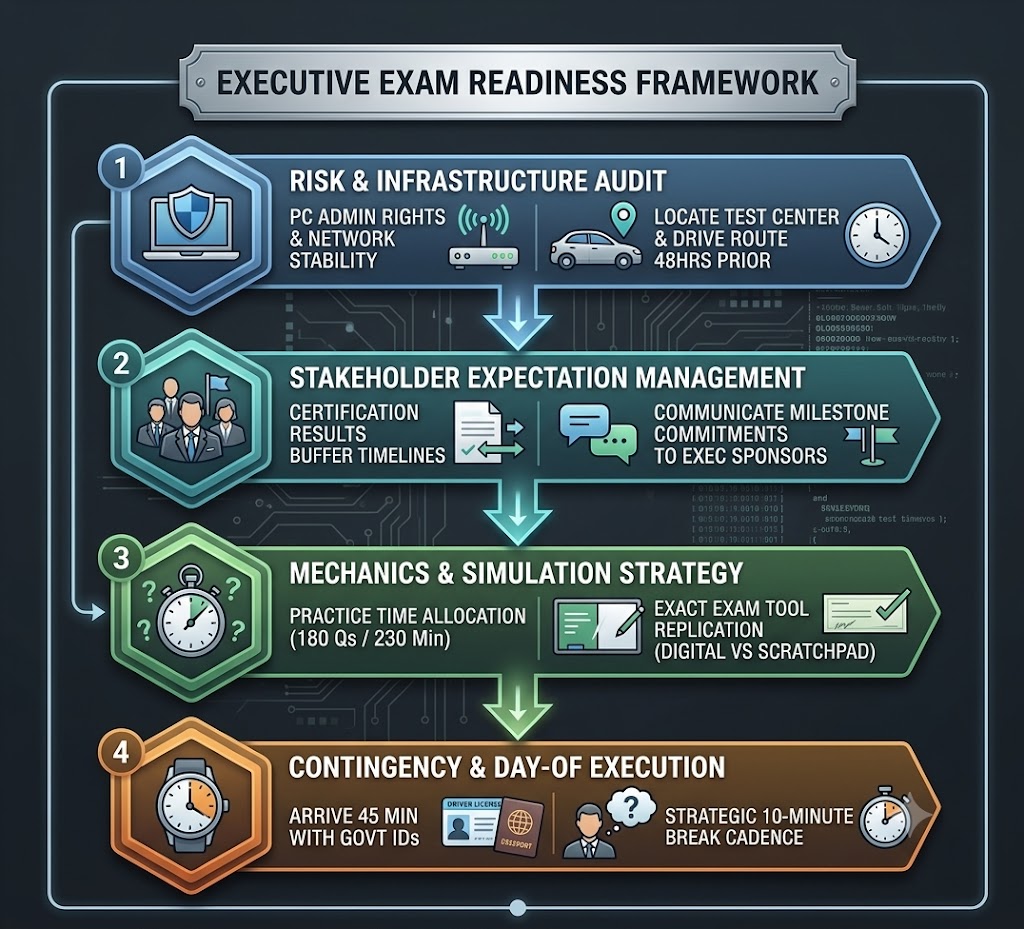
Step 1: Perform a Rigorous Infrastructure Audit
If you must select home testing, complete a system check on a personal laptop rather than a corporate machine to bypass administrative firewalls. Verify that your internet connection maintains stable upload and download speeds. If opting for center testing, locate the facility in advance. Drive to the location a few days prior to confirm parking, public transit options, and exact office suite positions to eliminate morning-of navigation delays.
Step 2: Establish a Stakeholder Expectation Plan
Project managers often damage their internal credibility by over-promising timelines to leadership.
Never declare your certification complete until official score reports are verified.
Build a 14-day contingency buffer into your professional development milestones to account for potential rescheduling, audit reviews, or scoring delays.
Frame your certification plan as a structured delivery project, updating your executive sponsors on key preparation milestones.
Step 3: Simulate the Specific Exam Mechanics
Match your practice sessions to the exact physical reality of your chosen testing format:
Time Allocation: Practice pacing yourself to spend no more than 75 to 80 seconds per question across the 230-minute exam window.
Tool Familiarity: If testing at home, practice solving mathematical scenarios using standard drawing tools to adapt to the digital whiteboard. If testing at a center, practice writing out formulas on physical paper.
Break Strategy: Plan your stamina around the two built-in 10-minute breaks. Ensure you are prepared to complete and submit each 60-question block cleanly before stepping away.
Step 4: Execute Day-of Risk Mitigation
On exam day, control every external variable:
Arrive at the testing center at least 30 to 45 minutes prior to your scheduled appointment.
Bring two forms of valid, unexpired government identification that match the exact spelling on your registration details.
Utilize provided earplugs or noise-canceling headphones immediately upon sitting down to shield yourself from ambient keyboard noise in the testing room.
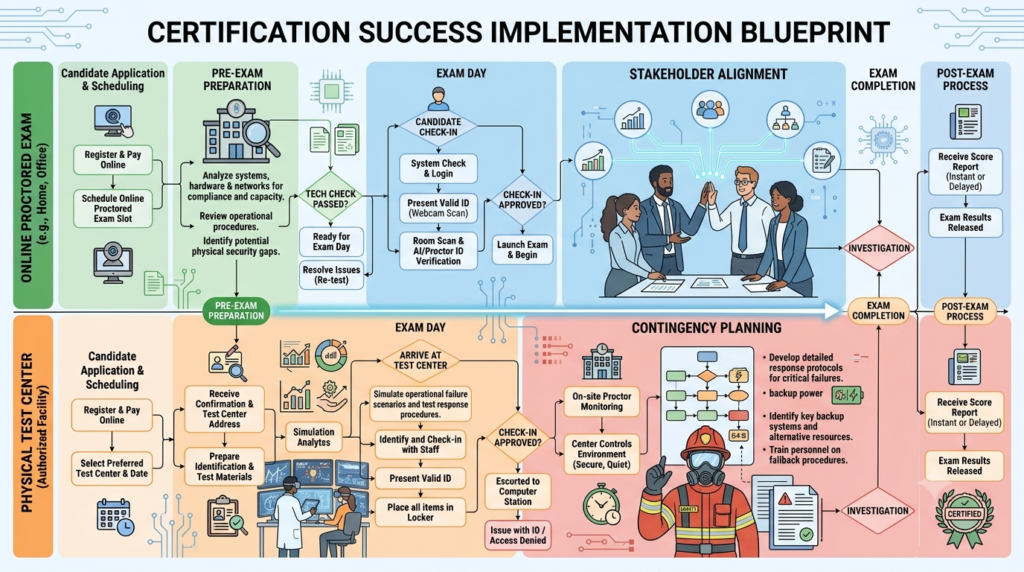
From Delivery Friction to Executive Authority
Mastering exam logistics is about far more than passing a standardized test. It is a direct reflection of how you approach high-stakes project execution. When you approach professional milestones with thorough risk analysis, clear contingency planning, and active stakeholder management, you demonstrate the exact competencies required of senior project leaders.
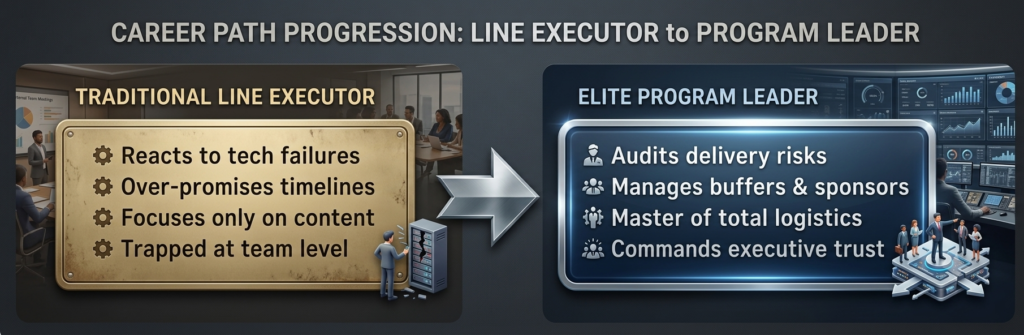
The transition from a line-level coordinator to an executive project manager requires moving away from reactive fire-fighting. By controlling your testing environment, anticipating operational bottlenecks, and aligning executive expectations, you safeguard your professional reputation. Mastering these operational details builds the composure and strategic foresight needed to lead enterprise-grade initiatives.
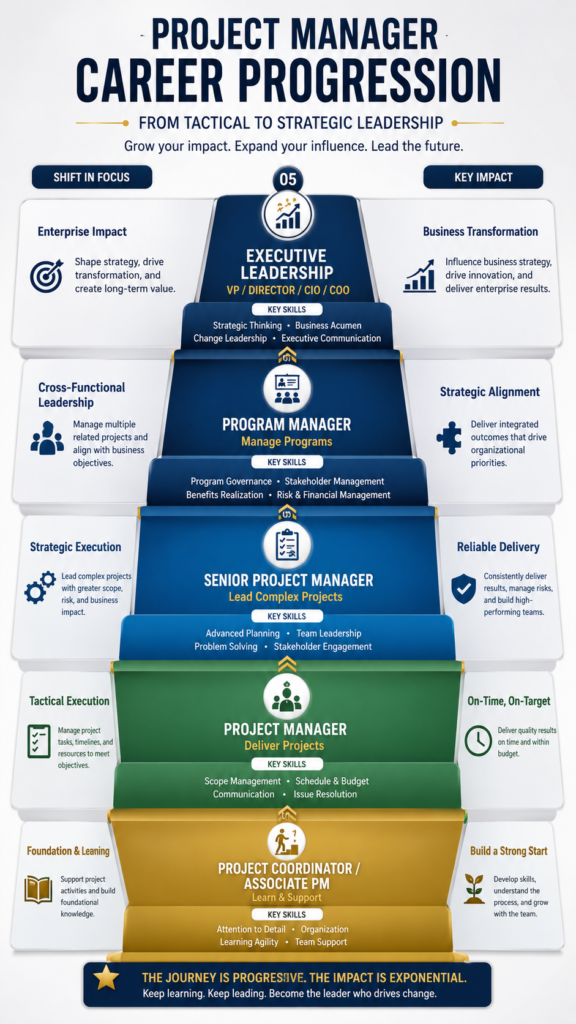
Accelerate Your Professional Growth with Skillsetify
Navigating professional certifications and advancing your project management career should never involve guesswork. True project leadership goes beyond memorizing formulas and process groups. It requires building real-world strategic authority, commanding stakeholder respect, and driving predictable business outcomes.
If you are ready to stop guessing, move up the corporate ladder, and learn project management the right way, reach out to Skillsetify. We do not just teach frameworks: we show you your exact career growth trajectory.