Why Stakeholder Perception Rules Project Success
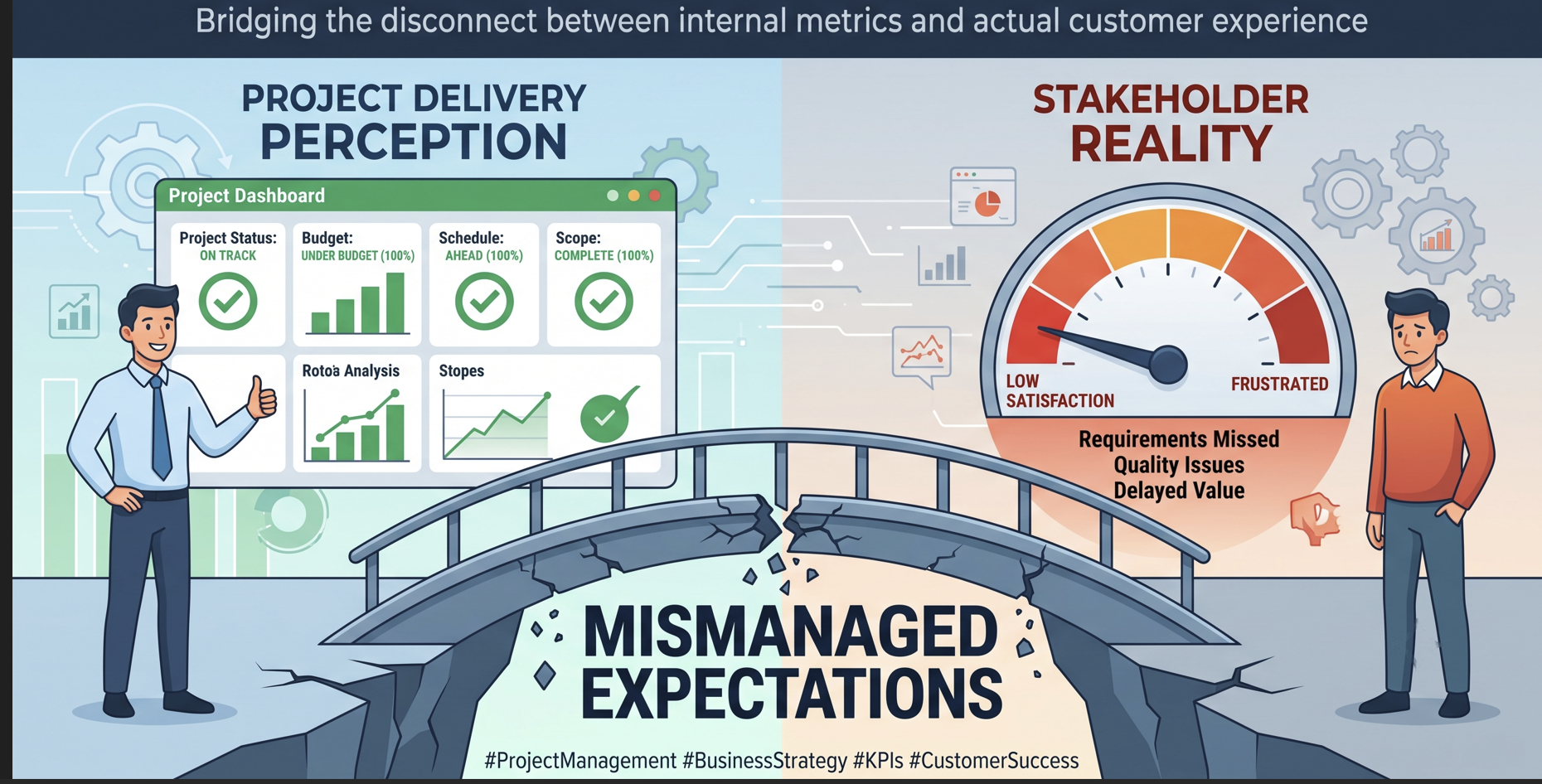
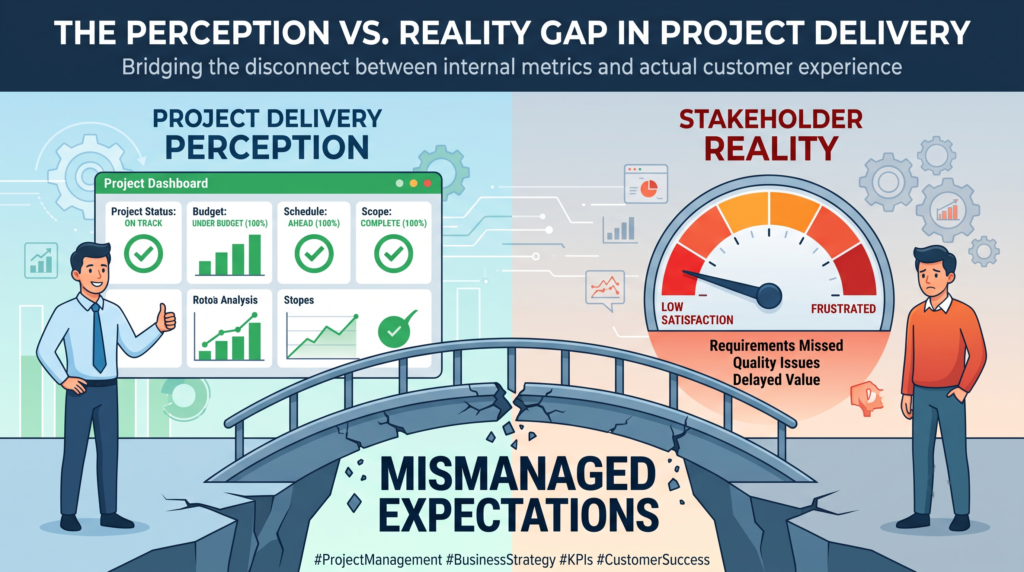
The project dashboard is glowing green across every classic KPI: scope is 100% complete, budget variance sits at a pristine under-spend of 2%, and milestone delivery matched the baseline schedule to the exact calendar day. You step into the quarterly executive steering committee meeting expecting applause, approval, and budget extension for the next phase.
Instead, the client Vice President folds their arms, looks across the executive table, and delivers a devastating verdict: “This system does not meet our operational realities, your team moved forward without true alignment, and we consider this release an absolute failure.”
In a single instant, your technical victory turns into an organizational disaster. How does a project delivered on time, on budget, and on scope end up classified as a critical failure?
The answer exposes the single biggest lie taught in traditional project management: the belief that execution performance guarantees customer satisfaction.
The brutal reality of enterprise delivery is that project delivery fails if stakeholder perception and expectations are mismanaged. It does not matter how impeccably your engineering team built the underlying technical architecture. If key decision-makers perceive the project as out of touch, risky, or misaligned with strategic business outcomes, the project is a failure. Success is not measured inside your Jira board; it is defined inside the minds of your stakeholders.
The Strategic Reality
Deconstructing Stakeholder Perception
To master client alignment, enterprise project leaders must stop viewing stakeholder management as a soft communication skill. Stakeholder management is a hard, risk-mitigation discipline. Perception is not a vague feeling; it is a measurable psychological gap between expectation and observed reality.
The Expectation Gap Equatione
In executive B2B project environments, stakeholder perception can be modeled through a simple mathematical relationship:
- Sp represents Stakeholder Perception (the subjective verdict of success).
- Rv represents Realized Value (the actual business outcome delivered).
- Ea represents Anchored Expectations (the stakeholder's dynamic baseline of what was promised).
If your team delivers extraordinary technical output (Rv = 90), but you allowed the executive team to anchor their expectations at an unrealistic ceiling (Ea = 100), your net perception score is negative (Sp = −10). Conversely, if you control, anchor, and adjust expectations transparently (Ea = 80) while delivering steady value (Rv = 85), your net perception score is positive (Sp = +5).
Flawless project delivery is not about giving stakeholders everything they ask for. It is about actively controlling the expectation baseline (Ea) throughout the execution lifecycle.
The Three Organizational Layers of Alignment
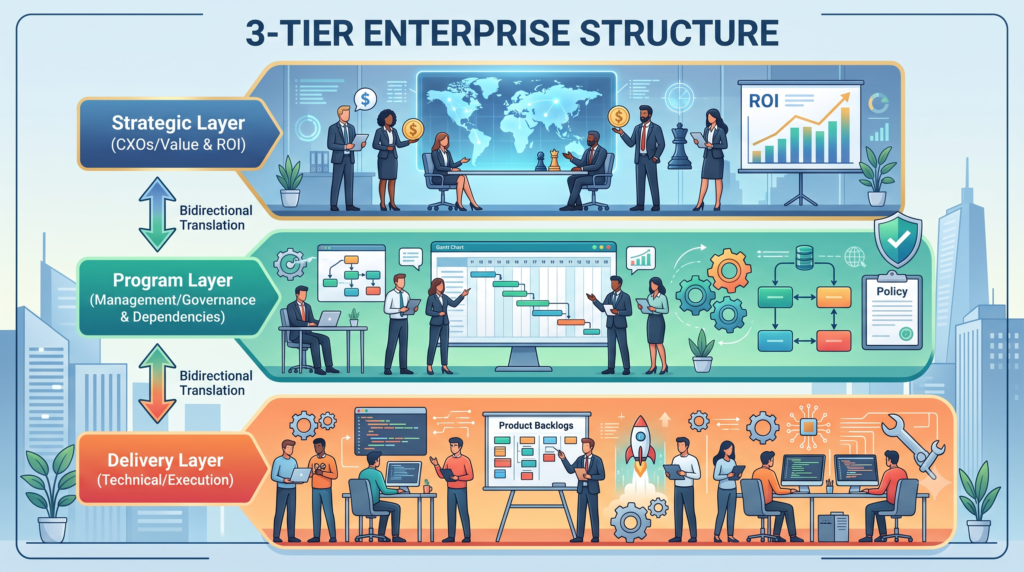
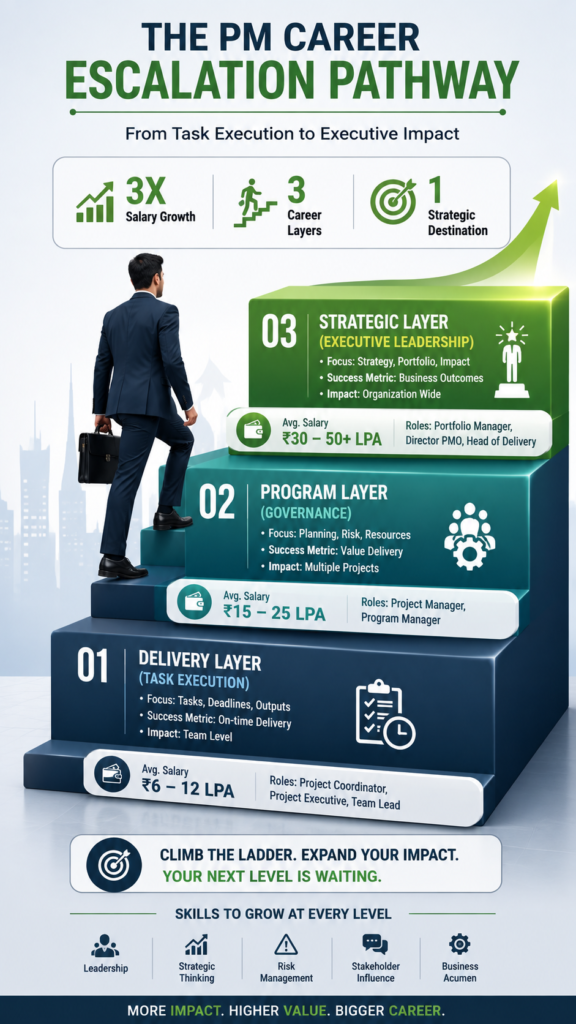
Project leaders often fail at expectation management because they communicate at the wrong organizational frequency. High-performing B2B organizations operate across three distinct operational layers:
The Strategic Layer (Executive Leadership / CXOs): Focused exclusively on business value, return on investment (ROI), market differentiation, and portfolio performance. They do not care about sprint velocity; they care about revenue acceleration and operational risk.
The Program Layer (Middle Management / Directors): Focused on governance, cross-functional dependencies, resource allocation, and predictable delivery cadences.
The Delivery Layer (Engineering / Technical Teams): Focused on technical tasks, user stories, bug backlogs, and immediate execution.
The most common point of failure for rising Project Managers is remaining trapped in the delivery layer. Technical excellence caps your career trajectory if you cannot translate delivery progress into the language of strategic value. To earn executive trust, you must act as the translation bridge connecting execution details up to strategic business goals.
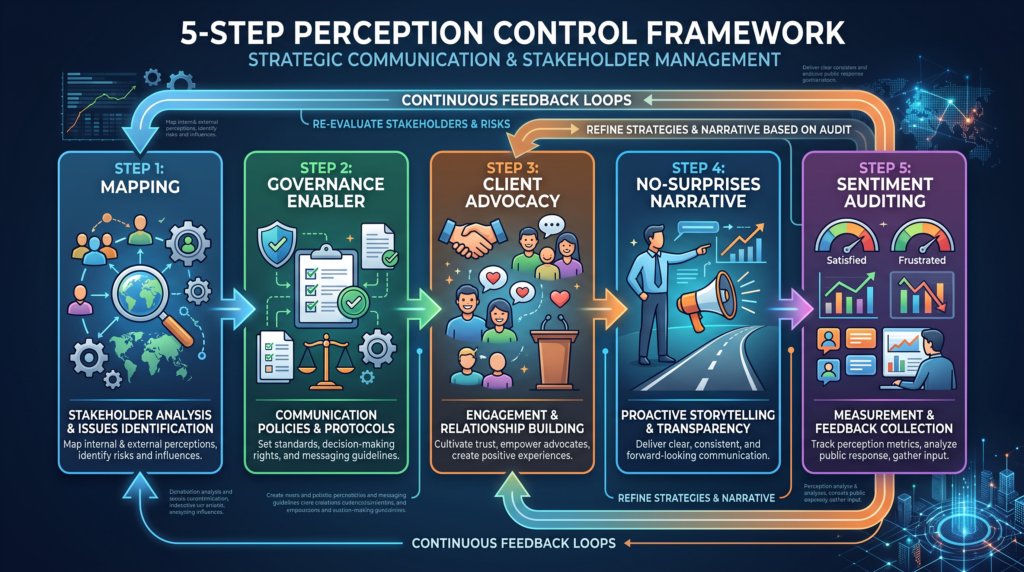
The 5-Step Implementation Framework for Perception Control
To shift your client interactions from reactive defense to proactive alignment, implement this actionable 5-step framework across your B2B engagements.
Step 1: Conduct Influence and Perception Baseline Mapping
Before writing a line of code or finalizing a project schedule, map out your stakeholder landscape beyond basic organizational charts. Categorize every key actor along two axes: Power/Influence and Perception Baseline.
Identify Internal Champion vs. Skeptic Dynamics: Uncover who benefits from your project and whose operational authority feels threatened by it.
Establish an Early Baseline: Interview key decision-makers individually. Ask one core question: “What does successful delivery look like for your business unit in 90 days?”
Document Perception Drivers: Determine if a stakeholder prioritizes cost containment, rapid go-to-market speed, system stability, or user adoption.
Step 2: Reframe Governance as an Enabler, Not a Blocker
A major mistake in stakeholder engagement is building rigid, defensive governance structures that slow down progress. Governance should never act as a bureaucratic wall; it must function as a delivery enabler.
Streamline Escalation Pathways: Define explicit trigger thresholds for when risks move from project team review to executive steering committees.
Eliminate Low-Value Meetings: Replace dense, hour-long status updates with standardized, visual executive dashboards focusing on decision points, upcoming milestones, and active risk responses.
Establish Joint Ownership: Require client stakeholders to co-sign risk response plans, ensuring shared accountability when scope adjustments are required.
Step 3: Implement the Client Advocate Operating Model
To build enduring trust, client stakeholders must feel that you are operating as an internal advocate sitting on their side of the table. While your organization pays your salary, the client ultimate funds the account.
Adopt “Client-Side” Language: Shift your communication style from “Our delivery team needs…” to “To protect your go-to-market timeline, we recommend…”
Defend Strategic Priorities: If your internal delivery team wants to push a shortcuts-heavy technical architecture that creates long-term operational debt for the client, push back internally.
Demonstrate Proactive Empathy: Acknowledge client internal pressures, such as board reviews or quarterly earnings, and adjust delivery cadence visual reports to align with their internal calendar.
Step 4: Institute a "No-Surprises" Risk Narrative
Perception is destroyed not by the occurrence of a risk, but by late disclosure. Executive stakeholders tolerate bad news far better than unexpected news.
| Communication Trigger | Traditional PM Reaction | Perception-Mastery PM Approach |
| Schedule Delay (2 Weeks) | Hide delay in technical details; hope engineering catches up in the next sprint. | Flag variance immediately: present 2 pre-costed mitigation options with recommended trade-offs. |
| Scope Creep Request | Accept request verbally to please the client; trigger team burnout later. | Validate request value; issue a transparent Impact Analysis displaying cost, time, and scope trade-offs. |
| Technical Blocker | Blame external vendors or client legacy infrastructure. | Take ownership of the resolution pathway; present immediate workaround and long-term resolution timeline. |
Step 5: Continuous Sentiment Auditing Mid-Flight
Do not wait for formal end-of-project surveys to evaluate client satisfaction. Implement real-time perception health checks:
Bi-Weekly Sentiment Scoring: At the end of major operational touchpoints, request a quick 1-5 rating from key client leaders on communication clarity and confidence in project trajectory.
Micro-Adjustments: If a stakeholder’s score drops from a 5 to a 3, schedule an immediate 1-on-1 alignment session within 24 hours to address emerging friction points before they escalate into formal complaints.
The Professional Transformation: Escalating Your Career Trajectory
Mastering stakeholder perception is the definitive boundary between a project coordinator and an elite corporate leader.
When you operate purely within the delivery layer, your value is tied to tactical task completion. You become vulnerable to burnout, endless scope creep, and defensive escalation meetings. You remain capped by a technical ceiling, regardless of how many technical skills or standard agile certifications you accumulate.
When you master executive alignment and expectation anchoring, your entire professional profile changes:
From Chaos to Predictability: You eliminate late-stage scope rejection, team overtime spikes, and contentious invoice approvals.
From Order Taker to Strategic Advisor: Clients and internal executives stop viewing you as an administrative task-tracker and begin consulting you as an indispensable business partner.
From Technical Ceiling to C-Suite Trajectory: Senior leadership naturally pulls perception-driven project leaders up into high-visibility strategic programs, portfolio management, and executive leadership roles.
Great project managers do not just manage deliverables; they manage the executive narrative surrounding those deliverables. When you master both technical execution and psychological alignment, you unlock unprecedented leverage in your career progression.
Mastering Executive Leadership with Skillsetify
The difference between average project delivery and executive-level leadership isn’t found in standard textbooks or basic framework guides. It requires mastering real-world stakeholder dynamics, executive communication strategies, and practical enterprise governance models.
If you are ready to stop guessing, move up the corporate ladder, and learn project management the right way, reach out to Skillsetify. We do not just teach frameworks: we show you your exact career growth trajectory.