Shifting from Blame to True Accountability in Retrospective Root Cause Analysis
1. ATTENTION: The Silent Sprint Killer and the Illusion of Green Metrics
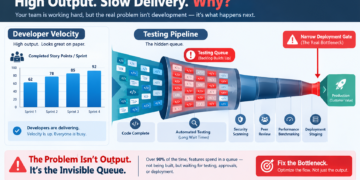
Imagine a Monday morning executive dashboard completely filled with bright green progress indicators. Velocity looks steady, burn-down charts show crisp linear trajectories, and every sprint goal is technically checked off as completed. Yet, the enterprise product is failing in production. Crucial software integrations are breaking under real-world load, customer churn is reaching historic highs, and engineering teams are quietly burning out behind closed doors.
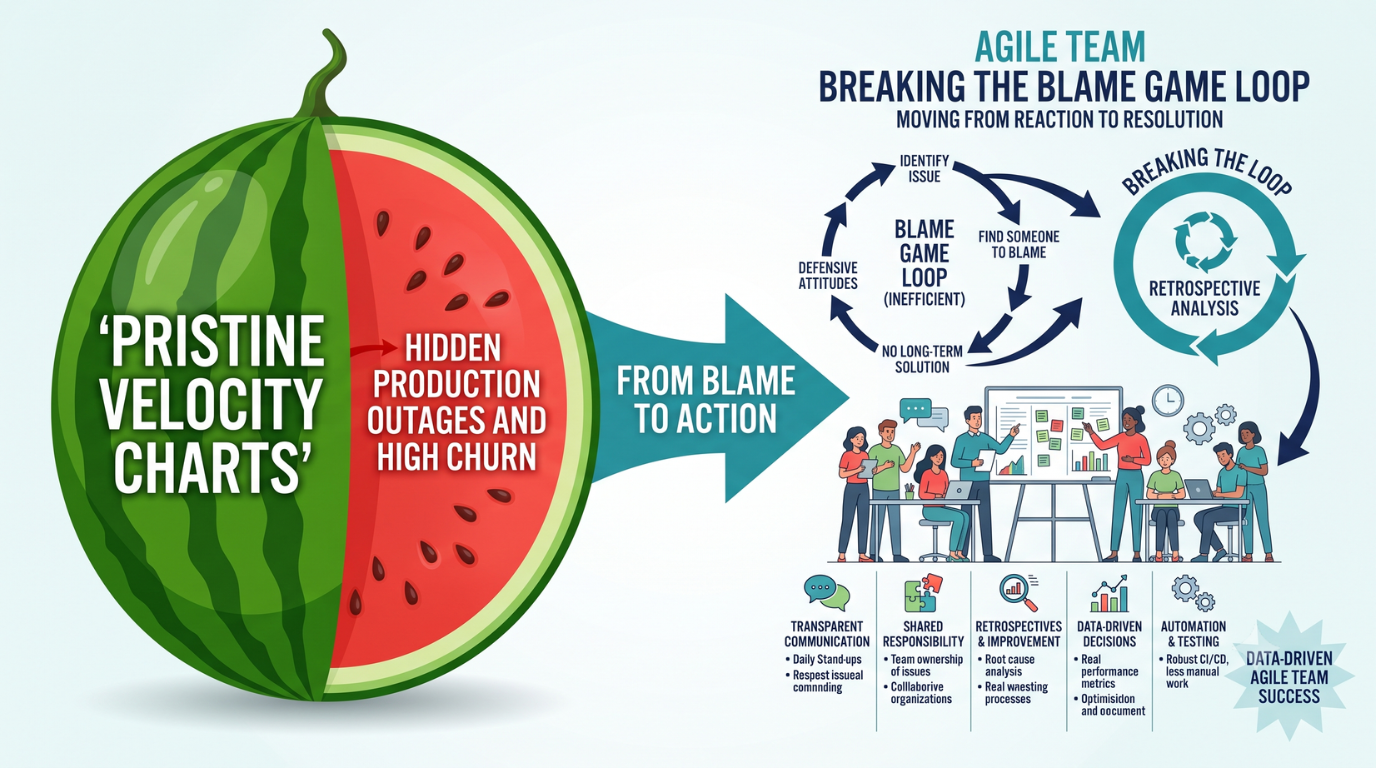
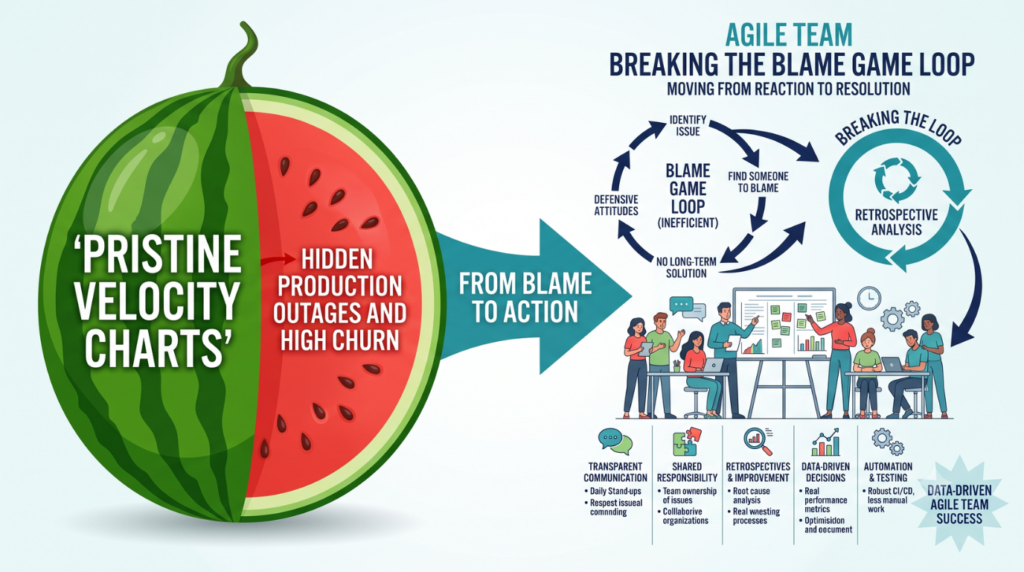
This is the ultimate corporate paradox, often referred to as the watermelon effect. Everything looks perfectly green on the outside, but when you slice into the project, it is deeply bleeding red.
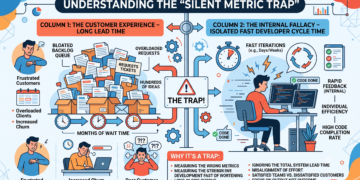
When a critical failure occurs, the standard corporate defense mechanism is immediate and predictable, shifting into an organizational blame game. Leaders demand to know who broke the build, developers defensive posturing begins, and scrum masters frantically search through documentation to prove the process was followed.
The standard corporate myth states that performance tracking is about enforcing strict numerical output metrics. This approach is completely wrong. Tracking metrics without establishing a rigid accountability matrix for engineering failures turns continuous improvement into a performative compliance exercise.
True agile maturity does not hide behind pristine velocity charts. It is built entirely on how a team handles unexpected failure through structured, finger-pointing-free Root Cause Analysis (RCA) within the sprint retrospective.
2. INTEREST: The Mechanics of Retrospective Root Cause Analysis Accountability
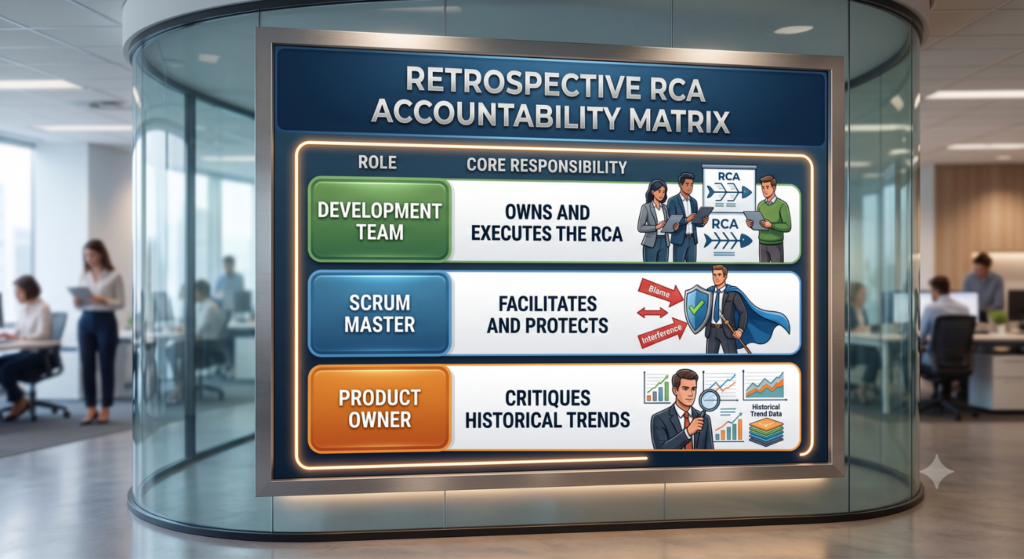
To build a high-performing engineering engine, organizations must move away from generic post-mortems and implement a highly structured system for analyzing failures. Retrospective Root Cause Analysis Accountability explicitly redefines individual team boundaries. It establishes exactly who performs the investigation, who guides the process, and who challenges structural engineering trends.
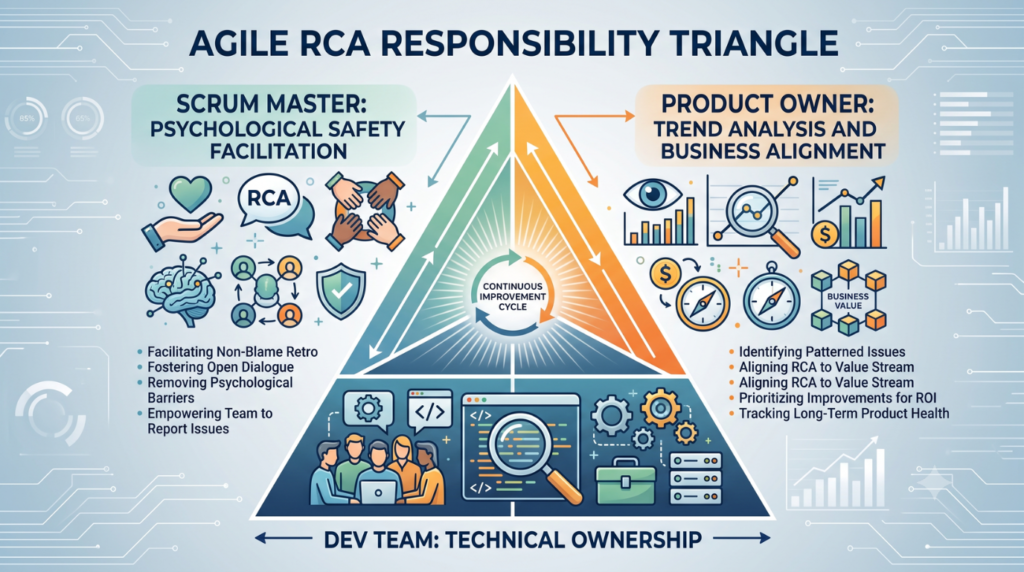
The Engineering Team Owns the Technical Deep Dive
The development team must completely own the execution of the root cause analysis. They are the only ones with the close technical context required to differentiate a superficial symptom from a foundational systemic flaw. When developers own the RCA, the investigation transforms from an external managerial interrogation into an internal engineering diagnostic process.
The engineering team is responsible for digging deep into architectural blind spots, identifying deployment bottlenecks, and parsing system dependencies. They cannot sit back and wait for a project manager to assign blame. Instead, they must proactively run the diagnostic models to uncover the structural reasons behind why an estimation failed or why a feature destabilized the core codebase.
The Scrum Master Guardrails the Psychological Safety
An engineering team cannot conduct an honest root cause analysis if they fear professional retaliation. The Scrum Master serves as the objective facilitator of the RCA process. Their job is to ensure the team adheres to strict analytical frameworks rather than descending into personal finger-pointing.
The Scrum Master manages the structural communication channels, keeping the conversation strictly focused on systemic failures rather than individual human errors. They guide the meeting flow, keep timelines concise, and ensure that every discovered root cause translates directly into an actionable, measurable backlog item for the upcoming sprint.
The Product Owner Evaluates Macro Level Trends
While the development team focuses on the microscopic technical failure, the Product Owner must step back to look at macro-level performance metrics. The Product Owner serves as the internal client and strategic business anchor, which means they are uniquely positioned to challenge long-term behavioral trends.
If a development team repeatedly completes sprints early but delivers unstable features, the Product Owner must aggressively question the underlying patterns. They look for signs of systemic over-estimation, cases where numbers are artificially inflated to beat the system, or instances where requirements are consistently misunderstood. The Product Owner balances the technical investigation with hard business realities, ensuring the team stays aligned with strategic commercial goals.
The Step-by-Step RCA Implementation Framework
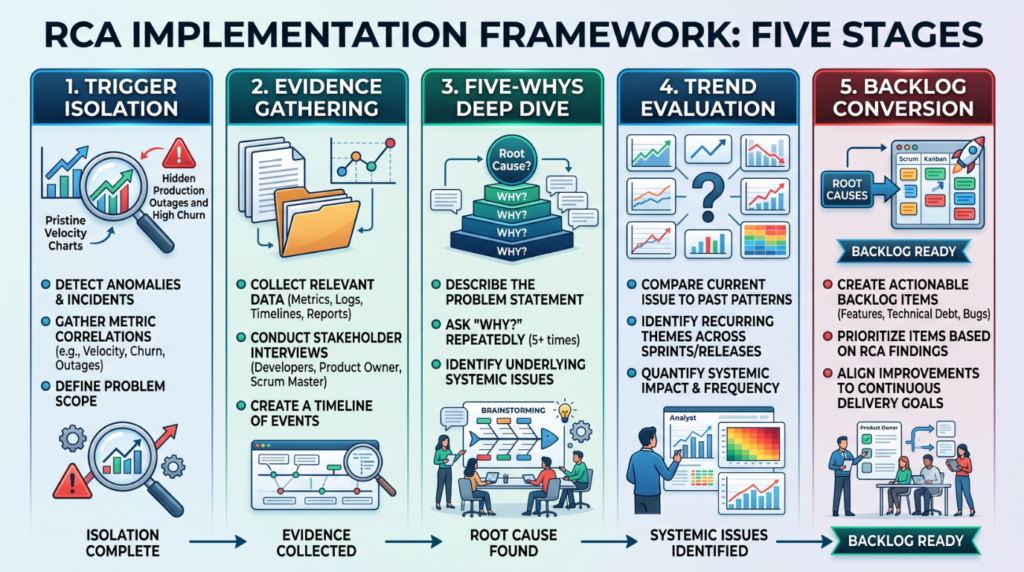
To deploy this methodology successfully without causing team friction, project leaders can immediately utilize the following step-by-step implementation guide during their very next retrospective.
Step 1: Trigger Event Isolation
Not every minor bug requires a multi-hour root cause analysis. The Scrum Master and Product Owner must pre-define explicit operational variance triggers, such as an estimation deviation greater than 20%, a critical severity production escape, or a sprint goal abandonment rate exceeding 15%. When a trigger condition is met, a formal retrospective RCA is automatically scheduled.
Step 2: Systemic Evidence Gathering
Before entering the retrospective room, the development team compiles data logs, deployment timestamps, and architectural schematics. This shifts the conversation entirely from emotional opinions to hard, objective system realities.
Step 3: The Collaborative Five-Whys Exercise
The Scrum Master facilitates a structured iterative interrogation process to separate superficial issues from core systemic vulnerabilities. Let us look at a real-world software deployment failure example:
Why did the release fail? The single sign-on integration crashed under live user authentication requests.
Why did the integration crash? The session cookie tokens conflicted with standalone legacy browser cookie configurations.
Why did the configuration conflict escape notice? The regression testing suite did not include multi-region session validation scenarios.
Why was that validation omitted? The core engineering acceptance criteria focused exclusively on localized standalone login paths.
Why did the criteria focus only on localized paths? The team analyzed user personas in structural isolation without mapping cross-functional global user behavior paths.

By using this rigorous framework, the team uncovers that a major live deployment crash was not caused by a single developer making a coding mistake. It was caused by an incomplete user persona definition phase at the very beginning of the product lifecycle.
Step 4: Trend Evaluation and Alignment
Once the root cause is isolated, the Product Owner evaluates historical data to check if this pattern has occurred across previous sprints. The Product Owner maps this specific failure against broader metrics, ensuring that any resolution directly protects long-term product delivery predictability.
Step 5: High-Impact Backlog Conversion
An RCA without a clear outcome is completely useless. Every isolated root cause must convert directly into a specific engineering item within the upcoming sprint backlog. These corrective items are prioritized, sized via standard agile estimation techniques, and assigned clear verification metrics to ensure the issue is permanently resolved.
3. DESIRE: The Elite Operational Transformation
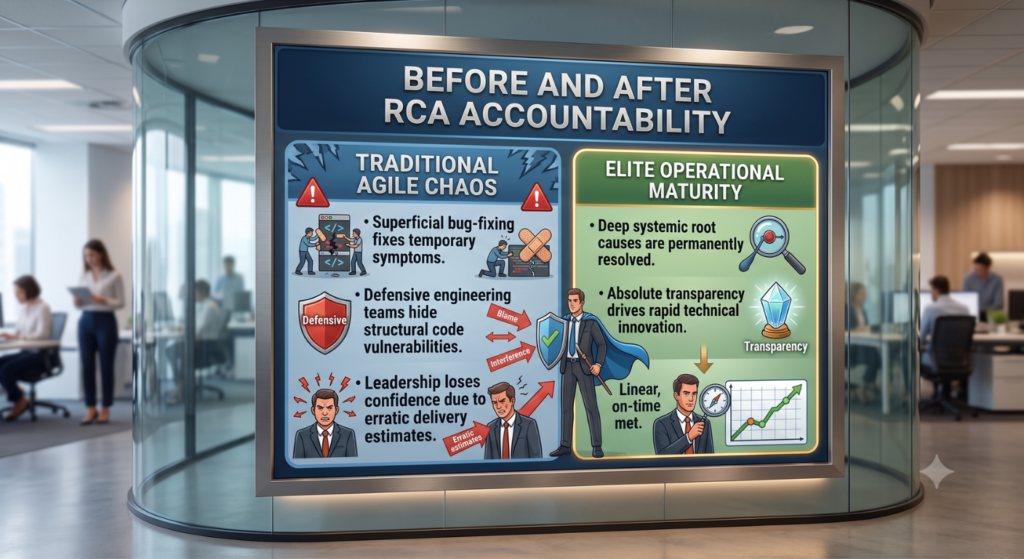
When you restructure your sprint retrospectives around this clear division of RCA accountability, the operational shift within your team is immediate and dramatic. Project chaos, erratic delivery velocity, and defensive finger-pointing disappear completely. They are replaced by an elite engineering operation characterized by pinpoint delivery predictability, robust codebase stability, and a highly motivated development team.
For an ambitious project manager, scrum master, or delivery director, mastering this specific accountability framework is a massive career accelerator. Corporate leadership teams do not promote coordinators who simply run basic administrative ceremonies and read status notes aloud. They reward strategic leaders who can step into a highly complex, chaotic operational environment, accurately diagnose structural process vulnerabilities, and steer the entire organization toward predictable execution.
By clearly separating technical diagnosis ownership from trend analysis, you stop managing projects via reactive crisis intervention. You transition into an elite operational leader who understands how to leverage metrics, optimize human engineering factors, and drive long-term business value.
ACTION: Accelerate Your Leadership Trajectory with Skillsetify
Pragmatic performance tracking is not something you can learn by scanning high-level theoretical textbooks or memorizing rigid exam definitions. It requires deep, real-world analytical strategies that allow you to manage complex human team dynamics, stabilize erratic corporate projects, and achieve elite delivery status.
If you are completely ready to stop guessing your way through operational crises, move up the corporate ladder, and learn modern project management the right way, reach out to Skillsetify today. We do not just teach abstract agile frameworks: we show you your exact career growth trajectory.
Our deeply customized, enterprise-grade training programs equip you with the practical frameworks, metrics models, and communication toolkits required to dominate your industry. Let us help you transform from a tactical manager into an elite B2B project leader. Connect with Skillsetify today, and take absolute command of your professional future.