Why Guarding the Frozen Sprint Backlog Is the Ultimate Test of Elite Project Leadership
It is Wednesday morning of a high-stakes, two-week sprint, and your delivery team is in a state of perfect execution flow. The burndown chart is tracking beautifully toward an on-time release, and developer focus is absolute. Then, a high-priority instant message flashes across your screen from a senior vice president: “We just need this one tiny field added to the registration page. It is a quick win for a critical enterprise client, so let us just slip it into the current iteration.”
Wanting to be cross-functional and accommodating, you agree to the request. You quietly add the user story to the active sprint board.
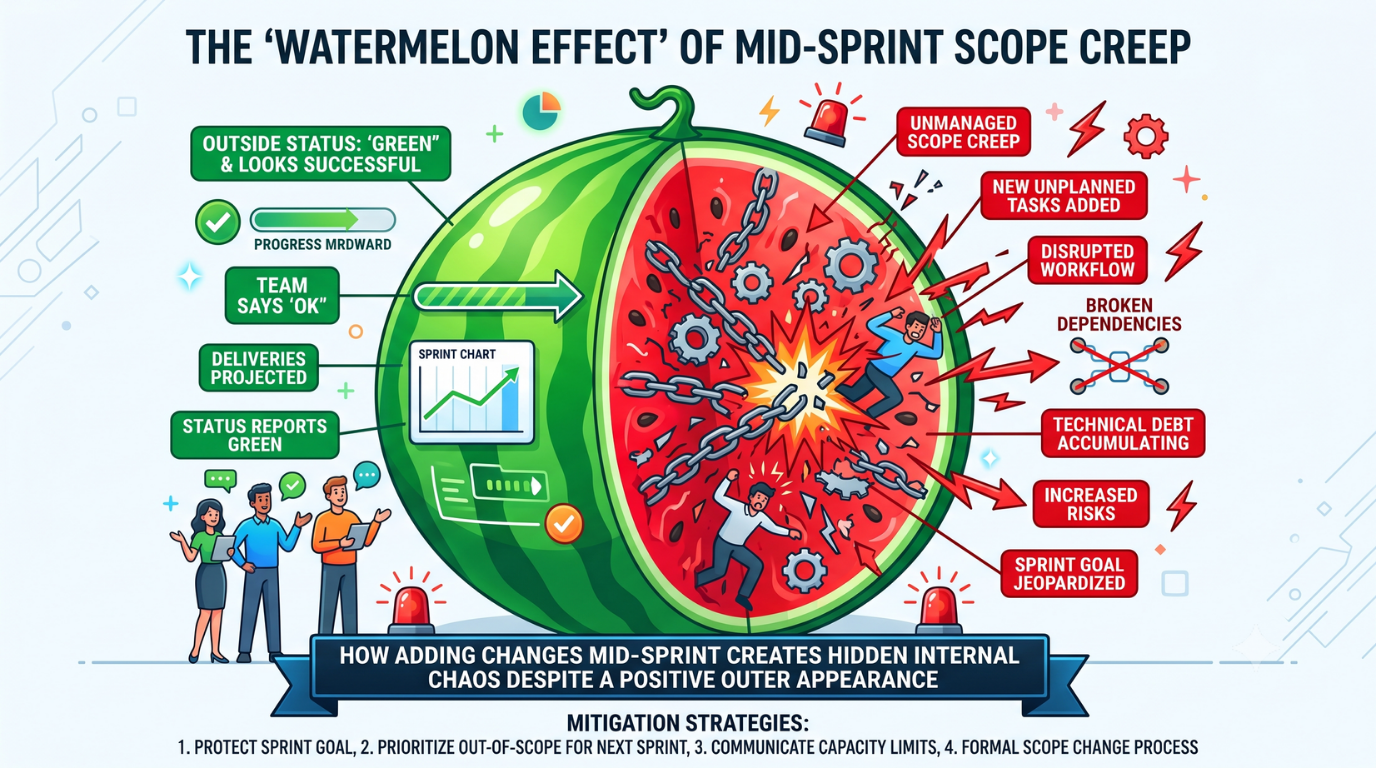
By Friday afternoon, that quick win has introduced a cascading database schema conflict, invalidated the automated testing suites, and completely derailed focus. The sprint ends in a catastrophic failure. Velocity plummets, three core committed features are pushed to the next iteration, and engineering morale is shattered. This is the classic, agonizing reality of unmanaged mid-sprint scope creep.
A pervasive, highly damaging corporate myth asserts that being Agile means operating with absolute, frictionless flexibility at any given second. Many leaders mistakenly believe that project managers should welcome incoming requirements mid-sprint as a sign of customer centricity. This interpretation is entirely wrong. True corporate agility is built on a foundation of intense operational discipline. While the product backlog is inherently dynamic, the committed sprint backlog must be treated as a frozen, protected environment. Safeguarding this boundary is not a bureaucratic choice: it is a prerequisite for predictable, elite delivery performance.
Understanding the Mechanics of Agile Performance Tracking
To effectively defend execution boundaries, a project leader must understand the mathematical physics of agile tracking metrics. Mid-sprint scope management is not merely an exercise in saying no to stakeholders: it is the systematic preservation of team capacity and predictability metrics.
What Is Mid-Sprint Scope Management?
When a scrum team concludes its sprint planning session, a binding agreement is formed. The development team commits to a specific sub-topic of work based on their historical velocity, and the product owner agrees to leave the scope of that sprint untouched. Mid-sprint scope management is the operational practice of enforcing this commitment.
From a strict framework perspective, the committed iteration backlog is frozen. Adding items mid-sprint is an absolute operational failure. If an organization continuously alters its active execution box, the metrics used for performance tracking become completely meaningless.
The Hidden Costs of Context Switching
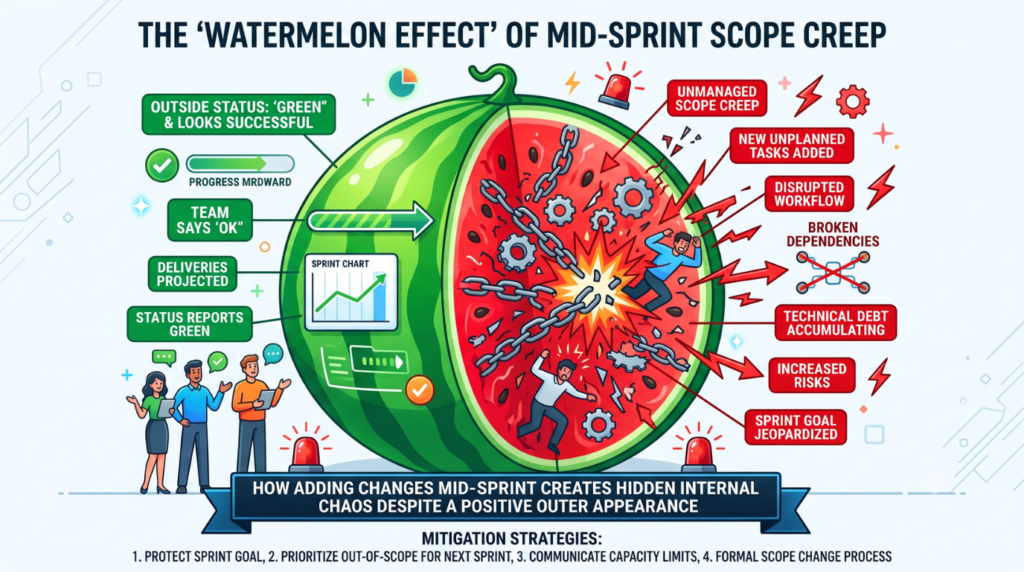
When scope is introduced in the middle of an iteration, the damage extends far beyond the story points assigned to the new task. The hidden operational taxes include:
Cognitive Resettling Costs: Every time a software engineer drops a complex programming task to look at a new requirement, it takes an average of twenty-three minutes to regain deep focus.
Testing Loop Corruptions: Automated regression testing pipelines are calibrated for the sprint commitment. Mid-sprint changes force manual interventions, increasing the probability of production defects.
Estimation Baseline Degradation: Velocity is calculated by tracking completed story points across stable iterations. Injecting unrefined variables destroys the accuracy of future release forecasting.
The Pure Governance Rule: The Structural "No"
For elite project managers, the structural rule is unyielding. If a new request is truly so revolutionary that it renders the current sprint goal entirely obsolete, the solution is not to modify the sprint backlog. The correct action is to formally cancel the sprint entirely.
Canceling the sprint forces the team to reset, run a new sprint planning session, and re-estimate capacity. This structural hurdle creates a natural governance barrier. When executives realize that their quick change requires a formal cancellation of the active iteration, they suddenly find that their urgent request can easily wait for the next sprint planning session.
The Elite Scope Defense Protocol: A Step-by-Step Implementation Framework
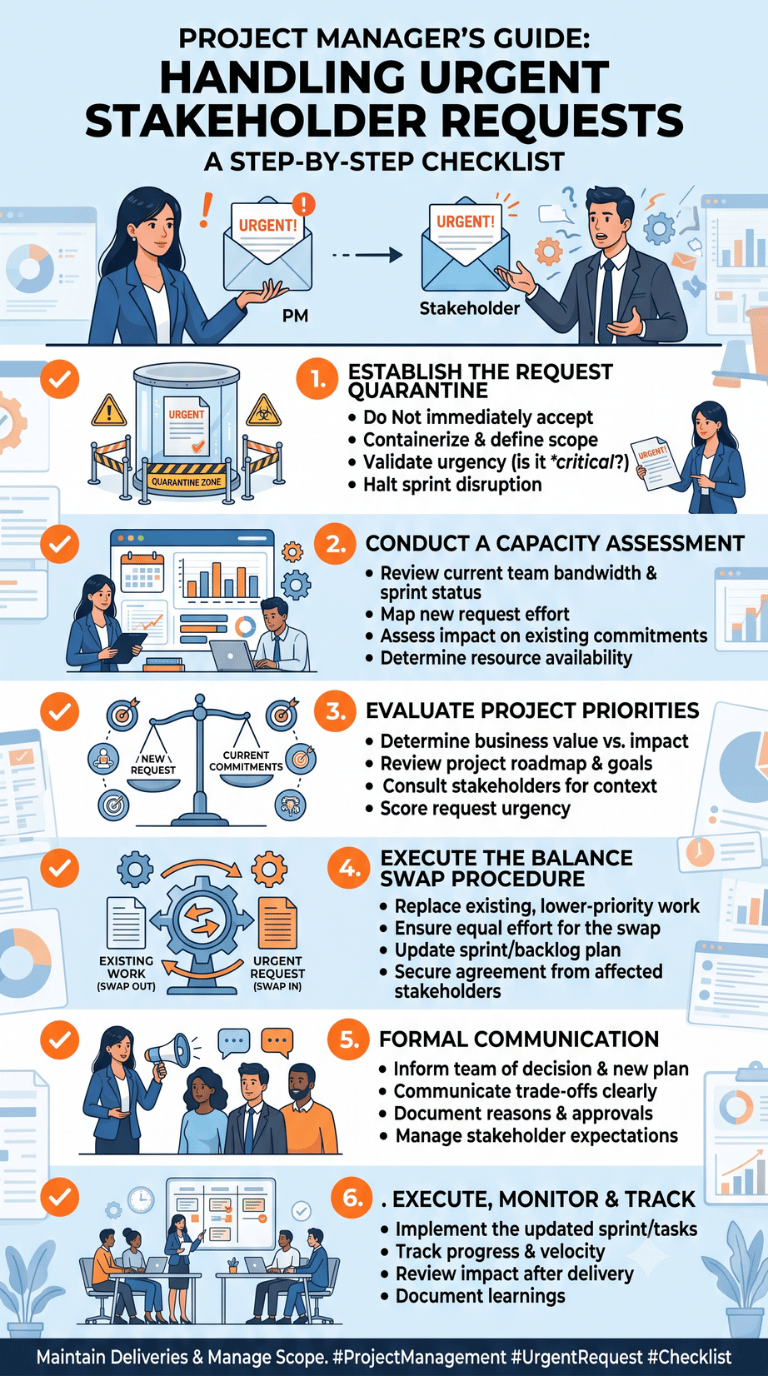
When unexpected requirements knock on the door mid-sprint, an elite project manager does not react with emotional resistance. Instead, they deploy a repeatable, highly structured intake process that transforms an adversarial conversation into a transparent, data-driven business decision.
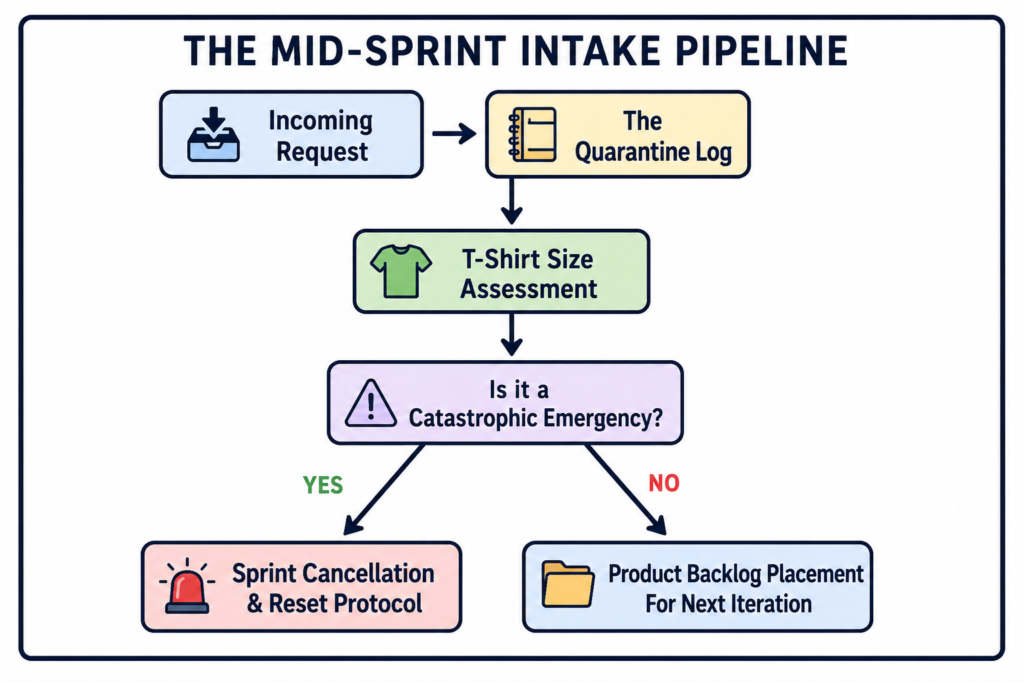
Step 1: Establish the Request Quarantine Log
Never allow stakeholders to bypass governance by speaking directly to individual developers. Implement a strict protocol where all mid-sprint requests must be routed through an automated quarantine log. The moment a request enters this log, it is assigned a timestamp and a clear business impact score. This process immediately filters out casual, unthinking requests from stakeholders who are simply trying to offload passing ideas.
Step 2: Execute a Rapid Capacity Assessment
If a request is flagged as a genuine business emergency, do not alter the active sprint board immediately. Convene a time-boxed, ten-minute session with the technical lead and product owner to run a rapid assessment. Calculate the story point size of the request and map it against the remaining hours in the current sprint.
Step 3: Enforce the Product Backlog Placement Route
If the request is valuable but not an immediate market existential threat, deploy the standard operating procedure. Log the item directly into the product backlog, refine the acceptance criteria, and prioritize it for the very next sprint planning loop. This protects the active iteration while assuring the stakeholder that their item has been captured systematically.
Step 4: The Real-World Swap Exception Procedure
In complex corporate environments, unexpected scenarios occasionally demand absolute operational flexibility. If a catastrophic production defect or a legal compliance mandate forces an item into an active sprint, you must apply the strict balance rule.
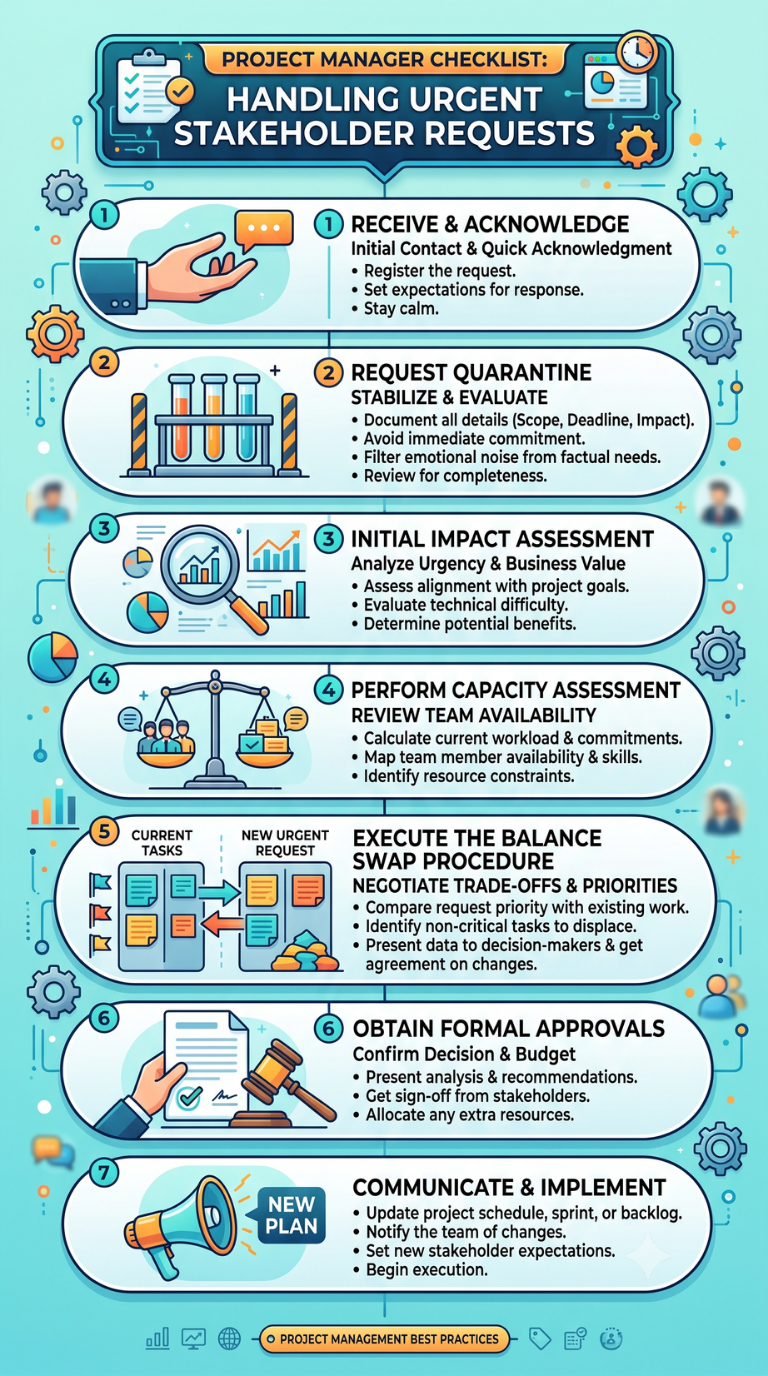
For every story point added to the active board, an equivalent value of story points must be formally evicted from the current sprint and returned to the product backlog. The development team’s total capacity footprint must remain completely neutral. If you add a five-point emergency ticket, you must remove a five-point committed user story. This maintains psychological safety for the team and demonstrates to stakeholders that scope additions carry a direct execution cost.
The Professional Transformation: Shifting from Chaos to Elite Delivery
When you establish clear operational boundaries and eliminate mid-sprint scope disruption, your professional reality undergoes a profound transformation. Project management ceases to be an exhausting cycle of firefighting and missed deadlines, shifting instead into an elite discipline of predictable throughput.
| Metric / Attribute | Unmanaged Scope Environment | Protected Sprint Boundary Environment |
| Team Velocity | Erratically fluctuates, making roadmap planning impossible. | Stabilizes within a narrow, predictable standard deviation. |
| Code Quality | Declines due to rushed, unrefined mid-sprint changes. | High, supported by robust testing and peer review cycles. |
| Stakeholder Trust | Low, caused by continuous missed commitments and delays. | High, built on a track record of reliable, repeatable delivery. |
| Team Burnout | Chronic, leading to engineer turnover and low morale. | Low, sustained by respected capacity commitments. |
Mastering this specific aspect of agile governance shifts your positioning inside the organization. Executives do not accelerate the careers of project managers who try to please everyone by saying yes to every disruptive whim, only to present broken systems and delayed launch dates at the end of the quarter.
They promote the strategic operators who understand how to protect the execution engine. By demonstrating a command over agile performance tracking, you position yourself as a business leader capable of driving complex, multi-million dollar corporate initiatives with absolute predictability.
Mastering the Art of Execution Boundaries
Protecting the iteration boundary is not about rigid inflexibility: it is about maximizing organizational throughput. A dynamic product backlog ensures that your project remains market-responsive, while a frozen sprint backlog guarantees that your team can actually deliver what they promise. True project leadership requires the courage to maintain this operational balance against organizational noise.
If you are ready to stop guessing, move up the corporate ladder, and learn project management the right way, reach out to Skillsetify. We do not just teach frameworks: we show you your exact career growth trajectory