How Legacy Oracle Constraints Vaporize Cloud Budgets (And How Elite PMs Fix It)
Six months ago, the enterprise embarked on what was marketed as a seamless migration from legacy Oracle E-Business Suite (EBS) to Oracle Fusion Cloud ERP. The initial schedule promised a full cutover in nine months with a budget of three million dollars. Today, you must deliver the devastating news: the project timeline has doubled to eighteen months, costs are escalating by forty percent, and the upcoming quarterly cutover is officially cancelled.
What caused this catastrophic shift? Was it poor developer coding? Was it a lazy project team? Not at all. The culprit is a pair of silent enterprise killers that derail over seventy percent of legacy-to-cloud migrations: custom workflow mismatches and unforeseen licensing hurdles.
Dispelling the Great Corporate Migration Myth
In boardroom meetings across Fortune 500 companies, consulting vendors repeat a dangerous corporate myth: Moving from on-premise ERP to SaaS cloud is a straightforward technical migration where legacy processes smoothly map into modern cloud modules.
This myth has destroyed countless executive careers.
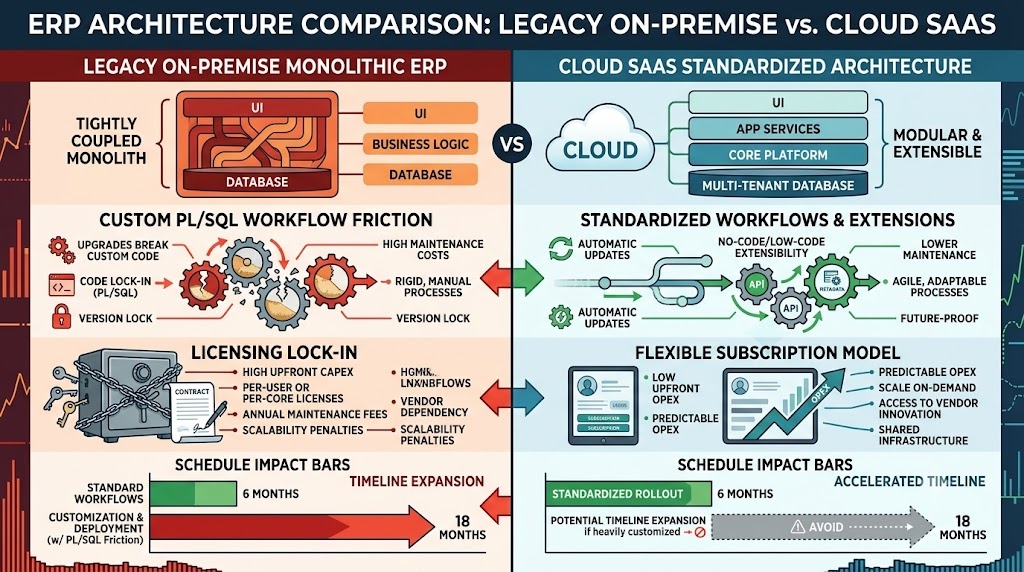
Legacy enterprise systems like Oracle EBS were built over two decades on monolithic database architectures. Organizations spent millions customizing PL/SQL scripts, database triggers, and intricate approval chains to match hyper-specific, legacy business quirks. Cloud SaaS platforms, by contrast, are standardized engines designed around modern industry best practices. They do not allow direct database modifications or arbitrary code injection.
When you attempt a direct technical migration without addressing underlying architectural constraints, your project collides with reality. Your custom approval workflows fail to map to cloud SaaS standards, legacy integration points break, and vendor licensing models trigger massive compliance penalties.
The Deep-Dive: Decoding Enterprise Constraints in Legacy-to-Cloud Systems
To successfully navigate an enterprise migration, a Senior Project Manager must master the core technical and operational mechanics that govern large-scale software transformations. When migrating from on-premise Oracle EBS to Oracle Fusion Cloud, two main drivers create schedule variance and budget expansion.
1. Custom Workflow Mismatches (The Customization Trap)
For twenty years, on-premise enterprise applications allowed IT departments to write custom database code directly inside the application layer. Over time, business logic became deeply embedded in custom PL/SQL packages, custom database tables, and non-standard approval trees.
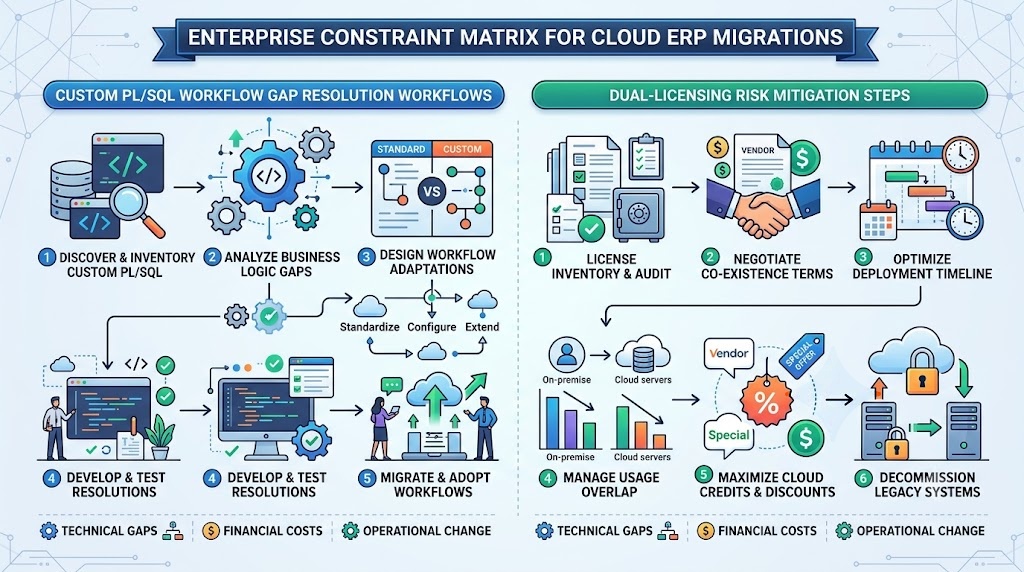
When transitioning to Oracle Cloud ERP, enterprise teams discover that Cloud SaaS operates on a multi-tenant, standardized architecture. You cannot simply upload custom PL/SQL code into a SaaS environment. Instead, every custom workflow must be evaluated through a rigid decision path:
Adopt Native SaaS Standards: Force the business to alter its operating process to fit standard cloud workflows.
Build Low-Code Cloud Extensions: Re-architect the customization using cloud integration tools, such as Oracle Integration Cloud (OIC) or PaaS extension frameworks.
Decommission the Process: Eliminate outdated legacy workflows that no longer deliver business value.
When project managers fail to audit these custom workflows during initial scoping, the project encounters massive technical debt during sprint execution, doubling development hours and stalling user acceptance testing.
2. Licensing Hurdles and Commercial Governance
The second major constraint during legacy-to-cloud shifts is commercial friction. Legacy systems are historically licensed on perpetual, core-processor, or named-user metrics hosted on local hardware. Cloud ERP, conversely, operates on annual subscription models based on active user tiers or transactional volume.
During migration, organizations encounter severe commercial risks:
Dual-Licensing Overhead: Paying for ongoing legacy on-premise maintenance support while simultaneously paying multi-year SaaS subscription seats before go-live.
Third-Party Integration Adapters: Unanticipated middleware licensing costs needed to connect legacy on-premise edge systems to new cloud APIs.
Compliance Audit Penalties: Unexpected license compliance discrepancies discovered during data extraction from legacy databases.
Methodological Mastery: Progressive Elaboration vs. Rolling Wave Planning
When managing complex enterprise constraints, traditional “Big Bang” planning fails. Elite project managers deploy two complementary methodologies to maintain control: Progressive Elaboration and Rolling Wave Planning.
Many project practitioners incorrectly treat these two concepts as identical. They are fundamentally distinct tools that work together within enterprise governance:
Progressive Elaboration: The umbrella philosophy of continuously refining project requirements, scope, and technical specs as clearer data becomes available throughout the lifecycle. It acknowledges that you cannot know every hidden custom PL/SQL logic on Day 1.
Rolling Wave Planning: An operational scheduling technique where near-term work (e.g., the immediate 2 to 4 sprints) is planned in exhaustive, task-level detail, while long-term phases (e.g., cutover or final data reconciliation) remain at high-level milestone buckets.
As you execute near-term sprints, new technical constraints emerge through Progressive Elaboration, which immediately informs the detailed breakdown of the subsequent wave in Rolling Wave Planning. Combining both methodologies ensures your architecture team adapts to unexpected workflow gaps while maintaining a firm baseline schedule.
Key Takeaway: Cloud ERP migrations are not mere infrastructure updates. They are enterprise transformation initiatives bounded by strict architectural, workflow, and commercial constraints.
The Step-by-Step Enterprise Migration Framework: Part 1
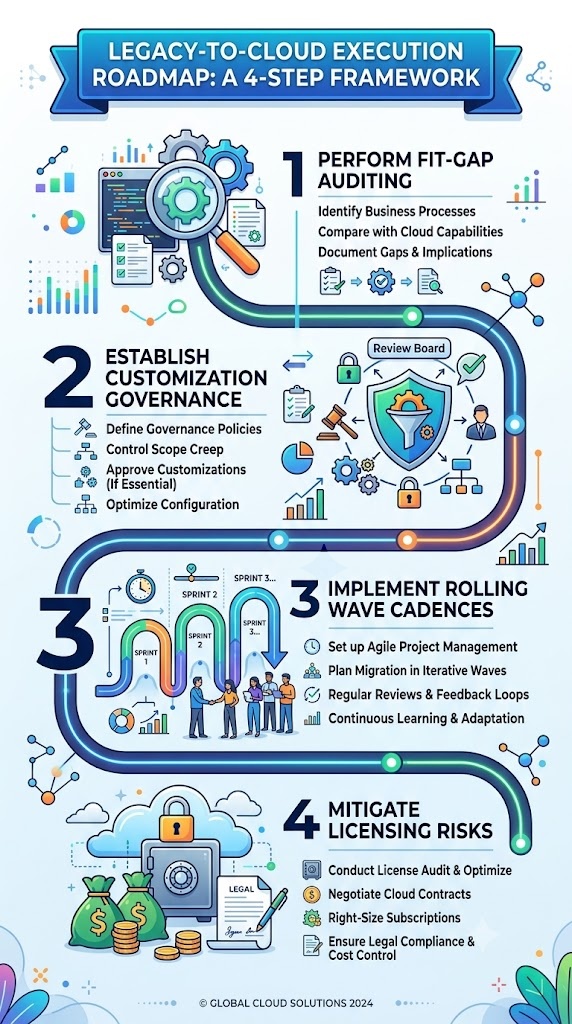
If you are tasked with leading an enterprise system migration, do not rely on generic project templates. Use this structured four-step execution framework to systematically identify constraints, manage workflow gaps, and protect your schedule
Step 1: Conduct a Comprehensive Fit-Gap and Customization Audit
Before finalizing project schedules, conduct an exhaustive inventory of all legacy workflows and code bases. Extract all custom PL/SQL packages, custom forms, reports, and third-party interface scripts from the legacy environment. Map each custom asset against standard out-of-the-box Cloud ERP capabilities and classify every gap using the RICEFW standard (Reports, Interfaces, Conversions, Extensions, Forms, Workflows).
Step 2: Implement a Strict Customization Governance Board
To prevent scope creep, establish a Change Control Board (CCB) dedicated exclusively to workflow customizations. Enforce a mandatory business case rule: No custom extension will be built in the cloud unless it delivers a measurable competitive advantage or regulatory requirement. Force business unit leaders to justify why their teams cannot adopt the standardized Cloud SaaS workflow, and require explicit sign-off from Enterprise Architects and Financial Controllers before approving any custom development effort.
The Step-by-Step Enterprise Migration Framework: Part 2
Step 3: Structure Sprints with Rolling Wave Cadences
Align your project delivery schedule around iterative discovery cycles rather than rigid, multi-year Gantt charts. Detail the exact technical tasks, data mapping scripts, and unit tests for the current phase (Wave 1). Maintain high-level scope definitions and budgetary estimates for downstream phases (Waves 2 and 3). Conduct bi-weekly Progressive Elaboration reviews to convert newly discovered workflow requirements into detailed user stories for the upcoming wave.
Step 4: Build a Commercial and Licensing Risk Matrix
Mitigate financial surprises by mapping all licensing liabilities early in the project charter stage. Audit all legacy processor licenses against current usage to prevent true-up penalties during data extraction. Negotiate dual-use licensing terms or credits with cloud vendors to offset legacy maintenance costs during the transition period. Reserve an explicit fifteen to twenty percent schedule and budget contingency buffer specifically earmarked for complex middleware adapter licensing.
The Professional Transformation: From Project Chaos to Strategic Leadership
Imagine stepping into your next steering committee meeting with absolute confidence. Instead of presenting unexpected delays and cost overruns, you present a predictable, controlled transformation strategy.
When you apply structured constraint management, Progressive Elaboration, and rigorous workflow governance, the chaos of legacy enterprise projects disappears:
Scope Creep is Neutralized: Unplanned customizations are filtered out by your governance board before they touch the development backlog.
Schedules Become Predictable: Rolling Wave Planning ensures your engineering team focuses on validated, well-defined technical tasks rather than shifting targets.
Executive Trust Escalates: Senior leadership views you not as an administrative note-taker who reports bad news, but as a strategic leader who protects corporate capital and navigates complex technical risks.
Accelerating Your PM Career the Right Way
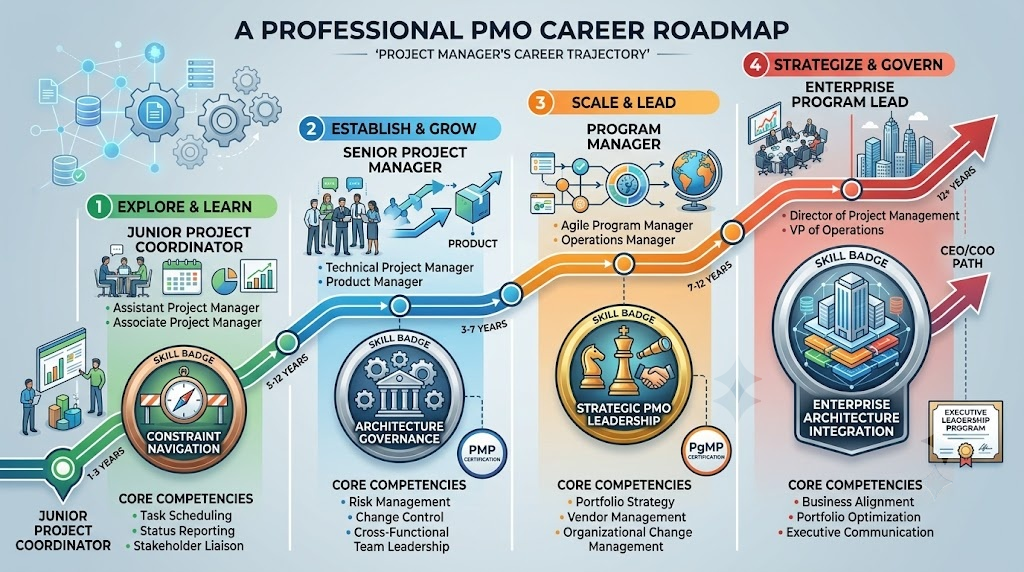
Mastering standard project concepts like baseline updates or simple task tracking is fine for entry-level roles. However, climbing to Senior Project Manager, Program Director, or VP of PMO requires a fundamentally higher skill set.
Top enterprise organizations do not pay premium compensation for managers who simply track deadlines. They hire elite leaders who understand enterprise environmental constraints, technical architecture trade-offs, and commercial risk governance. When you learn to manage high-stakes enterprise projects using proven, real-world frameworks, your career trajectory shifts dramatically. You transition from fire-fighting daily crises to orchestrating seamless, high-impact business transformations.
Master Enterprise Project Delivery with Skillsetify
Legacy-to-cloud enterprise migrations are among the most complex challenges in modern corporate IT. As legacy platforms approach end-of-support deadlines, organizations are desperately seeking project management professionals who know how to navigate custom workflow mismatches, licensing hurdles, and complex architectural constraints without doubling schedules.
By mastering Progressive Elaboration, Rolling Wave Planning, and robust constraint governance, you position yourself as an indispensable strategic asset in today’s competitive B2B marketplace.
If you are ready to stop guessing, move up the corporate ladder, and learn project management the right way, reach out to Skillsetify. We do not just teach frameworks: we show you your exact career growth trajectory.