Unlocking Enterprise Agility Through Progressive Elaboration and Rolling Wave Planning
An enterprise cloud transformation team sits in a glass-walled boardroom, paralyzed. Three months into a multi-million-dollar core infrastructure migration, the original 800-line Gantt chart is entirely obsolete. An unexpected vendor licensing constraint emerged in month two, forcing an architectural shift to cloud-native microservices. Yet, project managers are spending up to 20 hours a week frantically re-baselining micro-tasks scheduled for eleven months down the line. Budget variance reports are flashing red, the engineering team is demoralized by fictitious deadlines, and executive leadership demands to know why the team cannot simply stick to the original baseline.
This nightmare scenario repeats daily across enterprise organizations. It stems from a deeply ingrained corporate myth: the belief that detailed upfront planning equals project control. When executives confuse predictability with rigidity, project teams fall into the trap of false certainty. Even worse, many leaders conflate two critical project management concepts meant to solve this exact crisis, assuming that Progressive Elaboration and Rolling Wave Planning are identical synonyms.
They are not. Mistaking an overarching philosophy for a tactical tool leads directly to delivery failure.
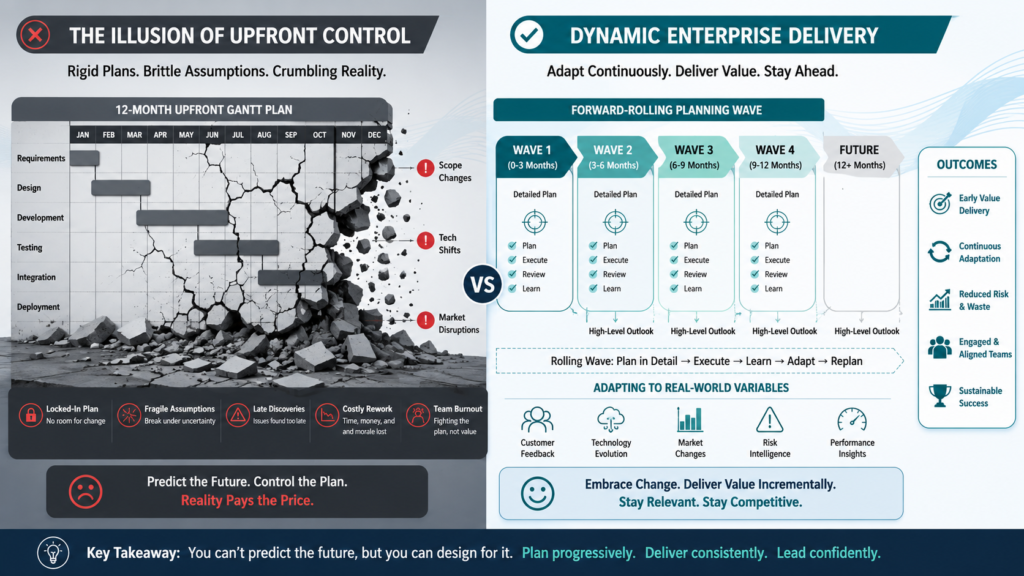
The Architecture of Dynamic Delivery: Core Concepts Unpacked
To lead complex B2B initiatives effectively, senior project managers must master the structural distinction between strategic philosophy and tactical execution.
Progressive Elaboration: The Overarching Strategic Philosophy
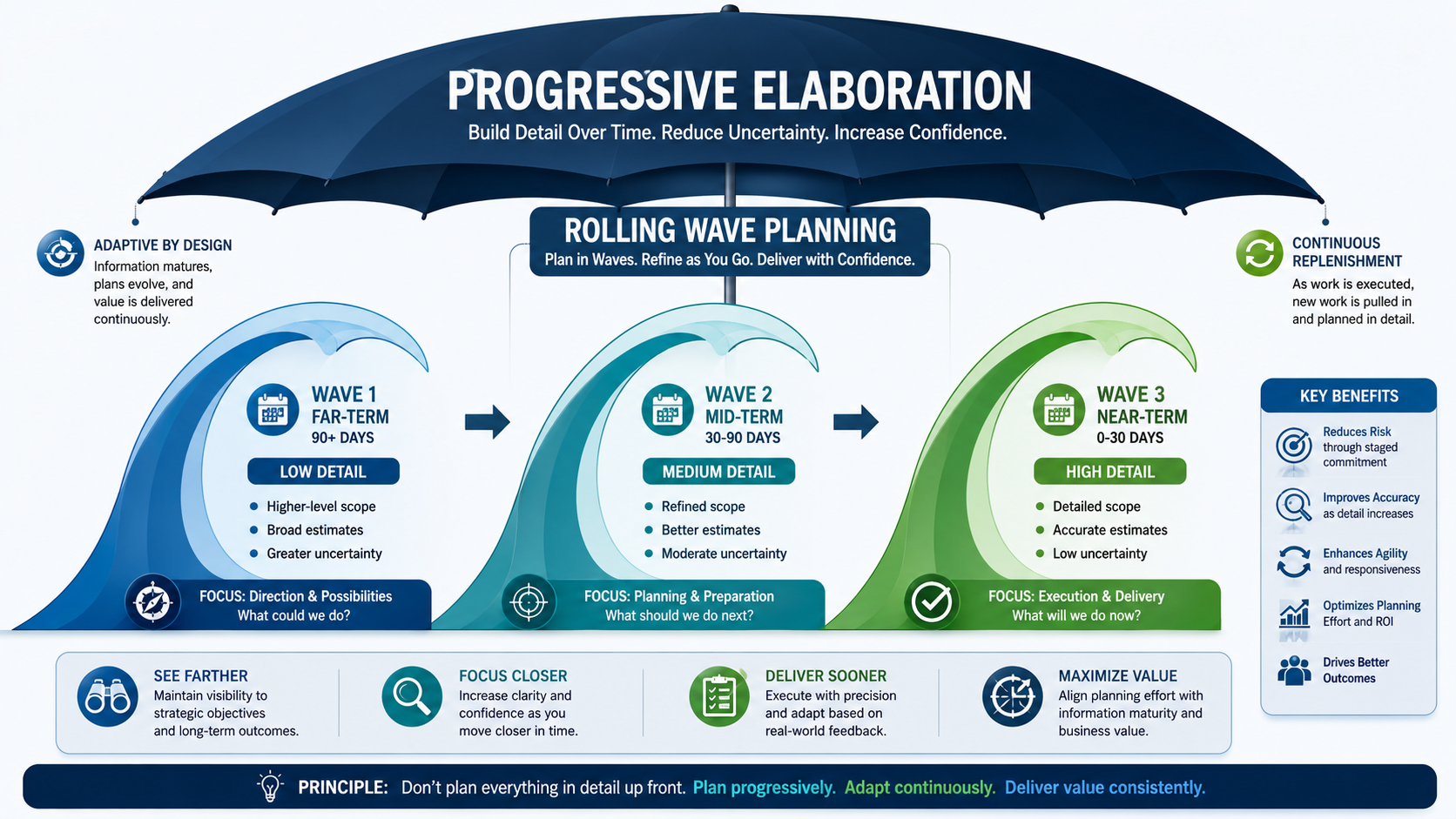
Progressive Elaboration is the broader umbrella concept under which dynamic project management operates. It is the continuous process of increasing the level of detail in a project management plan as greater amounts of information and more specific estimates become available.
In any large-scale enterprise initiative, uncertainty is at its absolute highest on Day 1. Requirements are high-level, technical dependencies are partially hidden, and market conditions remain fluid. Progressive Elaboration accepts this reality as a fundamental truth. It acknowledges that project scope, deliverables, technical specifications, and risk profiles naturally evolve as execution yields hard data.
Crucially, Progressive Elaboration does not mean shifting goalposts or tolerating scope creep. The overarching strategic destination and core business objectives remain firm. What evolves is the clarity of the path required to reach that destination. For example, in an enterprise ERP rollout across global subsidiaries, the final objective (unifying financial reporting on cloud infrastructure) remains fixed. However, the precise sequence of database schema conversions and custom workflow adaptations for subsidiary entities is progressively elaborated as initial pilot rollouts deliver real-world telemetry.
Rolling Wave Planning: The Tactical Execution Engine
If Progressive Elaboration is the broader strategic umbrella, Rolling Wave Planning is the active tactical mechanism that makes it operational.
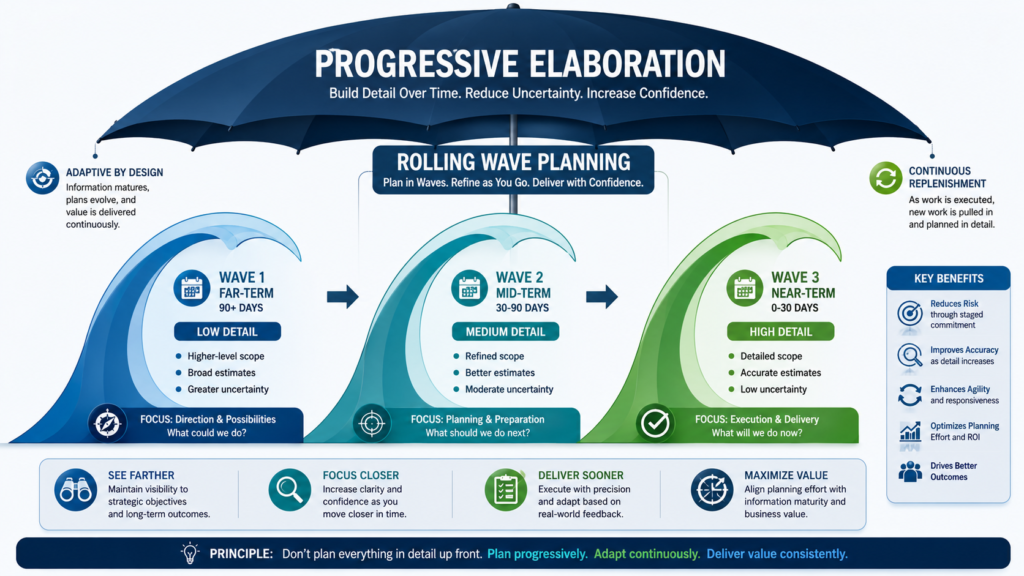
Rolling Wave Planning is an iterative planning technique where work to be accomplished in the near term is planned in detail, while work far in the future is planned at a high level. It applies a temporal lens to Work Breakdown Structures (WBS) and scheduling baselines.
Instead of burning hundreds of hours creating granular, low-level task estimates for work happening a year from now, project managers focus their analytical energy where certainty is highest:
Near-Term Horizon (0 to 30 Days): Planned at maximum granularity with daily or weekly task breakdowns, concrete resource allocations, and explicit acceptance criteria.
Mid-Term Horizon (30 to 90 Days): Planned at the work package level with moderate detail, including defined dependencies, required skill sets, and estimated milestones.
Far-Term Horizon (90+ Days): Maintained at the high-level release or epic milestone level, focusing on strategic outcomes, broad cost estimates, and macro risk factors.
The Interlinked Mechanics: Why Rolling Wave Facilitates Progressive Elaboration
Progressive Elaboration without Rolling Wave Planning leads to chaotic, unanchored changes. Teams refine plans sporadically, creating scope drift, budget erosion, and stakeholder confusion. Conversely, attempting Rolling Wave Planning without embracing Progressive Elaboration creates operational resistance: teams try to roll waves forward while refusing to adjust downstream scope based on new insights.
Rolling Wave Planning acts as the structured cadence for Progressive Elaboration. As the project timeline advances, the wave rolls forward. High-level items previously sitting in the 60-to-90-day horizon roll into the active 0-to-30-day window. Precisely at this transition point, the team applies Progressive Elaboration, using fresh data from completed work packages to elaborate those upcoming high-level epics into fine-grained tasks.
The Step-by-Step Enterprise Implementation Framework
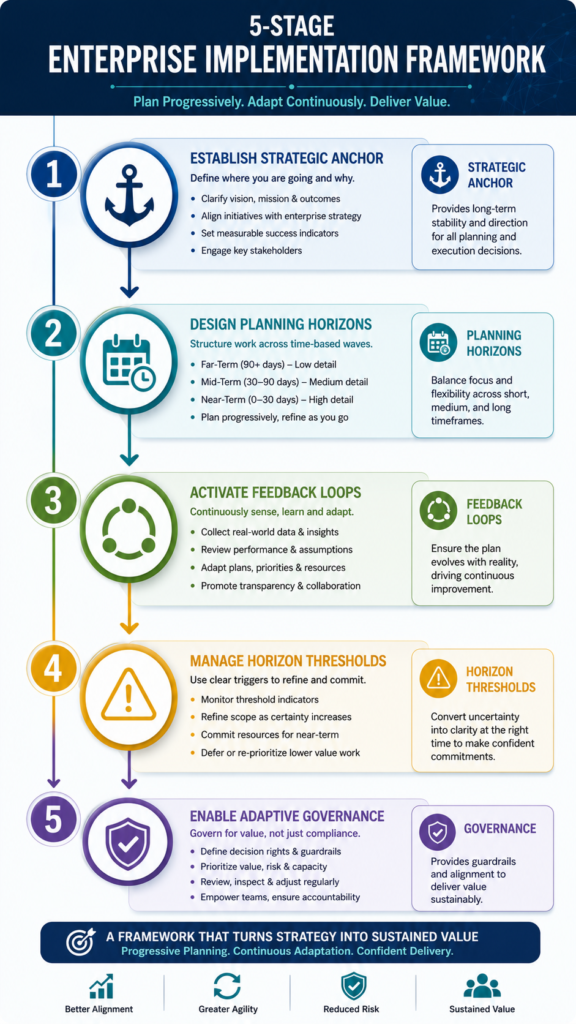
Implementing this interlinked relationship in enterprise environments requires a disciplined operational framework. Project leaders can immediately deploy this five-stage model to achieve structural agility.
Stage 1: Establish the Fixed Strategic Anchor
Define the non-negotiable project boundaries, business outcomes, and key financial parameters upfront.
Draft a comprehensive Project Charter establishing core business goals, target budget caps, and ultimate target release dates.
Create a high-level Work Breakdown Structure (WBS) that captures the total project scope without getting bogged down in low-level activity lists.
Stage 2: Segment the Planning Horizons
Divide the project lifecycle into clear, time-bound planning zones across the organization.
Define the Operational Wave (Next 2 to 4 Weeks): Mandate full task-level decomposition, strict effort estimation, and explicit definition-of-done standards.
Define the Tactical Horizon (Next 1 to 3 Months): Group work into defined feature sets or epics with high-level technical architecture spikes.
Define the Strategic Horizon (4+ Months Out): Maintain macro milestones tied directly to core business value increments.
Stage 3: Build Continuous Information Feedback Loops
L
Engineers, architects, and business analysts must feed real-time execution telemetry back into the planning system.
Schedule formal Wave Refinement Sessions at the end of every operational cycle.
Analyze variance between near-term estimates and actual delivery performance to refine estimation formulas for upcoming waves.
Capture newly uncovered technical constraints, licensing hurdles, or organizational dependencies.
Stage 4: Trigger Progressive Elaboration at the Horizon Threshold
When a milestone enters the upcoming 30-day operational window, execute the elaboration process.
Decompose high-level work packages into actionable user stories or concrete engineering tasks.
Incorporate lessons learned from previous cycles to adjust the execution path without compromising the baseline scope.
Re-estimate resource commitments using actual historical velocity rather than theoretical capacity.
Stage 5: Formalize Governance and Baseline Adjustments
Progressive elaboration is not an excuse for ungoverned changes.
Distinguish clearly between elaboration (refining detail within approved scope boundaries) and scope change (adding new baseline capabilities).
Utilize a streamlined Change Control Process for adjustments that impact macro milestones or financial baselines, while granting team autonomy over task-level refinements within the active wave.
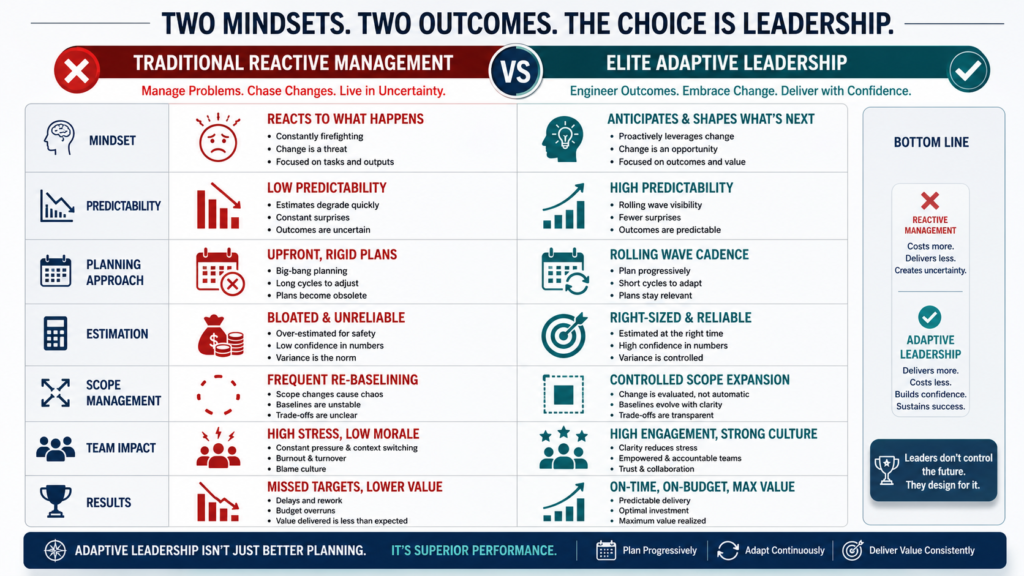
The Professional Transformation: From Project Chaos to Elite Delivery
When project leaders transition from rigid upfront planning to the interlinked power of Progressive Elaboration and Rolling Wave Planning, the operational shift is immediate and profound.
Imagine stepping out of the vicious cycle of endless status meetings, fictitious 12-month task schedules, and constant team burnout. Instead of defending an obsolete baseline created when certainty was at its lowest, you command a responsive, highly disciplined delivery engine.
In this optimized operating environment:
Resource Efficiency Soars: Teams eliminate hundreds of wasted hours spent estimating distant, ill-defined tasks that inevitably change.
Predictability Replaces Guesswork: Near-term commitments are hit with high accuracy because they are planned using real-time historical data.
Stakeholder Trust Hardens: Executive leaders receive realistic, data-backed updates rather than artificial assurances, building lasting executive confidence.
Scope Creep is Neutralized: Clear governance separates healthy technical elaboration from unbudgeted feature creep.
Mastering these concepts transforms your professional standing within the enterprise. Executives do not promote project managers who simply follow rigid checklists and report green status indicators on failing initiatives. They promote strategic delivery leaders who navigate uncertainty, manage complex stakeholder dynamics, and consistently land multi-million-dollar programs on target.
Learning project management the right way elevates you from an administrative coordinator to a high-impact enterprise strategist. It shifts your trajectory from managing schedules to driving enterprise value creation.
Navigating the complex realities of enterprise delivery requires more than reading theoretical frameworks: it demands practical, real-world mastery. Combining the overarching philosophy of Progressive Elaboration with the structured mechanics of Rolling Wave Planning gives modern organizations the exact balance of strategic stability and tactical flexibility needed to thrive in unpredictable markets. If you are ready to stop guessing, move up the corporate ladder, and learn project management the right way, reach out to Skillsetify. We do not just teach frameworks: we show you your exact career growth trajectory.