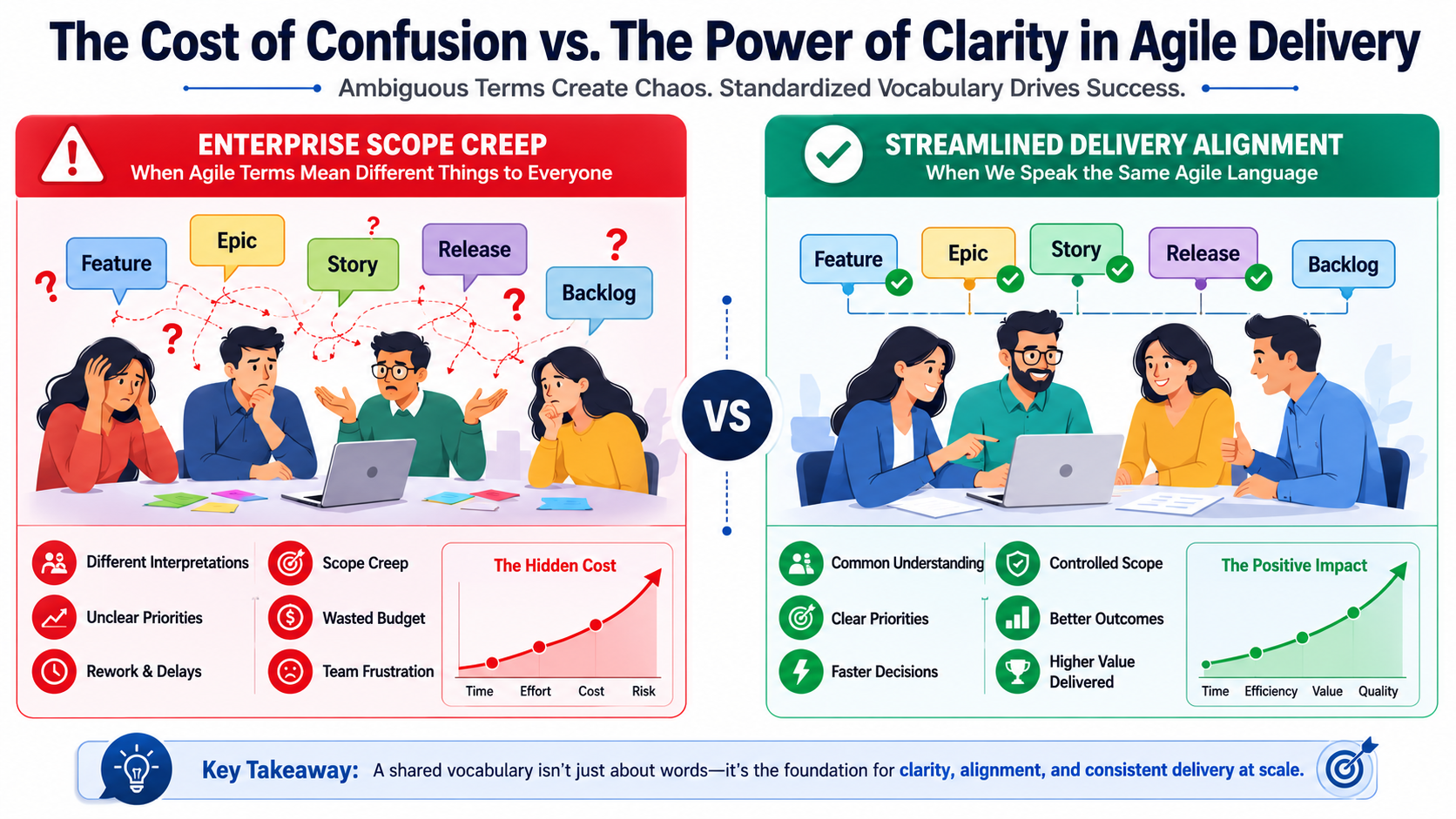
Picture this scenario. You are standing in a crowded boardroom during a high-stakes mid-quarter review meeting. The Vice President of Product looks up from a dashboard and asks a straightforward question:
“Why hasn’t the new customer onboarding module shipped to production yet?”
Your lead project coordinator steps up and answers with confidence: “Because our Sprint ends next Tuesday.”
The VP frowns. “Wait, your update last week said the team completed its two-week Iteration on Friday. Why isn’t the working software live?”
Silences like that cost enterprises millions. In that single exchange, a fundamental misunderstanding of project management terminology derailed executive alignment, eroded stakeholder trust, and exposed a gaping hole in the organization’s execution strategy.
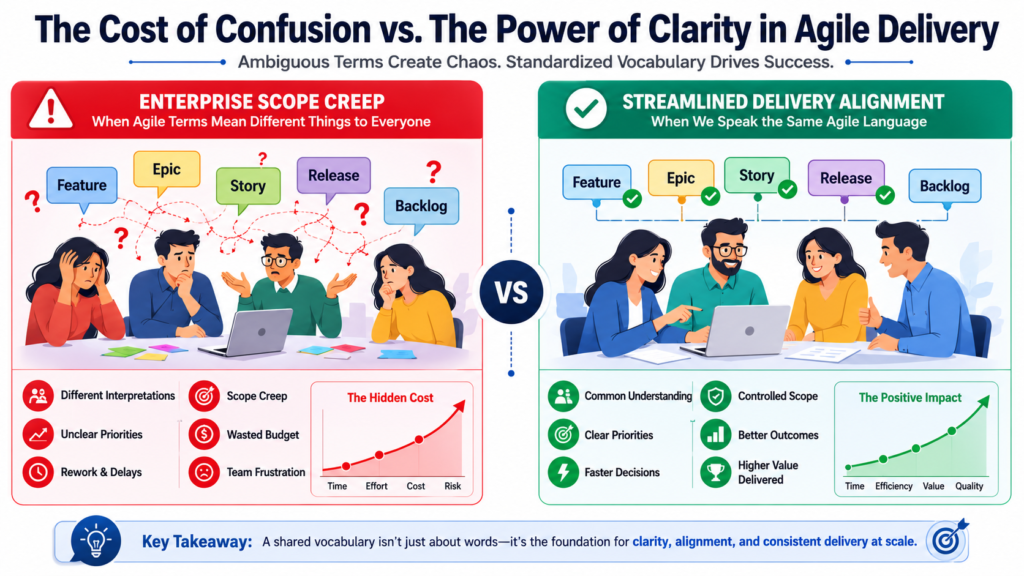
The myth holding back thousands of delivery organizations today is simple: the belief that “Sprint” and “Iteration” are identical, interchangeable terms, and that Agile is just a corporate synonym for Scrum.
When project managers treat these precise technical terms as casual corporate jargon, operational discipline degrades rapidly. Scope creep sneaks into commitments, release schedules collapse, and engineering teams suffer from perpetual burnout caused by constantly moving target lines.
Sprints vs. Iterations
To master modern delivery management, you must start by establishing absolute precision in your team’s lexicon. Words define operational boundaries. When terms are conflated, processes fracture.
"Sprint": The Scrum-Exclusive Timebox
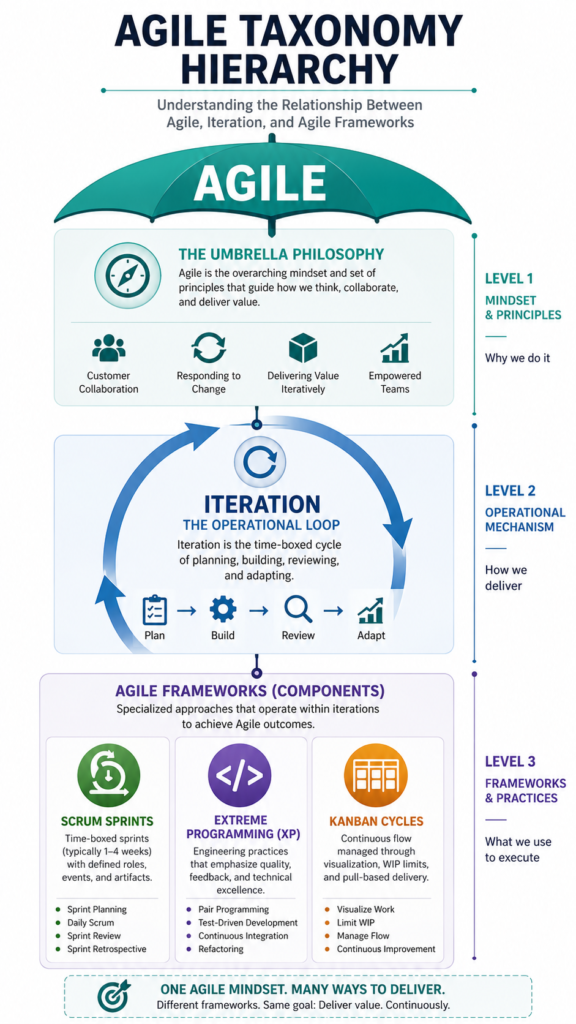
A Sprint is not a generic term for working fast or rushing a release. It is a specific, highly structured time-boxed event native exclusively to the Scrum framework.
Fixed Duration: Sprints run for a consistent duration, typically one to four weeks. Once established, the length remains constant throughout the product development lifecycle to build a predictable operational rhythm.
Prescribed Governance: A Sprint operates under strict structural rules defined by Scrum. It begins with Sprint Planning, relies on Daily Scrums, ends with a Sprint Review and Sprint Retrospective, and requires specific roles including the Product Owner, Scrum Master, and Developers.
Protected Scope: During a Sprint, no changes are made that would endanger the locked-in Sprint Goal. Scope is renegotiated only between the Product Owner and the team if unexpected technical complexity arises.
"Iteration": The Broad Agile Umbrella
An Iteration, by contrast, is the overarching, methodology-neutral term across the broader Agile landscape.
Framework Neutrality: Whether you operate under Extreme Programming (XP), Scaled Agile Framework (SAFe), Feature-Driven Development (FDD), or a custom hybrid Agile model, any repeating, time-boxed work cycle is an iteration.
Conceptual Breadth: All Sprints are iterations, but not all iterations are Sprints. An iteration in an XP environment might emphasize pair programming and continuous integration without adhering to Scrum-specific events or roles.
Adaptive Refinement: The broader concept of an iteration focuses on repeating a development cycle to gather feedback, refine output, and continuously adjust direction based on real-world inputs.
The Strategic Mechanics: Iterative vs. Incremental Delivery
Understanding the difference between timeboxing terms is only half the battle. To drive predictable value, an elite Project Manager must master the distinct mechanics of Iterative Delivery and Incremental Delivery.
Iterative Delivery: Refinement for High Quality
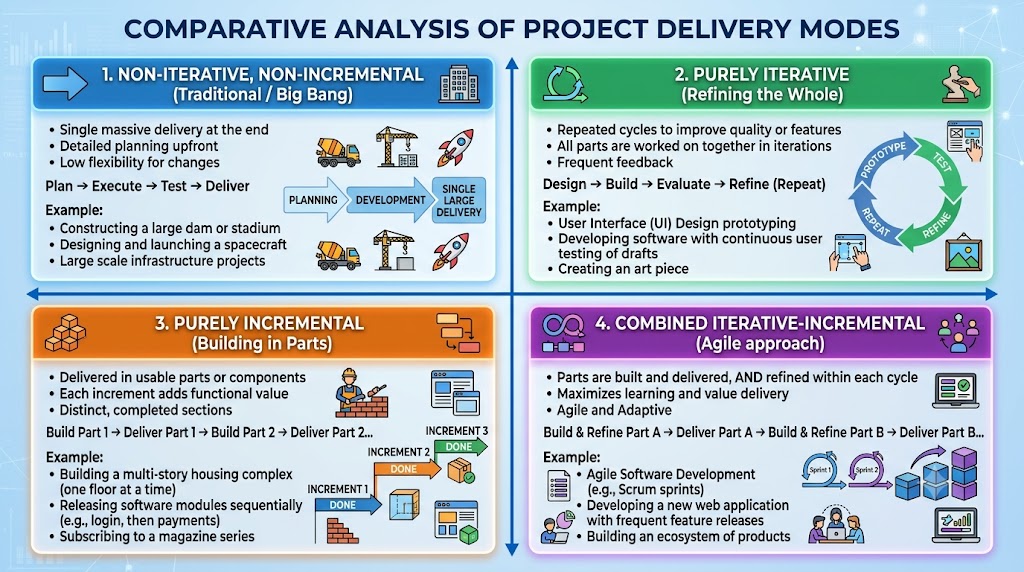
Iterative delivery is about polish and evolutionary refinement. You build a crude version of the entire concept, analyze feedback, and progressively refine the output across successive cycles until it reaches high quality.
Primary Goal: Quality improvement, risk reduction, and validation of user experience.
Operational Dynamic: You move in progressive cycles. You plan, execute, evaluate, and redo until the desired standard of perfection is achieved.
Real-World Example: Imagine creating a complex architectural blueprint. You start with a rough draft wireframe, gather feedback from structural engineers, refine the draft with mechanical details, and polish the final blueprint across three feedback loops.
Incremental Delivery: Additive Slices of Functionality
Incremental delivery is about building completed, usable slices of a product brick-by-brick. Rather than refining a broad concept all at once, you deliver fully functional portions of the final solution in sequence.
Primary Goal: Early realization of value, speed to market, and immediate operational utility.
Operational Dynamic: Each increment adds a concrete, fully tested piece of working software or capability onto the pre-existing foundation.
Real-World Example: Building an enterprise e-commerce platform by releasing the product search module in month one, adding the payment gateway in month two, and launching the customer analytics engine in month three. Each release is functional and stands on its own.
Combining Iterative and Incremental for Elite PM Execution
Elite project delivery rarely relies on purely iterative or purely incremental approaches alone. High-performing teams blend both. They deliver small, fully functional increments of product value (Incremental), while continuously refining those increments through structured feedback loops (Iterative).
The 5-Step Enterprise Standardization Framework
If your organization suffers from semantic confusion and unpredictable release cycles, apply this practical, five-step framework to standardize terminology and align execution.
Step 1: Audit and Baseline Team Vocabulary
Conduct a comprehensive review of your organization’s delivery documentation, Jira/Azure DevOps board structures, and status reporting templates. Identify where terms like “Sprint,” “Iteration,” “Cycle,” and “Release” are being mixed up. Establish a single, authoritative organizational glossary
Step 2: Map Framework Definitions to Delivery Artifacts
Explicitly define which methodology your teams are using. If a team uses Scrum, enforce the correct usage of Sprint Planning, Sprint Backlogs, and Increment definition. If a team uses Kanban or a hybrid model, transition their language to Iteration or Cadence to prevent false expectations from senior leadership.
Step 3: Establish Clear DoD vs. DoR Guidelines
Ensure every increment produced at the end of a timebox meets strict quality standards by separating preparation from completion criteria.
Definition of Ready (DoR): The mandatory checklist a user story must satisfy before being pulled into an iteration or Sprint.
Definition of Done (DoD): The non-negotiable quality criteria (e.g., unit tests passed, security review cleared, documentation updated) required for an increment to be declared shippable.
Step 4: Align Governance and Stakeholder Expectations
Educate non-technical executives and enterprise stakeholders on what delivery terms mean. Clarify that completing an Iteration means finishing a cycle of work, whereas producing a Scrum Increment means delivering potentially deployable software functionality.
Step 5: Implement Continuous Feedback Loops
Use the end of every iteration to reflect on both technical output and process compliance. Evaluate whether the team effectively balanced quality refinement (iterative) with tangible feature delivery (incremental) during retrospectives.
The Operational Payoff: From Friction to Predictable Velocity
Imagine what your enterprise environment looks like once this precision is embedded across your teams.
No longer are executive steering meetings derailed by semantic misunderstandings. Your engineering teams operate with clear boundaries, free from mid-cycle scope shifts and goalposts that move under the guise of “Agile flexibility.” Stakeholders receive predictable, high-quality releases because everyone shares a single definition of what constitutes a shippable increment versus an exploratory refinement iteration.
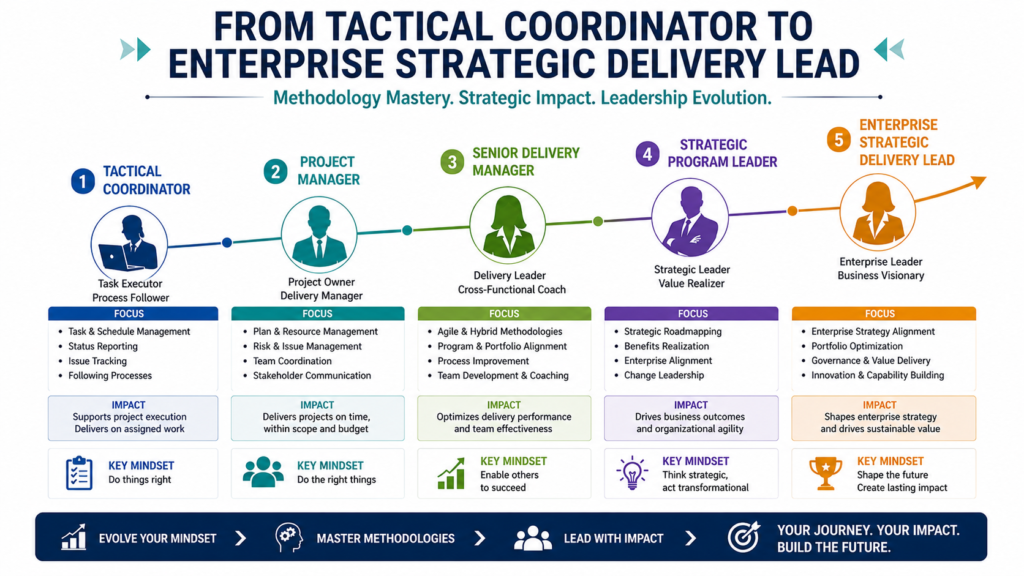
When you master these core methodology nuances, you stop acting as a mere task-tracker and step into the role of a strategic delivery leader. You become the professional who brings clarity to chaos, safeguards team capacity, and drives measurable business value quarter after quarter. This level of delivery expertise is precisely what separates tactical project managers from high-earning, sought-after enterprise Delivery Heads and Directors of PMO.
Navigating project management in today’s fast-paced enterprise landscape requires far more than memorizing buzzwords or blindly following surface-level guidelines. True leadership stems from deep methodology fluency, tactical execution skills, and the confidence to guide complex organizations through transformational change.
If you are ready to stop guessing, move up the corporate ladder, and learn project management the right way, reach out to Skillsetify. We do not just teach frameworks: we show you your exact career growth trajectory.