How Top Product Leaders Pivot Without Losing Control
You walk into the office with a hot cup of coffee, feeling confident about the massive product launch scheduled for next month. Your team has spent the last eight months rigidly following a 100-page upfront specification document. Millions of dollars have been poured into development, and the launch date is etched in stone by executive leadership.
Then, the Head of Customer Success knocks on your door.
A key competitor just released a streamlined, low-cost alternative that completely solves your target market’s biggest pain point in three clicks. Worse yet, early pilot feedback for your own product just came in, showing that end users are completely ignoring your core feature set. They are struggling with a clunky, outdated user flow that was designed based on assumptions made a year ago.
Your stomach drops. You realize your team just built a pristine, perfectly engineered monument to a market reality that no longer exists.
The Ultimate Corporate Myth
In corporate project management, there is a pervasive, dangerous myth: “A successful project is one that strictly adheres to the original plan.”
This mentality treats the initial project plan as a sacred text. Leaders often believe that any departure from the initial blueprint represents a failure of planning, foresight, or execution.
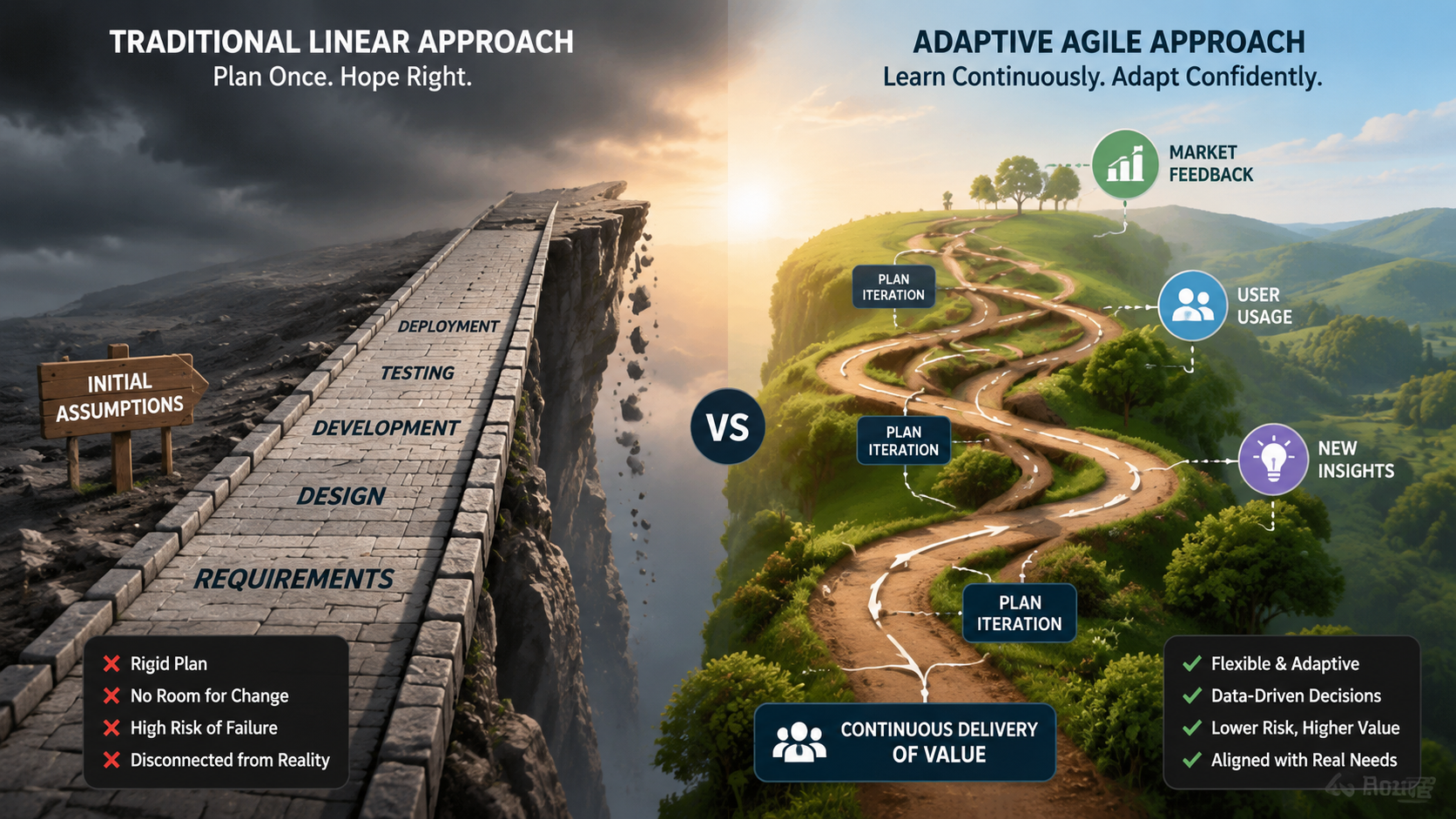
The reality? Rigidly sticking to an initial plan in a dynamic market is corporate suicide. Initial assumptions are merely educated guesses. The true mark of an elite B2B Project Manager or Product Leader is not the ability to execute an initial guess without deviation, but the ability to continually adapt, adjust, and pivot strategic visions based on real market usage data and newly acquired insights.
This core capability is known as Progressive Elaboration.
What is Progressive Elaboration?
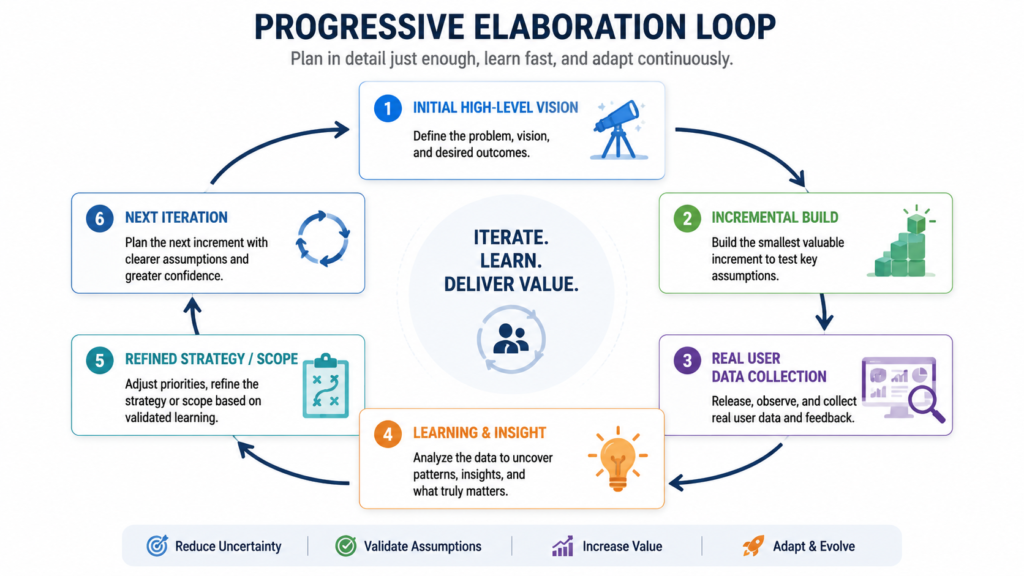
Progressive Elaboration is an iterative project management practice where a project plan is continuously refined, updated, and detailed as more specific information, real-world market usage data, and newly acquired insights become available.
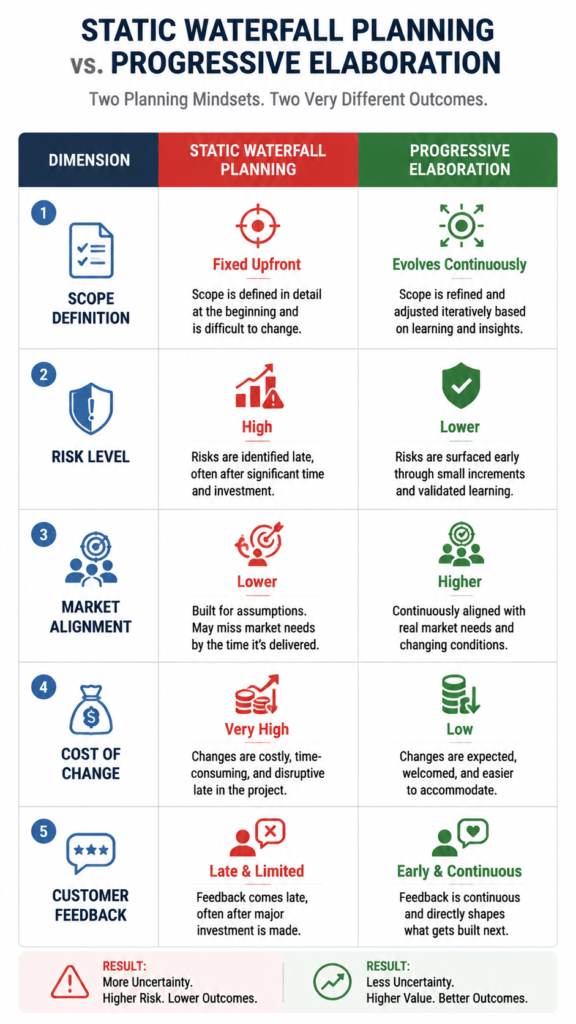
Unlike traditional “Waterfall” approaches that demand complete, static documentation upfront, Progressive Elaboration acknowledges a fundamental truth of modern business: You know the least about a project at the moment you start it.
Progressive Elaboration vs. Rolling Wave Planning
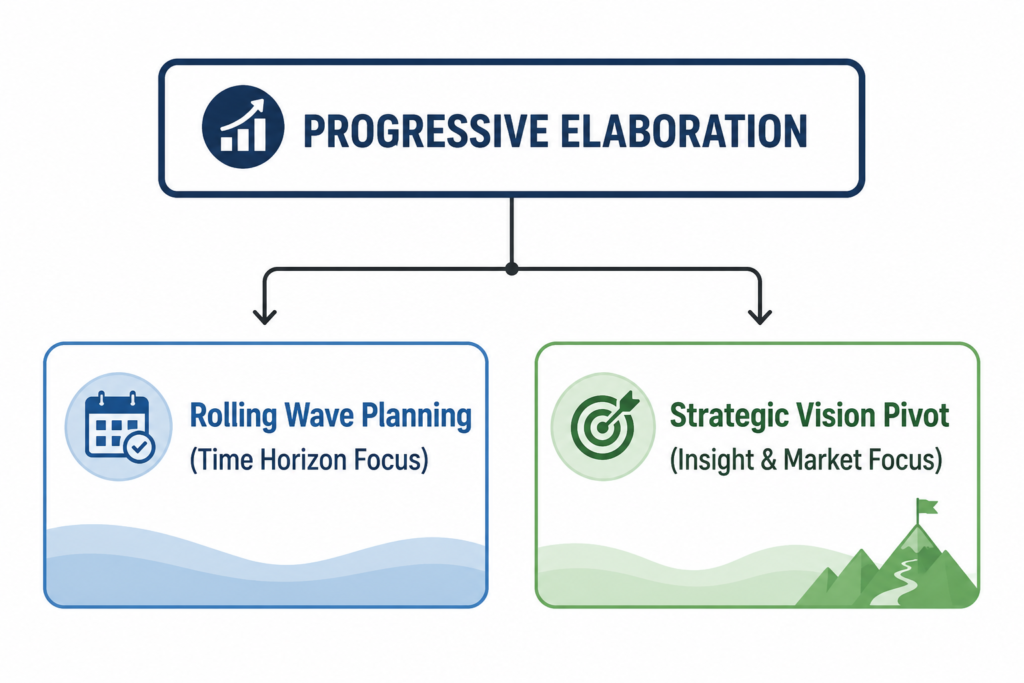
While often used interchangeably, Progressive Elaboration and Rolling Wave Planning have distinct strategic nuances:
Rolling Wave Planning is a specific time-based technique where near-term work is planned in detail, while future work is left at a high level. It focuses primarily on time horizons.
Progressive Elaboration is a broader overarching philosophy and practice. It applies to scope, requirements, architectural runway, and strategic direction. It is driven by knowledge acquisition and feedback loops, rather than just the passage of time.
The Core Mechanics: Data-Driven Refinement
Progressive Elaboration operates across multiple layers of product management:
Strategic Vision: Continuously adjusting the long-term target market and product positioning as usage trends emerge.
Product Roadmap: Shifting upcoming feature sets, deprioritizing unused capabilities, and accelerating features that show high engagement.
Backlog Management: Transforming broad feature epics into detailed user stories right before development, incorporating lessons learned from the previous release cycle.
The Progressive Elaboration Implementation Framework
To execute Progressive Elaboration effectively without devolving into scope creep or chaos, organizations need a structured, repeatable framework. Here is a step-by-step implementation guide that project leaders can deploy immediately.
Step 1: Establish High-Level Strategic Anchors
Begin with a macro-level vision rather than low-level specifications. Define the core problem, target audience, and primary success metrics. Avoid locking down exact design specifications for features scheduled six months out.
Step 2: Implement Short Feedback Loops
Deploy small, functional increments of work to get real user interaction data quickly. Use the following validation artifacts strategically across the product lifecycle:
Proof of Concept (POC): Test technical feasibility early.
Prototypes: Test visual and design mechanics.
Minimum Viable Product (MVP): Test market demand and core value propositions with real users.
Step 3: Establish Data Observability
Before launching any functional increment, build telemetry to track how users interact with the product. Key metrics include:
Feature adoption rates
User drop-off points
Task completion time
User retention per feature module
Step 4: Conduct Bi-Weekly Progressive Refinement Sessions
Hold dedicated backlog refinement and strategic alignment sessions. Bring three critical streams of data to the table:
Quantitative market usage data
Qualitative customer feedback
Technical debt and architectural learnings
Step 5: Pivot or Persevere Decisions
.
Evaluate current insights against your strategic vision. Decide whether to:
Persevere: Continue detailing the next planned wave of features because data validates your assumptions.
Pivot: Adjust the roadmap, alter user flows, or re-allocate resources to double down on unexpected usage trends.
Shifting from Chaos to Predictable, Elite Delivery
Without Progressive Elaboration, project delivery frequently descends into a cycle of chaos. Teams burn out trying to meet arbitrary deadlines for features nobody wants. Scope creep runs rampant because stakeholders try to squeeze every possible requirement into the upfront specification document out of fear they won’t get another chance.
When you master Progressive Elaboration, the entire workplace dynamic shifts:
Scope Creep Neutralized: Change is no longer an invasive interruptor: it is a structured, expected part of the management lifecycle.
Reduced Development Waste: Engineering hours are spent exclusively on capabilities that user data proves valuable.
Decreased Risk Profile: Large-scale project failures are eliminated. Unviable ideas fail fast and cheap early in the lifecycle rather than late in an expensive rollout.
High Team Morale: Teams build features that deliver visible value, eliminating the demoralizing experience of shipping software that gets ignored.
Accelerating Your Career Trajectory
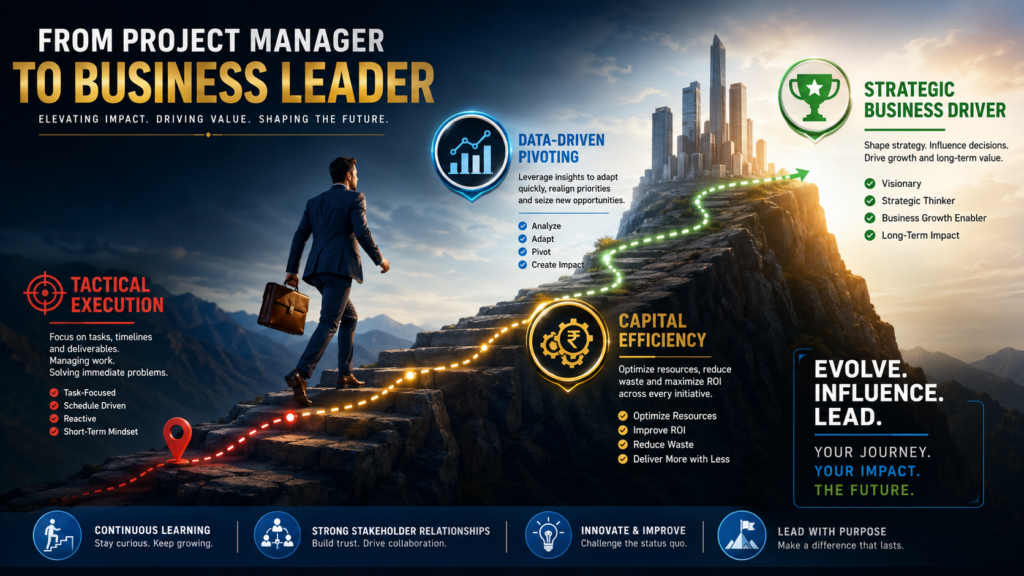
In the modern corporate ecosystem, executives do not measure project leadership by how strictly a project manager follows a gantt chart. They measure leadership by business outcomes, capital efficiency, and strategic agility.
Positioning yourself as a practitioner of Progressive Elaboration demonstrates to senior executives that you understand business viability, financial return, and customer value. It marks your transition from a tactical “task tracker” to a strategic “business driver.”
When you demonstrate the ability to steer complex corporate investments, pivot strategies safely based on real-world data, and deliver high-impact results, you become irreplaceable. This expertise is precisely what separates mid-level managers from executive project leaders and Product VPs.
The Path to Strategic Mastery
Static planning in a dynamic market is a strategy of the past. The future belongs to organizations and leaders who can adapt, learn, and pivot based on real-world insights. Progressive Elaboration provides the framework to do just that, ensuring that every hour of engineering effort aligns with current market demand.
Mastering these methodologies requires more than reading theories, it demands structured mentorship, practical execution frameworks, and a clear vision for your career trajectory.
Static planning in a dynamic market is a strategy of the past. The future belongs to organizations and leaders who can adapt, learn, and pivot based on real-world insights. Progressive Elaboration provides the framework to do just that, ensuring that every hour of engineering effort aligns with current market demand.
Mastering these methodologies requires more than reading theories, it demands structured mentorship, practical execution frameworks, and a clear vision for your career trajectory.
Static planning in a dynamic market is a strategy of the past. The future belongs to organizations and leaders who can adapt, learn, and pivot based on real-world insights. Progressive Elaboration provides the framework to do just that, ensuring that every hour of engineering effort aligns with current market demand.
Mastering these methodologies requires more than reading theories, it demands structured mentorship, practical execution frameworks, and a clear vision for your career trajectory.
Transform Your Project Leadership Strategy with Skillsetify
If you are ready to stop guessing, move up the corporate ladder, and learn project management the right way, reach out to Skillsetify. We do not just teach frameworks: we show you your exact career growth trajectory.