How Confusing Projects with Programs Destroys Enterprise Value
Imagine a high-profile corporate initiative tasked with launching a new electric vehicle model. The executive team assigns a superstar Project Manager, hands them a $500 million budget, and tells them to “get it done”.
The Project Manager sets up a master schedule, tracks milestones, and runs daily standups. They focus heavily on constructing the car’s body shell. Meanwhile, a separate engineering team works on the battery powertrain, another builds the infotainment software, and a third handles global supply chain logistics.
Ten months later, disaster strikes. The battery team delivers a high-capacity power cell, but it is physically too large to fit into the vehicle’s body frame. The software team builds an advanced navigation suite, but it requires a screen dimensions protocol that the interior design team completely scrapped six weeks prior.
Everyone delivered their assigned project scope on time. Yet, the vehicle cannot be built, millions of dollars are wasted in rework, and the launch date is pushed back by a year.
This workplace crisis plays out daily in software, engineering, and digital transformation initiatives. A dangerously persistent corporate myth claims that a program is simply a “very big project” and that managing a program just requires doing project management harder, faster, and with larger spreadsheets.
In reality, a project and a program are fundamentally different organizational concepts. Treating a complex, multi-layered initiative as a giant project leads directly to ego clashes, dependency chaos, integration failures, and corporate waste.
Defining the Core Concepts: Project vs. Program Management
To build scalable organizational systems, leaders must clearly separate these two core structures.
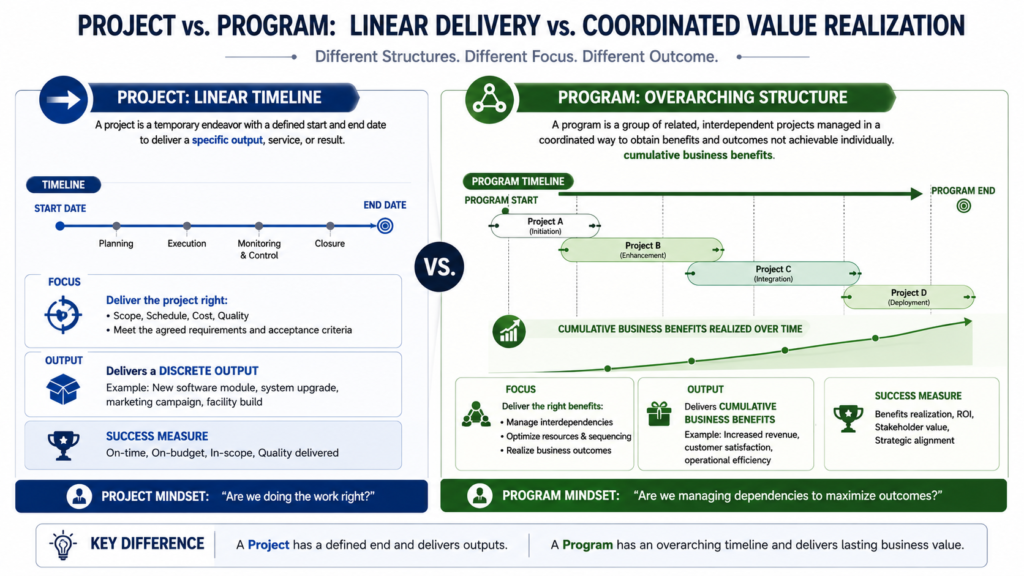
What Is a Project?
A project is a temporary endeavor with a clear, defined beginning and an end. Regardless of whether a project runs for a month, a year, or a decade, it must wrap up at a specified point in time.
Primary Objective: Deliver a specific, tangible output, deliverable, or asset (such as a mobile app feature, a building, or an API integration).
Success Criteria: Delivering defined scope on time, within budget, and to agreed quality specifications.
Operational Mindset: Task-level execution, resource scheduling, critical path tracking, and risk management within a bounded domain.
What Is a Program?
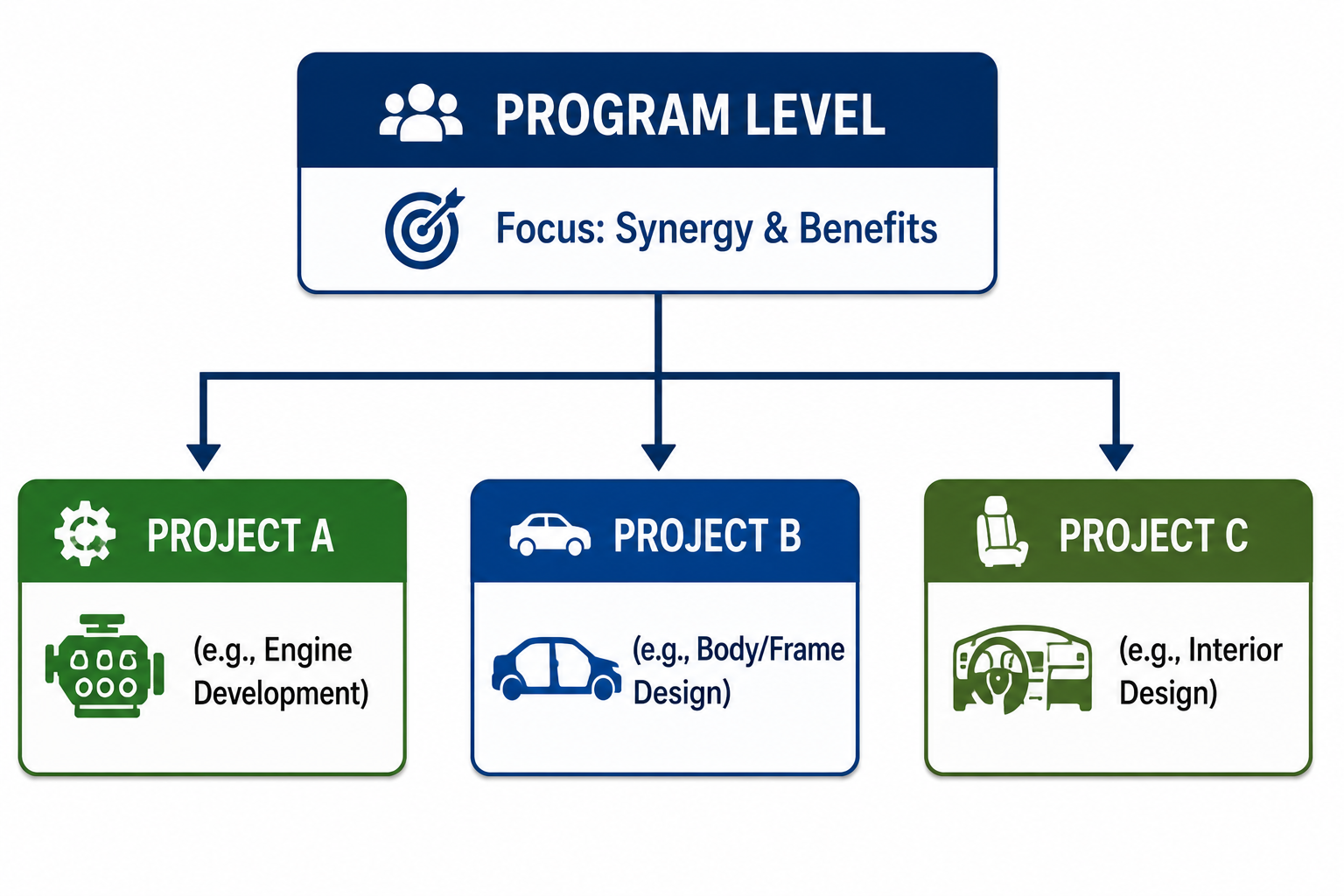
A program is a coordinated group of related, interdependent projects and operational activities managed together to achieve benefits that could not be realized by managing them individually.
Using an enterprise sports analogy: executing a single tennis match or swimming event is a project. Hosting the entire Olympic Games, which requires coordinating security, venue construction, international broadcasting, vendor logistics, and hundreds of individual sporting events, is a program.
Primary Objective: Drive organizational transformation, capability building, and benefits realization (such as cost savings, market expansion, or revenue growth).
Success Criteria: Delivering systemic strategic value, business outcomes, and long-term organizational change.
Operational Mindset: Managing cross-project interdependencies, aligning conflicting priorities, resolving peer-level friction, and optimizing shared capacity.
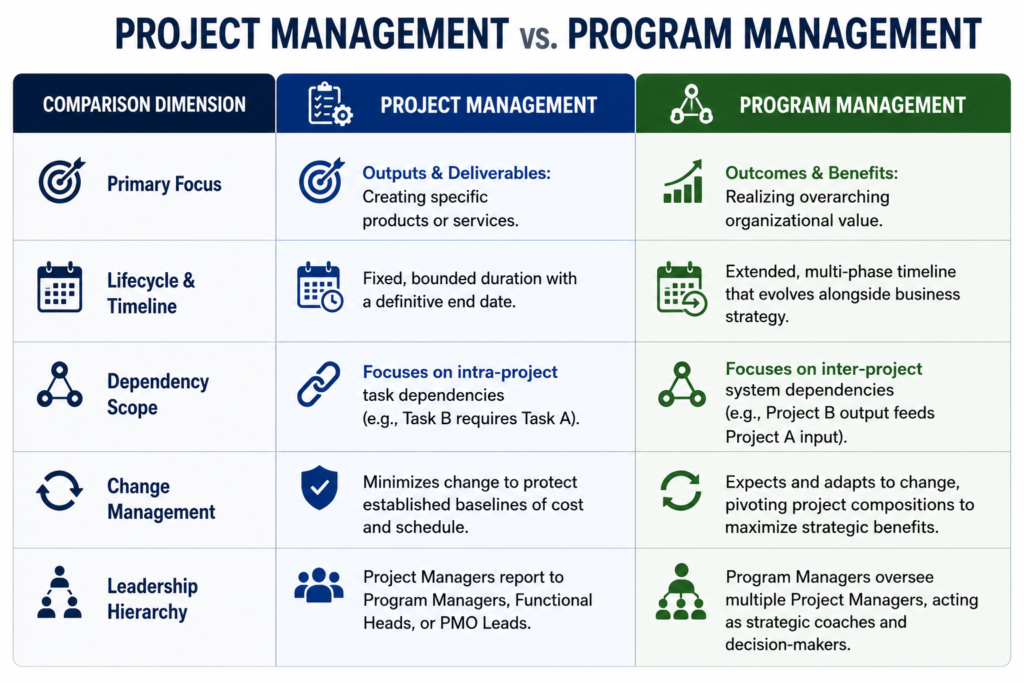
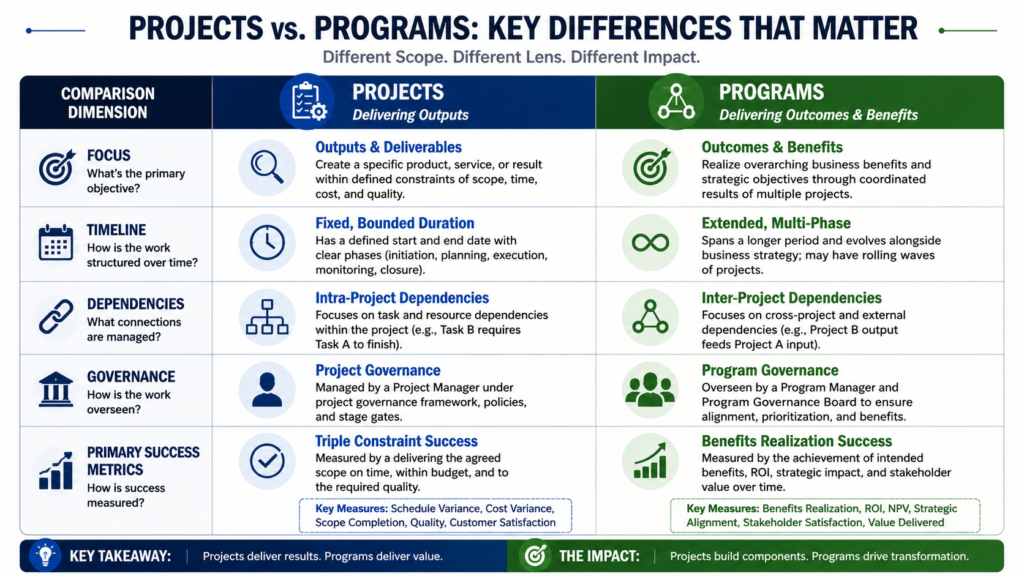
Key Differences Between Projects and Programs
To lead complex organizational transformations, project managers must master the structural differences between these two tiers:
The Human Factor: Why Peer-Level Coordination Fails Without Program Leadership
Why can’t an enterprise simply hire ten talented Project Managers and let them coordinate among themselves?
Human psychology and organizational dynamics make un-governed peer-level coordination nearly impossible at scale.
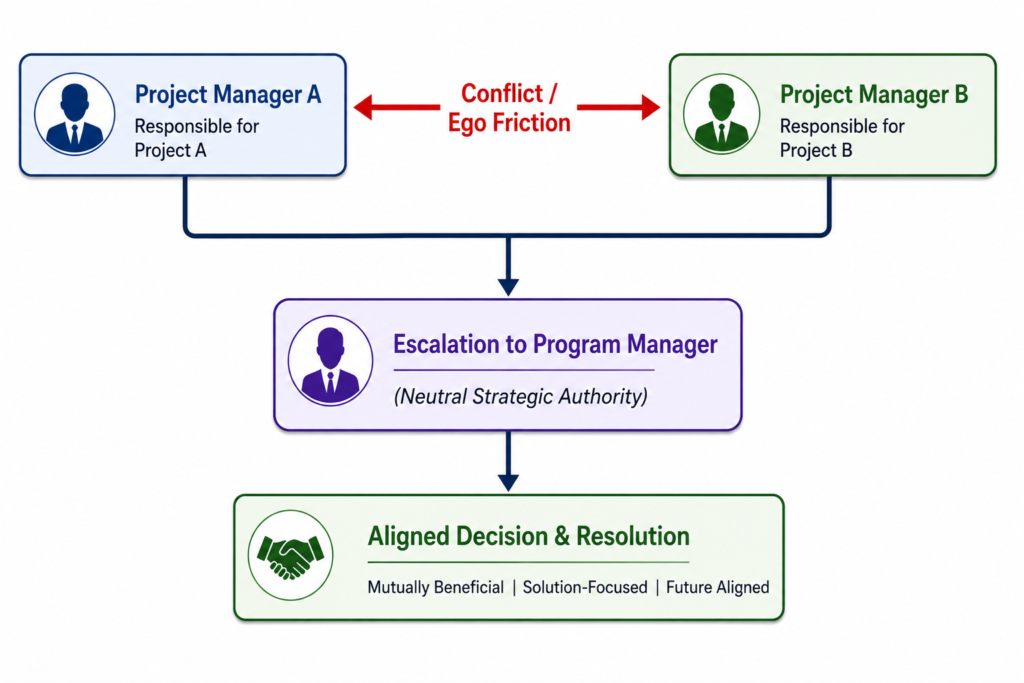
When project managers operate at the same organizational tier, peer-level negotiation quickly breaks down when conflicts arise over schedules, shared resources, or technical specs.
The Peer Negotiation Trap: If Project Manager A needs Project Manager B to adjust their release schedule, Manager B often responds: “Why should I compromise my project metrics for yours?” Egos get involved, communication shuts down, and initiatives descend into political infighting.
The Program Manager Solution: A Program Manager acts as a strategic authority above individual project silos. They don’t micro-manage tactical daily tasks. Instead, they evaluate the larger picture, resolve inter-project friction, realign schedules, and keep all teams aligned toward cumulative value delivery.
Step-by-Step Implementation Framework: Transitioning from Project Execution to Program Governance
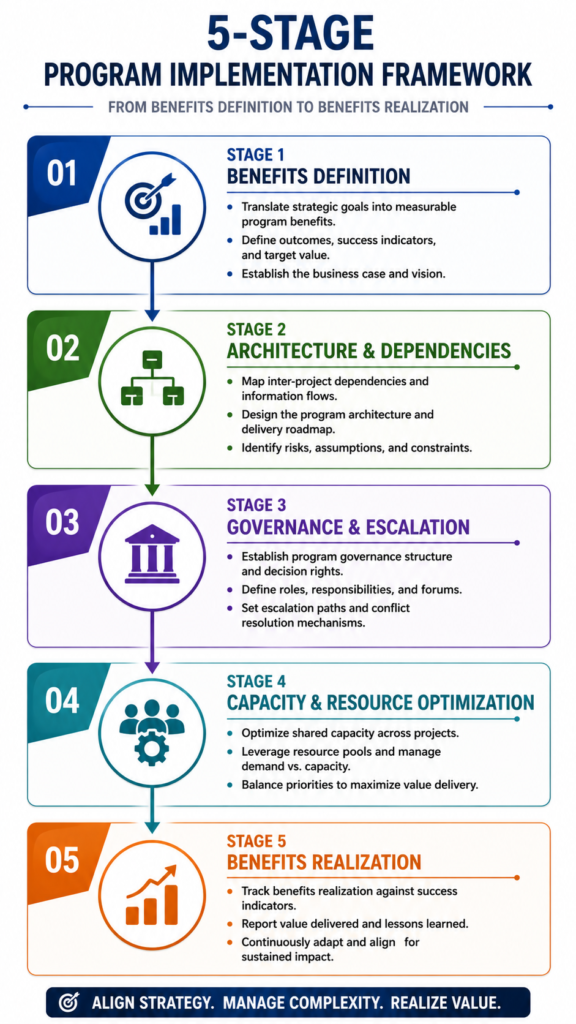
To structure complex initiatives correctly, organizations should follow a repeatable 5-stage framework.
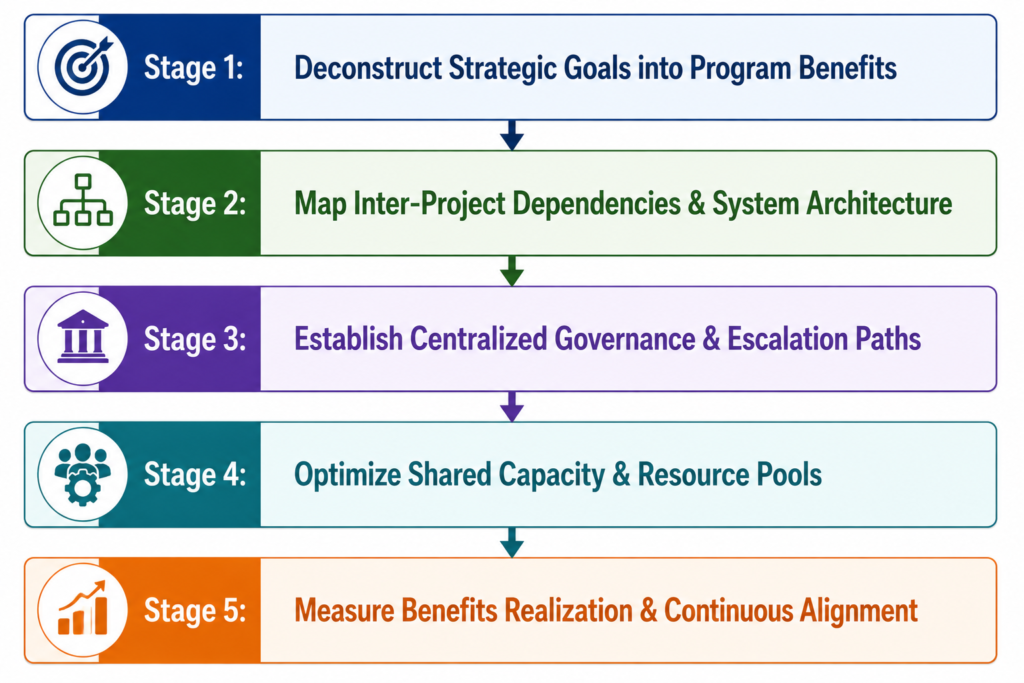
Stage 1: Deconstruct Strategic Goals into Program Benefits
Start with the overarching corporate objective. Define the precise business benefits required (for example, expanding into three global markets or reducing operational overhead by 20%). Break these high-level outcomes into discrete, manageable sub-initiatives.
Stage 2: Map Inter-Project Dependencies
Identify every interface point between projects:
Catalog all technical inputs, software APIs, physical components, and operational handoffs.
Map out cross-project milestones to ensure sequential alignment.
Identify shared infrastructure requirements to prevent resource bottlenecks.
Stage 3: Establish Centralized Governance & Decision Rights
Define clear decision-making boundaries:
Project Managers hold decision rights over task scheduling, daily team assignments, sprint backlogs, and localized risk mitigation.
Program Managers hold decision rights over cross-project schedule changes, scope trade-offs between projects, shared resource reallocations, and strategic benefit tracking.
Stage 4: Optimize Capacity Management & Shared Benches
Avoid resource hoarding. Program leaders establish pooled benches of technical experts (such as database architects, QA automation engineers, or security auditors) that can be dynamically deployed across individual projects based on critical path demands.
Stage 5: Measure Benefits Realization
Transition status reporting away from simple task progress reports. Establish program dashboards that track incremental business value, system performance, cost efficiency, and customer adoption metrics.
Elevate Your Career from Tactical Execution to Strategic Leadership
Mastering the distinction between project execution and program governance is a critical turning point for any ambitious project manager.
When you move beyond tracking isolated tasks and begin orchestrating complex programs, your standing in the organization transforms. You stop spending late nights putting out reactive fires, managing scope creep, or dealing with team burnout.
By learning how to align interdependent projects, manage executive stakeholders, and drive benefits realization, you step out of tactical execution and into strategic business leadership.
Understanding project and program management the right way positions you among the elite top percentage of delivery leaders who command boardroom respect, shape corporate strategy, and drive real enterprise value.
Transform Your Strategic Leadership with Skillsetify
If you are ready to stop guessing, move up the corporate ladder, and learn project management the right way, reach out to Skillsetify. We do not just teach frameworks: we show you your exact career growth trajectory.
Mastering advanced program management, enterprise governance, and strategic execution is the fastest route to executive leadership roles. Contact Skillsetify today to elevate your skill set, lead high-stakes organizational transformations, and command authority at every level of project delivery.