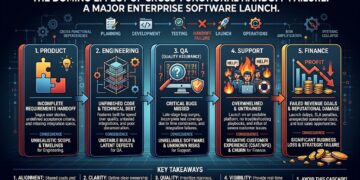
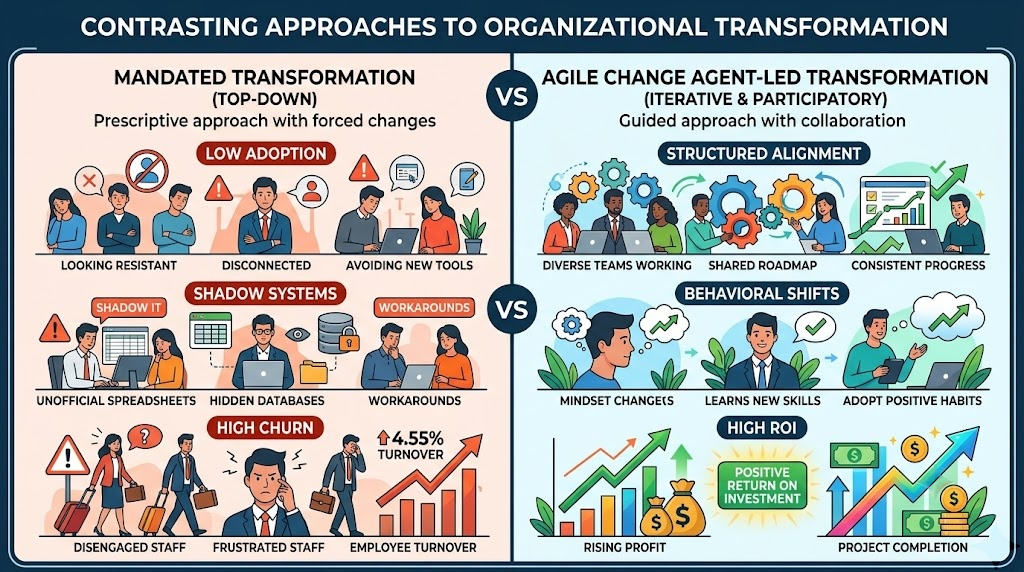
A global enterprise deploys a multi-million-dollar operational shift to streamline cross-departmental delivery. Executive sponsorship was secured, training slide decks were distributed, and leadership declared go-live. Within hours, support tickets surge by 400%, department heads quietly retreat to shadow spreadsheets, and project velocity grinds to a halt.
The enterprise fell victim to the most expensive misconception in corporate operations: the belief that organizational change happens by executive mandate. Purchasing new platforms or restructuring team frameworks does not transform a business. Behavioral alignment transforms a business.
Without an effective Change Agent bridging executive strategy and front-line execution, enterprise transformations devolve into passive resistance, operational friction, and wasted capital.
Decoding the Change Agent: The Catalyst of Agile Transformation
In modern Agile leadership, a Change Agent is not a passive project coordinator tracking milestone dates. A Change Agent is an operational catalyst who designs structured pathways for process shifts, builds cross-functional alignment, and systematically dismantles resistance to change.
Transformations fail when leaders treat process shifts as single-event rollouts rather than continuous behavioral evolutions. An Agile Change Agent operates with a dual focus: maintaining macro-level strategic vision while resolving micro-level operational friction.
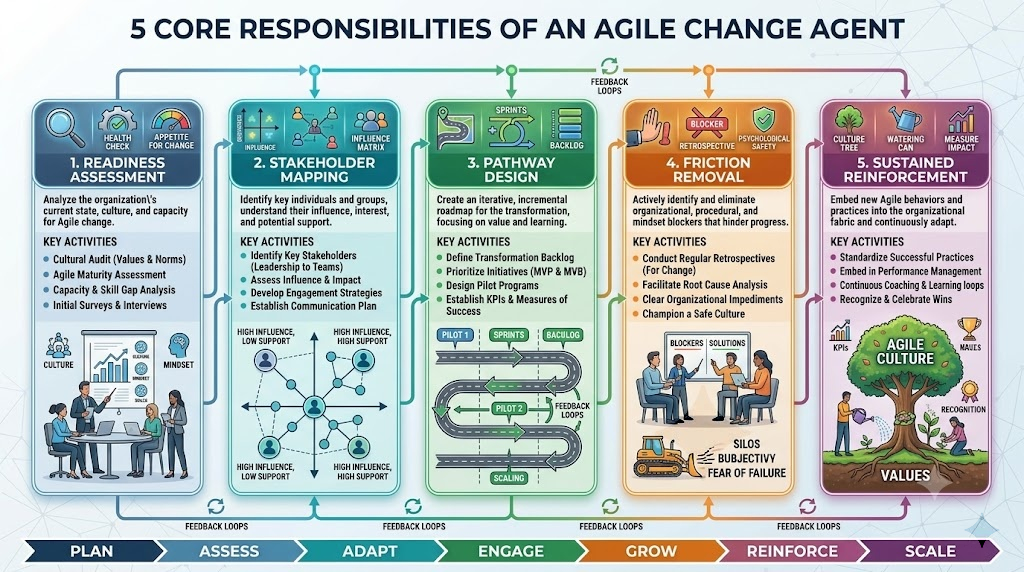
The Five Core Responsibilities of an Agile Change Agent
Organizational Readiness Assessment: Evaluating technical, cultural, and operational preparedness before introducing process shifts.
Stakeholder Alignment and Mapping: Navigating executive power dynamics, identifying internal change champions, and directly engaging vocal skeptics.
Structural Pathway Design: Translating high-level transformation goals into incremental, actionable roadmaps that teams can adopt without operational burnout.
Behavioral Friction Removal: Diagnosing the root causes of team resistance, distinguishing between technical impediments, communication gaps, and intentional procrastination.
Sustained Behavioral Reinforcement: Embedding new workflows into daily operations through continuous feedback loops, ensuring legacy habits do not resurface.
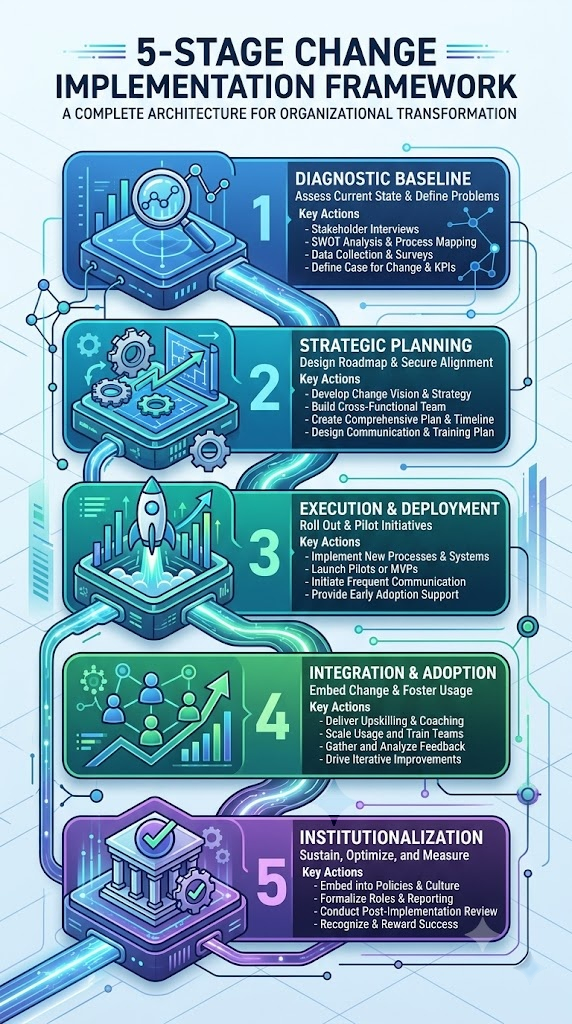
The 5-Stage Change Implementation Framework
Successfully guiding an enterprise through structural change requires a repeatable, adaptable framework. Project leaders can immediately apply this step-by-step methodology to structure complex process transitions.
Stage 1: Diagnostic Baseline and Readiness Audit
Analyze current-state workflows to quantify inefficiencies and identify hidden shadow processes. Conduct anonymous readiness surveys across affected departments to establish baseline sentiment, technical maturity, and cultural friction points.
Stage 2: Co-Creating the Transformation Vision
Establish the strategic context behind the shift. Clearly articulate the broader business value while defining the direct benefit for individual contributors. Align executive sponsors and operational managers around shared success criteria before deploying new workflows.
Stage 3: Targeted Pilot Deployments
Avoid high-risk, single-day enterprise rollouts. Deploy process shifts to a high-trust, cross-functional pilot team first. Use this controlled environment to stress-test workflows, capture real-time telemetry, refine training materials, and build referenceable proof points.
Stage 4: Active Friction Management
Monitor team adoption during full rollout using transparent tracking systems. Deploy a soft yet firm communication model: protect teams from unmanaged external chaos while holding individuals accountable to newly established operational standards.
Stage 5: Institutionalization and Continuous Refinement
Incorporate new practices directly into daily Agile ceremonies, retrospective reviews, and performance frameworks. Continuously audit process compliance to ensure operational habits reflect long-term strategic goals.
Navigating Human Resistance: Soft Leadership, Hard Accountability
Managing change requires navigating complex human dynamics. Leaders often fall into one of two extreme traps: over-protecting teams from organizational pressure or acting as a passive pass-through for executive stress.
Over-protecting a team creates an artificial bubble where individuals take process shifts for granted, miss deadlines, or quietly resist adoption without consequence. Conversely, dumping executive urgency directly onto teams destroys morale, increases turnover, and breeds cynicism.
Mastering the Change Agent role requires balancing empathy with unyielding structural clarity.
When teams resist a new workflow, elite leaders perform root-cause analysis rather than issuing punitive demands. Is the delay caused by inadequate training, poor tooling integration, or behavioral procrastination? Apply targeted behavioral solutions for cultural issues and structural solutions for process blockers.
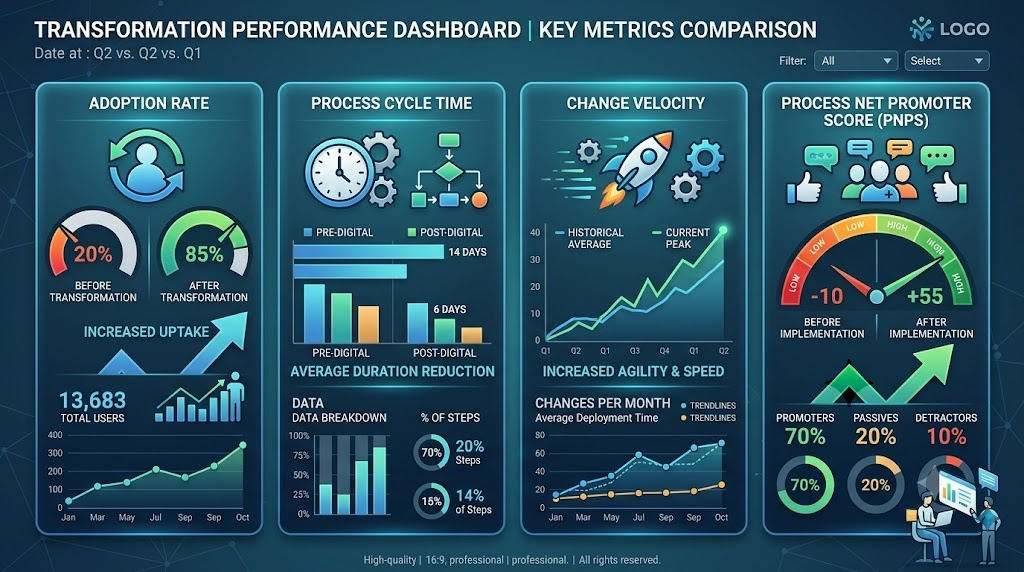
Operational Change Metrics Matrix
| Metric Name | Primary Objective | Measurement Method | Target Industry Benchmark |
| Change Adoption Rate | Measures active utilization of newly deployed processes. | Ratio of active users on new workflow vs. total target audience. | > 85% within 45 days of rollout |
| Process Cycle Time | Evaluates operational efficiency gained from the shift. | Total duration required to complete an end-to-end workflow phase. | 15% to 30% reduction post-stabilization |
| Change Velocity | Tracks the speed at which teams adapt to new iterations. | Story points or operational tasks transitioned per sprint cycle. | Stable or upward trend after Sprint 2 |
| Process Net Promoter Score (pNPS) | Assesses internal user sentiment regarding the process change. | Periodic anonymous survey scoring team satisfaction (-100 to +100). | Score > +30 |
The Change Agent Tactical Playbook
Transforming your management style to lead organizational change begins with immediate, structured execution.
Audit Internal Stakeholders: Build an Influence-Interest Matrix for your current initiative. Categorize key players into high-power key players, high-interest champions, and low-interest skeptics.
Establish a Transparent Friction Log: Track process blockers openly alongside your standard project risk register. Treat behavioral adoption issues with the same rigor as technical bugs.
Implement Soft and Firm Communication: Frame process adherence around shared team success rather than individual compliance. Emphasize that while external stress will be buffered by leadership, process standards remain non-negotiable.
Iterate Workflows via Retrospectives: Dedicate specific retrospective sessions strictly to evaluating process change performance. Encourage honest feedback, identify operational bottlenecks early, and rapidly adjust procedures.
Leading organizational transformation is an ongoing operational discipline. By mastering the structural mechanics of the Change Agent role, project managers evolve from tactical task coordinators into indispensable strategic leaders capable of navigating complex corporate environments.
Skillsetify equips modern project leaders with actionable frameworks, advanced Agile certifications, and enterprise-grade leadership insights. Elevate your project management capability and lead your organization’s next breakthrough transformation with confidence.