How Great Project Leaders Build People, Not Just Projects
When Your Team Can Deliver, But Cannot Grow
On a Thursday.
The sprint is closing. A critical story is incomplete. One developer is waiting for clarification. Another team member has made the same mistake for the third sprint in a row. A junior analyst keeps asking for approval before making even a small decision.
The Project Manager reacts the way many managers do.
“Just do this.”
“Follow the process.”
“Why didn’t you ask earlier?”
“Next time, make sure this doesn’t happen.”
The immediate problem may get resolved.
But the leadership problem gets worse.
The team becomes increasingly dependent on the manager. People stop thinking independently. Junior professionals wait for instructions. Experienced employees become frustrated. Mistakes repeat because nobody is developing the capability to prevent them.
This is where the Coach role in Agile leadership becomes powerful.
A common corporate myth is that coaching means being soft, avoiding difficult conversations, or simply encouraging people. It does not.
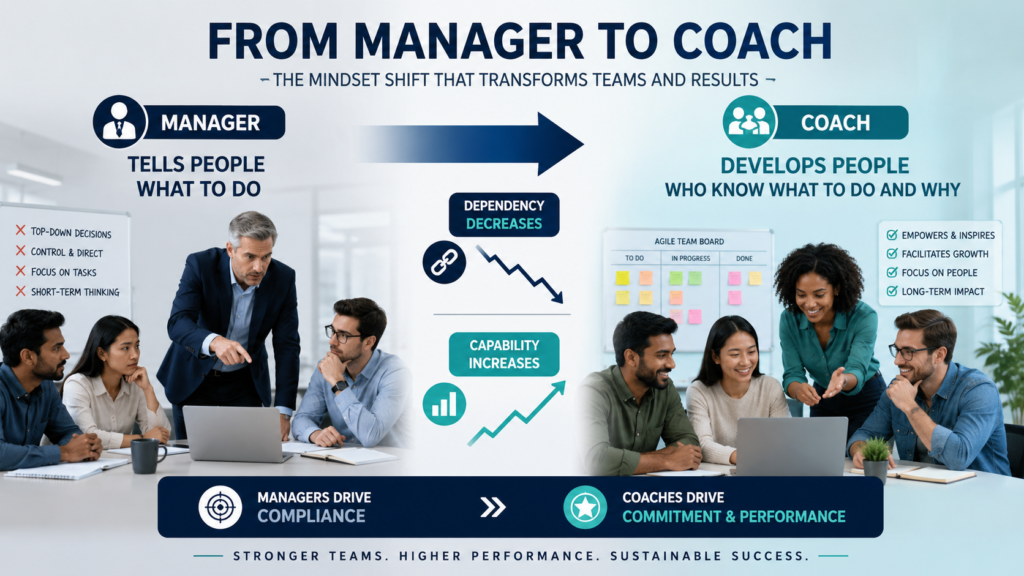
A strong Agile Coach helps people become more capable, more confident, and more self-sufficient. The role focuses on individual growth through mentoring, guidance, feedback, motivation, and helping people understand why the work matters, not merely what they are supposed to do.
Modern professional guidance makes a similar distinction. The CIPD describes coaching as a development approach focused on specific skills, goals, performance improvement, and individual development. Mentoring generally involves a more experienced person sharing knowledge to support another person’s development.
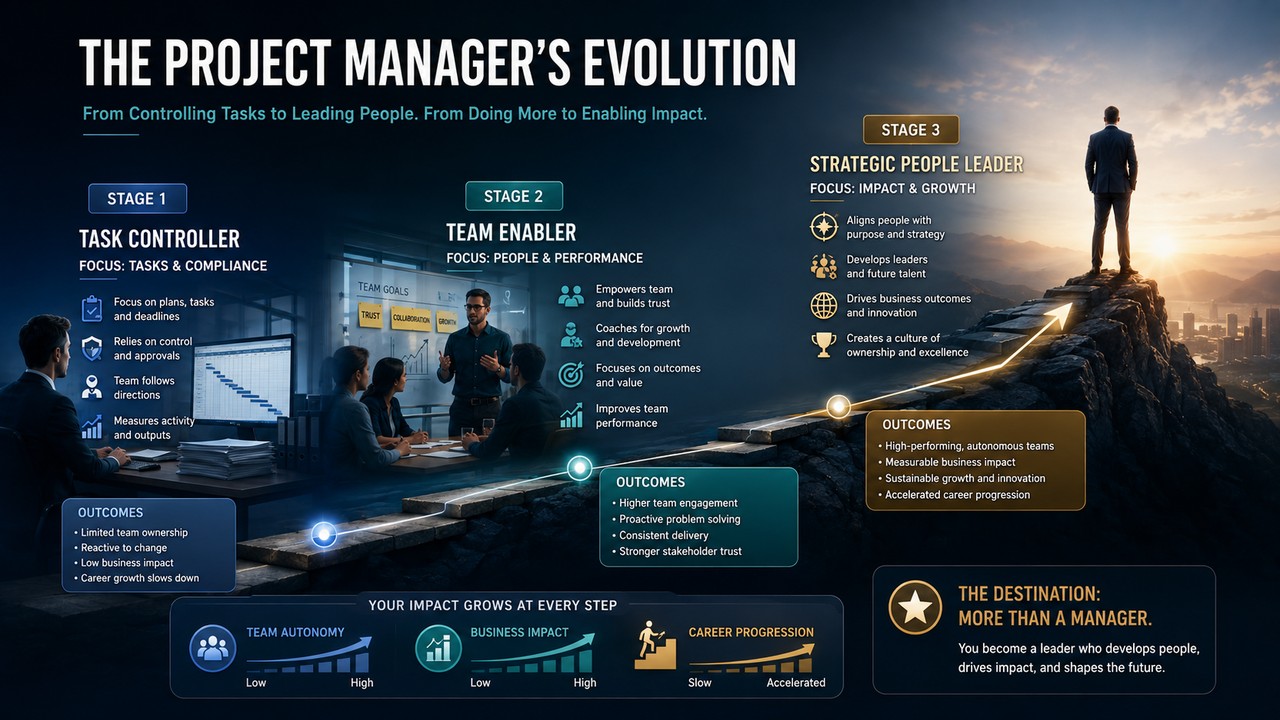
The objective is therefore not to create employees who need a better manager.
It is to create professionals who need less management.
What Exactly Is the Coach Role?
The Coach role is fundamentally about developing people so they can perform at a higher level without becoming dependent on the leader.
The underlying model has several interconnected responsibilities:
Identify individual potential
Understand development gaps
Mentor team members
Ask questions that encourage thinking
Provide useful feedback
Explain context and rationale
Build confidence and capability
Encourage ownership
Support people through challenges
Gradually reduce dependency on the leader
The distinction between coaching and simply managing is critical.
A manager might say
“Use this approach.”
A coach might ask:
“What approaches have you considered, and what do you think would work best here?”
The first approach can solve today’s problem.
The second can develop tomorrow’s problem solver.
That distinction matters enormously in Agile environments because Agile depends on teams being capable of inspecting, adapting, collaborating, and making decisions close to the work. The Scrum Guide explicitly emphasizes transparency, inspection, and adaptation as foundations of Scrum.
The Coach Does Not Mean “Never Give Answers”
This is another important misconception.
Coaching does not mean refusing to provide direction.
Sometimes a person genuinely lacks knowledge. In that situation, teaching is appropriate.
Sometimes they need experience-based guidance. That is mentoring.
Sometimes they need space to discover the solution themselves. That is coaching.
Sometimes the situation requires immediate direction. That is leadership.
Agile leadership therefore requires judgment about which stance is appropriate.
Research and industry guidance increasingly recognize this distinction. Agile coaching practices commonly move between teaching, mentoring, facilitation, and coaching depending on team maturity and context.
The leadership material supporting this framework makes the same point: Agile leaders should adapt their approach according to the situation rather than permanently operating in one leadership mode.
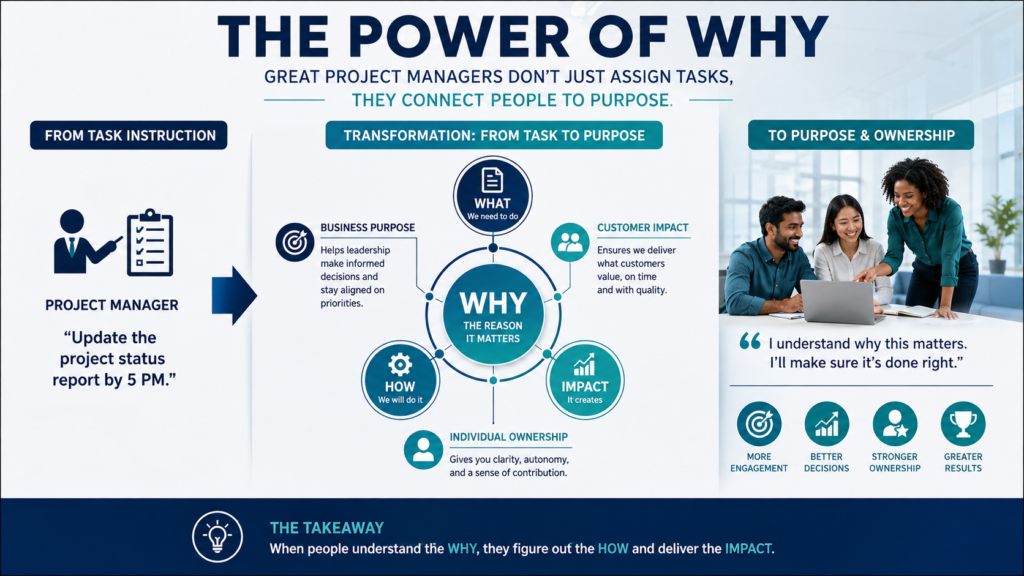
Why the “Why” Matters More Than the Instruction
One of the most underestimated responsibilities of a Coach is explaining the rationale behind work.
Consider two Project Managers.
The first says:
“Please update the risk register before the steering committee.”
The second says:
“Please update the risk register before the steering committee because the leadership team will use it to understand which risks could affect the release date and where decisions are required.”
The task is identical.
The level of understanding is not.
When people understand the why, they can make better decisions when circumstances change.
That is particularly important in Agile because plans evolve continuously. A team member who only understands an instruction may become stuck when the context changes. A team member who understands the underlying objective can often determine the next appropriate action independently.
The supplied Agile leadership material explicitly positions the Coach as someone who helps team members understand why they are doing something and supports their development journey.
This also connects with Google’s research on effective teams. Its research identified psychological safety, dependability, structure and clarity, meaning, and impact among the key dynamics associated with team effectiveness. In particular, team members benefit when they understand how their work contributes to organizational goals.
The Coach's Operating System
A Practical Framework
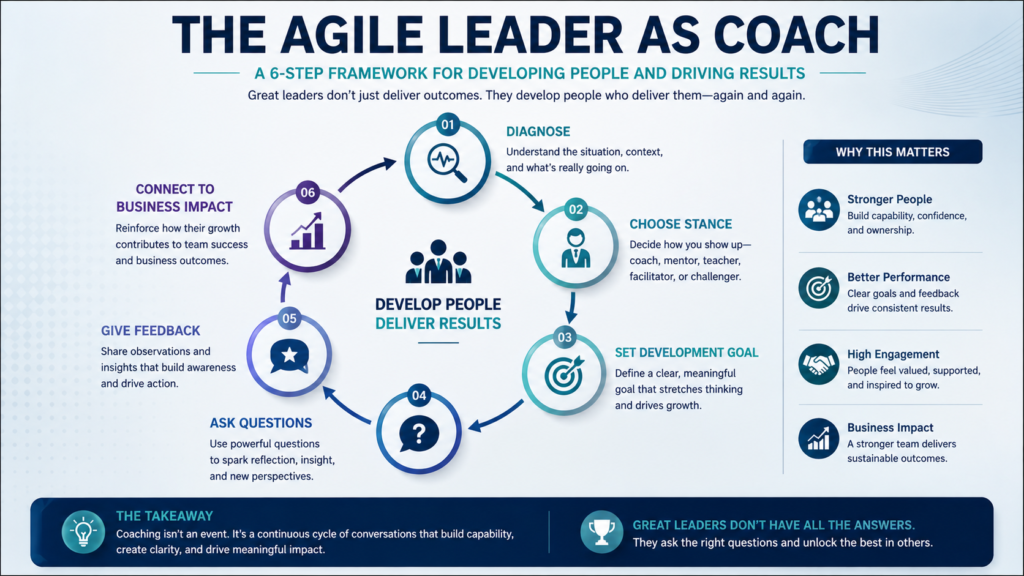
A Project Manager can turn the Coach role into a repeatable operating system.
Step 1: Diagnose Before Advising
When someone is struggling, do not immediately prescribe a solution.
Start with questions:
What is blocking you?
What have you tried?
What do you think is causing the issue?
What information are you missing?
What decision are you unsure about?
What support would help you move forward?
This prevents the manager from solving the wrong problem.
A missed deadline might appear to be a motivation problem.
It could actually be:
unclear ownership
missing stakeholder approval
inadequate skills
conflicting priorities
fear of making a decision
excessive workload
unclear expectations
The source material emphasizes identifying the root cause before selecting the intervention. Behavioral problems may require behavioral fixes. Environmental problems may require changing the environment. Blockers may require removing impediments.
Step 2: Determine the Correct Leadership Stance
Ask yourself:
Does this person need knowledge, experience, thinking space, or direction?
Use this simple model:
Situation Appropriate stance
Person does not know how Teach
Person needs experienced guidance Mentor
Person can solve it but lacks confidence Coach
Team discussion is stuck Facilitate
Critical incident requires immediate action Direct
Person repeatedly avoids accountability Challenge
This prevents a common leadership failure: using coaching for every problem.
The CIPD similarly cautions that coaching is not a universal solution and should be selected according to the individual’s development needs, readiness, and circumstances.
Step 3: Create Individual Development Goals
Do not limit development conversations to annual performance reviews.
For each team member, identify:
Current capability → Desired capability → Development experience → Evidence of progress
For example:
Current capability: Strong technical delivery but weak stakeholder communication.
Desired capability: Independently manage stakeholder conversations.
Development experience: Allow the employee to lead the next stakeholder discussion with preparation support.
Evidence: Stakeholder questions are handled independently and follow-ups are clearly documented.
This converts “development” from a vague corporate phrase into a project-management mechanism.
Step 4: Coach Through Questions
A useful coaching conversation can follow five questions:
What is happening?
What is the real challenge?
What options do you see?
What would you recommend if you owned the decision?
What will you do next, and by when?
The final question matters because coaching without accountability becomes conversation.
Harvard Business Review’s guidance similarly emphasizes creating space for employees to explain their perspective and using open-ended questions to understand how they view their performance and what support they need.
Step 5: Give Feedback That Creates Movement
Feedback should answer three questions:
What happened?
Why does it matter?
What should change?
For example:
“During the stakeholder meeting, you answered every question yourself. That kept the meeting moving, but it also prevented the analyst from demonstrating ownership. Next time, give them the opportunity to answer first, then step in if clarification is required.”
That is far more useful than:
“You need to delegate more.”
Effective feedback should be specific enough to influence future behavior.
It should also be delivered as developmental support rather than personal criticism.
Step 6: Explain the Business Context
A Coach should continuously connect individual work to project and business outcomes.
Instead of:
“Complete the testing documentation.”
Explain:
“This documentation gives the release team evidence that the critical scenarios were validated. If we cannot demonstrate that coverage, the release decision becomes harder and the business carries additional risk.”
Now the employee sees the work differently.
They are not completing documentation.
They are reducing release risk.
That shift from task execution to outcome ownership is one of the most valuable transitions an Agile leader can create.
What Happens When You Actually Lead as a Coach?
Imagine a project where team members increasingly solve problems before escalating them.
A developer identifies a dependency and approaches the relevant stakeholder directly.
A Business Analyst recognizes an unclear requirement and challenges it before development begins.
A Scrum Master notices a recurring team issue and facilitates the team toward its own solution.
A junior Project Manager starts leading stakeholder conversations instead of simply attending them.
The Project Manager’s calendar changes too.
There are fewer conversations beginning with:
“What should I do?”
And more conversations beginning with:
“Here is the problem. I have considered three options. I recommend option two because…”
That is the real return on coaching.
The leader has not become less important.
The leader has become more scalable.
Coaching Creates Capability Multiplication
If a Project Manager personally solves ten problems every week, the project depends on that individual.
If the Project Manager develops ten people who can independently solve those problems, the organization’s capability expands.
This is why mentoring and shared learning are powerful Agile practices. Atlassian’s research and guidance on Agile teams highlights continuous mentoring and shared skill development as important mechanisms for strengthening team capability and reducing dependency on individual specialists.
Google provides another compelling example. Its employee-to-employee learning network includes thousands of employees who teach courses, mentor colleagues, and create learning materials. Google reports that 80% of tracked training is delivered through this internal peer-learning network.
The lesson for Project Managers is simple:
Do not become the team’s smartest bottleneck.
Become the person who makes the team smarter.
Coaching Also Builds Psychological Safety
People rarely develop when every mistake becomes a public judgment.
A Coach creates an environment where people can raise concerns, admit uncertainty, ask questions, and discuss mistakes without automatically fearing punishment.
Google’s team-effectiveness research identified psychological safety as the most important dynamic among the factors it studied. Teams with stronger psychological safety were better positioned to take interpersonal risks, raise difficult issues, and contribute ideas.
But psychological safety is not permissiveness.
A strong Coach combines:
Safety + clarity + accountability.
You can tell someone:
“I want you to feel safe raising problems early.”
And simultaneously:
“I also expect you to raise them before they become critical.”
That is mature Agile leadership.
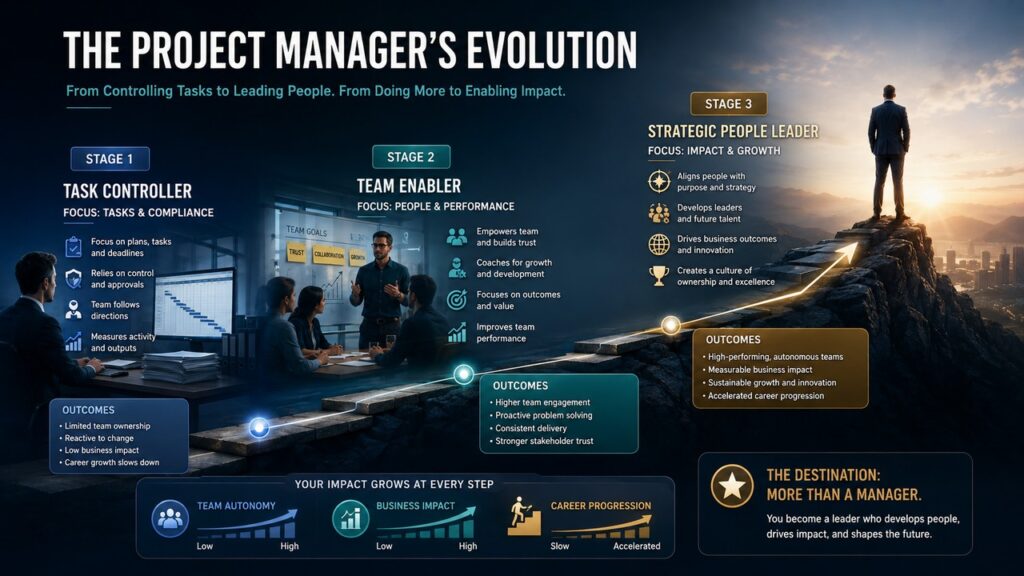
The Career Advantage: Why This Makes You a Better Project Manager
Learning project management the right way is not about memorizing ceremonies, terminology, or frameworks.
It is about learning how to produce outcomes through people.
A Project Manager who understands coaching can:
Develop high-performing team members.
Reduce dependency on personal intervention.
Improve stakeholder communication.
Build stronger ownership.
Identify root causes faster.
Handle performance issues more intelligently.
Create future leaders.
Increase team resilience.
Adapt leadership style to different situations.
Build credibility beyond simple task coordination.
The source framework places the Coach alongside other Agile leadership capabilities such as servant leadership, adaptive leadership, facilitation, vision, and change leadership. The important insight is that these are not mutually exclusive identities. Effective Agile leadership requires choosing the appropriate stance for the situation.
The career implication is significant.
Organizations do not promote Project Managers indefinitely because they can update schedules.
They promote people who can lead increasingly complex systems, stakeholders, decisions, and people.
Coaching is one of the mechanisms that allows that leadership capacity to scale.
Stop Managing Tasks. Start Developing Capability.
The Coach role is not about being the nicest person in the room.
It is about becoming the person who can see potential, diagnose capability gaps, provide the right level of support, explain the purpose behind the work, give useful feedback, and gradually transfer ownership back to the individual.
The best coaching question is often not:
“How can I solve this for you?”
It is:
“How can I help you become capable of solving this yourself?”
That is the shift from manager to Agile leader.
And that is also the difference between learning project management as a collection of tools and learning project management the right way.
If you are ready to stop guessing, move up the corporate ladder, and learn project management the right way, reach out to Skillsetify.
We do not just teach frameworks.
We show you your exact career growth trajectory.